


What Is Mean By Inventory Management
Inventory management means tracking every product your business buys, stores, and sells. It covers the full cycle from receiving goods to shipping orders and restocking shelves. The goal is simple: the right product, in the right quantity, in the right place, at the right time. If you run a warehouse or distribute wholesale goods, this is the work your team does every day.
Reviewed and updated: October 2026
Book a callInventory Management Defined
Inventory management is the process of tracking what you have, where it is, and how much of it is moving. It starts when a truck pulls up to your dock and ends when a shipment leaves for your customer. Every step in between, counting, storing, picking, and reordering, falls inside that definition.
The IRS puts it plainly in Publication 538: "To figure taxable income, you must value your inventory at the beginning and end of each tax year." That is not optional. But good inventory management goes further than a year-end count. It keeps your numbers accurate every single day, so you are never caught short or sitting on dead stock.
We build it for your operation, and the first look is free
If you would rather not compare products, describe how your operation already works and we build the system around it.
No build cost. You see it running on your own process first, and the monthly subscription starts only once it is live.
Book a callWhat Inventory Management Actually Includes
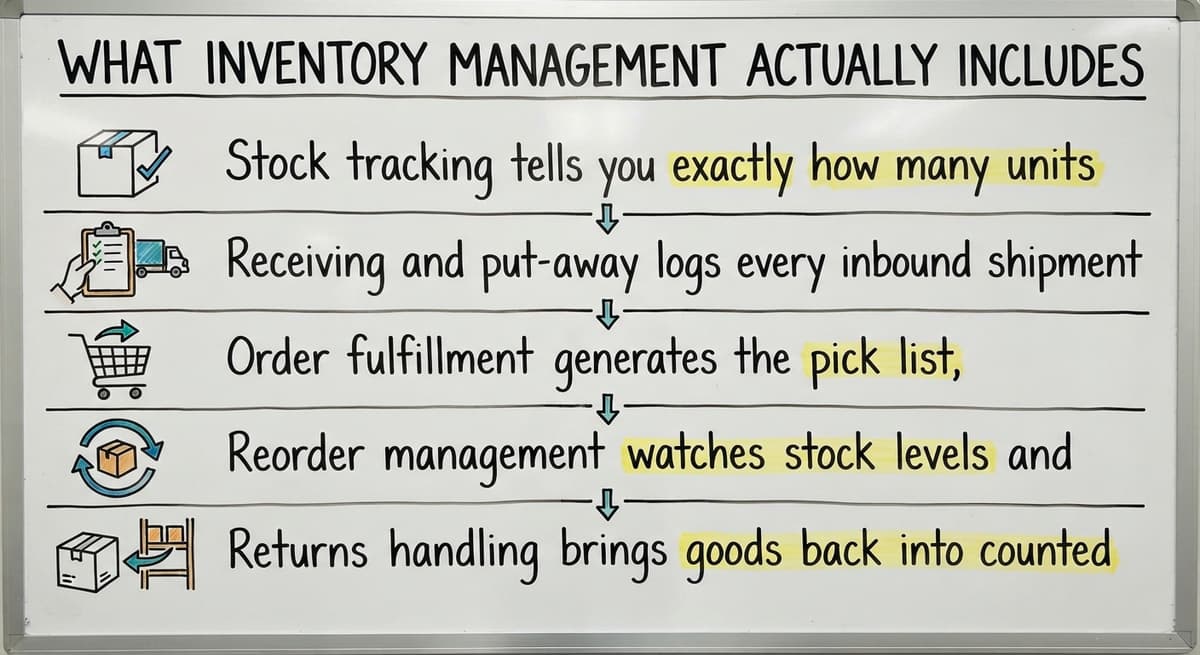
Inventory management is not one task. It is a set of connected processes that keep stock moving correctly. Here is what it covers:
- Stock tracking tells you exactly how many units are on hand at any moment, by location and by SKU.
- Receiving and put-away logs every inbound shipment and places items in the right bin or shelf before they get lost.
- Order fulfillment generates the pick list, confirms the right items go in the box, and records the shipment.
- Reorder management watches stock levels and triggers a buy order before you run out.
- Returns handling brings goods back into counted inventory rather than leaving them in a corner.
Why Every Scan Depends on a Common Standard
GS1, the global standards body behind product barcodes, notes that "barcodes are the most widely used automatic spotting technology in the world," and every scan-based count in a warehouse depends on those same standards to keep records accurate. Taken together, these steps form a loop. When one breaks, the rest suffer.
Why Does Inventory Management Matter for Wholesale Distributors and Fulfillment Centers?
Inventory management matters because a wrong count costs you money in 2 ways at once: you lose the sale you could not fill, and you pay to store the stock you did not need. For a wholesale distributor or fulfillment center, that double hit adds up fast.
Stockouts push customers to a competitor. Overstock ties up cash that could fund your next buy order. Manual tracking with spreadsheets and printed sheets makes both problems worse. One missed entry compounds into a count that is off by dozens of units before anyone notices.
The comparison is easier when one option is built for you
Off-the-shelf means fitting your process to the software. We do it the other way round, and the first look costs nothing.
Book a call
What the Inventories-to-Sales Ratio Reveals
The US Census Bureau's Monthly Wholesale Trade data tracks the inventories-to-sales ratio across wholesale firms nationally. When that ratio climbs, it signals that distributors are holding more stock than they are moving, often because reorder decisions are based on guesses rather than live counts. Accurate stock levels let your operations team make faster calls without walking the floor to verify every number.
The Difference Between Inventory Management and Accounting
Accounting packages like small-business accounting software record the financial value of inventory. They do not track physical movement in real time. Your accounting software knows what you paid for a pallet. It does not know which bin that pallet is in, how many units your team picked this morning, or whether 3 boxes came back from a customer last Tuesday.
Inventory management fills that gap by recording every physical action: receipt, pick, move, and ship. The 2 systems work best side by side. Your accounting software handles invoicing and financial reporting. The inventory system handles what is actually on your shelves. Businesses running on accounting software alone are often missing the real-time layer that prevents pick errors and reorder mistakes.
Think of it as how inventory software works with your accounting platform: each system does its own job, and neither has to replace the other.

Common Inventory Management Methods
Several approaches exist. The right one depends on what you sell and how your operation runs.
- FIFO (first in, first out): The oldest stock ships first. This is standard in food, pharmaceuticals, and any product with an expiration date.
- LIFO (last in, first out): The newest stock ships first. Less common in practice. Used in specific tax or costing scenarios where it reduces taxable income during periods of rising costs. The IRS Publication 538 covers the rules for both methods.
Choosing Between Just-in-Time and Reorder Point
- Just-in-time: You order only what you need, just before you need it. Holding costs drop, but this method needs suppliers who deliver on schedule every time.
- Reorder point method: You set a minimum quantity for each SKU. When stock falls to that number, a buy order goes out automatically. This is the most practical starting point for most distributors.
Choose the method that matches your product type and your supplier reliability, not the one that sounds most sophisticated.
See it running on your own process first
No build cost. The subscription starts once it is live and doing the job, not before.
Book a call
How Inventory Management Software Works
Inventory management software replaces manual logs, spreadsheets, and printed pick sheets with a single live system. Every team member works from the same data at the same time.
Here is what happens in a typical day:
- A shipment arrives. A worker scans each barcode. Stock counts update instantly.
- An order comes in. The system generates a pick list that reflects actual stock levels, not yesterday's spreadsheet.
- A picker scans items as they pull them. The count drops in real time.
- When a SKU hits its reorder point, the system sends an alert or creates a draft buy order.
- A manager checks the dashboard and sees current stock, open orders, and low-stock alerts in one view.
Why Process Alignment Matters More Than Features
This is what inventory management software for wholesale distributors is built to do: remove the manual steps that cause errors, not overhaul how your team works. The NIST Manufacturing Extension Partnership recommends process-aligned tools specifically because forcing teams to change how they work is where rollouts fail. Replacing Excel and spreadsheets with an inventory system does not mean starting over. It means the same workflow, recorded automatically.
Signs Your Current Inventory Process Is Holding You Back
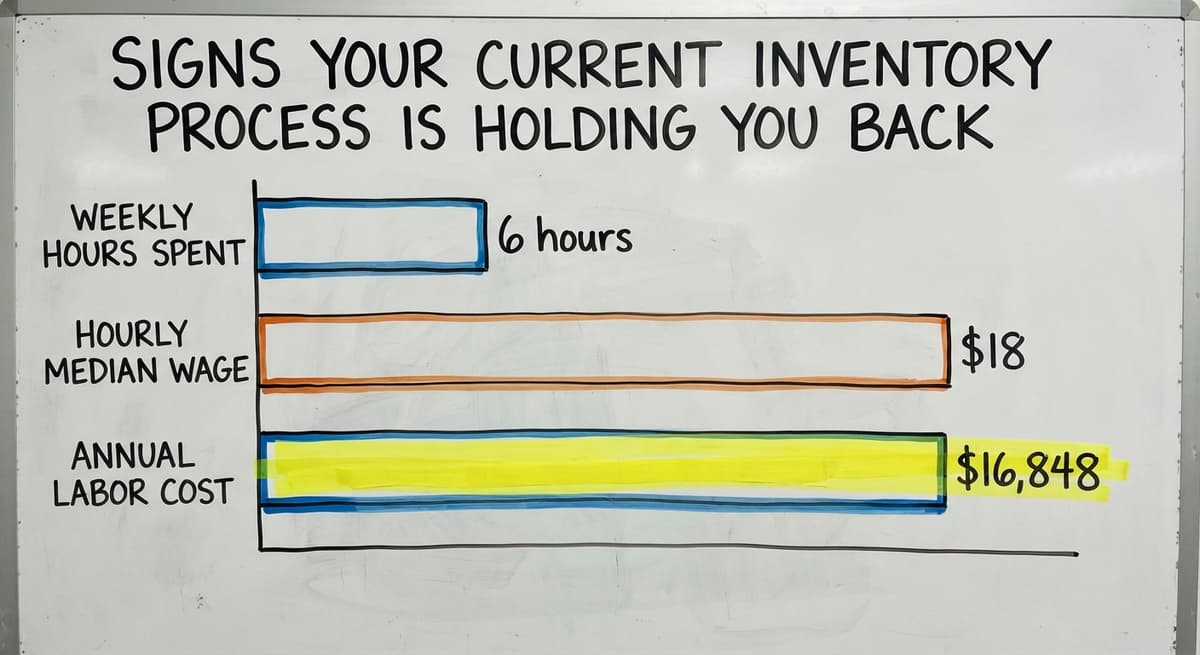
Your process may be costing more than you realize. Consider the math: 3 staff members each spending 6 hours a week reconciling counts by hand, at the median wage for stock clerks of around $18 an hour according to the US Bureau of Labor Statistics, adds up to roughly $16,848 a year in labor alone, before a single error is corrected.

Beyond the cost, watch for these signs:
- Stock counts never match what your accounting package or spreadsheet says, and no one can explain why.
- Orders ship with wrong items or wrong quantities more than once in a while.
- Your team spends hours each week doing manual counts instead of moving product.
- No one can answer "when should we reorder this SKU?" without walking to the shelf.
- Customers call to ask where their order is because your team cannot see real-time status.
The Regulatory Risk of an Inaccurate Count
The FTC's Mail, Internet, or Telephone Order Merchandise Rule needs businesses to ship when they say they will or notify customers of delays. An inaccurate count is often what causes a business to promise stock it does not have.
If more than 2 of these signs feel familiar, the manual inventory process is the problem, not the people running it.
Not sure this is the right shape for your operation
Describe how the work runs today. We map it on a call and show you what it would look like built around that, before you spend anything.
Book a call
What Good Inventory Management Looks Like in Practice
A well-run inventory operation is not complicated to describe. It is just consistent.
Every inbound shipment is logged in seconds. The worker scans, the system records, and the count is current before the truck leaves the dock. Pick lists come from the system, not from a printed sheet that was accurate 3 hours ago. When a picker pulls an item, the available quantity drops at once.
How the Inventory System and Accounting Software Divide the Work
Managers can see 3 numbers at any moment: what is on hand, what is on order, and what is already committed to open customer orders. That view makes reorder decisions fast and confident. Your accounting software still handles invoicing and financials. The inventory system handles physical movement. Neither gets in the way of the other. Custom warehouse software built around your workflow can be scoped to replace only the manual steps that cause the most friction, without changing what already runs smoothly.
The operation looks the same from the outside. Inside, the guesswork is gone.
How Do You Get Started Improving Inventory Management?
Start by mapping how inventory actually moves through your operation today, not how the procedure manual says it should move. Walk the floor. Watch a shipment come in. Follow an order from pick to ship. You will find the manual steps quickly because they are the ones where someone is writing something down.
Then name the single biggest pain point:
- Receiving errors that show up days later
- Pick errors that reach the customer
- Reorder timing that relies on someone remembering to check
- Stock counts that never match the system
Scoping a Solution Around Your Existing Workflow
Choose a system that fits the existing workflow. A custom-built solution can be scoped to replace only the manual steps that cause the most problems, leaving everything else in place. That is a much smaller change than a full system overhaul, and it is where most operations see results fastest. If your team is ready to stop reconciling counts by hand and start running from live data, the right starting point is a conversation about what your current process actually looks like.
Frequently asked questions
Why do we manage inventory?
Inventory management prevents 2 costly problems at once: running out of stock and holding too much of it. Without active management, businesses oversell what they do not have, lose customers to stockouts, and tie up cash in goods that sit unsold. The IRS also needs businesses to value inventory at the start and end of each tax year, so accurate counts are a legal obligation, not just a preference.
What is doing inventory?
Doing inventory means counting, tracking, and recording every product your business holds. In practice it includes logging inbound shipments, placing items in the right storage location, picking and packing orders, watching stock levels, and triggering reorders before you run out. In a manual process, much of this happens on paper or in a spreadsheet. In a software-based process, scans and system rules handle most of it automatically.
What is inventory defined as?
Inventory is the total of all goods a business holds for sale or for use in producing what it sells. That includes raw materials, work in progress, and finished products ready to ship. For a wholesale distributor, inventory is usually finished goods sitting in a warehouse waiting to fill customer orders.
What is an inventory management system?
An inventory management system is a tool, ranging from a spreadsheet to a cloud platform to a custom-built application, that records every physical movement of stock. It logs receipts, tracks locations, generates pick lists, and alerts your team when quantities fall below a set reorder point. The right type depends on your volume, your team size, and how complex your product catalog is. A small operation may start with a simple app. A distributor with multiple locations and thousands of SKUs usually needs a system built around its specific workflow.
How is inventory management different from what your accounting software already does?
Your accounting software records the financial value of your inventory and tracks what you paid for it. It does not record physical movement in real time. It cannot tell you which bin a product is in, how many units your team picked today, or whether a return has been restocked. Inventory management software tracks every physical action: receipt, pick, move, and ship. The 2 systems complement each other rather than compete.
What is the reorder point method?
The reorder point method sets a minimum quantity for each product. When stock falls to that number, the system automatically creates an alert or a draft buy order. It removes the need for anyone to manually check shelves and guess when to reorder. The reorder point is usually calculated from average daily usage and how long it takes your supplier to deliver.
Can a small distributor start improving inventory management without replacing everything at once?
Yes. The most practical approach is to identify the single step causing the most errors, whether that is receiving, picking, or reorder timing, and fix that first. A system scoped to replace only the manual steps that cause problems leaves the rest of the operation in place. Most small distributors see the biggest return by automating receiving and generating pick lists from live stock data before touching anything else.
Start with a free first look
A 30 minute call, your operation mapped, and a clear picture of what we would build. No obligation and nothing to install.
Book a callRelated guides
The rest of this guide, for the parts of the job this page does not cover.
- What is the Difference Between Aggregate and Item Inventory Management
- What is Abc Classification in Inventory Management
- What is Inventory Management and Its Types
- What is the Main Purpose of Inventory Management
- What is Information Technology Inventory Management
- What is Risk Pooling in Inventory Management
- What is Inventory Management Mary Kay
- What is Stock Taking in Inventory Management
- What is Bin Number in Inventory Management
- What is the Goal of Inventory Management Quizlet
- What is the Implication of Proper Inventory Management
- What is Inventory Management and Its Importance
- What is the Importance of Quality Inventory Management
- What is Inventory Management and Why is It Important
- What is the Management and Non Managerial Human Resources Inventory
- Mro Inventory Meaning
- Inventory Reserve Meaning
- What Does Receiving Mean in a Warehouse?
- What is Inventory Listing
- What is Inventory
- What is the Best Warehouse Inventory Management System?
- What is the Difference Between Warehousing and Inventory Management
- What is B Type of Inventory in Warehouse Management
- What is Warehousing and Inventory Management