


What Is Inventory Management Meaning In Hindi
Inventory management in Hindi is सूची प्रबंधन (soochi prabandhan). It means tracking, storing, and moving goods so a business always has the right amount on hand. Every warehouse and wholesale distributor needs it, no matter which language the team speaks.
Reviewed and updated: October 2026
Book a callInventory Management Meaning in Hindi: The Short Answer
The Hindi phrase for inventory management is सूची प्रबंधन (soochi prabandhan). "Soochi" means list or stock. "Prabandhan" means management or control. Put them together and the phrase describes the full job: know what you have, where it is, and when to order more. A warehouse manager can share this phrase with any Hindi-speaking team member and both will be talking about the same thing.
We build it for your operation, and the first look is free
If you would rather not compare products, describe how your operation already works and we build the system around it.
No build cost. You see it running on your own process first, and the monthly subscription starts only once it is live.
Book a callWhy the Hindi Term Matters for Wholesale and Warehouse Teams
Many wholesale distribution and warehousing operations across the US run with bilingual staff or owners whose roots are in South Asia. When the office uses one word and the floor uses another, small gaps turn into costly errors.
Shared vocabulary closes that gap. A picker who hears "soochi prabandhan" and a manager who says "inventory management" are describing the same task. Fewer picking errors, fewer miscounts, and fewer arguments about what the screen says versus what the shelf holds.
The idea behind the words is universal. As GS1 explains, barcode standards exist to give every item a common language across the supply chain, and the same logic applies to the words a team uses day to day. You can read more about those standards at GS1's barcode standards page. Every business that holds physical goods needs a shared system, in every language.
What Are the Core Concepts Inside Inventory Management?
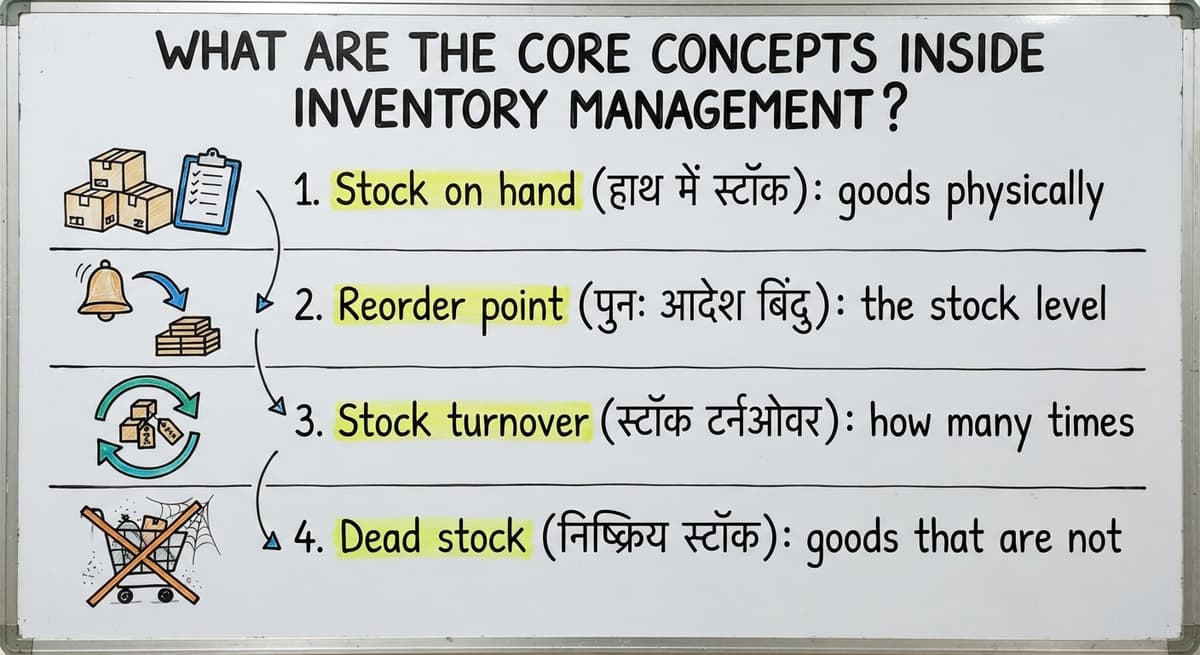
The core concepts inside inventory management each have a Hindi equivalent, and knowing both helps a bilingual team work from the same mental model.
Here are the 4 terms every warehouse team should know:
- Stock on hand (हाथ में स्टॉक): goods physically sitting in the warehouse right now. Example: 240 cases of canned goods on shelf B-3.
- Reorder point (पुनः आदेश बिंदु): the stock level that triggers a new buy order. Example: when cases on B-3 drop to 40, the system flags a reorder.
- Stock turnover (स्टॉक टर्नओवर): how many times inventory is sold and replaced in a set period. A high number means goods move fast. A low number is a warning sign.
- Dead stock (निष्क्रिय स्टॉक): goods that are not selling and tying up cash on shelves that could hold faster-moving items.
Learning these 4 terms in both languages gives a bilingual team a shared reference point for every daily decision on the floor.
How Inventory Management Works in a Small Warehouse
The process follows a clear sequence. Each step builds on the one before it.
- Goods arrive. A staff member counts the items and checks them against the buy order. Any gap gets flagged before the truck leaves.
- Items go to labeled locations. A bin number or shelf label means any picker can find the item without asking someone else.
- An order goes out. Stock levels drop. If the count hits the reorder point, the system creates an alert or a draft buy order.
This loop, repeated daily, keeps the numbers on the screen honest.

Why Cycle Counts Are a Legal Need, Not Just a Preference
Instead of shutting down for a full annual count, staff check a section of the warehouse at a time. The IRS notes that "to figure taxable income, you must value your inventory at the beginning and end of each tax year," per IRS Publication 538, so keeping counts accurate is a legal need, not just a preference. A weekly cycle count keeps that requirement met without disrupting daily operations.
The comparison is easier when one option is built for you
Off-the-shelf means fitting your process to the software. We do it the other way round, and the first look costs nothing.
Book a callCommon Inventory Management Methods Used in Warehouses
Different operations use different rules for deciding which goods ship first. The right method depends on what you sell and how long it lasts.
- FIFO (First In, First Out / पहले आया, पहले गया): the oldest stock ships first. Best for food, medicine, or anything with an expiration date.
- LIFO (Last In, First Out): the newest stock ships first. Less common in the US after accounting rule changes, but still used in some non-perishable industries.
- Just-in-Time (JIT): stock arrives only when a customer order demands it, cutting storage costs but leaving the operation exposed if a supplier is late.
- ABC Analysis: rank every item by its sales value. "A" items are your top sellers and need the closest watch. "B" and "C" items get less attention and less prime shelf space.
Most small distributors start with FIFO and add ABC analysis once they have reliable data on what actually moves.

Signs Your Current Inventory System Is Not Working
A failing system shows up in daily friction before it shows up in the numbers. These are the patterns that signal a real problem:
- Stockouts delay shipments. The FTC's mail and telephone order rule needs sellers to ship when promised, per the FTC Business Guide. A bad count breaks that promise.
- Overstock fills the shelves. Cash sits in slow-moving goods instead of funding the next order of fast sellers.
- The accounting package shows a quantity the shelf does not match. This gap erodes trust in every report the office produces.
- Orders ship wrong because location data lives in one person's head. When that person is out sick, the whole floor slows down.
What Manual Reconciliation Actually Costs
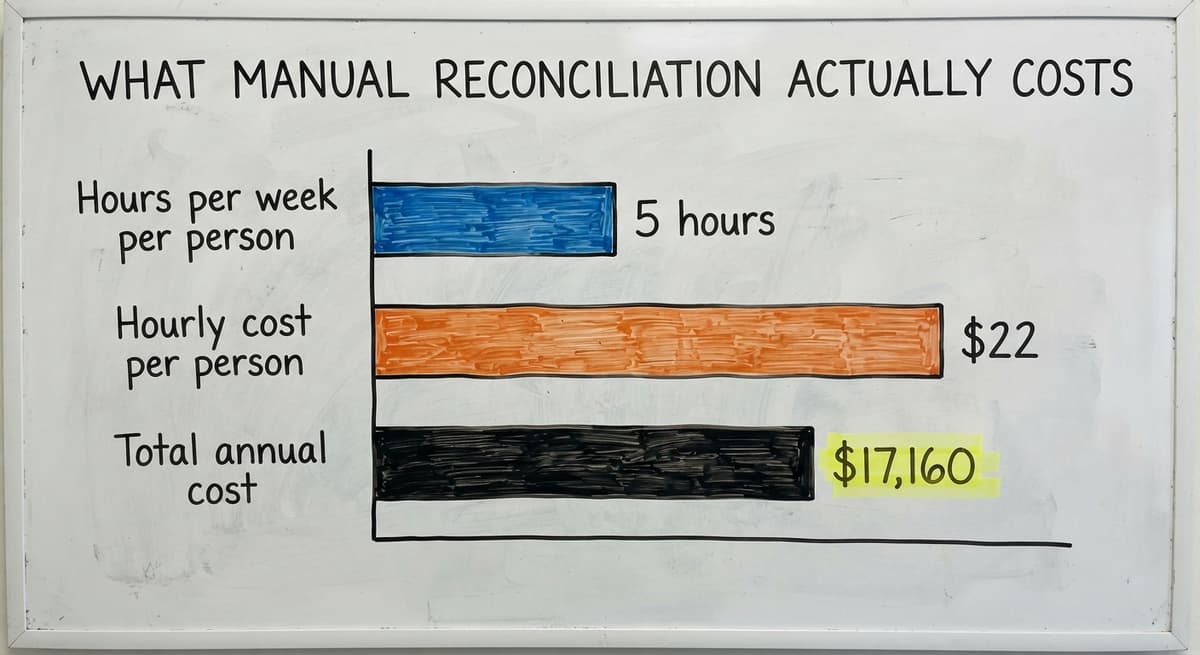
Consider 3 people spending 5 hours a week each on manual counts, at $22 an hour. That is $17,160 a year spent on a problem a system could solve in minutes. Staff spending hours reconciling spreadsheets is not a minor inconvenience; it is a measurable drain on payroll. A system that depends on memory and printed sheets is not a system; it is a risk.

What Should Good Inventory Management Software Do?
Good inventory management software closes the gap between what the screen says and what the shelf holds, and it does that in real time.
The right tool handles these jobs without adding complexity:
- Tracks every unit as it moves, so the count on screen matches the count on the shelf at any moment.
- Sends automatic reorder alerts before a stockout happens, not after a customer calls to complain.
- Replaces printed pick sheets and back-and-forth emails with one source of truth the whole team reads from.
- Scales to the size of the operation. A team of 10 does not need the same system as a team of 500.
How Good Software Connects the Floor to the Books
The right tool connects with your accounting software so financial data stays current without anyone re-entering numbers by hand. This is the core promise of how custom warehouse software works with your accounting software. The NIST Manufacturing Extension Partnership notes that strong supply chain processes reduce waste and improve responsiveness, per NIST MEP. The measure of good software is not its feature list; it is whether the floor runs smoother the week after it goes in.
See it running on your own process first
No build cost. The subscription starts once it is live and doing the job, not before.
Book a call
How a Custom System Fits a Small Distributor or Warehouse
Inventory management software for small distributors does not have to mean a long, expensive rollout. A custom-built system starts with the workflow already in place and adds structure where the gaps are.
The accounting package stays where it is useful. The custom layer handles the parts it was never built for: bin locations, cycle counts, reorder triggers, and picking logic. Warehouse order management for wholesale operations runs cleaner when the tool matches the real floor layout rather than a generic template.
Why Small Operations Do Not Need a Full Replacement
Small operations with 5 to 100 staff get a tool sized for their scale. No six-month rollout. No features the team will never touch. The builder learns the operation first, then writes the code to fit it. Replacing Excel and spreadsheets in a warehouse does not need replacing everything at once. A targeted fix for the manual work that slows the team down is often enough to recover hours every week and reduce the errors that cost real money. A system built around the operation earns trust faster than one that asks the operation to change.

What Are the Next Steps for Wholesale and Warehouse Owners?
The first step is simple: audit what your team tracks manually today. Write it down. That list is the gap map.
Three actions move the work forward:
- Audit the manual work. List every task that runs on a spreadsheet, a printed sheet, or someone's memory.
- Name the biggest gap. Is it stockouts? Mismatched counts? Hours lost to matching? Pick the one that costs the most.
- Talk to a builder who understands small-scale distribution. Not a vendor selling a platform, but a team that will learn your operation before recommending anything.
Why Speed Matters for Small Distributors
The US Census Bureau tracks wholesale inventories monthly, and the data at Census Bureau Wholesale Trade shows that inventory-to-sales ratios shift fast. Small distributors cannot afford a slow, expensive system change. Custom working software for fulfillment centers and small warehouses can be scoped, built, and running in weeks, not quarters. If the manual work is slowing your team down, the fix is a targeted build, not a bigger budget.
Conclusion
Inventory management meaning in Hindi is सूची प्रबंधन (soochi prabandhan). The words are different. The problem they describe is the same for every warehouse and wholesale distributor: know what you have, keep the count honest, and ship on time.
Bilingual teams that share the vocabulary make fewer errors. Operations that use the right software stop losing money to stockouts and spreadsheet mismatches. And small distributors with 5 to 100 staff can get a system built for their scale without the cost or complexity of an enterprise tool.
If your team is ready to close the gap between the screen and the shelf, start with the audit. The rest follows from there.
Frequently asked questions
What is the Hindi word or phrase for inventory management?
The Hindi phrase is सूची प्रबंधन, written in English letters as 'soochi prabandhan.' 'Soochi' means list or stock, and 'prabandhan' means management or control. Together they describe the full job of tracking, storing, and moving goods in a warehouse or distribution operation.
What does 'soochi prabandhan' mean in English?
Soochi prabandhan translates directly to inventory management. It covers every step of knowing what stock you have, where it is stored, when to reorder, and how to move it out to customers correctly and on time.
Why would a warehouse team need to know the Hindi term for inventory management?
Many US wholesale and warehousing operations have bilingual staff or owners with South Asian roots. Using the same term in both languages reduces picking errors, miscounts, and miscommunication between the office and the warehouse floor. Shared vocabulary is a practical working tool, not just a courtesy.
What are the most common inventory management methods used in warehouses?
The 4 most common methods are FIFO (oldest stock ships first), LIFO (newest stock ships first), Just-in-Time (stock arrives only when needed), and ABC Analysis (rank items by sales value to focus attention on the most important stock). Most small distributors start with FIFO and add ABC analysis once they have reliable sales data.
How does inventory management software work alongside your accounting software?
A well-built inventory system connects to your accounting software so stock counts and financial data stay in sync without anyone entering the same number twice. Your accounting software handles the accounting side. The inventory layer handles bin locations, reorder triggers, and picking logic that your accounting software was not built to manage on its own.
Can a small warehouse with fewer than 100 staff benefit from inventory management software?
Yes. A system built for a team of 5 to 100 does not need enterprise-level complexity. A targeted build focused on the manual tasks that slow the team down, such as cycle counts, reorder alerts, and pick-sheet replacement, can recover hours every week and reduce costly errors without a long or expensive rollout.
How do you know when your current inventory system is failing?
The clearest signs are frequent stockouts that delay shipments, overstock that ties up cash, staff spending hours each week reconciling spreadsheets, quantities in the accounting package that do not match the shelf, and orders picked wrong because location data lives in one person's head rather than a shared system.
How does a custom-built inventory system differ from a one-size-fits-all tool?
A custom system maps to the workflow already in place. The builder learns the operation first, then writes code to fit it. A generic platform asks the operation to change to fit the software. For small distributors with specific floor layouts and existing accounting tools, a custom build is usually faster to adopt and less disruptive to daily work.
Start with a free first look
A 30 minute call, your operation mapped, and a clear picture of what we would build. No obligation and nothing to install.
Book a callRelated guides
The rest of this guide, for the parts of the job this page does not cover.
- What is Mean by Inventory Management
- What is the Difference Between Aggregate and Item Inventory Management
- What is Abc Classification in Inventory Management
- What is Inventory Management and Its Types
- What is the Main Purpose of Inventory Management
- What is Information Technology Inventory Management
- What is Risk Pooling in Inventory Management
- What is Inventory Management Mary Kay
- What is Stock Taking in Inventory Management
- What is Bin Number in Inventory Management
- What is the Goal of Inventory Management Quizlet
- What is the Implication of Proper Inventory Management
- What is Inventory Management and Its Importance
- What is the Importance of Eoq in Inventory Management
- What is the Importance of Quality Inventory Management
- What is Inventory Management Explain Techniques of Inventory Management
- What is Inventory Management and Why is It Important
- What is the Rationale for Inventory Management Quizlet
- What is the Purpose of Inventory in Operations Management
- What is Inventory Management Whiteboard Wednesday
- What is Fluctuation Stock in Inventory Management
- What is the Management and Non Managerial Human Resources Inventory
- Mro Inventory Meaning
- Inventory Reserve Meaning