


Inventory Reserve Account
An inventory reserve account is a contra-asset account that reduces the stated value of your inventory on the balance sheet. It records the estimated portion of your stock that will not sell at full price due to damage, theft, spoilage, or obsolescence. No cash moves. The reserve is an accounting estimate, not a fund. This guide was reviewed in July 2025 and covers everything a warehouse owner or operations manager needs to know.
Book a callWhat Is an Inventory Reserve Account
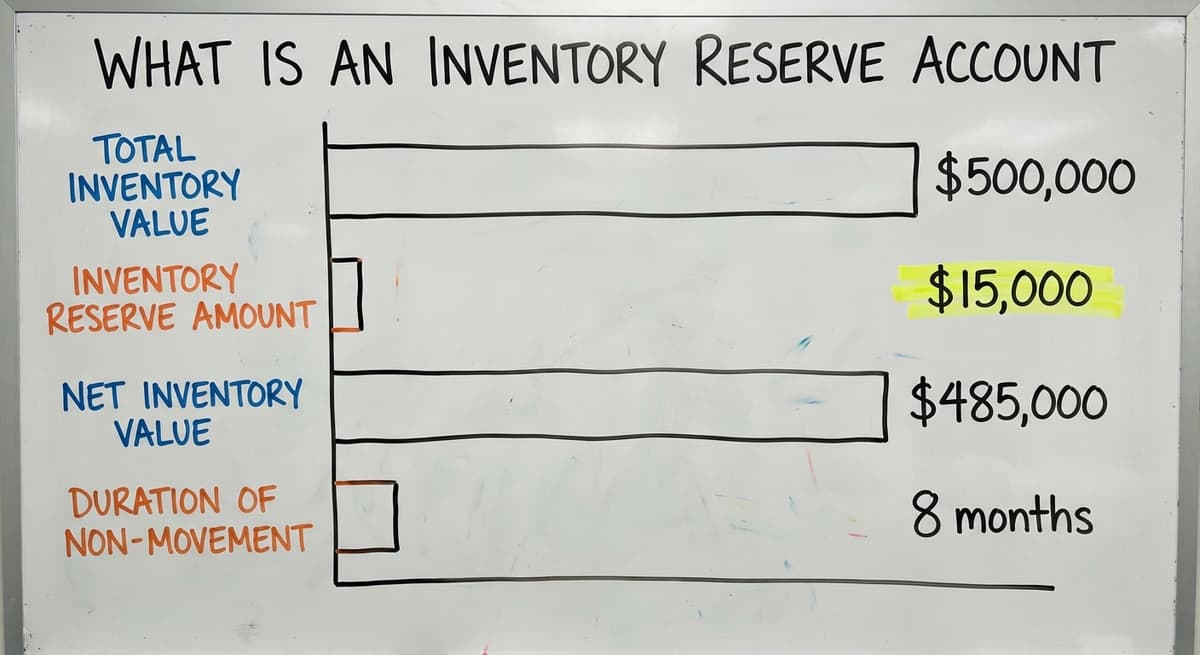
A contra-asset account sits on the balance sheet and offsets another asset. The inventory reserve account offsets your gross inventory value. If you carry $500,000 in inventory and hold a $15,000 reserve, your balance sheet shows $485,000 as the net inventory value.
Reviewed September 2026. Figures are worked from the assumptions stated beside them, so you can substitute your own and the arithmetic still holds.
The reserve is not cash set aside. It is an estimate of losses you expect but have not confirmed yet. Think of a pallet of seasonal goods in your warehouse that has not moved in 8 months. You have not thrown it out, but you know it will not sell at full price. The reserve captures that risk now, before you confirm the loss.
This is different from a physical write-off. A write-off removes inventory from your books after you confirm it is gone or unsellable. The reserve expects that moment.
We build it for your operation, and the first look is free
If you would rather not compare products, describe how your operation already works and we build the system around it.
No build cost. You see it running on your own process first, and the monthly subscription starts only once it is live.
Book a callWhy Wholesale Distributors Need an Inventory Reserve Account
Inventory rarely holds its full value from the day you receive it to the day it ships. Damage, theft, spoilage, and slow-moving inventory all chip away at what your stock is actually worth.
Without a reserve, your balance sheet overstates your assets. Lenders, partners, and buyers read that number and make decisions based on it. Overstated inventory misleads all of them.
Wholesale distributors carry large SKU counts. That makes this risk bigger than in retail. One product line going obsolete can wipe out more value than a year of shrinkage in a small shop.
Why GAAP Requires Timely Inventory Loss Recognition
GAAP (Generally Accepted Accounting Principles) needs you to match the loss to the period in which the risk appears, not the period when you finally dispose of the goods. GS1, the global body behind supply chain standards, notes that accurate item-level data is the foundation of reliable inventory control, which is why their barcode standards at gs1.org/standards/barcodes are widely used in warehouse operations to support the clean counts that make reserve calculations defensible.
The reserve keeps your books honest in real time.
How Does an Inventory Reserve Account Work in QuickBooks?
QuickBooks handles the inventory reserve account as a contra-asset sitting under your Inventory Asset parent account. You create it manually, and it offsets the gross inventory balance on the balance sheet.
The double-entry works like this:
- Debit: Inventory Write-Down Expense (or Cost of Goods Sold) for the reserve amount
- Credit: Inventory Reserve Account (contra-asset) for the same amount
QuickBooks does not calculate the reserve for you. You run the calculation outside the system, then post a manual journal entry. That gap, between what QuickBooks shows and what your actual stock data says, is exactly where reserve accuracy breaks down for most small distributors.
When you confirm a loss and write off specific inventory, the entry flips: debit the reserve account, credit the Inventory Asset. The reserve absorbs the hit rather than sending a surprise charge to your income statement.
Types of Inventory Reserves
Not all inventory risk looks the same. Distributors usually carry 4 types of reserves, and knowing which applies helps you set the right amount.
- Obsolescence reserve: Covers slow-moving inventory or discontinued SKUs that will not sell at full price. This is the most common reserve for wholesale distributors with long product catalogs.
- Shrinkage reserve: Accounts for theft, breakage, and counting errors. If your physical counts regularly come in below QuickBooks, shrinkage is the cause.
- LCNRV reserve: The lower of cost or net realizable value (LCNRV) rule needs you to write inventory down when its market price drops below what you paid for it. The reserve captures that gap.
- Damage reserve: Covers goods damaged in the warehouse or in transit that you have not yet disposed of.
Most distributors need at least 2 of these running at the same time.
The comparison is easier when one option is built for you
Off-the-shelf means fitting your process to the software. We do it the other way round, and the first look costs nothing.
Book a callHow to Calculate an Inventory Reserve for Your Distribution Business
Three methods are common: percentage of total inventory value, aging analysis, and specific spotting. The right choice depends on your SKU count, your data quality, and how much time your team can spend on the calculation.
Whichever method you choose, apply it the same way every period. Auditors and lenders look for consistency. Switching methods without records raises questions you do not want to answer during a loan review.
Percentage of Inventory Value Method
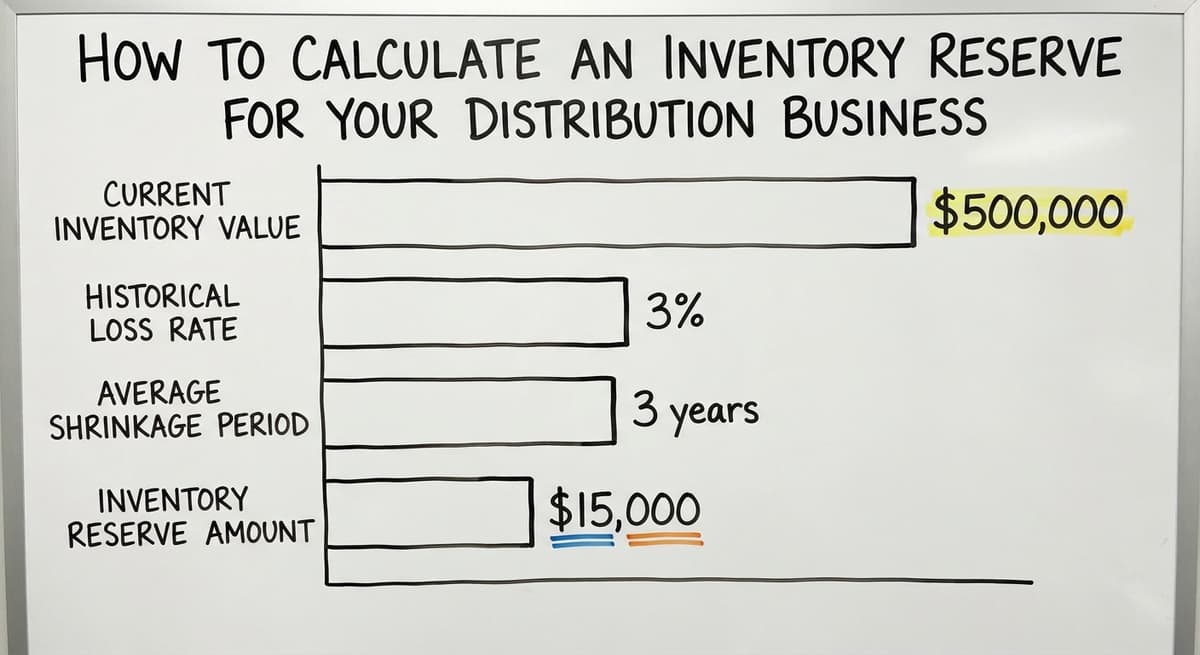
The percentage of inventory value method is the simplest starting point. You apply a flat loss rate to your total inventory value.
Example: You carry $500,000 in inventory and your historical loss rate is 3%. Your reserve is $15,000.
The percentage comes from your own write-off history. Pull your actual shrinkage and write-off data from the past 2 to 3 years and average it. If you do not have that history yet, start conservative and refine it as data builds.
This method works well when SKU counts are high and tracking each item individually is not practical. The weakness is that a single flat rate can under-reserve if one product category carries far more risk than the rest of your catalog. A mix of fragile goods and stable hardware, for instance, should not share the same percentage.
Aging Analysis Method
Aging analysis groups inventory into time buckets and assigns a reserve percentage to each. Older stock gets a higher reserve rate because the chance of selling it at full value drops the longer it sits.
A typical structure looks like this:
| Age of Stock | Inventory Value | Reserve Rate | Reserve Amount |
|---|---|---|---|
| 0 to 90 days | $300,000 | 1% | $3,000 |
| 91 to 180 days | $120,000 | 5% | $6,000 |
| 181 to 365 days | $60,000 | 15% | $9,000 |
| Over 365 days | $20,000 | 50% | $10,000 |
| Total | $500,000 | $28,000 |
This method is more accurate than a flat percentage because it reflects how your actual stock ages. The catch is that it needs clean, current inventory data. That is where many small distributors struggle: if your QuickBooks data and your physical stock are out of sync, the aging buckets are wrong before you start.
Specific Identification Method
Specific spotting is used when you can track and value individual items precisely. It is common for high-value, low-volume SKUs such as specialty parts, serialized equipment, or custom-order goods.
You set the reserve item by item based on known condition, confirmed demand, or customer cancellations. A $40,000 piece of equipment with a canceled order gets reserved at the difference between cost and its best alternative sale price.
This method is the most accurate but the most time-intensive. Most distributors combine it with one of the other methods: specific spotting for their top 10 high-value SKUs, aging analysis or percentage for everything else.

How Do I Record the Journal Entry for an Inventory Reserve?
The journal entry is straightforward once you have your reserve amount. Here is how it works for a distribution company setting a $15,000 reserve.
Step 1: Create the reserve
- Debit Inventory Write-Down Expense: $15,000
- Credit Inventory Reserve Account: $15,000
This reduces net inventory on the balance sheet and records the expected loss as an expense in the current period.
Step 2: Write off confirmed losses
When you confirm that specific inventory is gone, damaged beyond sale, or disposed of:
- Debit Inventory Reserve Account: $15,000
- Credit Inventory Asset: $15,000
The reserve absorbs the write-off. Your income statement does not take a second hit because you already recorded the expense when you built the reserve. That is the point of doing it in advance.
Reversing or Adjusting the Reserve
Reserves are estimates, and estimates need to be revisited. Review yours at least once a quarter.
If your actual losses come in lower than reserved, reverse the excess back into income with a credit to Inventory Write-Down Expense and a debit to the reserve account. If losses run higher, post another entry to increase the reserve.
The IRS states plainly: "To figure taxable income, you must value your inventory at the beginning and end of each tax year," per IRS Publication 538. That valuation obligation is part of why keeping the reserve current matters beyond just clean books.
Document every adjustment. Auditors and lenders expect to see a logical reason for each change, not arbitrary swings up or down.
See it running on your own process first
No build cost. The subscription starts once it is live and doing the job, not before.
Book a callInventory Reserve vs. Inventory Write-Off
The inventory reserve and the inventory write-off are related but not the same, and confusing them creates real accounting problems.
The reserve comes first. You create it when a loss is probable but not yet confirmed. A pallet of goods sitting in your warehouse with visible water damage is a candidate for a reserve entry today, even if you have not decided what to do with it.
The write-off comes second. It happens when you confirm the inventory is unsellable, stolen, or disposed of. At that point, you debit the reserve and credit the Inventory Asset account.
The sequence matters because GAAP needs you to recognize the loss in the period the risk becomes probable. Waiting until disposal can shift losses into the wrong period and distort your financials across quarters. Think of the reserve as your acknowledgment that the loss is coming, and the write-off as closing the file.

Tax Treatment and GAAP: What Your CPA Needs to Know
GAAP needs the reserve for accurate financial reporting. The IRS does not always agree.
For federal tax purposes, you generally cannot deduct an inventory loss until the inventory is actually written off. The reserve creates a temporary difference between your book income and your taxable income. You may show a lower net income on your financial statements than on your tax return in the same year.
This is one of the most common points of confusion for business owners running QuickBooks themselves. Your books look one way; your tax return looks another. Both can be correct at the same time.
Before applying for a line of credit, taking on a new investor, or filing after a year with a large unexpected write-off, ask your CPA to review the reserve. The method must be documented and defensible, especially if a lender or auditor asks about it.
Is Your Inventory Reserve Slipping? Signs to Watch For
Your reserve process may be losing accuracy if any of these describe your operation right now.
- You update the reserve only at year-end, not quarterly
- Your inventory value in QuickBooks does not match your last physical count
- SKUs that have not moved in over a year are still booked at full value
- One person owns the reserve spreadsheet and no one else can run the calculation
- Your CPA or a lender has flagged inventory as overstated
Any one of these is a signal. All 5 together mean your balance sheet is carrying risk that is not showing up anywhere on it.
How Inventory Management Software Improves Reserve Accuracy
Manual reserve calculations in Excel break down as SKU counts grow. A team of 3 people spending 6 hours a week each on manual inventory matching at $22 an hour spends over $20,500 a year on a process that still produces stale data.
Inventory management software for small distributors changes that math. It flags slow-moving inventory and aging stock automatically, so you are not relying on someone remembering to check. Clean, real-time data means your aging buckets reflect what is actually in the warehouse, not what was there last month.

How QuickBooks Integration Closes the Reserve Data Gap
QuickBooks integration for warehouse operations means the journal entry can be prepared from current data without re-keying numbers from a spreadsheet. That removes the most common source of reserve errors: the gap between what QuickBooks shows and what the warehouse actually holds.
Replacing Excel-based inventory tracking with custom software does not need a full ERP rollout. The right system connects to QuickBooks, surfaces the data you need for the reserve calculation, and keeps the two in sync. That is the practical fix for lean teams running hundreds of SKUs without a dedicated accounting staff.
Not sure this is the right shape for your operation
Describe how the work runs today. We map it on a call and show you what it would look like built around that, before you spend anything.
Book a callSetting Up an Inventory Reserve Account in QuickBooks
Follow these 5 steps to get the account working correctly from the start.
- Create the account. In your Chart of Accounts, add a new account under Other Current Assets. Set the type to Contra Asset and name it Inventory Reserve.
- Choose your calculation method. Decide whether you will use the percentage method, aging analysis, or specific spotting. Write down your choice and the reason for it.
- Run your first calculation. Use your current inventory data to set the opening reserve balance. Post the journal entry: debit Inventory Write-Down Expense, credit Inventory Reserve.
Maintaining and Reconciling Your Inventory Reserve Account
Once the account is active, keep it current with these steps.
- Set a quarterly calendar reminder. Review and adjust the reserve every 90 days. Compare actual write-offs to the reserve balance and adjust up or down with records.
- Reconcile at year-end. Compare the reserve balance to total confirmed write-offs for the year. Reverse any excess or post an extra entry if losses exceeded the reserve.
Inventory counting and matching best practices recommend tying this matching to your physical count cycle so the two processes reinforce each other.

Key Takeaways for Operations Managers
An inventory reserve account reduces the stated value of your inventory to reflect losses you expect but have not confirmed. It keeps your balance sheet honest and your lenders informed.
The reserve is not a one-time entry. It needs quarterly attention, consistent method, and clean underlying data. Your reserve is only as accurate as the inventory data behind it. If QuickBooks and your physical stock are out of sync, the reserve is wrong before you calculate it.
Software that connects your warehouse data to QuickBooks is the practical fix. It does not replace your accountant or your process. It gives both the current numbers they need to work with.
Frequently Asked Questions
Is an inventory reserve account required under GAAP? GAAP needs accurate inventory valuation, which means recognizing probable losses in the period they occur. For most businesses following GAAP, a reserve is required when losses are probable and estimable. Private companies not under audit may not face a legal mandate, but lenders and investors expect it.
Does the reserve affect cash flow? No. The inventory reserve account is a non-cash accounting entry. It reduces the reported value of your inventory on the balance sheet but does not move money in or out of your accounts.
How often should I update my inventory reserve? At minimum, review the reserve every quarter. High-turnover operations with fast-moving SKUs benefit from monthly reviews. Year-end-only updates leave too much time for the reserve to drift from reality.

Frequently Asked Questions (continued)
Can I use the same reserve percentage every year? Only if your loss history is stable and your product mix has not changed. If you have added new product categories, changed suppliers, or had an unusual year for write-offs, recalculate from current data rather than carrying forward last year's rate.
What is the difference between an inventory reserve and an inventory write-off? The reserve is created when a loss is probable but not yet confirmed. The write-off happens when you confirm the inventory is gone or unsellable. The reserve entry goes first; the write-off entry closes it out.
How does the IRS treat inventory reserves for tax purposes? The IRS generally does not allow a deduction for the reserve itself. The deduction comes when inventory is actually written off. This creates a temporary difference between your book income and your taxable income. Confirm your specific situation with your CPA before filing.
Frequently asked questions
Is an inventory reserve account required under GAAP?
GAAP needs accurate inventory valuation, which means recognizing probable losses in the period they occur. For most businesses following GAAP, a reserve is required when losses are probable and estimable. Private companies not under audit may not face a legal mandate, but lenders and investors expect it.
Does the inventory reserve account affect cash flow?
No. The inventory reserve account is a non-cash accounting entry. It reduces the reported value of your inventory on the balance sheet but does not move money in or out of your accounts.
How often should I update my inventory reserve?
At minimum, review the reserve every quarter. High-turnover operations with fast-moving SKUs benefit from monthly reviews. Year-end-only updates leave too much time for the reserve to drift from reality.
What is the difference between an inventory reserve and an inventory write-off?
The reserve is created when a loss is probable but not yet confirmed. The write-off happens when you confirm the inventory is gone or unsellable. The reserve entry goes first; the write-off entry closes it out.
Can I use the same reserve percentage every year?
Only if your loss history is stable and your product mix has not changed. If you have added new product categories, changed suppliers, or had an unusual year for write-offs, recalculate from current data rather than carrying forward last year's rate.
How does the IRS treat inventory reserves for tax purposes?
The IRS generally does not allow a deduction for the reserve itself. The deduction comes when inventory is actually written off. This creates a temporary difference between your book income and your taxable income. Confirm your specific situation with your CPA before filing.
How do I set up an inventory reserve account in QuickBooks?
Create a new account in your Chart of Accounts under Other Current Assets, set the type to Contra Asset, and name it Inventory Reserve. Then choose your calculation method, run your first calculation, post the journal entry, and set a quarterly calendar reminder to review and adjust the balance.
Start with a free first look
A 30 minute call, your operation mapped, and a clear picture of what we would build. No obligation and nothing to install.
Book a callRelated guides
The rest of this guide, for the parts of the job this page does not cover.
- Accounting and Inventory Software for Small Business
- Excess Inventory
- Multi Location Inventory Management Software
- Inventory Management for Multiple Locations
- Costing Inventory
- Inventory Management System for Manufacturing
- Excel Inventory Template
- Jewelry Inventory Management
- Dental Inventory Management
- Qr Code for Inventory Management
- Inventory Formulas
- Hvac Inventory Management Software
- Calculate Beginning Inventory
- Inventory Management Software for Schools
- Find Beginning Inventory
- Nonprofit Inventory Management
- Manual Inventory Management
- Inventory Bin System
- Inventory Management Software Costs
- Manual Inventory System
- Hvac Inventory Management
- Warehouse Inventory Management Software
- Warehouse Inventory Tracking Software
- Warehouse Inventory Management Systems