


Find Beginning Inventory
Beginning inventory is the dollar value or unit count of stock you have on hand at the start of an accounting period. To find it, pull last period's ending inventory from your records. That single number is your beginning inventory. This guide, reviewed for accuracy in June 2025, walks through the formula, QuickBooks steps, and the mistakes that throw the number off.
Book a callWhat Beginning Inventory Means and Why It Matters
Beginning inventory is a snapshot, not a running total. It captures what you owned on day one of the period, whether that period is a month, a quarter, or a full year. Every period's beginning inventory is the prior period's ending inventory. Nothing is recounted. The number simply rolls forward.
We build it for your operation, and the first look is free
If you would rather not compare products, describe how your operation already works and we build the system around it.
Reviewed September 2026. Figures are worked from the assumptions stated beside them, so you can substitute your own and the arithmetic still holds.
No build cost. You see it running on your own process first, and the monthly subscription starts only once it is live.
Book a callWhy an Accurate Beginning Inventory Is a Legal and Financial Requirement
For a wholesale distributor or fulfillment center, that snapshot feeds directly into cost of goods sold (COGS), which is the cost of the products you actually sold. If the snapshot is wrong, your COGS is wrong. Wrong COGS means wrong gross profit, which means wrong tax filings and misleading numbers for any lender reviewing your books.
The IRS makes the obligation clear. IRS Publication 538 states: "To figure taxable income, you must value your inventory at the beginning and end of each tax year." That is not a suggestion. Accurate beginning inventory is a legal requirement, not just a best practice.
Smarter purchasing also depends on it. A buyer who does not know what is already on the shelf will over-order or under-order. Both outcomes cost money.
The Beginning Inventory Formula: What Is It and When Do You Use It?
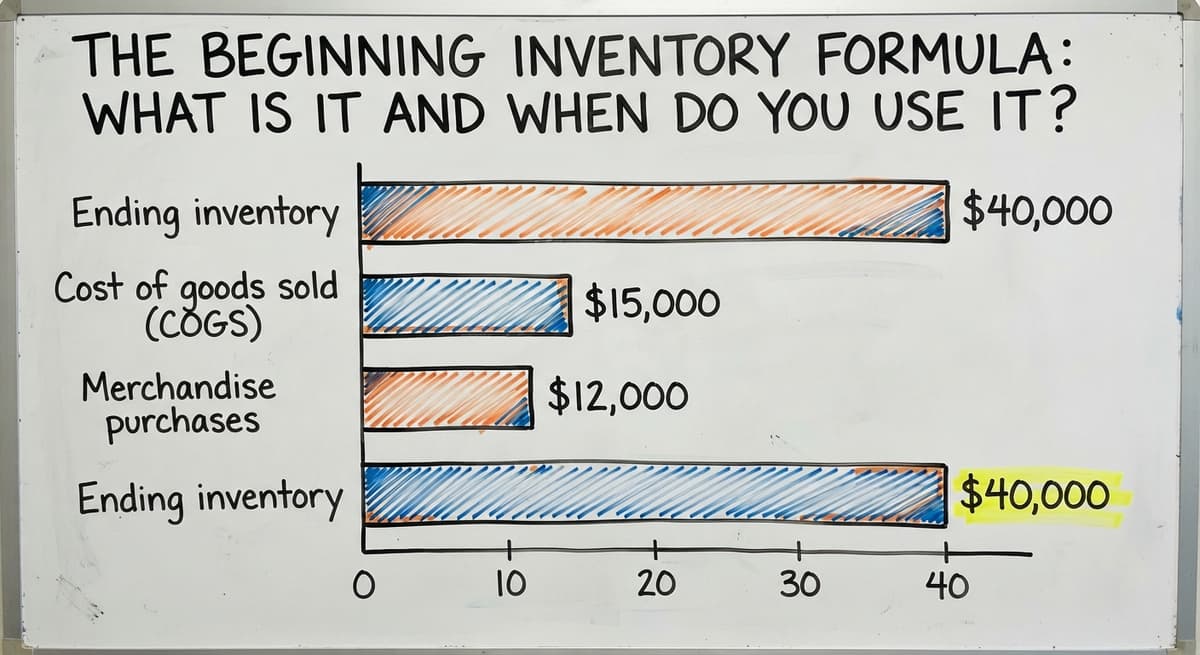
What is the beginning inventory formula? Beginning Inventory = Ending Inventory (prior period) + COGS (prior period) - Buys (prior period).
Each variable does one job:
- Ending inventory (prior period) is the closing stock value from the last count or report.
- COGS (prior period) is the cost of goods you sold during that period.
- Buys (prior period) is the total cost of stock you bought and received during that period.
Use this formula when you have reliable records but no recent physical count. If your records are suspect, skip the formula and do a physical count instead. A physical count resets the baseline and is always the more reliable starting point.
Whole-dollar example: Ending inventory was $40,000. COGS was $15,000. Buys were $12,000. Beginning inventory = $40,000 + $15,000 - $12,000 = $43,000.
A Step-by-Step Example for a Small Wholesale Distributor
Picture a small distributor that sells cleaning supplies. The team is closing out Q1 and needs to set Q2's beginning inventory.
Here are the Q1 numbers:
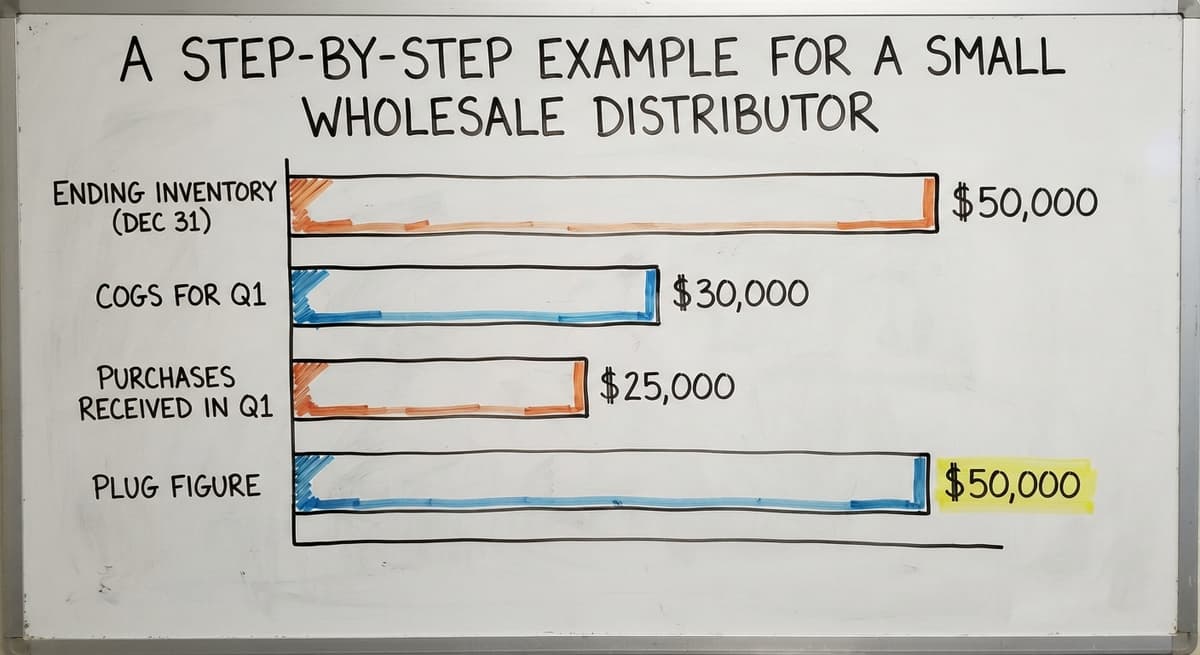
- Ending inventory (Dec 31): $50,000
- COGS for Q1: $30,000
- Buys received in Q1: $25,000
Plug them in: $50,000 + $30,000 - $25,000 = $55,000.
That $55,000 is Q2's beginning inventory. It tells the owner that more stock moved out than came in during Q1. If the owner expected to hold steady at $50,000, the $5,000 gap is worth investigating before placing the next buy order.
This kind of check takes about 10 minutes when the records are clean. When the records live across 3 spreadsheets and a printed count sheet, it can take half a day, and the result is still uncertain.
How to Find Beginning Inventory in QuickBooks
QuickBooks already holds the number. You do not need to calculate it from scratch if your books are current.
Two reports surface it directly:
- Inventory Valuation Summary: Run it for the last day of the prior period. The "Asset Value" column shows ending inventory, which becomes this period's beginning inventory.
- Balance Sheet: Set the date to the last day of the prior period. Inventory appears as a current asset.
The Most Common QuickBooks Mistake When Pulling Beginning Inventory
The most common mistake is a wrong date range. QuickBooks defaults to the current period. If you forget to change the end date, you pull current inventory, not prior-period ending inventory. Always double-check the date in the report header before you record the number.
QuickBooks inventory data is already there. The job is knowing which report to open and which date to set. For QuickBooks integration for warehouse operations, the same reports feed receiving, picking, and adjustment workflows when the system is set up correctly.
Inline FAQ: Where exactly does beginning inventory appear in QuickBooks?
Beginning inventory does not appear as a labeled line in QuickBooks. Run the Inventory Valuation Summary for the last day of the prior period and read the Asset Value total. That figure is your beginning inventory for the current period.
The comparison is easier when one option is built for you
Off-the-shelf means fitting your process to the software. We do it the other way round, and the first look costs nothing.
Book a call
Finding Beginning Inventory Without QuickBooks
Not every distributor runs QuickBooks. Some operations track stock in spreadsheets, printed count sheets, or older database tools. The manual process follows the same logic: last physical count + goods received since that count - goods sold since that count = current inventory, which becomes next period's beginning inventory.
What to Record When Tracking Inventory Manually
The risk with spreadsheets is version control. When 3 people work from copies of the same Excel file and email updates back and forth, it is easy to lose a receiving entry or double-count a return. Replacing Excel-based inventory tracking with custom software removes that version-control risk entirely, but even a simple shared log or ledger is better than separate files.
At minimum, keep one record that shows:
- The date of the last physical count and the count total.
- Every receipt of goods since that count, with the cost.
- Every sale since that count, at cost.
That log gives you a defensible beginning inventory number every time a new period opens.
Physical Count vs. Calculated Beginning Inventory
Calculating beginning inventory from records is faster. Doing a physical count is more accurate. Both methods have a place.
Use the calculated method when your records are current, your receiving team logs every shipment, and you have not had unusual losses. Use a physical count when you suspect shrinkage, when a large adjustment appeared at the last count, or when you are starting fresh with a new system.
Shrinkage (theft or loss), damage, and data-entry errors all cause the calculated number to drift from reality. A physical count resets the baseline and gives you a clean starting point that no formula can match.
Most auditors and lenders prefer a physical count at least once a year. More frequent counts, even cycle counts of a portion of the warehouse each week, keep the calculated number honest between full counts.

Does Beginning Inventory Affect Cost of Goods Sold?
Yes, directly. The COGS formula is: Beginning Inventory + Buys - Ending Inventory = COGS.
If beginning inventory is overstated, COGS rises. Higher COGS lowers reported gross profit. Lower gross profit means lower taxable income, which sounds good until a lender or the IRS questions why margins dropped without a change in sales volume.
How a Beginning Inventory Error Ripples Through the Income Statement
If beginning inventory is understated, COGS falls. Gross profit looks higher than it really is. That inflates taxable income and can trigger a larger tax bill.
Accuracy protects you in both directions. Tax liability, lender covenants, and the trust of any investor all rest on a COGS figure that reflects what actually happened. A beginning inventory error does not stay in one line item. It ripples through the entire income statement.
Inline FAQ: What happens if beginning inventory is recorded incorrectly?
An incorrect beginning inventory shifts COGS up or down, which changes gross profit, taxable income, and any ratio a lender uses to evaluate the business. The error does not self-correct. It carries into the next period unless a physical count resets the baseline.
Periodic vs. Perpetual Inventory Systems
Periodic and perpetual inventory systems differ in how often the inventory balance updates.
Periodic inventory sets the balance at fixed intervals, usually monthly, quarterly, or annually. Between counts, you do not know the exact on-hand quantity from the system. You calculate it at period end using the formula above.
Perpetual inventory updates the balance after every transaction. A sale reduces the count. A receipt adds to it. The system always shows a current balance.
Most small distributors use a hybrid in practice. QuickBooks supports perpetual inventory, but many teams enter receipts in batches or skip entries during busy periods. That turns a perpetual system into something closer to periodic. The result is a system balance that drifts from reality and needs a physical count to correct.
Knowing which system you actually operate, not which one the software supports, work out how often you need to verify beginning inventory against a physical count.
See it running on your own process first
No build cost. The subscription starts once it is live and doing the job, not before.
Book a call
How Often Should You Establish Beginning Inventory, and Which Valuation Method Should You Use?
Frequency and valuation method are two separate decisions, but they belong together because both affect what the number means.
On frequency: Monthly periods catch discrepancies early, when they are small and traceable. Quarterly works for businesses with slower-moving stock. Annual is the legal minimum under IRS Publication 538. Align the period to how the business actually orders and sells. A distributor that turns stock every 30 days benefits from monthly periods. One that holds slow-moving specialty items may find quarterly enough.
Which Inventory Valuation Method Should You Use?
Three methods are common.
- FIFO (first in, first out) assumes the oldest stock sells first. In a rising-cost environment, FIFO produces a higher ending inventory and lower COGS.
- LIFO (last in, first out) assumes the newest stock sells first. It is less common and not permitted under international accounting standards.
- Weighted average cost smooths price swings by averaging the cost of all units on hand.
The method chosen work out the dollar value assigned to beginning inventory. Switching methods mid-year distorts the number and makes period-to-period comparisons meaningless. Consult an accountant before changing valuation methods.
Common Mistakes When Finding Beginning Inventory
Most errors come from process gaps, not math errors. Watch for these:
- Wrong date range in accounting software: Pulling the current balance instead of the prior period's ending balance is the single most common mistake. Always check the report date.
- Goods in transit left out: Stock that has shipped from a supplier but not yet arrived may or may not belong in your beginning inventory, depending on your FOB terms.
- Customer returns double-counted: A return that hits both the sales reversal and the inventory adjustment gets counted twice.
- Units and dollars mixed in the same calculation: Beginning inventory must be all units or all dollars. Mixing them produces a number that means nothing.

Does FOB Shipping Point Change What Goes Into Beginning Inventory?
Yes. FOB terms work out who owns the goods while they are moving.
FOB shipping point means ownership transfers when the supplier ships. The goods belong to you the moment they leave the supplier's dock, even if the truck is still three days away. Those units belong in your beginning inventory.
FOB destination means ownership transfers when the goods arrive at your warehouse. Until the truck pulls in, the stock is still the supplier's. It does not belong in your count.
Why Consistent FOB Policy Application Matters for Distributors
For a wholesale distributor receiving truckloads from multiple vendors, this distinction can shift thousands of dollars in or out of beginning inventory. Apply one policy consistently every period. A policy that changes period to period makes comparisons impossible and raises questions during an audit.
GS1, the global standards body behind barcode and supply chain spotting, notes that accurate item-level data at the point of shipment is the foundation of reliable ownership tracking. Their barcode standards, described at gs1.org/standards/barcodes, are what make scan-based receiving possible and FOB determinations defensible.
Inline FAQ: How do goods in transit affect my beginning inventory?
Goods shipped FOB shipping point belong to you in transit and must be included. Goods shipped FOB destination do not belong to you until they arrive and should be excluded. Apply the same rule every period.
Signs Your Beginning Inventory Number Is Wrong
The system rarely announces an error. These signals usually appear first:
- Gross margin swings that do not match sales changes: If margin drops 8 points in a quarter where pricing held steady, the inventory number is the first place to look.
- Frequent stockouts on items the system shows as available: Staff stop trusting the system and start keeping personal spreadsheets as a workaround.
- Large adjustments every time a physical count is done: A consistent gap between the system and reality means the beginning inventory baseline has been drifting for multiple periods.
Any one of these signals is worth investigating. All three together mean the process needs a reset, starting with a full physical count.
Not sure this is the right shape for your operation
Describe how the work runs today. We map it on a call and show you what it would look like built around that, before you spend anything.
Book a call
Why Manual Processes Make Beginning Inventory Harder to Find
Does your operation use QuickBooks for accounting, Excel for receiving, printed pick sheets on the floor, and email for buy orders? That patchwork is the reality for most 5-to-100-person distributors. Each tool holds a piece of the inventory record. None of them talk to each other automatically.
The Real Cost of Reconciling Inventory Data Across Siloed Tools
At period end, someone has to pull data from every source, reconcile the differences, and produce a single number. That matching takes time. The Bureau of Labor Statistics reports median wages for stock clerks and order fillers in the range that makes manual matching expensive fast. Three people spending 6 hours each at period end, every quarter, is 72 hours a year spent producing a number that a connected system would surface in seconds.
This is a process problem, not a people problem. The staff doing the matching are working hard. The issue is that the data lives in silos and must be manually assembled every time.
How Inventory Management Software and a Quick-Start Checklist Solve the Scramble
Purpose-built inventory management software keeps a live running balance. Beginning inventory is always available because every receipt, pick, and adjustment feeds one record automatically. There is no period-end scramble because the data was never scattered to begin with.
Good software syncs with QuickBooks rather than replacing it. Accounting stays in QuickBooks. Inventory movement stays in the warehouse system. The two stay in sync without manual exports. How inventory management software works for small distributors is straightforward: it sits between the warehouse floor and the accounting system and keeps both current.
When evaluating options, look for:
- QuickBooks integration that fits your current workflow, not one that forces you to rebuild how you receive and ship.
- The ability to handle your specific pick, pack, and ship process, not a generic template.
- Short setup time and no long enterprise contracts, because a 5-person operation cannot absorb a 6-month rollout.
- Accessible support, not a help-desk queue that routes to a different time zone.
A Quick-Start Checklist for Finding Beginning Inventory Today
To find beginning inventory today without waiting for new software, work through this checklist:
- Pull last period's ending inventory from the Inventory Valuation Summary in QuickBooks, or from the most recent signed physical count sheet.
- Confirm which valuation method (FIFO, LIFO, or weighted average) was used and apply the same one now.
- Check for goods in transit and apply your FOB policy to decide what to include.
- Record the final figure with the date and the source document so the next period starts with a clean, traceable baseline.
That last step matters as much as the number itself. A beginning inventory figure with no documented source is hard to defend and hard to hand off.
Frequently Asked Questions About Beginning Inventory
Is beginning inventory the same as ending inventory? Yes, from the prior period's perspective. The ending inventory on December 31 is the beginning inventory on January 1. The number does not change. Only the label changes when the period rolls over.
What if I have no prior period records? Start with a physical count. Count every unit, assign a cost using your chosen valuation method, and document the date and the counter. That count becomes your opening baseline. Going forward, every period has a starting point.
Can beginning inventory be zero? Yes. A brand-new business starts with zero inventory. A business that launches a new product line also starts that line at zero. Zero is a valid and accurate beginning inventory when it reflects reality.
More Frequently Asked Questions About Beginning Inventory
Does beginning inventory appear on the balance sheet? Not as a separate line. Beginning inventory feeds into COGS on the income statement. The balance sheet shows the current inventory value as a current asset, which is the ending inventory for the current period, not the beginning inventory from the prior one.
How does beginning inventory affect my tax return? COGS is a deductible expense. Beginning inventory is part of the COGS calculation. An overstated beginning inventory raises COGS and lowers taxable income. An understated one does the opposite. Either error can draw IRS scrutiny, which is why IRS Publication 538 needs valuation at both the start and end of every tax year.
What is the fastest way to find beginning inventory right now? Open QuickBooks, run the Inventory Valuation Summary, set the date to the last day of the prior period, and read the Asset Value total. That is your beginning inventory. If QuickBooks is not current, pull the most recent signed physical count sheet and use that figure instead.
Clean beginning inventory is not an accounting exercise. It is the foundation every purchasing decision, tax filing, and lender conversation rests on. If the process that produces it is still a quarterly scramble through spreadsheets and printed sheets, that is the problem worth solving first.
Frequently asked questions
Where exactly does beginning inventory appear in QuickBooks?
Beginning inventory does not appear as a labeled line in QuickBooks. Run the Inventory Valuation Summary for the last day of the prior period and read the Asset Value total. That figure is your beginning inventory for the current period. Check the date in the report header before you record the number.
What happens if beginning inventory is recorded incorrectly?
An incorrect beginning inventory shifts COGS up or down, which changes gross profit, taxable income, and any ratio a lender uses to evaluate the business. The error does not self-correct. It carries into the next period unless a physical count resets the baseline.
How do goods in transit affect my beginning inventory?
Goods shipped FOB shipping point belong to you while in transit and must be included in beginning inventory. Goods shipped FOB destination do not belong to you until they arrive and should be excluded. Apply the same rule every period so comparisons between periods stay valid.
Is beginning inventory the same as ending inventory?
Yes, from the prior period's perspective. The ending inventory on December 31 is the beginning inventory on January 1. The number does not change. Only the label changes when the period rolls over.
Can beginning inventory be zero?
Yes. A brand-new business starts with zero inventory. A business that launches a new product line also starts that line at zero. Zero is a valid and accurate beginning inventory when it reflects reality.
Does beginning inventory appear on the balance sheet?
Not as a separate line. Beginning inventory feeds into COGS on the income statement. The balance sheet shows the current inventory value as a current asset, which is the ending inventory for the current period, not the beginning inventory from the prior one.
What if I have no prior period inventory records?
Start with a physical count. Count every unit, assign a cost using your chosen valuation method, and document the date and the counter. That count becomes your opening baseline. Every period going forward has a clean starting point.
Start with a free first look
A 30 minute call, your operation mapped, and a clear picture of what we would build. No obligation and nothing to install.
Book a callRelated guides
The rest of this guide, for the parts of the job this page does not cover.
- Calculate Beginning Inventory
- Excess Inventory
- Multi Location Inventory Management Software
- Inventory Management for Multiple Locations
- Costing Inventory
- Inventory Management System for Manufacturing
- Excel Inventory Template
- Jewelry Inventory Management
- Dental Inventory Management
- Qr Code for Inventory Management
- Inventory Formulas
- Hvac Inventory Management Software
- Inventory Management Software for Schools
- Nonprofit Inventory Management
- Manual Inventory Management
- Inventory Bin System
- Inventory Management Software Costs
- Manual Inventory System
- Hvac Inventory Management
- Inventory Reserve Account
- Warehouse Inventory Management Software
- Warehouse Inventory Tracking Software
- Warehouse Inventory Management Systems
- Quickbooks Inventory Management Software