


Inventory Software Barcode
Last reviewed: June 2025
Reviewed September 2026. Figures are worked from the assumptions stated beside them, so you can substitute your own and the arithmetic still holds.
If your team is still updating stock counts by hand, a barcode-based inventory system is the most direct fix. Barcode inventory management software links every physical item to a digital record the moment a scanner reads it. This article explains how that connection works, what problems it solves, and how to know when your operation is ready to make the switch.
Book a callWhat Inventory Software Barcode Means and How It Works
Inventory software barcode is not a single product. It is a category of tools that use barcodes to keep digital records in sync with physical stock. The barcode is the bridge: scan it, and the software knows what moved, where, and when.
When a scanner reads a barcode, it sends an item ID to the software. The software matches that ID to a record and logs the event in real time. That event could be a receipt, a pick, a pack, or a transfer. As GS1, the global standards body behind barcode formats, explains, barcodes are "the foundation of supply chain efficiency, enabling accurate and fast data capture" at gs1.org/standards/barcodes. The scan can come from a handheld device, a phone camera, or a fixed reader mounted at a dock door. The software does not care which device reads it.
Every scan builds a running stock count automatically, replacing the manual tally sheets and spreadsheet updates your team is doing now.
We build it for your operation, and the first look is free
If you would rather not compare products, describe how your operation already works and we build the system around it.
No build cost. You see it running on your own process first, and the monthly subscription starts only once it is live.
Book a callWhat Types of Barcodes Are Used in Inventory Management?
The answer depends on how much data you need to store on the label itself. 1D barcodes such as UPC, Code 128, and Code 39 store a short string of numbers or letters. They work well for retail shelf items and standard warehouse cartons. 2D barcodes such as QR codes and Data Matrix store far more data in the same space, which makes them useful for small parts, medical devices, or pallets that need lot and expiry information encoded directly on the label.
Most modern barcode inventory management software reads both formats. Choose the format based on the item, not the scanner.

Receiving, Picking, and Cycle Counting with a Barcode Scanner
Three warehouse tasks gain the most from barcode scanning: receiving stock in, picking orders out, and counting what is on hand.
Receiving and Picking
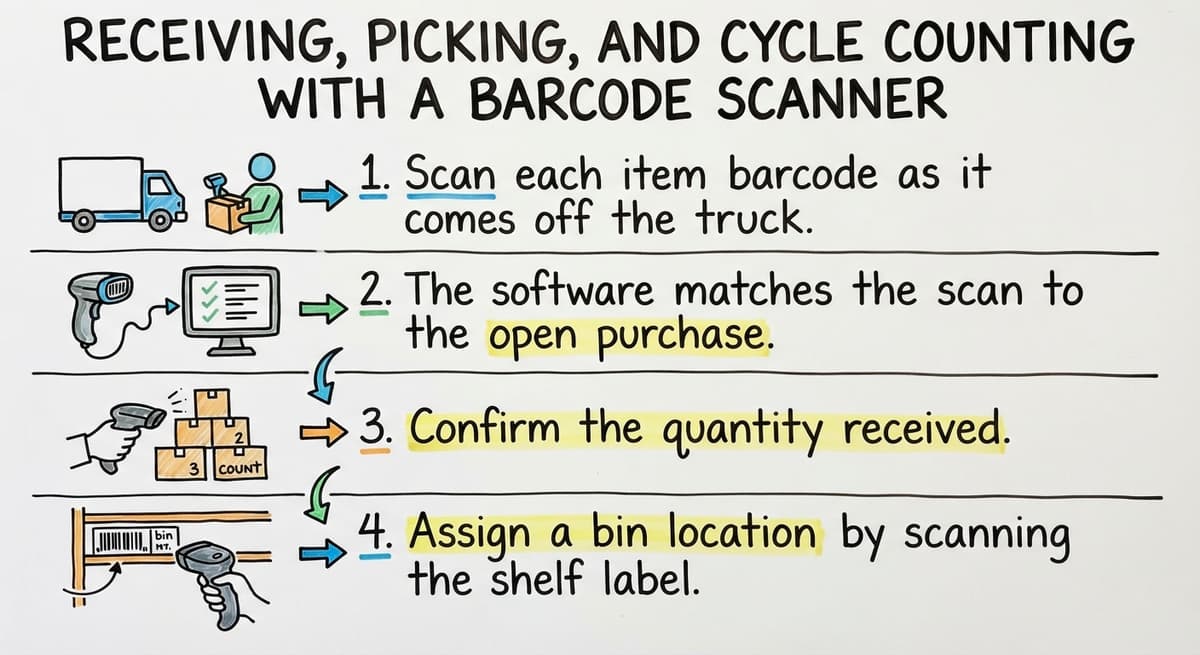
When a delivery arrives, the receiving workflow runs like this:
- Scan each item barcode as it comes off the truck.
- The software matches the scan to the open buy order.
- Confirm the quantity received.
- Assign a bin location by scanning the shelf label.
If the quantity does not match the buy order, the software flags the gap at once. No paper receiving log, no keying errors.
For outbound orders, the software generates a pick list and sends it to the scanner. The picker scans each item to confirm the right product was pulled. A packing scan then checks the completed order before it ships. Scan-to-confirm picking removes the single biggest cause of wrong shipments: pulling by memory.
The US Federal Trade Commission needs businesses to ship orders when promised, and an accurate stock count is what makes that possible. See the FTC's order merchandise rule for the full obligation.
The comparison is easier when one option is built for you
Off-the-shelf means fitting your process to the software. We do it the other way round, and the first look costs nothing.
Book a callCycle Counting
Cycle counting means counting a portion of your inventory on a rolling schedule rather than shutting down for a full physical count once a year. The software assigns count tasks to specific zones or bins. A worker scans each item in the assigned area, and the software records the result against the expected quantity.
A full physical count can take days and halt operations. Cycle counting keeps accuracy high without stopping the warehouse. Consistent cycle counts also satisfy the IRS requirement that inventory be valued at the start and end of each tax year, as stated in IRS Publication 538: "To figure taxable income, you must value your inventory at the beginning and end of each tax year."

Can Barcode Inventory Software Work Alongside QuickBooks?
Yes, and for most small distributors, that is exactly how it should work. QuickBooks handles your accounting. Barcode inventory management software handles the warehouse floor. The 2 systems connect so that stock counts and item costs flow into QuickBooks records without manual entry.
You do not need to migrate away from QuickBooks. QuickBooks integration for distributors means your books stay current every time a scan happens, not just at month end when someone reconciles a spreadsheet.
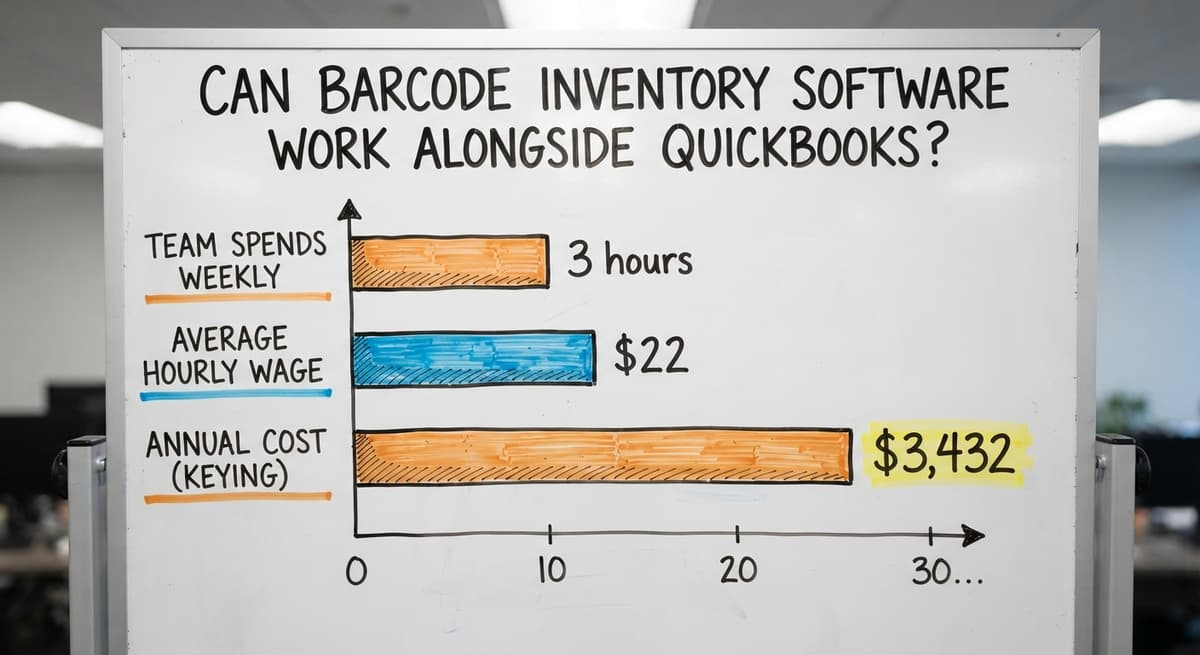
If your team spends 3 hours a week keying inventory updates into QuickBooks at an average wage of $22 an hour (see BLS wage data for stock clerks), that is $3,432 a year in labor for a task a sync can handle in seconds.

Why Spreadsheets Break Down and What Hardware You Actually Need
Why Spreadsheets Break Down
Spreadsheets cannot receive a scan directly. Someone still has to read the scanner screen and type the number in. That manual step is where errors enter. Add 2 people updating the same file from different devices, and version control collapses fast. A spreadsheet has no real-time view of the warehouse floor, which means every decision is based on yesterday's data at best.
Purpose-built barcode tracking software solves this by writing every scan to a single shared record the moment it happens.
Hardware You Need to Start
The basic kit for a small warehouse is modest:
- A barcode scanner: dedicated handheld units are faster and more durable; a smartphone with a scanning app works for lower volumes
- A label printer: thermal printers produce durable labels without ink costs
- Labels: use manufacturer barcodes where they exist; print your own for internal items, bin locations, and anything without a standard label
Consistent label placement matters as much as the hardware. Labels should face outward, sit on a flat surface, and survive the environment they live in. The whole system is only as reliable as the label it reads.
Serial Numbers, Lot Tracking, and Location Visibility
Serial number tracking assigns 1 unique barcode to 1 unit. Lot tracking assigns 1 barcode to a batch of identical units made at the same time. Electronics and high-value equipment usually need serial tracking. Food, pharmaceuticals, and chemicals usually need lot tracking for recall purposes.
Location barcodes work the same way. Each bin, aisle, and zone gets its own label. Scanning a location barcode ties an item to a specific spot in the warehouse. The software builds a map of where every item lives, which cuts picking time and reduces lost stock.
Cloud-connected warehouse barcode systems show stock levels across multiple sites in real time. A manager can check what is on hand at any location without walking the floor, which matters when making a purchasing call or promising a delivery date. Visibility across sites is what turns a reactive operation into a planned one.
See it running on your own process first
No build cost. The subscription starts once it is live and doing the job, not before.
Book a call
What Problems Does Barcode Inventory Software Actually Solve?
The most common pain points barcode scanning fixes directly are:
- Overselling out-of-stock items because the software updates the count the moment a pick is confirmed, not at end of day
- Losing track of items moved between locations because every transfer needs a scan at the origin and destination
- Hours spent reconciling paper receiving logs because the scan creates the record at the moment of receipt
- Shipping the wrong item because scan-to-confirm picking checks the barcode before the box closes
If any of these sound familiar, your operation is likely ready. Other clear signs: stock counts are wrong more than once a month, receiving takes more than a few minutes per line item, or staff spend time updating spreadsheets instead of moving product.
Custom vs. Off-the-Shelf, and What Implementation Looks Like
Off-the-shelf barcode inventory software is built for a generic operation. Your team adapts to it. Custom inventory software for small warehouses is built around how your operation already works. That does not always mean expensive or slow. A focused build that covers receiving, picking, and cycle counting can deploy in weeks, not months.
The NIST Manufacturing Extension Partnership recommends starting with a clear picture of your current workflow before choosing any tool. That is good advice whether you buy off the shelf or build custom.
A typical rollout runs through these steps:
- Review the current workflow and find the highest-cost manual steps.
- Set up item records and assign SKUs or item IDs.
- Print and apply labels to items, bins, and locations.
- Configure scanners and connect them to the software.
- Train staff, usually in a single shift.
Most warehouse staff learn barcode scanning in one shift. The software can enforce correct scan sequences so workers cannot skip a step by accident. Adoption is almost always faster than operations managers expect.
Reports and alerts come with the territory. Useful ones include stock on hand by location, movement history, low-stock alerts, and receiving accuracy by supplier. Alerts notify managers when stock falls below a set level. Every scan creates an audit trail, which supports purchasing decisions and removes the need for emergency orders.
Getting Started with Barcode Inventory Software
The path from manual tracking to a working barcode inventory management system starts with a workflow review, not a software buy. Know where the manual steps cost the most time and money. Then find a system that fits those gaps rather than one that forces you to change everything at once.
The right inventory software barcode setup fits your operation. It connects to QuickBooks without replacing it, runs on hardware you can afford, and gives your team a system they can learn in a day.
If you want to talk through what that looks like for your specific workflow, reach out to a local rollout partner who builds around how you already work, not around a vendor's default settings.
Frequently asked questions
What is the best app for inventory barcodes?
There is no single best app. The right choice depends on your order volume, whether you need QuickBooks integration, and how many locations you manage. For small warehouses, options like Fishbowl, inFlow, and Sortly are commonly used. For operations that need a system built around their specific workflow, a custom build often fits better than adapting to an off-the-shelf product. Start by listing your 3 biggest manual pain points, then evaluate tools against those.
How to create a barcode system for inventory?
Start by assigning a unique item ID or SKU to every product you stock. Print barcode labels for each item and for every bin and shelf location in your warehouse. Connect a barcode scanner to your inventory software. Then define the scan events you need: receiving, picking, transfers, and cycle counts. Most small warehouses can have a working system in place within 1 to 2 weeks.
How much does a barcode inventory system cost?
A basic setup for a small warehouse usually runs $500 to $2,000 for hardware (scanner, label printer, labels) and $50 to $300 per month for software, depending on features and number of users. Custom-built systems vary more widely based on scope. Compare that cost against the labor your team currently spends on manual counts and spreadsheet updates. For many operations, the system pays for itself within the first year.
Which barcode scanner is best for inventory management?
Dedicated handheld scanners from brands like Zebra and Honeywell are the standard choice for warehouses because they are durable, fast, and designed for all-day use. Smartphone-based scanning works for lower volumes and cuts hardware cost. The best scanner is the one that reads your barcode format reliably in your environment. If your labels are in tight spaces or low light, a dedicated unit with a laser or imager will outperform a phone camera.
Can barcode inventory software connect to QuickBooks without replacing it?
Yes. Barcode inventory management software is designed to sit alongside QuickBooks, not replace it. Stock counts, item costs, and buy order data sync between the two systems. Your accounting stays in QuickBooks. The warehouse floor runs through the barcode software. Most integrations are set up once and run automatically after that.
What is the difference between serial number tracking and lot tracking?
Serial number tracking assigns one unique barcode to one unit. It is used for high-value or regulated items where you need to know the history of each individual piece. Lot tracking assigns one barcode to a batch of identical units produced at the same time. It is used for food, pharmaceuticals, and chemicals where a recall needs to cover a whole production run. Your inventory software records and retrieves both types of history.
How long does it take to implement a barcode inventory system?
A focused rollout for a small to mid-size warehouse usually takes 2 to 6 weeks from workflow review to live scanning. The main steps are item setup, label printing, scanner setup, and staff training. Training usually takes a single shift. Custom builds may take longer depending on the number of integrations, but they do not need months of disruption if the scope is defined clearly at the start.
What reports does barcode inventory software provide?
Most barcode tracking software includes stock on hand by location, item movement history, receiving accuracy by supplier, and low-stock alerts. Alerts notify the right person when a product falls below a set quantity. Every scan creates a timestamped record, so you have a full audit trail for every inventory movement. These reports support purchasing decisions and reduce the need for reactive emergency orders.
Start with a free first look
A 30 minute call, your operation mapped, and a clear picture of what we would build. No obligation and nothing to install.
Book a callRelated guides
The rest of this guide, for the parts of the job this page does not cover.
Guides
- Inventory Management Software Barcode Scanner
- Inventory Management Software with Barcode
- Free Inventory Management Software with Barcode Scanner
- Barcode Scanner Inventory System
- Barcode System for Inventory Free
- Rfid Inventory Software
- Barcode Abbreviation
- 2d Barcode Readers
- Barcode Systems for Warehouse
- Barcode Reader Description
- Barcodes and Labels
- Alphanumeric Barcode
- Lpn Barcodes
- Imager Barcode Scanner
- 2d Wireless Barcode Scanner
- System Id Barcode Solutions
- 2d Imaging Barcode Scanners
- Quickbooks Barcode Reader
- Excel Barcode
- 2d Imager Barcode Scanner
- 2d Usb Barcode Scanner