

Rfid Inventory Software
RFID inventory software tracks stock automatically using radio-frequency spotting tags that broadcast their location without being scanned one at a time. It updates counts in real time, flags missing items, and connects to tools like QuickBooks. This guide covers how it works, what it costs, and when it makes sense for a small distributor. Reviewed and updated: June 2025.
Book a callWhat Is RFID Inventory Software
RFID stands for radio-frequency spotting. An RFID tag is a small chip attached to a product or pallet. It broadcasts a signal that a reader picks up automatically, no line of sight needed. RFID inventory software collects those signals and turns them into stock counts, location data, and movement logs.
Reviewed September 2026. Figures are worked from the assumptions stated beside them, so you can substitute your own and the arithmetic still holds.
In a warehouse, this means a pallet rolling through a dock door gets logged without anyone touching a scanner. Items on a shelf update their count as they move. The software does the work that a person used to do by hand.
The IRS is clear on why this matters: "To figure taxable income, you must value your inventory at the beginning and end of each tax year," per IRS Publication 538. Accurate counts are a legal need, not just a convenience.
We build it for your operation, and the first look is free
If you would rather not compare products, describe how your operation already works and we build the system around it.
No build cost. You see it running on your own process first, and the monthly subscription starts only once it is live.
Book a callHow RFID Tags and Readers Work Together
Every RFID system has 3 parts: a tag on the item, an antenna that carries the signal, and a reader that collects it. Think of it like a library self-checkout kiosk. You hold the book near the pad and it registers instantly, no barcode flip required. As GS1 notes in its barcode and RFID standards, "RFID technology enables automatic spotting of objects using radio waves," and a single reader can capture dozens of tags at once without physical contact. That bulk read is what separates RFID from every barcode workflow.
Passive vs Active RFID Tags: Which Type Fits Your Operation
Passive RFID tags carry no battery. The reader sends out a radio wave, the tag absorbs a tiny bit of that energy, and uses it to send back its ID. Passive tags cost a few cents to under a dollar each. They work well at receiving docks and in defined shelf zones. Active RFID tags carry their own battery and broadcast continuously. Read range can stretch past 100 feet. They cost more per tag but suit high-value equipment or large outdoor yards where a passive signal would not reach.
Is RFID Better Than Barcode Scanning for My Warehouse?
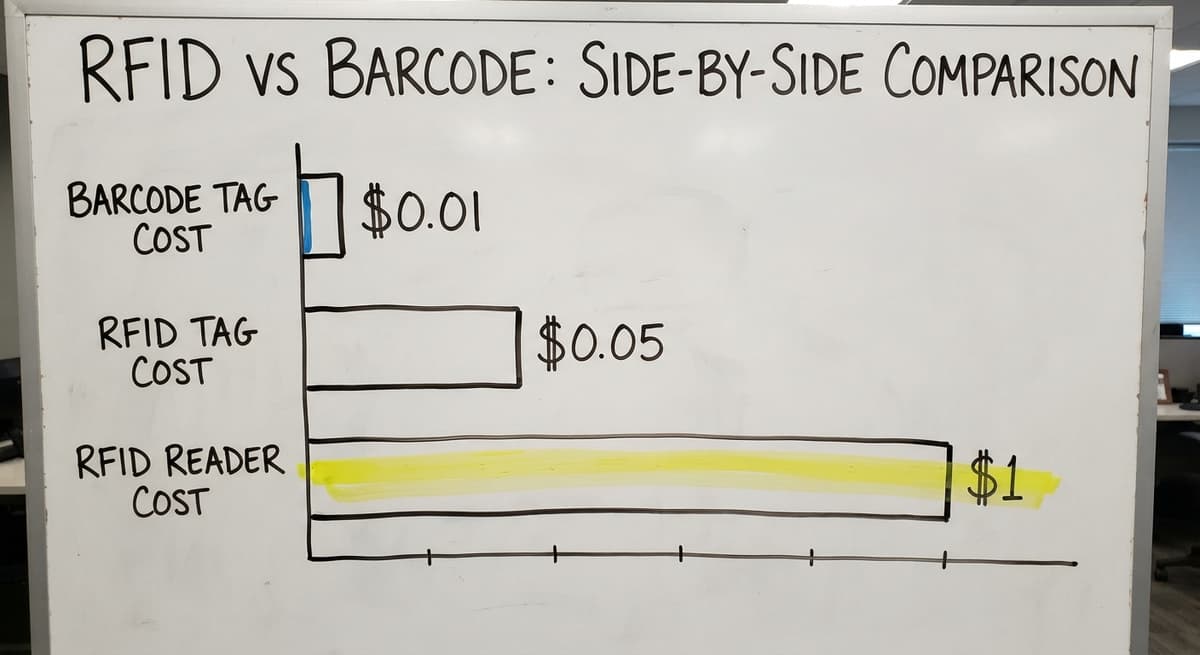
For most mid-volume distributors, RFID cuts labor time faster than barcodes can. A barcode needs line of sight and reads one item at a time. An RFID reader captures a full pallet in seconds without anyone pointing a gun at each label. The trade-off is upfront tag cost. Barcodes print for fractions of a cent. RFID tags start at a few cents and rise from there. For a low-SKU operation where staff scan correctly and errors are rare, barcodes may still be the right tool.
RFID vs Barcode: Side-by-Side Comparison
The table below shows where each system fits:
| Factor | Barcode | RFID |
|---|---|---|
| Line of sight needed | Yes | No |
| Items read at once | 1 | Dozens |
| Tag cost | Under $0.01 | $0.05 to $1.00+ |
| Labor cost over time | Higher | Lower |
| Best fit | Low volume, low error rate | High volume, fast-moving stock |
A hybrid approach, RFID at the dock and barcodes in low-traffic aisles, often delivers the best return for a growing distributor.
When Barcode Scanning Still Makes More Sense
Barcode scanning wins when SKU counts are low and items move slowly. If a team of 3 scans 50 items a day with no errors, adding RFID hardware and tags costs more than the problem it solves.
Barcodes are also simpler to keep. Labels print on demand. A damaged label gets reprinted in seconds. RFID tags can be harder to replace on certain surfaces, like metal or liquid containers, where the radio signal reflects or absorbs poorly.
Start with barcodes if your current error rate is near zero. Add RFID at the points where volume or speed creates the most friction.
The comparison is easier when one option is built for you
Off-the-shelf means fitting your process to the software. We do it the other way round, and the first look costs nothing.
Book a callCore Features to Look for in RFID Inventory Software
Not all RFID inventory software is built the same. The features below separate a tool that saves time from one that adds complexity.
- Real-time location tracking shows where each item or pallet sits, down to the bin or zone, without a manual check.
- Automatic stock updates adjust counts the moment an item moves through a reader, so the number in the system matches the floor.
- Receiving and shipping confirmation logs inbound and outbound freight against buy orders without manual entry.
- Alerts for low stock or wrong-zone items catch problems before they become customer complaints.
- Movement history by SKU gives a full audit trail that supports cycle count audits and shrinkage investigations.
- QuickBooks or accounting tool sync pushes updated counts and costs back to the financial system the team already uses.

Why Simpler RFID Software Outperforms Feature-Heavy Platforms
The right software does fewer things well rather than many things poorly. A small distributor does not need a feature built for a 500-person DC. Platforms loaded with modules for cross-docking, multi-site merging, and carrier bidding add screens, training time, and licensing cost that a growing operation will never recover. A focused build around the features listed above covers the real pain points without the overhead.
Can RFID Inventory Software Connect to QuickBooks?
Yes, and the connection is simpler than most vendors suggest. QuickBooks handles financials well but has no native RFID support. The job of RFID inventory software is to feed QuickBooks accurate numbers, not replace it. Most connections work one of 2 ways. An API pushes data automatically on a schedule or when a count changes. A flat-file export drops a CSV that QuickBooks imports on demand. Both methods keep QuickBooks as the financial record while the RFID layer handles the physical count.
Avoiding a Full ERP Migration When Adding RFID
The goal is to avoid a full ERP migration. A custom-built system can be designed around the QuickBooks fields the team already uses, so no one has to learn a new financial tool. QuickBooks Inventory Integration works best when the RFID software treats it as the destination, not the competition. The US Federal Trade Commission needs sellers to ship when promised. An accurate, real-time count is what makes that promise keepable.

What Problems Does RFID Inventory Software Actually Solve?
The biggest wins show up in 4 places that drain time and money in most small warehouses. Cycle counts that used to take a full day drop to under an hour. A staff member walks the floor with a handheld reader or fixed readers capture the count automatically overnight. Inventory cycle count software built on RFID turns a disruptive event into a routine background task. Receiving errors caused by manual entry disappear. When a pallet rolls through the dock door, the reader logs every tag against the buy order. Discrepancies show up at once rather than at month-end.
See it running on your own process first
No build cost. The subscription starts once it is live and doing the job, not before.
Book a callThe Real Cost of Manual Inventory Work
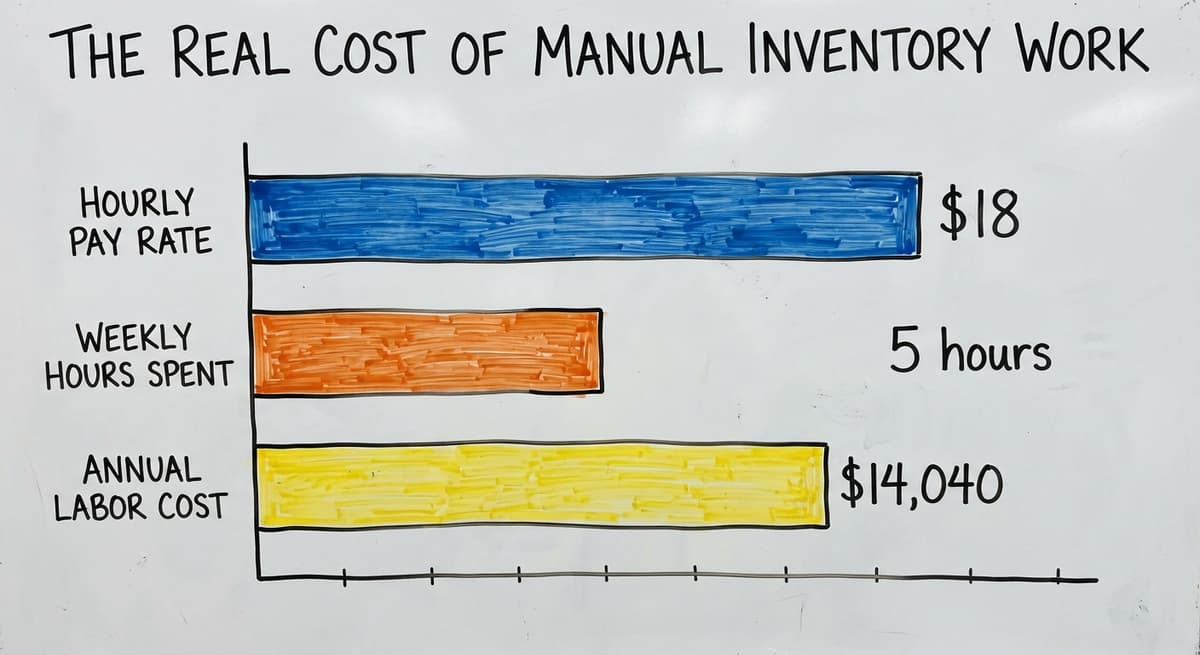
Shrinkage becomes easier to trace. Every movement is logged with a timestamp. When an item goes missing, the last known location is in the system. Staff stop spending shifts searching for misplaced stock. The Bureau of Labor Statistics puts median pay for stock clerks and order fillers at around $18 per hour. Three people spending 5 hours a week on manual counts and searches costs roughly $14,040 a year. RFID can recover most of that.
Is RFID Inventory Software Right for a Small Warehouse
RFID was once an enterprise-only tool. That has changed. Tag costs have dropped far enough that operations with 5 to 100 staff can see a real return. The right fit depends on 3 factors: item volume, item value, and current error rate. A distributor moving 10,000 units a week with a 2% receiving error rate is a strong candidate. A shop moving 500 units a week with clean records may not be. The NIST Manufacturing Extension Partnership offers vendor-neutral guidance on supply chain process review, which is a useful starting point before any software conversation.

How to Scale RFID Without Overbuilding on Day One
Small warehouse software built on RFID does not need to cover every corner of the facility on day one. Start with the dock door. Add aisle readers later. A custom inventory software build scales to exactly what the operation needs without charging for features that never get used. RFID is not always the answer, but for a distributor with real volume and real errors, it pays back faster than most expect.
RFID in Receiving, Picking, and Outbound Shipping
The receiving dock is where RFID delivers its clearest win. Fixed readers at the dock door log an entire pallet in seconds. The software matches the tag data to the open buy order and flags any gap. Staff focus on moving freight, not counting boxes.
In picking, confirmation happens as items pass a reader rather than at a dedicated scan station. The pick list updates automatically. A wrong item triggers an alert before it reaches the outbound door.
At shipping, the manifest builds itself from tag reads as items leave the building. Wrong quantities are caught before the truck pulls out, not after a customer calls. Customer accuracy improves without adding headcount.
The US Census Bureau's Monthly Wholesale Trade data shows that wholesale inventories-to-sales ratios remain tight. Distributors carrying lean stock cannot afford receiving or shipping errors that create phantom inventory.
Not sure this is the right shape for your operation
Describe how the work runs today. We map it on a call and show you what it would look like built around that, before you spend anything.
Book a callWhat Does a Custom RFID Software Build Look Like?
A well-built system starts with a process map of how the operation runs today, not how a vendor thinks it should run. The first question is: where do errors happen, and how much do they cost? From there, reader placement follows the pain points. A dock with frequent receiving errors gets a fixed reader first. A high-value zone with shrinkage gets a reader next. The tag strategy matches the items: passive UHF tags for most warehouse goods, active tags for equipment that moves across a large yard.

How Long a Custom RFID Build Takes to Implement
Custom inventory software for distributors connects the output to existing tools from day one. QuickBooks gets updated counts. The existing order system gets shipping confirmations. No one has to log into a new portal to find a number they used to find in a spreadsheet. Rollout for a small operation usually runs 4 to 12 weeks, with hardware installation and tag application taking the most time. Software setup runs in parallel. Training is short when the software mirrors the way the team already works.
How to Calculate ROI on RFID Inventory Software
Start with what the current process costs. Count the labor hours spent on cycle counts, receiving checks, and error correction each week. Multiply by the hourly rate. Add the estimated annual shrinkage loss from the last audit.
For example: 3 staff spending 6 hours a week on manual inventory tasks at $20 an hour is $18,720 a year. Add $15,000 in annual shrinkage. That is $33,720 in recoverable cost.
Compare that against the tag, reader, and software investment. A small dock setup with handheld readers and passive tags might run $8,000 to $20,000 to start. Most small distributors see payback within 12 to 24 months when the baseline cost is measured honestly before the proposal is signed.
Hardware Requirements for RFID Inventory Software
The hardware side has 3 main components. Fixed readers mount at dock doors, aisle entry points, or zone boundaries. They capture tags automatically as items pass. Handheld readers let staff do spot checks anywhere in the facility without waiting for a fixed reader to log the move.
Tags must match the frequency the readers use. UHF (ultra-high frequency) is the standard for warehouse use because of its read range and bulk-read ability. HF tags work at shorter range and suit item-level tracking in retail or pharmacy settings.
Software must either be built to work with the specific hardware brand or designed to be hardware-agnostic. A hardware-agnostic build gives the operation flexibility to swap readers without rebuilding the software layer. That matters when a reader vendor changes pricing or discontinues a model.
Questions to Ask Before Choosing RFID Inventory Software
The right questions cut through vendor noise fast. Ask these before any proposal is discussed.
- Does it connect to QuickBooks or the current accounting tool without a custom build on your side?
- Who supports it when something breaks, the vendor, a local team, or a helpdesk in another time zone?
- Can the software be adjusted as the operation grows without a full rebuild?
- Is pricing based on users, item count, or a flat fee? Item-count pricing punishes growth.
- Can the vendor walk through how the software fits your specific dock and pick workflow, not a generic demo?
What Are the Red Flags in an RFID Software Proposal?
A weak proposal shows its problems early. Watch for these signs before signing anything.
- Long timelines with no clear milestones signal a vendor who has not scoped the job properly.
- Any proposal that needs replacing QuickBooks or another working tool is adding cost, not reducing it.
- Pricing that scales with item count means the software gets more expensive as the business grows, which is the wrong direction.
- A vendor who cannot explain how the software fits your workflow has not looked at it. A process review should come before any price.

Next Steps for Distributors Considering RFID Inventory Software
Three steps move the decision from idea to action without wasting time on the wrong vendor.
First, map the 3 biggest manual pain points in the current inventory process. Write down where errors happen, how long counts take, and what shrinkage cost last year. These numbers drive the ROI case.
Second, get a read on current error rates at receiving and shipping. A warehouse running clean may not need RFID yet. One with a consistent 1 to 3% error rate almost certainly does.
Third, talk to a software team that has built for operations your size. Ask for a process review before any proposal or price is discussed. The right partner asks about your workflow before they mention their product.
Frequently asked questions
Can RFID be used to track inventory?
Yes. RFID tags attach to items, pallets, or bins and broadcast their identity to readers placed around the facility. The software collects those reads and updates stock counts, locations, and movement logs automatically. No manual scan is needed for each item. This makes RFID well suited to receiving docks, high-volume pick zones, and any area where counting by hand takes too long or produces too many errors.
How much does an RFID inventory system cost?
A small dock setup with fixed readers, a handheld unit, and software usually runs between $8,000 and $25,000 to start, depending on facility size and tag volume. Passive UHF tags cost a few cents to under a dollar each. Active tags for high-value assets cost more. Custom software built for a specific operation often costs less over time than a licensed SaaS platform because you are not paying for features the operation never uses. Most small distributors see payback within 12 to 24 months when baseline labor and shrinkage costs are measured before the project starts.
What are the top 5 inventory management software?
There is no single correct list because the right tool depends on operation size, existing systems, and workflow. Commonly cited platforms include Fishbowl, inFlow, Cin7, Extensiv (formerly 3PL Central), and NetSuite. Each has strengths for specific business types. A small distributor running QuickBooks may find that a custom-built RFID layer connected to QuickBooks outperforms any off-the-shelf platform because it fits the existing workflow rather than forcing a process change. The best starting point is a process review before any software is evaluated.
Can you program your own RFID?
Yes, within limits. Most UHF RFID tags are writeable, meaning you can encode a custom ID, SKU, or serial number using a compatible reader and encoding software. Many operations encode tags at the point of receiving so the tag ID matches the internal item number. Programming the tag itself is straightforward. The harder work is building the software that collects those reads, matches them to orders, and pushes the data to QuickBooks or another system. That layer is where most operations need outside help.
Is RFID inventory software affordable for small warehouses?
It is more affordable than it was five years ago. Tag costs have dropped, and reader hardware has a wider price range than it once did. A small operation does not need to cover every square foot on day one. Starting with a single dock door reader and a handheld unit keeps the entry cost low while proving the ROI before expanding. A custom build scoped to the actual operation avoids paying for enterprise features that never get used.
What hardware do I need to run RFID inventory software?
Most warehouse setups need fixed UHF readers at dock doors or zone boundaries, at least one handheld reader for spot checks, UHF passive tags matched to the items being tracked, and a network connection for the readers to send data to the software. The software should either support the specific hardware brand or be built to be hardware-agnostic so the operation is not locked to one vendor's equipment roadmap.
How long does it take to implement RFID inventory software?
Most small distribution operations go live in 4 to 12 weeks. Hardware installation and tag application take the most time. Software setup runs in parallel with hardware setup rather than after it. Training is short when the software is built around the way the team already works rather than requiring a process change to match the software.
Can I add RFID to an operation that already uses barcodes?
Yes, and this is one of the most practical approaches for growing distributors. RFID layers on top of a barcode system without replacing it. High-volume or high-value zones get RFID readers and tags. Low-traffic areas keep barcodes. The two systems can feed the same inventory software, with RFID handling the bulk reads and barcodes covering the areas where the volume does not justify the tag cost.
Start with a free first look
A 30 minute call, your operation mapped, and a clear picture of what we would build. No obligation and nothing to install.
Book a callRelated guides
The rest of this guide, for the parts of the job this page does not cover.
Guides
- Inventory Management Software Barcode Scanner
- Inventory Management Software with Barcode
- Free Inventory Management Software with Barcode Scanner
- Warehouse Inventory Management Software
- Warehouse Inventory Tracking Software
- Quickbooks Inventory Management Software
- Inventory and Warehouse Management Software
- Custom Inventory Management Software
- Warehouse Inventory Software Programs
- Manufacturing Inventory Management Software
- Cost of Inventory Management Software
- Inventory Software Warehouse
- Inventory Management Software Freeware
- Inventory Tracking Software for Small Business
- Accounting and Inventory Software for Small Business
- Inventory Control Software for Small Business
- Best Inventory Management Software for Small Businesses
- Inventory Sales Software Small Business
- Free Inventory Management Software for Small Business
- Manufacturing Inventory Software
- Barcode Scanner Inventory System
- Barcode System for Inventory Free
- Quickbooks Inventory Scanner