


What Are Serial Numbers
A serial number is a unique code assigned to one specific physical item. No 2 items from the same maker share the same serial number. It works like a fingerprint for a product. Warehouses use serial numbers to track exactly which unit was received, stored, and shipped. This page was reviewed in July 2025.
Published 12 July 2026. Reviewed and updated 15 September 2026.
Book a callThe Simple Definition of a Serial Number
A serial number is a unique identifier tied to one single item, not a product type.
Every unit that rolls off a production line gets its own code. That code can be digits, letters, or a mix. No other unit from that maker carries the same one.
Reviewed September 2026. Each figure comes from the assumptions stated beside it, so you can substitute your own and the arithmetic still holds.
Think of it this way. A warehouse might hold 200 identical power drills. The model number is the same on all 200 boxes.
The serial number is different on every single drill inside those boxes. One number tells you what the product is. The other tells you which one it is.
Would you rather have it built around your operation?
The first look is free. If you would rather not compare products, describe how your operation already works and we build the system around it.
No build cost. You see it running on your own process first, and the monthly subscription starts only once it is live.
Book a callSerial Numbers vs. Model Numbers: What Is the Difference
A model number names a product type. A serial number names one specific unit of that type. Every 65-inch TV of a given model shares 1 model number. Each TV has its own serial number printed on the back.
For distributors, mixing these up causes real damage. Receiving staff who log a model number instead of a serial number lose the ability to trace that unit. Warranty disputes become guesswork. Recall notices become impossible to act on with precision.
The IRS makes inventory tracking a legal matter, not just a preference.
As IRS Publication 538 states, "To figure taxable income, you must value your inventory at the beginning and end of each tax year." Knowing which specific units you hold, not just how many, is the foundation of that valuation for serial-tracked goods.
Why Does the Distinction Matter in Receiving?
When a shipment arrives, staff need to scan or enter the serial number on each unit, not the model number from the box.
A model number tells the system what arrived. The serial number tells it which one arrived. Both are needed. Only 1 is unique to that item.
Are Serial Numbers the Same as Barcodes?
No, a serial number and a barcode are not the same thing. A serial number is the data. A barcode is a way to store and display that data so a scanner can read it fast.
One barcode label can hold a serial number, a lot number (a code for the production run), and other details all at once.
The scanner reads the barcode and pulls out each piece of data in under a second. Without a barcode, staff type the serial number by hand, which is slower and creates more errors.
A barcode inventory management system uses barcodes to capture serial numbers at each step: receiving, put-away, picking, and shipping. The serial number is what gets stored in the system. The barcode is just the delivery method.
Where Do Serial Numbers Come From?
Manufacturers assign serial numbers during production. The format follows rules set by the maker or by the industry. Electronics makers embed the production date and factory code into the number itself. Medical device makers follow strict rules set by regulators.
Distributors sometimes assign their own internal serial numbers on top of the manufacturer's number. This happens when a product arrives without a readable code or when the internal system needs its own reference.
The manufacturer's serial number stays the source of truth for warranty and recall purposes, even when an internal number exists alongside it.
Some industries, including medical devices and defense, need serial number formats approved by standards bodies. Others leave the format entirely to the maker.

What Information Does a Serial Number Hold?
Some serial numbers are purely sequential: unit 1, unit 2, unit 3. They carry no embedded meaning. Others use a structured format where each segment means something specific.
A 12-character serial number might break down like this: the first 4 characters name the factory, the next 4 encode the production date, and the last 4 are a sequence number.
Trained staff can read the format at a glance and know when and where a unit was made without opening any software.
The meaning depends entirely on how the maker designed the system. Two products sitting side by side can use completely different formats. When a new product line arrives, it helps to ask the supplier what each segment of the serial number means.
Is the comparison easier when one option is built for you?
Yes. Off-the-shelf means fitting your process to the software, and custom is the other way round. The first look costs nothing.
Book a callWhy Do Serial Numbers Matter in a Warehouse or Distribution Center?
Serial number tracking tells you exactly which unit was received, where it was stored, who picked it, and which order it shipped on. Without that, you only know counts. You do not know identities.
This gap costs money in 3 specific ways:
- Warranty claims need proof that the specific unit in question passed through your facility. A count tells you nothing useful.
- Recalls need you to identify affected units fast. Without serial records, you pull all stock of a product, not just the bad batch.
- Customer disputes about whether the right item shipped are settled in seconds with a serial record, and in days without one.
High-value goods and regulated products almost always need serial tracking. For everything else, the question is whether the cost of a dispute or recall exceeds the cost of tracking. For most distributors handling goods above a few hundred dollars per unit, it does.
The Cost of Not Tracking
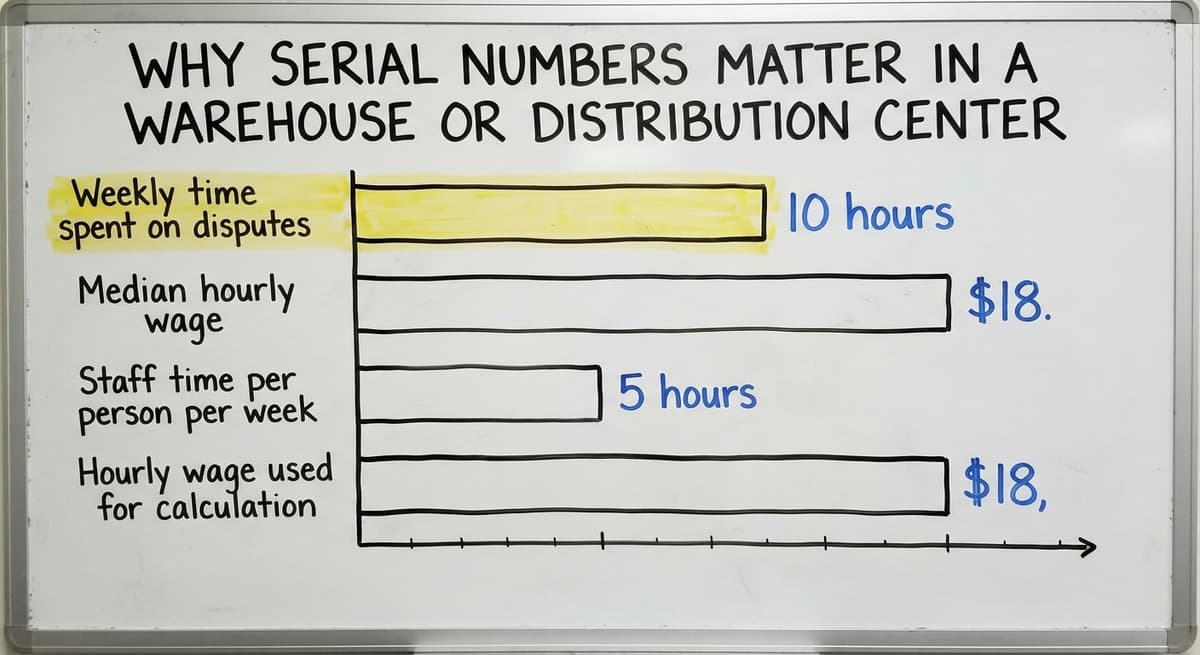
Consider 2 warehouse staff spending 5 hours a week each resolving serial-number disputes by digging through paper logs.
The Bureau of Labor Statistics puts the median hourly wage for stock clerks and order fillers near $18. That is 10 hours a week at $18, or roughly $9,360 a year, spent on a problem a serial tracking system would largely prevent.

How Serial Number Tracking Works in an Inventory System
The process follows the item through every stage of its time in the facility.
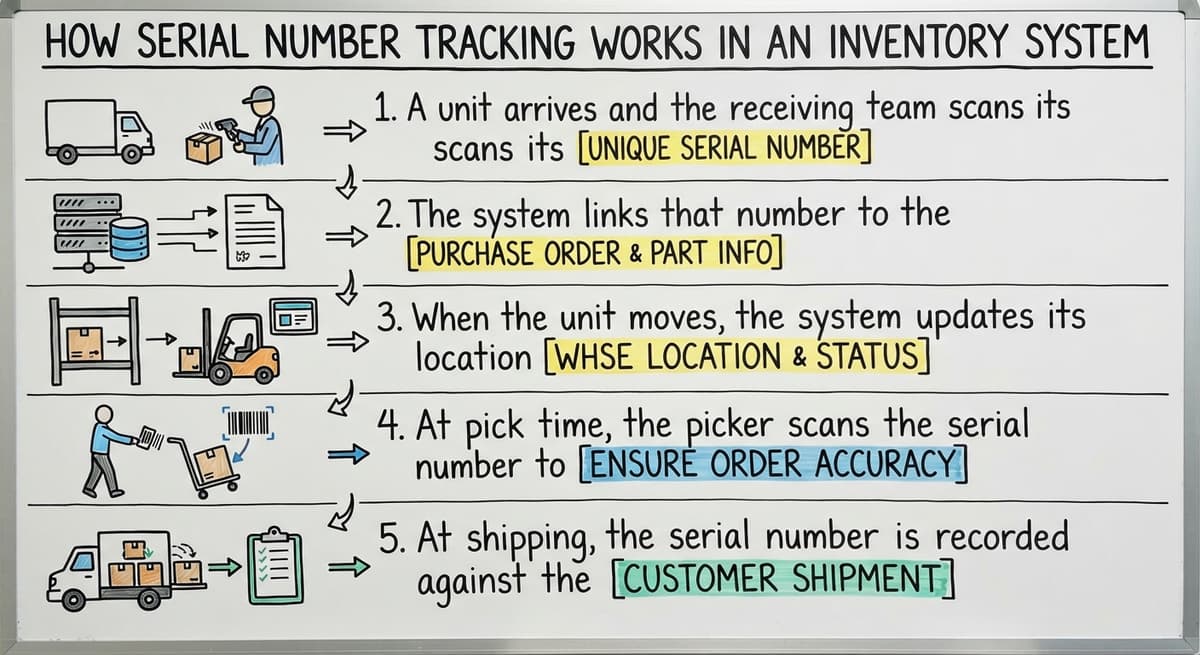
- A unit arrives and the receiving team scans its serial number.
- The system links that number to the buy order, the supplier, and the storage location.
- When the unit moves, the system updates its location.
- At pick time, the picker scans the serial number to confirm the right unit is leaving.
- At shipping, the serial number is recorded against the outbound order and the customer record.
The result is a full history for every unit, from the moment it arrived to the moment it left. Any serial number can be looked up in seconds. Staff can see where it is right now, where it has been, and which customer received it.
This replaces printed logs and spreadsheet tabs with a single searchable record. It also removes the manual entry step where most errors enter the system.
Which Products Usually Need Serial Number Tracking
Not every product needs this level of detail. The ones that do tend to share certain traits.
- Electronics and appliances carry serial numbers for warranty registration and repair tracking.
- Power tools and industrial equipment need serial records for service history.
- Medical devices are required by law to be tracked to the individual unit.
- High-value items where theft is a real risk benefit from serial records that prove chain of custody.
Any product where the manufacturer offers a warranty almost always carries a serial number. If the maker cares enough to issue one, the distributor should care enough to record it.
What does it look like running on your own process?
The first thing you see is it running on your own process, at no build cost. The subscription starts once it is live and doing the job, not before.
Book a call
How Do Serial Numbers Help During a Product Recall?
Serial numbers let you find exactly which units are affected by a recall, so you do not have to pull everything. A recall notice names a range of serial numbers or a specific production batch.
If your system holds serial records, you can run a search and know within minutes which units are on your shelves and which have already shipped to customers.
Without serial records, a recall forces you to treat every unit of that product as suspect. That means pulling all stock, contacting every customer who bought the product in the relevant period, and hoping none of the safe units get caught up in the process.
A barcode inventory system can flag a recalled serial number the moment a staff member scans it. The scanner alerts them before the unit moves any further. That one feature alone can prevent a recalled item from reaching a customer after the notice is issued.
The Difference Between Serial Number Tracking and Lot Tracking
Lot tracking and serial number tracking solve related but different problems. Understanding both helps you choose the right approach, or know when you need both.
Lot tracking groups every item made in the same production run under one lot number. If a problem appears in that run, you can pull everything with that lot number.
Food, pharmaceuticals, and chemicals almost always use lot tracking because the risk is batch-level contamination or a formulation error.
Serial tracking goes one level deeper. It identifies each individual unit within a lot. If lot number A1047 contains 500 units and only 12 of them have a defect, serial tracking lets you find those 12. Lot tracking alone means pulling all 500.
Electronics and equipment more often use serial tracking. Some operations, particularly in medical distribution, use both at the same time. The lot number captures the production run.
The serial number captures the individual unit. For more on choosing between these approaches, see lot tracking vs serial number tracking.

Can the accounting software Track Serial Numbers?
The accounting software has a basic serial number field in its inventory module, but it is not built for warehouse volume or multi-step tracking.
A distributor receiving 50 serialized units a day will quickly find that the accounting software records the serial number at sale but does not track it through receiving, storage, and movement in between.
Many distributors end up keeping a spreadsheet alongside the accounting software. One file for accounting, one file for serial records. The 2 fall out of sync. Duplicates appear. A unit gets shipped twice in the spreadsheet or not at all in the accounting software.
A custom inventory layer connected to the accounting software handles serial tracking at every stage without replacing the accounting system. The serial data lives in the inventory system.
The financial data flows into the accounting software as it always has. For more on this approach, see how to connect a barcode system to the accounting software.
How a Barcode Inventory System Handles Serial Numbers
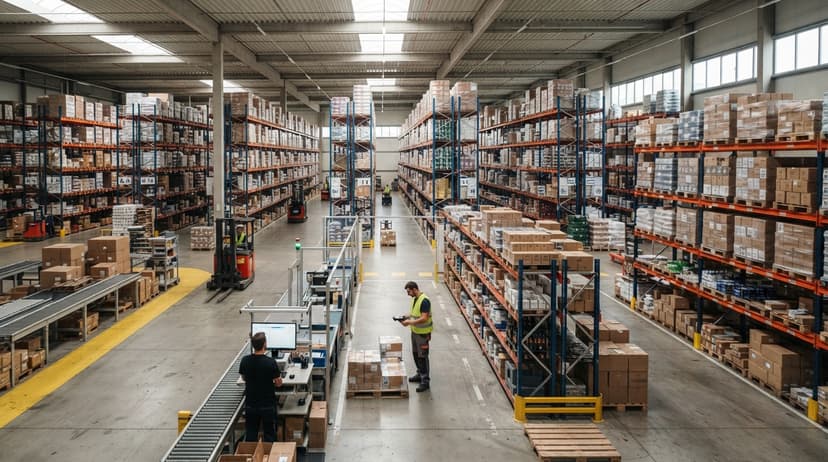
A barcode inventory system treats serial number capture as a built-in step at every stage of the workflow, not an afterthought.
At receiving, a scanner reads the barcode on each unit and the serial number is recorded automatically. No typing. No transcription errors. The system ties that number to the buy order, the supplier, and the put-away location before the box leaves the dock.
At pick and ship, the picker scans the unit. The system confirms it is the right item and records the serial number against the outbound order. If the wrong unit is scanned, the system flags it at once.
Staff can look up any serial number and see its full history in seconds. This replaces printed logs and spreadsheet tabs with one searchable record that anyone with access can use from any device on the floor.
For distributors in the Columbus area running on the accounting software, a custom system adds this layer without a full ERP switch. The warehouse gets real serial tracking.
The accounting team keeps the tools they already know. See warehouse inventory management for small distributors for more on how this works in practice.
Frequently Asked Questions
What are serial numbers used for? Serial numbers are used to identify one specific unit of a product. They support warranty claims, product recalls, theft recovery, and inventory tracking. A serial number lets you prove exactly which item passed through your hands and when.
What is a serial number example? A common example is the number printed on the back of a laptop or phone. It might look like SN-2024-0047-XB3.
Each segment can encode a factory code, a production date, and a sequence number. The exact format depends on the maker.
How do I find my serial number? For physical products, check the label on the bottom, back, or inside panel of the item.
For electronics, it is in the device settings under "About" or "Device Info." The original packaging and the receipt or invoice may also carry it.
What is a 10 digit serial number? A 10-digit serial number is simply a serial number that uses 10 characters. Some makers use all digits.
Others mix letters and numbers. The length and format are set by the manufacturer. There is no universal standard that needs 10 digits specifically.
Is a serial number the same as a barcode? No. A serial number is the unique identifier assigned to an item.
A barcode is a way to encode and display that number so a scanner can read it. The barcode holds the serial number. They are not the same thing.
How does lot tracking differ from serial number tracking? Lot tracking groups items from the same production run under one number.
Serial tracking identifies each unit individually. Lot tracking is common in food and pharma. Serial tracking is common in electronics and equipment. Some operations use both.
Frequently asked questions
What are serial numbers used for?
Serial numbers are used to identify one specific unit of a product. They support warranty claims, product recalls, theft recovery, and inventory tracking. A serial number lets you prove exactly which item passed through your hands and when.
What is a serial number example?
A common example is the number printed on the back of a laptop or phone. It might look like SN-2024-0047-XB3. Each segment can encode a factory code, a production date, and a sequence number. The exact format depends on the maker.
How do I find my serial number?
For physical products, check the label on the bottom, back, or inside panel of the item. For electronics, it is in the device settings under About or Device Info. The original packaging and the receipt or invoice may also carry it.
What is a 10 digit serial number?
A 10-digit serial number is a serial number that uses 10 characters. Some makers use all digits, others mix letters and numbers. The length and format are set by the manufacturer. There is no universal standard that needs 10 digits specifically.
Is a serial number the same as a barcode?
No. A serial number is the unique identifier assigned to an item. A barcode is a way to encode and display that number so a scanner can read it. The barcode holds the serial number. They are not the same thing.
How does lot tracking differ from serial number tracking?
Lot tracking groups items from the same production run under one number. Serial tracking identifies each unit individually. Lot tracking is common in food and pharmaceuticals. Serial tracking is common in electronics and equipment. Some operations use both at the same time.
Can the accounting software handle serial number tracking for a warehouse?
The accounting software has a basic serial number field but it is not built for warehouse volume. It records a serial number at the point of sale but does not track the unit through receiving, storage, and movement.
A custom inventory layer connected to the accounting software fills that gap without replacing the accounting system.
What is the difference between a model number and a serial number?
A model number names the product line and is shared by every unit of that design. A serial number is unique to one unit. Two identical printers share a model number and carry different serial numbers.
How can I find the serial number on an electronic device?
Look for a printed label on the back or underside, beside a barcode and marked S/N or Serial. Most devices also show it in the settings or about screen, and it appears on the original box and receipt.
What is in a free first look?
A 30 minute call, your operation mapped, and a clear picture of what we would build. No obligation and nothing to install.
Book a callRelated guides
The rest of this guide, for the parts of the job this page does not cover.
Guides
- Manufacturer's Serial Number
- Manufacturing Serial Number
- Serial Numbers on Products
- Serial Numbering
- Tracking Number Barcode
Common questions
- What is a Serial Number on a Product
- What Are Serial Numbers Used For
- Where Are Serial Numbers
- What Are the Numbers on a Barcode
- How to Read a Barcode Number
- What is Bin Number in Inventory Management
- What Does a Barcode Look Like
- What Do Barcode Scanners Scan
- What is E Inventory Management
- What is Roq in Inventory Management
- What is Barcoding in Inventory Management
- What is Online Inventory Management System
- What is Effective Inventory Management
- What is the Definition of Inventory Management
- What is Inventory Management Mary Kay
- What is Inventory Management Practices
- What is Fluctuation Stock in Inventory Management
- What is Abc Classification in Inventory Management
- What is the Purpose of Inventory in Operations Management