


What Is Inventory Management Practices
Inventory management practices are the repeatable methods a business uses to track, order, store, and move stock. They include cycle counting, reorder points, stock rotation, and receiving controls. Good practices reduce stockouts, cut waste, and keep orders shipping on time. This guide was reviewed in October 2026 and is written for operations managers and owners at small wholesale distributors who are currently running on spreadsheets and printed pick sheets.
Book a callWhat Inventory Management Practices Actually Mean
Inventory management practices are the how, not the what. They are the steps your team follows every day: how you count stock, when you place a buy order, how you rotate product on the shelf. Software is just the tool that helps you follow those steps consistently. A team using a spreadsheet can run solid inventory practices. A team using expensive software can still run poor ones. The practices come first. The tool supports them.
We build it for your operation, and the first look is free
If you would rather not compare products, describe how your operation already works and we build the system around it.
The obligation behind all of this is not optional. IRS Publication 538 states: “To figure taxable income, you must value your inventory at the beginning and end of each tax year.” A figure nobody trusts makes that number a guess.
No build cost. You see it running on your own process first, and the monthly subscription starts only once it is live.
Book a call
Why These Practices Matter for Distributors and Warehouses
Poor inventory practices carry a direct cost. Overstock ties up cash. Stockouts lose sales. Inaccurate counts send pickers to empty bin locations and slow every order that follows. Wholesale distributors and fulfillment centers feel this more sharply than retailers because margins are thinner and volume is higher. One wrong count can ripple across a dozen orders.
What Are the Core Inventory Management Practices?
The most widely used inventory management practices fall into 5 categories. Each one solves a specific problem in warehouse operations. Scan to the practice that matches the problem you are dealing with right now.

Accurate Stock Counting
Cycle counting means counting a small portion of your stock on a rotating schedule, rather than shutting down the warehouse for a full physical count once a year. An active warehouse might count 1 bin location per day, covering the whole facility over weeks or months. Full counts are disruptive and often inaccurate because staff rush them.
Cycle counting catches errors faster and with less disruption. The catch: counts only fix problems when the results go into a single source of truth. If 1 person updates a spreadsheet and another updates a whiteboard, the count means nothing. Every result needs to land in one place that the whole team reads from.
Reorder Point and Safety Stock
A reorder point is the stock level that triggers a new buy order. When a SKU drops to that number, someone buys more. The simple way to set one: multiply your average daily sales by your supplier lead time in days. Sell 20 units a day and your supplier takes 5 days to deliver, your reorder point is 100 units.
Safety stock is the buffer you hold on top of that. It covers a demand spike or a late delivery. A distributor holding 2 extra days of stock at 20 units a day keeps 40 units as safety stock. Setting these numbers is not complex math. It is knowing your sales rate and trusting your supplier data. Both numbers should live in your system, not in someone's head.
FIFO and FEFO Stock Rotation
FIFO means first in, first out: the oldest stock ships first. FEFO means first expired, first out: the stock with the earliest expiration date ships first, regardless of when it arrived. FIFO suits most general wholesale distribution. FEFO suits food, beverage, pharmaceuticals, and any product with a printed date.
Rotation rules only work when your receiving and picking processes enforce them every time. If receivers stack new product in front of old product because it is faster, FIFO breaks down at the dock before it ever reaches the shelf. Label placement, bin design, and team training all have to support the rule, not fight it.
The comparison is easier when one option is built for you
Off-the-shelf means fitting your process to the software. We do it the other way round, and the first look costs nothing.
Book a callABC Classification
ABC classification ranks every SKU by its contribution to revenue or how often it moves. A items are your top earners or fastest movers. They need tight controls, frequent counts, and prime bin locations close to the shipping dock. B items sit in the middle. C items move slowly and need lighter oversight.
This practice connects directly to labor. Counting every SKU with the same frequency wastes time on slow-moving products while high-value stock goes unchecked. Placing A items near the pick station cuts the distance your team walks per order. The NIST Manufacturing Extension Partnership supports this kind of process-based approach to supply chain efficiency as a vendor-neutral best practice.
Purchase Order and Receiving Controls
Inventory accuracy starts at the receiving dock, not on the shelf. When a delivery arrives, someone needs to count what came in and match it to the buy order before anything goes away. Quantity short? Note it. Wrong SKU? Flag it before it enters the system as correct stock.
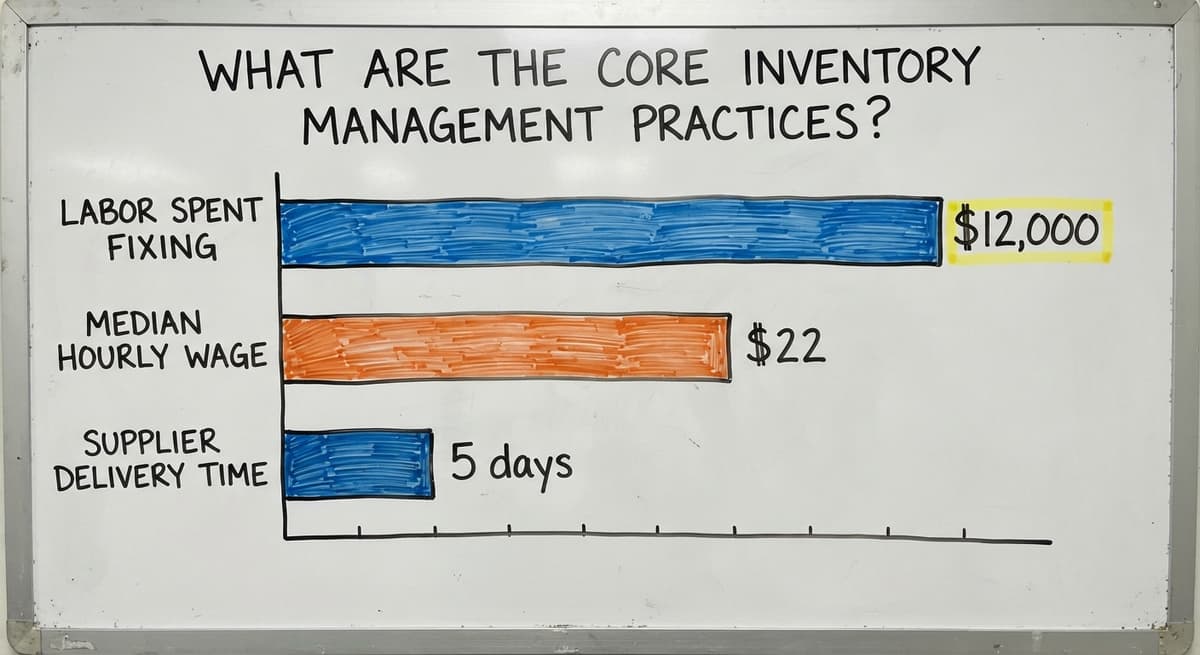
Errors caught at receiving cost almost nothing to fix. The supplier is still on the phone. The truck is still at the dock. Errors found during picking cost far more: a picker wastes time, an order is delayed, and a customer calls. Many small distributors skip the receiving check because it feels slow. Consider 3 receivers spending 30 minutes a day correcting downstream picking errors at a median wage of $22 an hour. That is roughly $12,000 a year in labor spent fixing what a 5-minute dock check would have caught.
When Manual Processes Stop Working
How do you know when spreadsheets are no longer enough? The signs are specific: count errors that appear weekly, staff spending 3 or more hours reconciling numbers that should match, and your accounting package showing stock levels that do not match the warehouse floor. These are not signs of lazy staff. They are signs that the volume has outgrown the tool.

The practices themselves do not change when a business scales. Cycle counting is still cycle counting. A reorder point is still a reorder point. What changes is whether a manual process can enforce those practices reliably at higher volume. Custom working software can automate the manual parts that break down, while keeping your existing accounting package in place. Inventory management software for wholesale distributors built around your actual workflow is easier to adopt than a system that forces you to change how you work. Replacing Excel and Access databases with purpose-built operations software does not mean starting over. It means giving your existing practices a tool that can keep up.
Putting Inventory Management Practices Into Action
Start with 1 broken practice. If receiving is the weak point, fix the receiving process before touching anything else. Document the steps, train the team, run it for 30 days, then measure whether errors dropped. Once the process is stable, decide what tool supports it best.

Software built around how your operation already works is faster to adopt and sticks longer than a system that rewrites your workflow from scratch. How custom software fits small and mid-size distribution operations is a question worth asking before committing to any platform. Good inventory practices are not just a cost-control measure. They are what lets a growing distributor take on more volume, more SKUs, and more customers without the wheels coming off. If your current setup is showing the strain, the right next step is a conversation about the process, not a software demo.
Frequently asked questions
How would you define inventory management?
Inventory management is the set of practices a business uses to track what stock it has, where it is, and when to order more. It covers counting, storing, rotating, and replenishing product so that the right items are available when a customer or order needs them. It applies to any business that holds physical goods, from a small wholesale distributor to a large fulfillment center.
What are common inventory management systems?
There is no single right answer. The best fit depends on your volume, team size, and how complex your SKU mix is. A small operation might manage well with a spreadsheet and a disciplined process. A growing distributor often needs a purpose-built inventory app that connects to an accounting package. Larger operations may use a full warehouse management system or a custom-built platform. The practice matters more than the tool: a good system running bad processes still produces bad results.
What are the best practices for inventory management?
The practices that consistently reduce errors and cost in warehouse operations are cycle counting, setting reorder points with safety stock buffers, enforcing FIFO or FEFO stock rotation, using ABC classification to rank high-value SKUs, and checking every delivery against its buy order at the dock. None of these need expensive software. All of them need consistent execution by the team.
What is inventory management theory?
Inventory management theory is the academic study of how businesses should balance the cost of holding stock against the cost of running out. It includes models like economic order quantity and just-in-time replenishment. For most small and mid-size distributors, the theory is less useful than the practice: know your reorder points, count your stock regularly, and fix errors at the receiving dock before they reach the shelf.
What is cycle counting and how is it different from a full physical count?
Cycle counting means counting a small section of your inventory on a rotating schedule throughout the year. A full physical count stops all warehouse activity and counts everything at once, usually once a year. Cycle counting is preferred in active warehouses because it catches errors more often, causes less disruption, and keeps the team from rushing through a count just to get back to work.
What is a reorder point and how do you set one?
A reorder point is the stock level that triggers a new buy order. To set one, multiply your average daily sales for a SKU by your supplier's lead time in days. If you sell 15 units a day and your supplier takes 4 days to deliver, your reorder point is 60 units. Add safety stock on top of that to cover demand spikes or late deliveries.
Why does inventory accuracy start at the receiving dock?
Because an error caught at the dock costs almost nothing to fix. The supplier is reachable, the shipment is still in front of you, and the wrong quantity or SKU has not yet entered your system as correct stock. An error found during picking costs far more: a delayed order, a frustrated customer, and staff time spent tracing where the count went wrong.
How can a small distributor improve inventory practices without a full ERP rollout?
Start by fixing one broken process, not by buying new software. Document the steps, train the team, and measure the result. Once the process is stable, look for a tool that supports how you already work rather than one that forces a new workflow. Many small distributors keep their existing accounting package in place and add purpose-built working software that handles the warehouse functions the accounting package was never designed for.
Start with a free first look
A 30 minute call, your operation mapped, and a clear picture of what we would build. No obligation and nothing to install.
Book a callRelated guides
The rest of this guide, for the parts of the job this page does not cover.
- What is the Difference Between Aggregate and Item Inventory Management
- What is Jit Inventory Management
- What is Kanban System of Inventory Management
- What is the Definition of Inventory Management
- What is an Important Factor in Inventory Management
- What is Abc Classification in Inventory Management
- What is Inventory Management in Working Capital
- What is Inventory Management and Its Types
- What is the Main Purpose of Inventory Management
- What is Effective Inventory Management
- What is Information Technology Inventory Management
- What is Risk Pooling in Inventory Management
- What is Inventory Management Mary Kay
- What is Stock Taking in Inventory Management
- What is Bin Number in Inventory Management
- What is the Goal of Inventory Management Quizlet
- What is the Implication of Proper Inventory Management
- What is Omni-channel Inventory Management
- What is Inventory Management and Its Importance
- What is the Importance of Eoq in Inventory Management
- What is the Importance of Quality Inventory Management
- What is Inventory Management Explain Techniques of Inventory Management
- What is Mean by Inventory Management
- What is Inventory Management Meaning in Hindi