


What Is The Purpose Of Inventory In Operations Management
Reviewed and updated: October 2026
Inventory exists to keep orders moving. It gives a business a buffer between what suppliers deliver and what customers need. When supply runs late or demand jumps, the right stock level means orders still ship on time. In operations management, inventory is a working tool, not a storage problem.
Book a callThe Short Answer: What Is the Purpose of Inventory in Operations Management?
Inventory is the stock a business holds so it can fill orders without waiting on a supplier every time. It covers 3 categories: raw materials waiting to be used, work-in-progress items moving through production, and finished goods ready to ship. The purpose of inventory in operations management is simple. It separates what you have from what you still need, so the operation keeps running even when something goes wrong upstream.
We build it for your operation, and the first look is free
If you would rather not compare products, describe how your operation already works and we build the system around it.
No build cost. You see it running on your own process first, and the monthly subscription starts only once it is live.
Book a callWhy Inventory Exists in the First Place
Suppliers miss delivery windows. Carriers lose freight. A factory shuts down for a week. Inventory absorbs those shocks so the customer never feels them.
Demand spikes without warning too. A distributor who lands a large unexpected order can fill it from stock rather than scrambling to source product overnight.
The concept behind this is called decoupling: inventory separates each stage of the operation so a problem in one stage does not freeze every stage after it. Think of it like a spare tire. A flat does not end the trip if you carry a spare. Inventory is that spare, sitting between your supplier and your customer.
Why Accurate Stock Identification Underpins Inventory Control
Tracking stock correctly depends on consistent spotting. As GS1 explains in its barcode standards records, barcodes give every item a unique, scannable identity that any system in the supply chain can read without ambiguity. Without that foundation, even a well-stocked warehouse loses visibility fast.
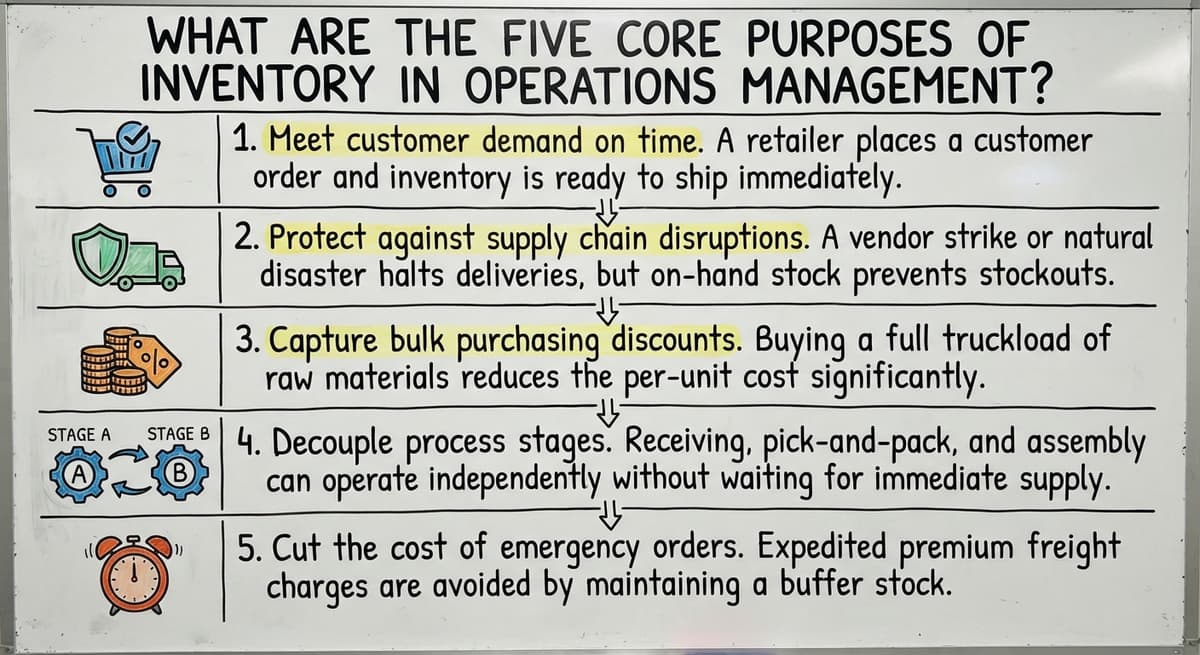
What Are the Five Core Purposes of Inventory in Operations Management?
The purpose of inventory in operations management covers 5 distinct jobs. Each one maps to a real problem a warehouse or distributor faces every week.
- Meet customer demand on time. A retailer places a same-week order. Stock on hand means the shipment goes out without delay or apology.
- Protect against supply chain disruptions. A vendor ships late or short. Safety stock covers the gap while the replacement order arrives.
- Capture bulk purchasing discounts. Buying a full pallet costs less per unit than buying a case. Holding that extra stock pays for itself if the carrying cost is lower than the discount earned.
- Decouple process stages. Receiving, pick-and-pack, and shipping can all run at their own pace when buffer stock sits between them. One team running slow does not stall the others.
- Cut the cost of emergency orders. Expedited freight and rush sourcing are expensive. A reorder point set correctly triggers a standard buy order before the shelf runs dry.
The comparison is easier when one option is built for you
Off-the-shelf means fitting your process to the software. We do it the other way round, and the first look costs nothing.
Book a call
What All Five Inventory Purposes Have in Common
Every one of these purposes comes back to the same outcome: orders ship when they are supposed to, and the operation does not pay a premium to make that happen.
Inventory and Cash Flow: The Trade-Off Every Operator Faces
More stock means more orders filled. It also means more cash sitting on a shelf instead of paying down a line of credit or funding a new hire.
Carrying costs are the price of holding inventory. They include warehouse space, insurance on the stock, spoilage on perishables, and obsolescence when a product goes out of date before it sells. Those costs add up quietly.

What Holding Too Little Inventory Costs You
Holding too little creates a different problem. A stockout means a lost sale, a frustrated customer, and sometimes a lost account. The US Federal Trade Commission's Mail and Telephone Order Rule needs businesses to ship within the timeframe they promised or give customers the option to cancel. An empty shelf makes that obligation impossible to meet.
The goal is the optimal inventory level: enough stock to fill orders reliably, not so much that cash is buried in a warehouse. That is a business decision, not just a warehouse decision.
How Inventory Connects to the Rest of Your Operation
Inventory levels do not stay inside the four walls of a warehouse. They drive decisions across the whole business.
When stock data is accurate, a purchasing manager knows exactly when to reorder and how much to buy. When it is not, buy orders go out too early, too late, or for the wrong quantity. Receiving teams log product against orders that do not match. Shipping teams pull from counts that are wrong before the pick even starts.

Why Inaccurate Inventory Is a Compliance Problem, Not Just an Operations Problem
Poor inventory data creates a ripple. Wrong counts produce wrong buy orders. Wrong buy orders produce wrong receipts. Wrong receipts produce wrong financial records. The IRS is direct on this point: IRS Publication 538 states, "To figure taxable income, you must value your inventory at the beginning and end of each tax year." Inaccurate counts are not just an operations problem; they are a compliance problem.
For operations running on an accounting package plus spreadsheets, inventory data often lives in 3 or 4 places at once. Each copy drifts from the others. Inventory visibility means every team sees one number, in real time, without reconciling files.
See it running on your own process first
No build cost. The subscription starts once it is live and doing the job, not before.
Book a callCommon Inventory Problems in Wholesale and Distribution
Wholesale and distribution operations run on tight margins. Inventory errors hit those margins directly.
Here are the problems that come up most often:
- Phantom inventory means the system shows stock available, but the shelf is empty. Orders get confirmed, then fail at pick. Customers find out the hard way.
- Stale reorder points cause over-ordering. When reorder triggers are tracked by hand and rarely updated, buyers order based on last season's demand, not this week's reality.
- No real-time view of what is on hand, what is in transit, and what is already committed to open orders means every decision is made on incomplete information.
- Paper-based fulfillment using printed pick sheets and email threads works until it does not. One missed email or a smudged sheet creates a shipment error that costs more to fix than the order was worth.

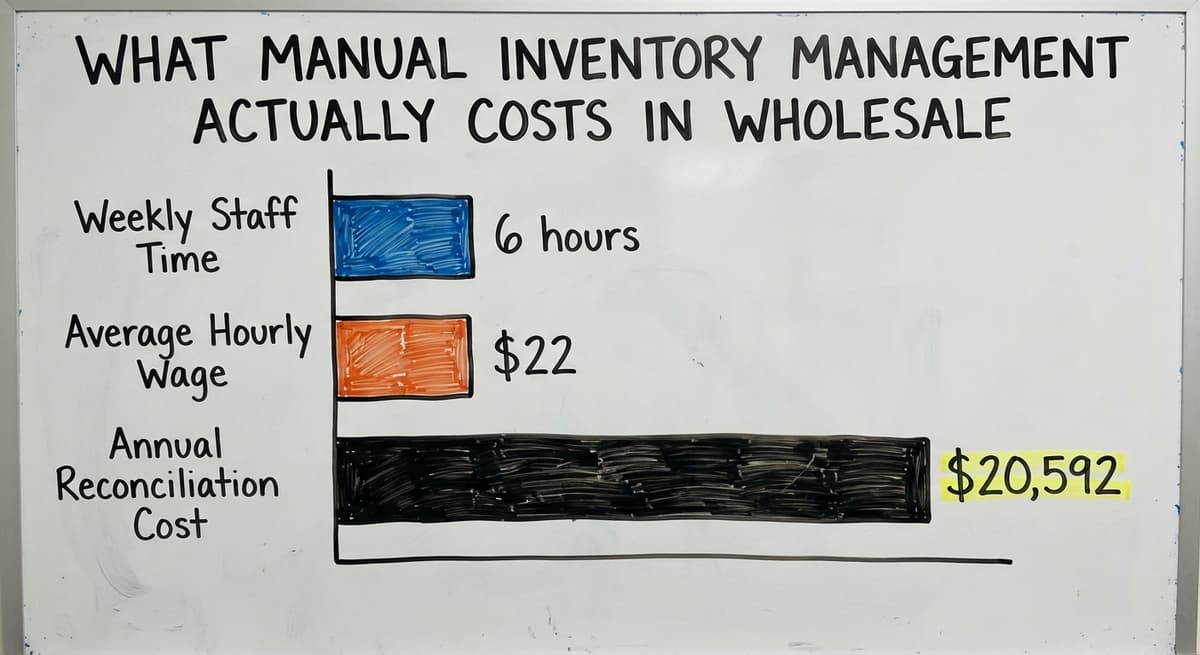
What Manual Inventory Management Actually Costs in Wholesale
The US Census Bureau's Monthly Wholesale Trade data tracks the national inventories-to-sales ratio for wholesale firms, which shows how much stock the industry carries relative to what it moves. When that ratio climbs, it signals that distributors are holding more than they are selling, often because visibility is low and reordering is reactive.
The cost of managing this manually is not invisible. Consider 3 staff members each spending 6 hours a week reconciling inventory counts at a wage of $22 an hour. That is $20,592 a year spent on a process that a connected inventory system handles automatically.
What Good Inventory Management Looks Like in Practice
Good inventory management is not complicated to describe. The gap between describing it and living it is where most operations get stuck.
In a well-run operation:
- Stock levels update the moment an order ships or a receipt is logged, with no manual entry step in between.
- Reorder alerts fire before a stockout happens, triggered by a reorder point set to actual lead times and actual demand patterns.
- Purchasing, receiving, and fulfillment teams all read from the same count at the same time, so no one is working from yesterday's spreadsheet.
- The accounting package stays in place for financial reporting. The inventory system feeds it clean, accurate data rather than creating a second set of books to reconcile.

What Measurable Improvement Looks Like After Getting Inventory Right
The outcome is measurable: fewer emergency freight charges, fewer customer service calls about missing orders, and less staff time spent fixing errors that should not have happened. The NIST Manufacturing Extension Partnership frames supply chain process improvement in the same terms: reduce waste in the process, and the margin improvement follows.
Accurate, real-time inventory data is what makes every downstream decision faster and cheaper.
Not sure this is the right shape for your operation
Describe how the work runs today. We map it on a call and show you what it would look like built around that, before you spend anything.
Book a callWhen Does a Spreadsheet Stop Being Enough?
A spreadsheet works when one person manages a small SKU count and order volume is low enough to track by eye. That window closes faster than most operators expect.
The signs that the spreadsheet has hit its limit are specific:
- Data entry errors are causing real losses: wrong quantities shipped, wrong items picked, credits issued for mistakes that should not have happened.
- Staff are spending hours each week reconciling counts between files, systems, and physical shelves.
- Orders are shipping wrong or late because the pick team and the order team are working from different information.
- Adding a new warehouse location or a second staff member to the process makes the problem worse, not better.
What Replaces the Spreadsheet Without Replacing Everything Else
The answer is not a massive enterprise system that takes 18 months to roll out. It is a purpose-built inventory tool designed around how the operation already works. For operations that run on a dedicated accounting package, that means a system that connects to it rather than replacing it. The accounting stays where it is. The inventory layer adds the visibility that the accounting package was never built to provide. Signs your warehouse operation has outgrown spreadsheets are usually visible long before the decision gets made.
What Are the Next Steps for Wholesale and Distribution Operations?
The purpose of inventory in operations management comes down to 3 outcomes: orders ship on time, cash stays healthy, and the operation runs on facts instead of guesses.
Start by finding where the current process breaks down. Is it phantom inventory? Stale reorder points? Data living in too many places? The break point is usually obvious once someone looks for it.
How to Choose the Right Inventory System Without Starting Over
How inventory management software works for wholesale distributors varies by operation size and complexity, but the starting point is always the same: one accurate count, visible to every team, updated in real time. Your accounting software and inventory management work well together when the inventory system is built to feed the accounting package rather than compete with it.
Custom operations software for small and mid-size distributors does not mean starting over. It means building a system around how the business already runs, not forcing the business to change shape to fit a vendor's template. How a custom-built system fits your existing workflow is the right question to ask before any tool decision gets made.
If the current setup has gaps, the practical next step is a conversation with a team that builds for operations at this scale, understands the day-to-day reality of warehouse operations, and can map a solution to what is already working rather than selling a replacement for everything.
Frequently asked questions
What is the purpose of inventory management in a business?
Inventory management keeps stock at the right level so orders ship on time without tying up more cash than necessary. It tracks what is on hand, what is committed to open orders, and when to reorder. Done well, it prevents stockouts, reduces emergency purchasing costs, and gives every team accurate numbers to work from.
What are three types of inventory?
The 3 main types are raw materials (inputs waiting to be used in production), work-in-progress items (goods partway through a process), and finished goods (products ready to ship to a customer). Wholesale distributors mostly deal with finished goods inventory, though some also hold raw materials if they do any light assembly or kitting.
What is an inventory record?
An inventory record is the data entry for a specific item: how many units are on hand, where they are stored, what they cost, and when they were last counted or received. Accurate inventory records are a legal requirement as well as an operations one. IRS Publication 538 needs businesses to value their inventory at the start and end of every tax year.
Why is inventory so important?
Inventory is the buffer between what a supplier delivers and what a customer needs. Without it, every order depends on a supplier being on time and demand being perfectly predictable. Neither of those things is reliable. Inventory absorbs the gap, so the business can fill orders even when something goes wrong upstream or demand spikes without warning.
How does inventory level affect cash flow?
Every unit sitting in a warehouse is cash that has been spent but not yet recovered. Carrying costs including storage, insurance, and the risk of spoilage or obsolescence add to that burden over time. Too much stock drains cash. Too little causes stockouts and lost sales. The right level depends on lead times, demand patterns, and the cost of running short versus the cost of holding extra.
What happens when inventory data is inaccurate or spread across multiple tools?
Inaccurate data creates a chain of errors. Wrong counts lead to wrong buy orders. Wrong buy orders lead to receiving mismatches. Receiving mismatches corrupt the financial records. Teams working from different spreadsheets make conflicting decisions. Customers get orders confirmed that cannot be filled. Each error costs time and money to fix, and the fixes rarely address the root cause.
Can a business keep its accounting package and still improve inventory management?
Yes. An accounting package handles financial reporting well but was not built to track real-time stock levels, reorder points, or fulfillment status. A purpose-built inventory system can connect to the accounting package and feed it accurate data automatically. The accounting stays in place. The inventory layer adds the visibility the accounting package cannot provide on its own.
Start with a free first look
A 30 minute call, your operation mapped, and a clear picture of what we would build. No obligation and nothing to install.
Book a callRelated guides
The rest of this guide, for the parts of the job this page does not cover.
- What is the Main Purpose of Inventory Management
- What is the Purpose of a Warehouse Management System
- What is the Difference Between Aggregate and Item Inventory Management
- What is Abc Classification in Inventory Management
- What is Inventory Management and Its Types
- What is Information Technology Inventory Management
- What is Risk Pooling in Inventory Management
- What is Inventory Management Mary Kay
- What is Stock Taking in Inventory Management
- What is Bin Number in Inventory Management
- What is the Goal of Inventory Management Quizlet
- What is the Implication of Proper Inventory Management
- What is Inventory Management and Its Importance
- What is the Importance of Eoq in Inventory Management
- What is the Importance of Quality Inventory Management
- What is Inventory Management Explain Techniques of Inventory Management
- What is Mean by Inventory Management
- What is Inventory Management Meaning in Hindi
- What is Inventory Management and Why is It Important
- What is the Rationale for Inventory Management Quizlet
- What is Inventory Management Whiteboard Wednesday
- What is Fluctuation Stock in Inventory Management
- What is the Management and Non Managerial Human Resources Inventory
- What is Warehousing Operations