


What Is Inventory Management Mary Kay
Inventory management for a Mary Kay consultant means knowing exactly what products you have, where they are, and when to reorder. You buy product upfront and sell from your own stock, so an accurate count protects your cash and your customers. This guide covers the basics, the warning signs, and when to upgrade your system. Reviewed and updated: October 2026.
Book a callWhat Inventory Management Means for Mary Kay Sellers
Inventory management is simply keeping track of what you have, where it is, and when you need more. For a Mary Kay consultant, that means knowing which skincare sets are on your shelf, which lipstick shades are running low, and which items a customer asked you to hold.
You are not a retail chain with a back-office team doing the counting. You are a direct seller working from home or a small office, and every dollar tied up in unsold product is a dollar you spent. Getting the count right is how you stay profitable. A clear system also means you never have to guess when a customer calls to reorder.
We build it for your operation, and the first look is free
If you would rather not compare products, describe how your operation already works and we build the system around it.
No build cost. You see it running on your own process first, and the monthly subscription starts only once it is live.
Book a callWhy Mary Kay Inventory Is Different from Retail Stock
Most stores have a central warehouse, a receiving team, and software that updates the count automatically. A Mary Kay consultant has none of that. You buy product upfront at wholesale and carry the financial risk if it does not sell. Seasonal sets, limited-edition colors, and customer reorders all create demand that shifts without warning.
Barcode standards exist to solve exactly this kind of problem at scale. As GS1 explains, barcodes are "the global language of business" that let any party in a supply chain read and share product data instantly. You may not scan barcodes today, but understanding why they exist shows how much manual work you are doing in their place. Every hour you spend counting by hand is an hour a barcode scan would remove.
Why the IRS Makes Inventory Tracking Non-Optional
The IRS adds another layer. IRS Publication 538 states plainly: "To figure taxable income, you must value your inventory at the beginning and end of each tax year." That is not optional. A working system makes tax time a short task rather than a stressful one.
What Are the Basic Parts of a Working Inventory System for a Direct Seller?
A working inventory system for a direct seller has 5 connected parts, and each one feeds the next. Here is what they are and why each one matters.
- Product catalog: A full list of every item you carry, with the product name, shade or variant, and the price you paid. This is your reference point for everything else.
- Quantity on hand: How much of each item you currently have. Without this number, you are guessing.
- Reorder point: The minimum quantity that tells you it is time to place an order. Set this before you run out, not after.
The comparison is easier when one option is built for you
Off-the-shelf means fitting your process to the software. We do it the other way round, and the first look costs nothing.
Book a call
How Sales Records and Customer History Complete the System
- Sales log: A record of every sale, by product and date. This shows you what moves fast and what sits.
- Customer buy history: Who bought what, and when. This is how you expect reorders before a customer has to ask.
When these 5 parts connect, you spend less time searching and more time selling.
How the Parts Work Together
The sales log feeds the quantity on hand. The quantity on hand triggers the reorder point. The customer buy history tells you which items to reorder in larger amounts. A gap in any one part breaks the chain. If you log sales but never update your count, you will still run out of stock without warning.
Common Ways Mary Kay Consultants Track Inventory
Most consultants start with one of 4 methods. Each one works up to a point.
- Paper logs: Fast to start, zero cost, and easy to lose. A spilled coffee or a missing notebook can wipe out weeks of records.
- Notes apps: Better than paper because the data lives on your phone. Still manual, still easy to fall behind on.
- Spreadsheets: The most common step up. A spreadsheet can hold your product catalog, your counts, and your sales log in one place. It works well for a solo seller with a small product range.
- The Mary Kay InTouch portal: Useful for order history and account details, but it does not track what you have on hand after you receive a shipment.
When Your Current Tracking Method Stops Working
A spreadsheet breaks down once you have multiple product lines, a growing customer list, or team members adding data at the same time. The method that got you started is rarely the one that keeps you growing.

FAQ: What is a good inventory management system?
There is no single answer. The right system depends on how many products you carry, how often you reorder, and whether you work alone or with a team. A spreadsheet is a good system for a solo seller with 20 to 30 products. A cloud-based inventory app makes more sense once you have frequent reorders and multiple customers to track. A custom build fits businesses that have outgrown off-the-shelf tools and need the system to match how they already work. Start with the simplest option that keeps your count accurate, and upgrade when that option slows you down.
Signs Your Current System Is Letting You Down
A tracking method that no longer fits your business sends clear signals. Watch for these.
- You run out of a bestselling product before you notice it is low, and a customer has to tell you.
- You over-order slow movers and tie up cash that could fund a better product mix.
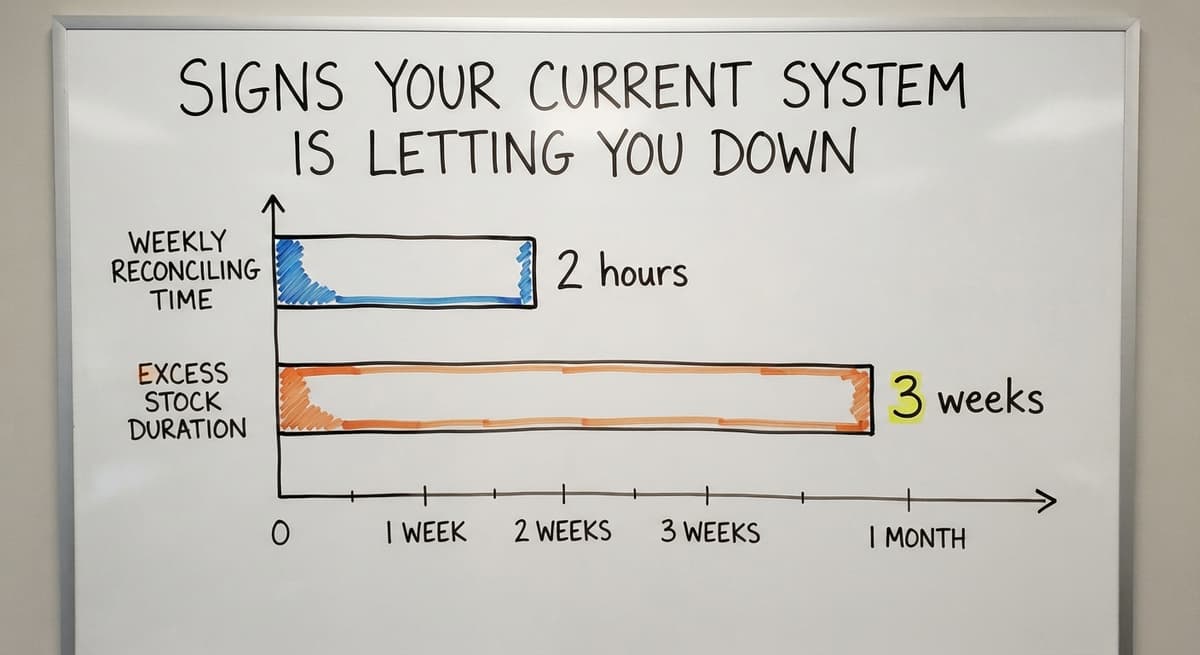
- You spend more than 2 hours a week reconciling what you sold against what you have left.
- A customer asks for a product and you cannot find it, or you forgot you had it.
- You place an order and later realize you already had enough stock to cover the next 3 weeks.
Each of these gaps costs you money, time, or customer trust, and usually all 3.
See it running on your own process first
No build cost. The subscription starts once it is live and doing the job, not before.
Book a call
What Good Inventory Management Looks Like in Practice
A simple process, done consistently, beats a complex one done rarely. Here is what a working routine looks like for a Mary Kay consultant.
- Count stock on a set day each week. Pick the same day every time so the habit sticks. A weekly count takes about 20 minutes once you know the drill.
- Log every sale the day it happens. Do not batch sales at the end of the week. Memory fades and errors compound.
How Reorder Minimums Prevent Stockouts and Over-Buying
- Set a reorder minimum for each item. For a fast seller like a core moisturizer, that minimum might be 3 units. For a slow mover, it might be 1. Write the number down and honor it.
- Place your order when any item hits its minimum. Do not wait until you are completely out.
This process cuts stockouts because you act before the shelf is empty. It also cuts over-buying because you reorder based on a real number, not a feeling. Consistency matters more than the tool you use to do it.
FAQ: What do you understand by inventory management?
Inventory management means knowing what physical product you have, tracking every sale that reduces that amount, and ordering more before you run out. For a direct seller, it also means tying that count to customer records so you can expect demand. The goal is to have the right product available at the right time without locking up more cash than necessary in unsold stock.

When a Spreadsheet Is Enough and When It Is Not
A spreadsheet is enough when you are a solo consultant, you carry fewer than 40 distinct products, and you place orders once or twice a month. It is a real tool, not a placeholder, and many successful sellers run their whole business on one.
How to Know When It Is Time to Move On
The tipping point is a business decision, not a technology one. Ask yourself: How long does it take me each week to keep the spreadsheet accurate? Can a team member update it without breaking a formula? Does it connect to my customer records? If the answer to any of those is "no" and the problem is slowing you down, the spreadsheet has done its job and it is time to move on. Upgrading is not about chasing software. It is about protecting the time and money you have already invested in building your business.
FAQ: Is inventory management a hard skill?
Yes. Inventory management is a measurable, learnable skill. It involves counting correctly, recording data consistently, reading trends in what sells, and making reorder decisions based on real numbers rather than guesswork. Like any skill, it improves with practice and the right tools. A direct seller who tracks inventory well has a concrete advantage over one who does not, because they spend less on excess stock and lose fewer sales to stockouts.
Not sure this is the right shape for your operation
Describe how the work runs today. We map it on a call and show you what it would look like built around that, before you spend anything.
Book a callHow Small Distributors and Fulfillment Operations Solve This Problem
The challenge a Mary Kay consultant faces is the same one any small operation selling physical product faces as it grows. You start with a manual system. It works. Then volume increases, the product range expands, or a team member joins, and the manual system becomes the bottleneck.
Small distributors and fulfillment operations that have outgrown spreadsheets often find that off-the-shelf platforms do not match how they actually work. The answer is not always a full system migration. Inventory management software for small distributors can be built around an existing workflow, replacing only the parts that cause errors without forcing a change to everything else.
For example, many small operations already use a popular small-business accounting package. A custom build can connect inventory counts and reorder triggers directly to that accounting package, so the financial picture stays accurate without double entry. Connecting your accounting software to your wholesale and distribution operation keeps the familiar tool in place and removes the manual steps that cause most of the errors.
The NIST Manufacturing Extension Partnership offers vendor-neutral guidance on supply chain process for exactly this kind of operation: businesses that need better systems but are not ready for enterprise software. The goal is to replace the error-prone parts, not rebuild everything from scratch.
The Real Cost of Leaving a Manual System in Place
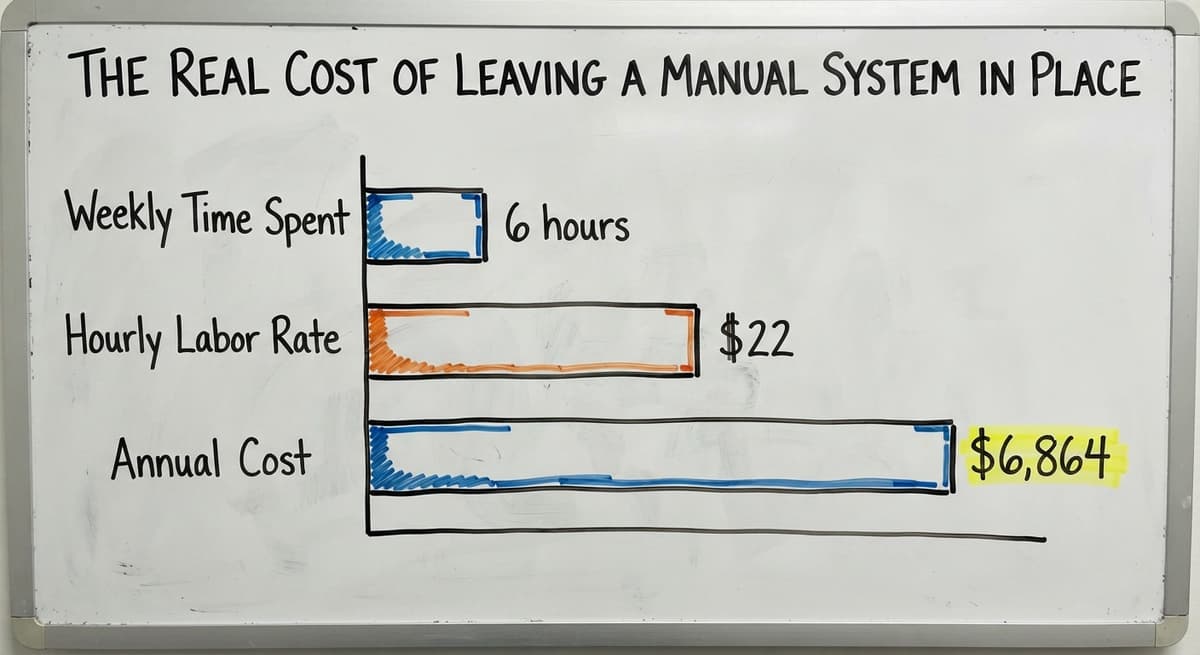
Consider the cost of doing nothing. If 1 person spends 6 hours a week reconciling inventory manually at $22 an hour (the median for stock clerks, per the Bureau of Labor Statistics), that is $6,864 a year in labor alone, before accounting for the cost of a single missed order or an over-buy that ties up cash for months.
What Should I Do First to Get My Inventory Under Control?
Start with an audit. Walk through every product you have and write down the count. That single step will show you where the gaps are. From there, the path is straightforward.
- Pick 1 tracking method and commit to it for at least 60 days before switching.
- Set a reorder minimum for your top 10 products this week, not eventually.
- Log every sale on the day it happens, even if it is just a note in your phone.
When to Consider Moving Beyond Manual Tracking
For sellers or small operations that have outgrown manual tracking, the next step is exploring how custom working software replaces manual workflows without forcing you to learn a new system from scratch. The right system fits your business as it is, and grows with it.
FAQ: What type of business model is Mary Kay?
Mary Kay operates as a direct sales or multi-level marketing business model. Independent consultants buy product at wholesale prices and resell it at retail prices, keeping the margin as income. Consultants can also recruit and mentor other consultants, earning extra income based on their team's sales. Because consultants carry their own physical stock, inventory management is a core business skill, not an optional one.
Frequently asked questions
What is a good inventory management system?
There is no single answer. The right system depends on how many products you carry, how often you reorder, and whether you work alone or with a team. A spreadsheet works well for a solo seller with a small product range. A cloud-based inventory app fits businesses with frequent reorders and multiple customers. A custom build suits operations that have outgrown off-the-shelf tools. Start with the simplest option that keeps your count accurate, and upgrade when that option slows you down.
What type of business model is Mary Kay?
Mary Kay operates as a direct sales business model. Independent consultants buy product at wholesale prices and resell it at retail, keeping the margin as income. Consultants can also recruit and mentor others, earning income based on their team's performance. Because consultants carry their own physical stock, inventory management is a core business skill, not an optional one.
Is inventory management a hard skill?
Yes. Inventory management is a measurable, learnable skill. It involves counting correctly, recording data consistently, spotting trends in what sells, and making reorder decisions based on real numbers. A direct seller who tracks inventory well spends less on excess stock and loses fewer sales to stockouts. Like any skill, it improves with practice and the right tools.
What do you understand by inventory management?
Inventory management means knowing what physical product you have, tracking every sale that reduces that amount, and ordering more before you run out. For a direct seller, it also means connecting that count to customer records so you can expect demand. The goal is to have the right product available at the right time without locking up more cash than necessary in unsold stock.
How do I set a reorder point for my Mary Kay products?
Look at how fast each product sells. If a moisturizer sells 3 units a week and it takes 5 days to receive a new order, you need at least 3 units on hand before you place that order. Set your reorder point at that number, write it down next to the product in your tracking system, and place an order the day you hit it. Adjust the number each quarter as your sales patterns change.
What is the biggest mistake direct sellers make with inventory?
The most common mistake is ordering by feel rather than by count. A seller who thinks a product looks low and orders more can end up with 3 months of stock she cannot move. The fix is simple: write down a reorder minimum for each item, check the count on a set day each week, and order only when the count hits that minimum. Guessing costs money; counting does not.
When should a Mary Kay consultant move from a spreadsheet to inventory software?
Move when the spreadsheet takes more time to keep than it saves. Specific signals include: a team member updates the file and breaks a formula, you have more than 40 products to track, you place orders more than twice a month, or you need to tie inventory counts to customer buy records. At that point the spreadsheet is the bottleneck, not the solution.
Does the IRS need Mary Kay consultants to track inventory?
Yes. IRS Publication 538 states that you must value your inventory at the beginning and end of each tax year to figure your taxable income. That requirement applies to any seller who carries physical product, including direct sellers. A consistent tracking system makes this calculation straightforward and reduces the risk of errors on your return.
Start with a free first look
A 30 minute call, your operation mapped, and a clear picture of what we would build. No obligation and nothing to install.
Book a callRelated guides
The rest of this guide, for the parts of the job this page does not cover.
Guides
Common questions
- What is the Difference Between Aggregate and Item Inventory Management
- What is Abc Classification in Inventory Management
- What is Inventory Management and Its Types
- What is the Main Purpose of Inventory Management
- What is Information Technology Inventory Management
- What is Risk Pooling in Inventory Management
- What is Stock Taking in Inventory Management
- What is Bin Number in Inventory Management
- What is the Goal of Inventory Management Quizlet
- What is the Implication of Proper Inventory Management
- What is Inventory Management and Its Importance
- What is the Importance of Quality Inventory Management
- What is Mean by Inventory Management
- What is Inventory Management and Why is It Important
- What is the Management and Non Managerial Human Resources Inventory
- What is Inventory Listing
- What is Inventory
- What is the Best Warehouse Inventory Management System?
- What is the Difference Between Warehousing and Inventory Management
- What is B Type of Inventory in Warehouse Management
- What is Warehousing and Inventory Management
- What is the Best Inventory Management Software for Small Business
- What is the Best Inventory Management System for Small Businesses?