


What Is Effective Inventory Management
Effective inventory management means knowing exactly what stock you have, where it sits, and when to reorder, at all times. It connects purchasing, receiving, storage, picking, and shipping into one clear picture. The goal is simple: the right product in the right place at the right time, without tying up extra cash in overstock. For small and mid-size distributors, getting this right is the difference between a warehouse that runs and one that fights itself every day.
Reviewed and updated: October 2026
Book a callWhat Effective Inventory Management Really Means
Effective inventory management is not a software category. It is a discipline. Every item that enters your warehouse should be counted when it arrives, tracked as it moves, and recorded when it leaves. That chain of events, kept accurate in real time, is what separates a warehouse that ships on time from one that guesses.
The IRS makes the counting obligation plain. IRS Publication 538 states: "To figure taxable income, you must value your inventory at the beginning and end of each tax year." That is the legal floor. Effective management goes further: it keeps that count accurate every day, not just at year end.
For a wholesale distributor running 5 to 50 staff, accurate counts protect more than the books. They protect every order you promise to ship.
We build it for your operation, and the first look is free
If you would rather not compare products, describe how your operation already works and we build the system around it.
No build cost. You see it running on your own process first, and the monthly subscription starts only once it is live.
Book a callWhy Inventory Management Matters for Distributors and Warehouses
A stockout does not just mean a delayed order. It means a customer who calls a competitor next time. Overstock is the opposite problem: cash sitting on a shelf instead of working in the business. Both failures come from the same root cause: not knowing what you actually have.
Manual tracking through spreadsheets and printed pick sheets creates errors that build on each other. One missed update leads to a wrong count. A wrong count leads to a bad buy order. A bad buy order leads to a stockout or a pile of product no one needed. For operations with 5 to 100 staff, one bad count can slow the whole warehouse down for a day.
Effective inventory management keeps orders accurate and staff focused on work that moves product, not on chasing down what went wrong.
What Are the Core Practices That Make Inventory Management Work?
The core practices of effective inventory management are a small set of habits that, done consistently, keep your warehouse data clean. Each one closes a specific gap that manual tracking leaves open.
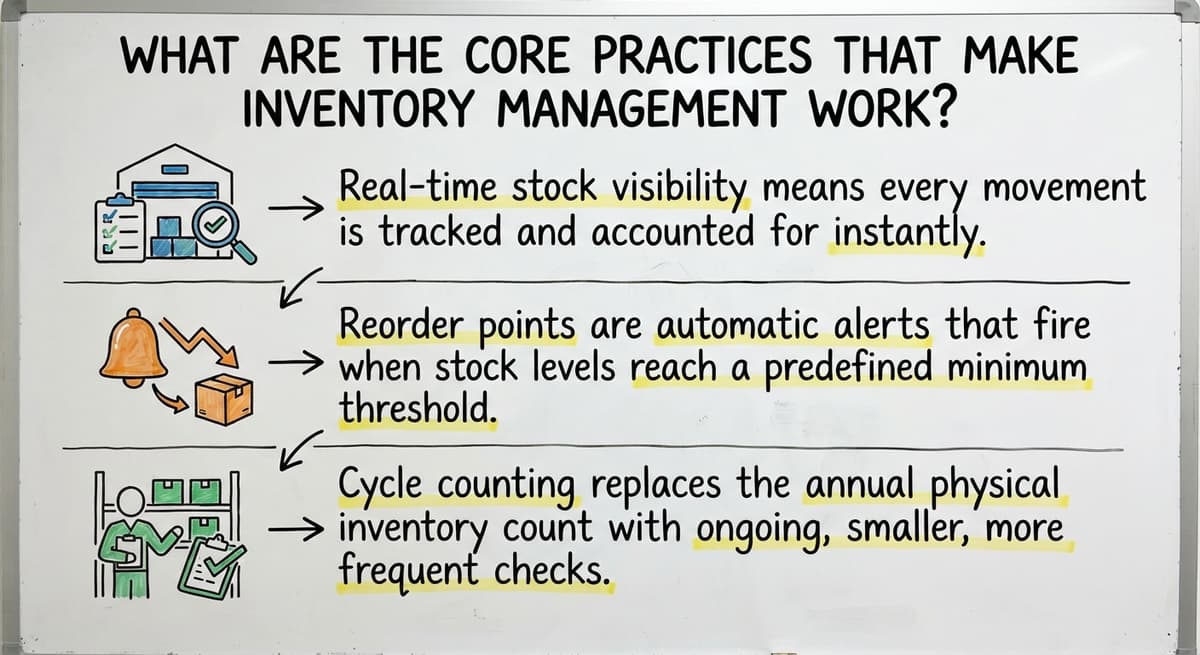
- Real-time stock visibility means every movement is recorded as it happens, not at the end of a shift. A pick that is not logged at once is a discrepancy waiting to surface.
- Reorder points are automatic alerts that fire when a SKU, meaning a specific product code, drops below a set minimum. Staff stop making reorder decisions from memory.
- Cycle counting replaces the annual physical inventory with regular partial counts. A small section of the warehouse is counted each week, so errors are caught before they compound.
How Bin Locations and Receiving Accuracy Complete the System
- Bin location tracking tells the system which shelf, bin, or zone holds each item. Pickers walk a direct path instead of searching.
- Receiving accuracy means every inbound shipment is checked against the buy order before stock is put away. What was ordered and what arrived are confirmed to match.
These practices do not need enterprise software. They need a system, whether digital or manual, that enforces each step every time. The discipline is the practice; the software makes it sustainable.

Where Manual Systems Break Down
Spreadsheets go stale the moment someone forgets to update a row. That is not a criticism of the person. It is a structural problem: a spreadsheet has no way to enforce an update, so updates get skipped when the warehouse is busy, which is exactly when accuracy matters most.
Email-based buy orders create a gap between what was ordered and what actually arrived. That gap lives in someone's inbox, not in the stock count.
Printed pick sheets show stock levels from the moment they were printed. By the time a picker uses one, another order may have already pulled the same item. The picker finds an empty bin and has to stop work to report it.
The comparison is easier when one option is built for you
Off-the-shelf means fitting your process to the software. We do it the other way round, and the first look costs nothing.
Book a callWhy Accounting Software Is Not a Warehouse System
Accounting software tracks financials well but was not built to manage bin locations or live warehouse counts. It records the value of inventory after the fact. It does not tell a picker where to find a product or alert a buyer when stock is low.
The gaps are normal for growing operations. The problem is letting them stay.
The Real Cost of Manual Inventory Tracking
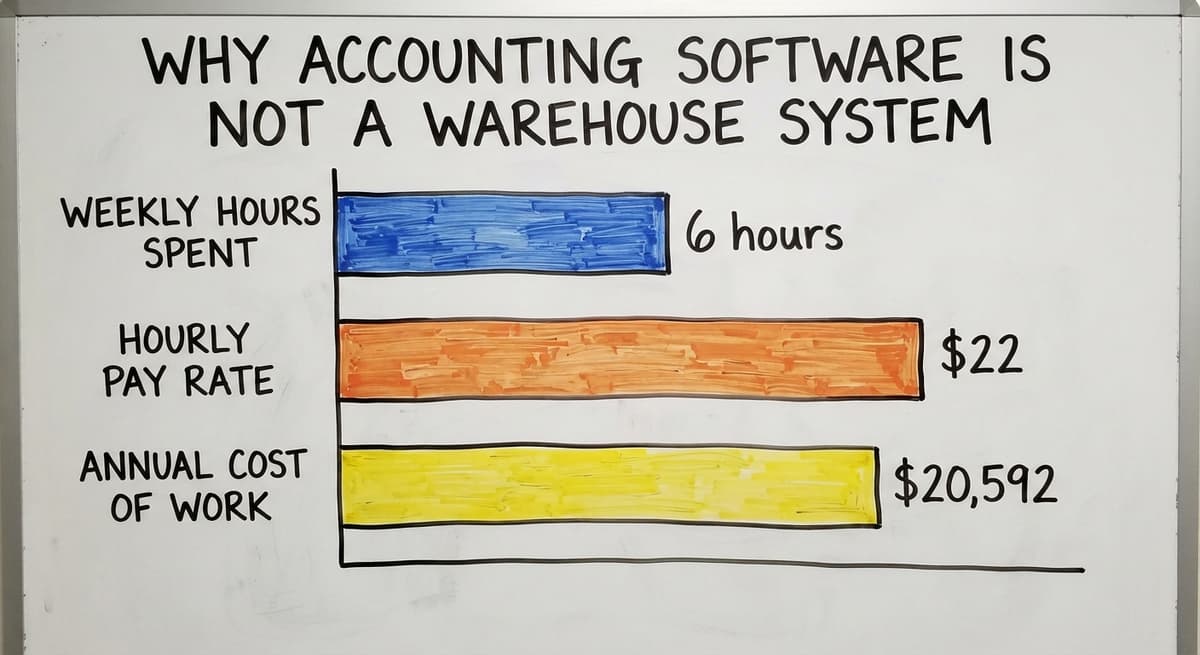
Consider 3 staff members each spending 6 hours a week reconciling spreadsheets, correcting pick errors, and chasing down stock discrepancies. Bureau of Labor Statistics data puts median pay for stock clerks and order fillers near $22 per hour. That is $20,592 a year spent on work that a system handles automatically. The number does not include the orders that shipped wrong or the customers who did not call back.
How Inventory Software Fills the Gaps
Good inventory management software records every receipt, pick, transfer, and adjustment in one place. There is no separate spreadsheet to update and no printed sheet to file. The record is made when the action happens, by the person doing the work.

Staff scan or enter movements on the warehouse floor rather than writing them down to enter later. That single change removes the delay between what happened and what the system knows.
Managers see live stock levels from any screen. A buyer can check a SKU before placing a buy order. A manager can answer a customer question about availability without asking someone to run a count.
Inventory management software for wholesale distributors can also connect to accounting software, so financial records stay accurate without double entry. One transaction updates both the warehouse count and the books.
The system handles the counting; the team handles the work.
Keeping Your Accounting Software and Adding What It Cannot Do
Your current accounting software is a solid tool and there is no reason to replace it. The question is not whether to keep it. The question is what to build around it.
Effective inventory management adds a layer that accounting software was never designed to handle: bin locations, pick queues, receiving workflows, and live counts. How custom warehouse software works with your accounting software is straightforward in practice. A sync layer pushes confirmed receipts and fulfilled orders into the accounting package automatically. The books stay clean. The warehouse runs on accurate, real-time data.
This approach avoids the cost and disruption of moving to a full ERP, meaning an enterprise resource planning system that replaces every tool at once. For most small and mid-size distributors, adding a focused inventory layer is faster, cheaper, and less risky than a full platform swap.

Signs Your Current Approach Is Holding You Back
Some operations know their manual system is a problem. Others have lived with it long enough that the workarounds feel normal. These are the signals worth watching.
- Orders ship late because staff cannot find stock quickly, even when the system says it is there.
- Cycle counts reveal regular gaps between what the records show and what is physically on the shelf.
- Purchasing decisions rely on a buyer's memory rather than a report.
- New staff take weeks to learn the paper-based system, and they still make errors after that.
- Managers spend hours each week reconciling spreadsheets instead of running the operation.
See it running on your own process first
No build cost. The subscription starts once it is live and doing the job, not before.
Book a callWhat to Do When the Manual System Becomes the Bottleneck
If 2 or more of these sound familiar, the manual system has become the bottleneck. The warehouse is not slow because of the staff. It is slow because the information the staff depends on is wrong or late.
Warehouse workflow automating for small operations does not have to be complex. Closing these specific gaps, one at a time, is enough to change how the floor runs.

What Effective Inventory Management Looks Like in Practice
A day-to-day picture is more useful than a definition. Here is what the same warehouse looks like when the system is working.
A receiving clerk scans an inbound pallet at the dock. Stock levels update instantly across every screen in the building. No one has to enter the receipt manually later.
A picker opens a digital pick list sorted by bin location. The route through the warehouse is efficient. The picker does not visit the same aisle twice or discover an empty bin that the system did not know about.
Before a vendor call, a manager pulls up a dashboard and checks stock levels directly. The question gets answered in 30 seconds instead of 30 minutes.
Why Small Distributors Do Not Need Enterprise Software to Run This Way
A reorder alert fires automatically when a fast-moving SKU hits its minimum. The buyer acts on data, not a hunch.
These are not enterprise-only capabilities. A small or mid-size distributor with the right system can run this way today. Custom operations software vs. off-the-shelf ERP is often the deciding question, and for most operations at this scale, a custom build that fits the existing workflow beats a generic platform that forces the workflow to change.
What Pick and Pack Looks Like With Real-Time Data
Pick and pack, the process of selecting items from storage and packing them for shipment, is where inventory errors become customer problems. A picker working from a live digital list, sorted by bin location, makes fewer trips and catches fewer surprises. When the list reflects actual stock, the pack station receives the right items and the order ships complete. That outcome depends entirely on the accuracy of the data behind the list.

How Long Does It Take to Get Started With Inventory Management Software?
Getting started does not need replacing everything at once, and a well-run rollout can show results in weeks rather than months. The right approach maps how the operation already works, then builds software around those workflows.
Staff learn a system that matches what they already do. That cuts training time and reduces resistance. A team that builds and supports the software locally can move faster and stay accountable when questions come up after launch.
The NIST Manufacturing Extension Partnership recommends that businesses map their existing supply chain processes before selecting or building any system. That step alone surfaces the specific gaps worth closing and prevents a technology project from solving the wrong problem.
The goal is fewer manual steps, not a bigger technology project. Start with the workflow that causes the most errors, fix that first, and build from there.
Getting the Most From Your Inventory Data
Accurate counts are the foundation. What a business does with that data is where the real return comes from.
The US Census Bureau's Monthly Wholesale Trade data tracks the inventories-to-sales ratio across wholesale firms nationally. When that ratio rises, distributors are carrying more stock relative to what they sell. A business with accurate, real-time data can spot the same pattern in its own numbers and act before the problem grows.
Buying decisions improve when they are based on actual turnover rates rather than estimates. Slow-moving SKUs become visible. Fast-moving ones get reorder points set at the right level. The purchasing team stops reacting and starts planning.
Inventory accuracy is not just an working metric. It is a financial one.
Frequently asked questions
What are some effective techniques for managing inventory?
The most reliable techniques are cycle counting, reorder points, bin location tracking, and real-time recording of every stock movement. Cycle counting means counting a small section of the warehouse each week rather than doing one large annual count. Reorder points are minimum stock levels that trigger a buy alert automatically. Bin location tracking tells staff exactly where each item is stored. Together, these four practices close the gaps that cause most inventory errors.
What are the key requirements for effective inventory management?
Three things are required: accurate data at the moment stock moves, a consistent process that every staff member follows, and a system that makes the right step easier than skipping it. Without real-time recording, counts go stale. Without a consistent process, errors vary by person. Without a system that enforces the workflow, both problems return as soon as the warehouse gets busy.
Can a business keep its accounting software and still improve inventory management?
Yes. Your accounting software handles the books well, and there is no reason to replace it. What it cannot do is manage bin locations, live warehouse counts, or pick queues. Adding a focused inventory layer that syncs with your accounting software gives the warehouse real-time data while keeping the books accurate. This avoids the cost and disruption of moving to a full ERP system.
What is a large enterprise resource planning platform in inventory?
A large enterprise resource planning platform includes inventory and warehouse management as part of a much broader system. It is built for organizations with complex, multi-site operations and large IT teams to support it. For small and mid-size distributors, the cost and complexity of such a platform are rarely justified. A focused inventory system, or a custom build that fits the existing workflow, usually delivers faster results at a fraction of the cost.
What skills do you need for inventory management?
The core skills are attention to detail, comfort with a counting process, and the discipline to record every movement at the time it happens rather than later. For managers, the added skill is reading stock data to spot trends, like a SKU that turns slowly or a supplier that consistently ships short. Software handles the math; the human skill is making sure the data going in is correct.
Do small operations need a full ERP to manage inventory well?
No. A full ERP, meaning a platform that replaces every business system at once, is built for large organizations with dedicated IT staff. Small and mid-size distributors get better results from a focused inventory system that closes specific gaps, connects to their existing accounting software, and fits the way the warehouse already works. The goal is accurate data and fewer manual steps, not a larger technology footprint.
What does effective inventory management look like day to day on the warehouse floor?
On a well-run floor, a receiving clerk scans inbound stock and the count updates instantly. Pickers work from a digital list sorted by bin location, so they walk a direct route and find what the list says is there. Reorder alerts fire automatically when stock hits a minimum. Managers check live dashboards instead of asking someone to run a count. Each of these outcomes depends on one thing: every stock movement recorded at the moment it happens.
Start with a free first look
A 30 minute call, your operation mapped, and a clear picture of what we would build. No obligation and nothing to install.
Book a callRelated guides
The rest of this guide, for the parts of the job this page does not cover.
- What is the Difference Between Aggregate and Item Inventory Management
- What is Jit Inventory Management
- What is an Important Factor in Inventory Management
- What is Abc Classification in Inventory Management
- What is Inventory Management in Working Capital
- What is Inventory Management and Its Types
- What is the Main Purpose of Inventory Management
- What is Information Technology Inventory Management
- What is Risk Pooling in Inventory Management
- What is Inventory Management Mary Kay
- What is Stock Taking in Inventory Management
- What is Bin Number in Inventory Management
- What is the Goal of Inventory Management Quizlet
- What is the Implication of Proper Inventory Management
- What is Omni-channel Inventory Management
- What is Inventory Management and Its Importance
- What is the Importance of Eoq in Inventory Management
- What is the Importance of Quality Inventory Management
- What is Inventory Management Explain Techniques of Inventory Management
- What is Mean by Inventory Management
- What is Inventory Management Meaning in Hindi
- What is Inventory Management and Why is It Important
- What is the Rationale for Inventory Management Quizlet
- What is the Purpose of Inventory in Operations Management