


What Is The Management And Non Managerial Human Resources Inventory
A management and non-managerial human resources inventory is a structured record of every person in your organization, split into 2 groups: those who direct work and those who do it. It captures job titles, skills, certifications, and capacity. Reviewed and updated for current operations as of July 2025.
Book a callThe Simple Definition of a Human Resources Inventory
A human resources inventory is a catalog of your people. Just as a product inventory tells you what stock you have, where it sits, and how much is available, a people inventory tells you who is on your team, what each person can do, and where they fit in your operation.
Reviewed October 2026.
Every person in the business appears in it. The record covers 2 groups: management staff (supervisors, team leads, directors, owners) and non-managerial staff (pickers, packers, drivers, clerks). Neither group is more important than the other. Both are required for the operation to function, and both carry risks when the data about them is missing or stale.
No HR degree is needed to build one. If you can list your people and describe what each one does, you already have the raw material.
We build it for your operation, and the first look is free
If you would rather not compare products, describe how your operation already works and we build the system around it.
No build cost. You see it running on your own process first, and the monthly subscription starts only once it is live.
Book a callWhat Goes Into a Management Inventory
A management inventory covers the people who make decisions: supervisors, team leads, operations managers, and owners. The data points that matter are job title, decision-making authority, skills, experience level, and which teams or shifts each person oversees.
The core question this layer answers is: who is responsible for what, and are those people ready to handle growth or change?
Why Management Authority Must Be on Record
In a warehouse or distribution center, that might mean knowing which shift lead can authorize a return, approve an order exception, or sign off on a carrier swap. Without that record, the answer lives in one person's head. When that person is out sick, work stops.
Standards bodies have long recognized that tracking authority and responsibility is part of a healthy working system. GS1, which publishes the barcode and data standards used across global supply chains, notes that consistent data capture is the foundation of reliable operations at gs1.org/standards/barcodes. The same logic applies to people-data: if you cannot look it up, you cannot rely on it. A management inventory also surfaces succession gaps before they become crises.
What Does a Non-Managerial Inventory Track?
A non-managerial inventory tracks every person who carries out day-to-day tasks: warehouse associates, forklift operators, order fillers, and customer service reps. The data points are role, certified skills, equipment each person is trained on, shift availability, and tenure.
This layer answers a specific working question: do you have enough trained hands to meet current order volume, or do gaps exist?
Capability Versus Capacity in the Non-Managerial Layer
For a fulfillment center running 3 shifts, that question is not abstract. If 2 of your 4 certified forklift operators are on the same shift, and one calls out, you may not be able to move product safely. The non-managerial inventory makes that risk visible before it causes a delay.
Ability and capacity are the two things this layer maps. Scheduling and time-tracking are separate tools. The inventory is not about when people show up. It is about what they can do when they are there. Tenure matters here too. A 3-year associate who knows your racking layout and your top 20 customers' preferences is not interchangeable with a new hire, even if both carry the same job title.
The comparison is easier when one option is built for you
Off-the-shelf means fitting your process to the software. We do it the other way round, and the first look costs nothing.
Book a callWhy the Two Groups Are Tracked Separately
Management and non-managerial roles carry different risks and different replacement costs. Tracking them in the same flat list hides those differences.
Losing a warehouse associate is disruptive. You post the role, train someone new, and absorb a few weeks of slower output. Losing the operations manager who knows every customer's quirks, every carrier's quirks, and every exception to your standard process is a different problem entirely. The knowledge gap is harder to fill, and the cost is harder to see until something breaks.

What Separate Tracking Lets You Spot
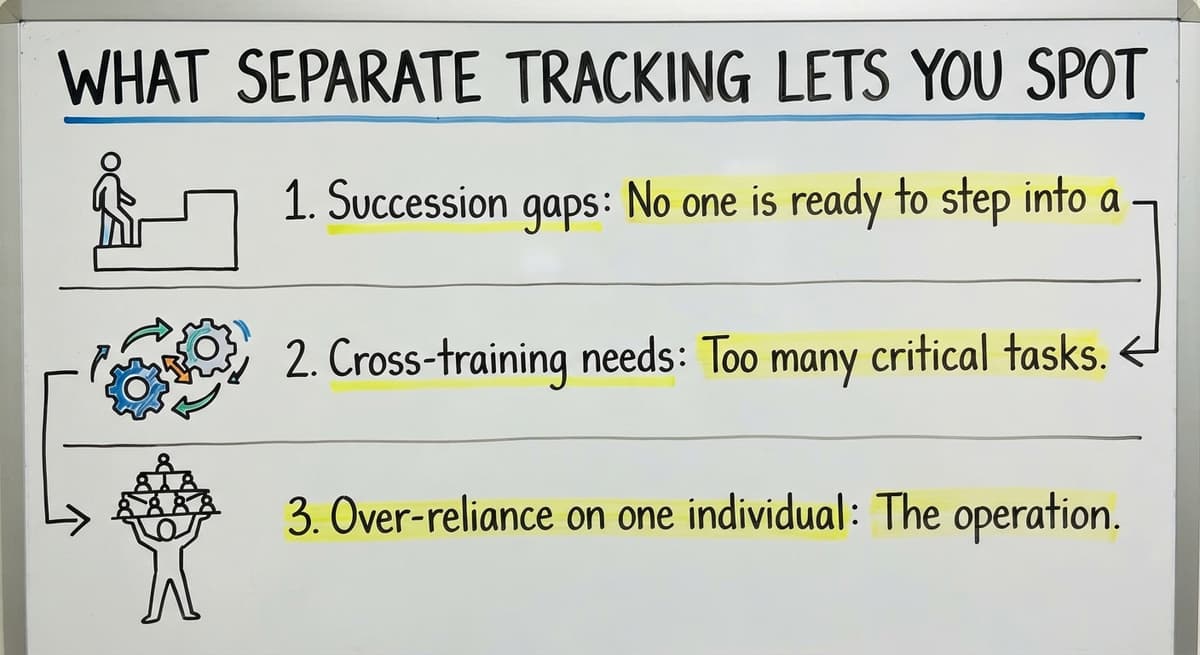
Separate tracking lets owners spot 3 specific problems before they become expensive:
- Succession gaps: No one is ready to step into a key role if the current holder leaves.
- Cross-training needs: Too many critical tasks depend on a single person.
- Over-reliance on one individual: The operation cannot function without them present.
Planning for growth is also cleaner when the 2 layers are distinct. If you are considering adding a second warehouse, you need to know whether your current management layer can handle a larger team. A flat list will not tell you that. Separate records will.
How an HR Inventory Connects to Operations
In wholesale, distribution, and fulfillment, people are part of the working system. They are not a separate department that HR manages in isolation.
A live HR inventory links directly to order volume, shift capacity, and throughput planning. When your system knows what each person can do, it becomes easier to assign tasks, flag bottlenecks, and plan for peak seasons without scrambling at the last minute.
Seeing Capacity Gaps Before the Shift Starts
Consider a simple example. A distributor runs 2 pick lines. Each line needs 1 certified scanner operator and 2 general associates. The HR inventory shows that only 3 people hold the scanner certification. On a normal day, that is fine. During peak season, when you add a third shift, you are short by 1 certified operator and you would not know it until the shift starts. A connected system flags that gap in advance.
This is where an HR inventory stops being a document filed in a shared drive and starts acting as a working part of your operation. The US Census Bureau tracks inventories-to-sales ratios for wholesale firms at census.gov/wholesale, and those ratios move with demand. Your people capacity needs to move with demand too, and that needs the same kind of real-time visibility.
See it running on your own process first
No build cost. The subscription starts once it is live and doing the job, not before.
Book a call
Why Accurate People Records Matter Beyond HR
The IRS is also clear that working records matter beyond HR: IRS Publication 538 states that "to figure taxable income, you must value your inventory at the beginning and end of each tax year," at irs.gov/publications/p538. Accurate records across the operation, including people, protect you when it counts.
The Problem With Keeping This in Spreadsheets
Most small distributors manage their HR inventory in a spreadsheet, a shared folder, or one manager's memory. That works until it does not.
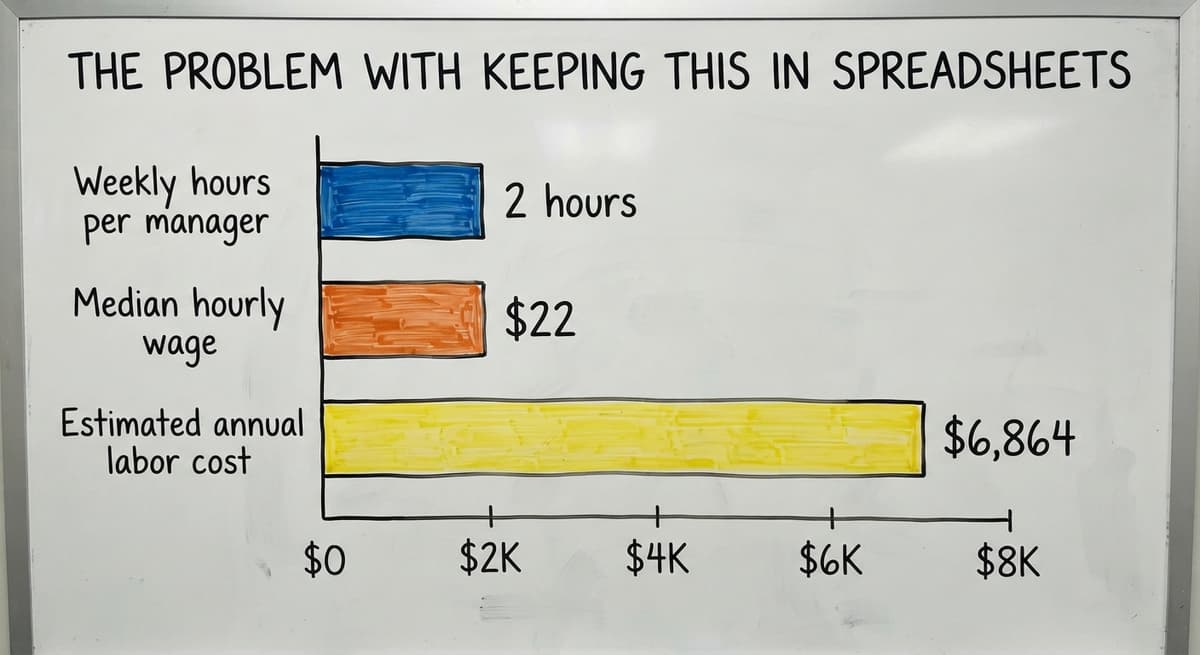
Spreadsheets go stale fast. A person changes roles, earns a new certification, or leaves. The file does not update itself. 3 managers each spending 2 hours a week reconciling stale staff records, at a median wage of $22 an hour, costs roughly $6,864 a year in labor alone. That figure uses the US Bureau of Labor Statistics wage data for related occupations at bls.gov/oes/current/oes435071.htm. The real cost is higher once you count the decisions made on bad data.
When Siloed People-Data Hits the Operation
When people-data sits in a file that is separate from your order management, your shipping workflow, and your scheduling, it cannot inform any of those systems. The gap is invisible until a missed shipment or a compliance issue makes it visible. At that point, the cost is no longer theoretical.

What a Connected System Does Differently
Custom working software can embed your HR inventory directly into the workflow. Not as a standalone HR module that someone has to open separately, but as a live layer that the rest of your operation reads from.
When a pick ticket is generated, the system checks who is trained on the required equipment, who is available on that shift, and who is already assigned. A supervisor does not have to remember. The system holds that knowledge and surfaces it at the moment it is needed.
Filling the Gap Your Accounting Software Was Never Built to Handle
This is the practical difference between a static list and a working part of your business. The list tells you what was true when someone last updated it. The connected system tells you what is true right now.
For operations already running on an established accounting package for payroll and financials, the path is not to replace that accounting package. Your accounting software does what it does well. The gap is the working people-data that an accounting tool was never built to handle: certifications, equipment assignments, shift capacity, and succession readiness. Custom working software for wholesale distributors fills that gap without forcing you to rebuild your entire financial setup. The NIST Manufacturing Extension Partnership offers vendor-neutral guidance on supply chain and working process design at nist.gov/mep/supply-chain. The consistent finding is that connected data outperforms siloed data every time.
Not sure this is the right shape for your operation
Describe how the work runs today. We map it on a call and show you what it would look like built around that, before you spend anything.
Book a callSigns Your HR Inventory Needs a Better System
Some working problems look like staffing problems. Most of them are actually data problems. Here are 4 signs the current approach is costing you more than you realize:
- One person holds all the knowledge about who can operate which equipment, and when that person is out, nobody else can answer the question.
- Onboarding a new hire means a walking tour and hoping someone explains the process, because no structured record exists to hand them.
- Managers spend time hunting for information that should be at their fingertips: who is certified, who is available, who has done this task before.
- Peak season exposes gaps you did not see coming, because there was no clear picture of capacity before the volume arrived.

Capacity Gaps Carry Regulatory Weight
These are working problems, not HR problems. They have working solutions. Replacing Excel and Access databases with connected software is not a technology upgrade for its own sake. It is a fix for the specific, measurable cost of not knowing what your team can do.
The FTC's guidance on order fulfillment obligations at ftc.gov/business-guidance/resources/business-guide-ftcs-mail-internet-or-telephone-order-merchandise-rule is a useful reminder that shipping when you said you would is not optional. Capacity gaps that cause missed shipments carry regulatory weight, not just working inconvenience.
How Do You Take the Next Step With Your HR Inventory?
The most valuable version of a management and non-managerial human resources inventory is one that is live, accurate, and connected to how work actually gets done.
For wholesale distributors and warehouses running on spreadsheets, the path forward is not a large ERP system that takes 18 months to stand up. It is custom software built around your existing operation, your team size, and your budget. Integrating your accounting software with your warehouse operations keeps your financials where they are. The new layer handles the working people-data that was never tracked properly in the first place.

Starting Small With Workflow Automation
Workflow automating for fulfillment centers can start small. A single connected record of who can do what, visible to every manager who needs it, is already a large step forward from a shared folder that nobody updates.
If you can describe how your operation works today, that is enough to start the conversation. Reach out, walk through your current setup, and explore whether a connected system makes sense for your team. No pressure, no pitch. Just a practical look at whether the fit is there.
Frequently asked questions
What is a human resource inventory?
A human resource inventory is a structured record of every person in an organization. It captures job titles, skills, certifications, experience, and capacity for each employee. The goal is to give managers a clear, current picture of what their team can do, not just who is on payroll. Most organizations split the record into management staff and non-managerial staff, because the two groups carry different risks and different data needs.
What is personnel management?
Personnel management is the practice of overseeing the people in an organization: hiring, training, assigning work, tracking performance, and planning for future needs. It is broader than HR administration. In a warehouse or distribution setting, personnel management includes knowing who is certified to operate which equipment, which shift lead has authority to approve exceptions, and whether the team has enough trained capacity to handle a volume spike.
What are the 7 C's of HR?
The 7 C's of HR is a framework sometimes taught in HR programs. The specific list varies by source, but common elements include competency, commitment, contribution, communication, congruence, cost-effectiveness, and creativity. For warehouse and distribution operators, the most actionable of these are competency (what each person can actually do) and cost-effectiveness (whether the staffing model matches the work volume). The framework is a useful lens, but the practical starting point is always an accurate record of who is on your team and what they are trained for.
Can you give me some examples of non-managerial employees?
In a warehouse or distribution center, non-managerial employees include order pickers, forklift operators, packers, receiving clerks, shipping associates, and customer service representatives. These are the people who carry out the day-to-day tasks that move product. They are distinct from supervisors and team leads, who direct the work rather than perform it directly. Both groups appear in a complete HR inventory, but the data tracked for each group differs.
What is the difference between a management inventory and a non-managerial inventory?
A management inventory tracks the people who make decisions: supervisors, team leads, operations managers, and owners. It records decision-making authority, the teams each person oversees, and whether they are ready to handle more responsibility. A non-managerial inventory tracks the people who carry out tasks: pickers, packers, drivers, and clerks. It records certified skills, equipment training, shift availability, and tenure. The two are tracked separately because they carry different replacement costs and different working risks.
Why do wholesale distributors need a separate HR inventory from their accounting software?
Accounting software tracks payroll and financials. It was not built to record certifications, equipment assignments, shift capacity, or succession readiness. Those working details live outside the accounting layer, and when they are stored in a spreadsheet or someone's memory, they cannot inform decisions about staffing, workflow, or peak-season planning. A separate working HR inventory, connected to the rest of the workflow, fills that gap without replacing the accounting tools already in place.
When does an HR inventory become an working tool rather than just an HR document?
An HR inventory becomes an working tool when it is live, connected to the workflow, and readable by the systems that assign tasks and plan capacity. A static spreadsheet is a document. A connected record that tells a pick-ticket system who is trained and available on the current shift is an working tool. The difference is not the data itself. It is whether the data is isolated or integrated into how work gets done.
Start with a free first look
A 30 minute call, your operation mapped, and a clear picture of what we would build. No obligation and nothing to install.
Book a callRelated guides
The rest of this guide, for the parts of the job this page does not cover.
Guides
- Multi Location Inventory Management Software
- Inventory Management for Multiple Locations
- Inventory Management System for Manufacturing
- Inventory Management Pics
- B2b Inventory Management
- Jewelry Inventory Management
- Dental Inventory Management
- The Objective of Inventory Management is To
Common questions
- What is the Difference Between Aggregate and Item Inventory Management
- What is Inventory Management and Its Types
- What is the Main Purpose of Inventory Management
- What is Information Technology Inventory Management
- What is Risk Pooling in Inventory Management
- What is Stock Taking in Inventory Management
- What is Bin Number in Inventory Management
- What is Inventory Management and Why is It Important
- What is Inventory Listing
- What is Inventory
- What is the Best Warehouse Inventory Management System?
- What is the Difference Between Warehousing and Inventory Management
- What is B Type of Inventory in Warehouse Management
- What is Warehousing and Inventory Management
- What is the Best Inventory Management Software for Small Business
- What is the Best Inventory Management System for Small Businesses?