


What Is The Importance Of Quality Inventory Management
Quality inventory management keeps your business from bleeding cash, losing orders, and making decisions based on wrong numbers. For a small wholesale distributor or fulfillment center, it means knowing exactly what you have, where it is, and when to reorder. That single ability protects revenue, controls costs, and lets your team work from facts instead of guesses. Reviewed and updated: October 2026.
Book a callWhy Inventory Management Matters for Wholesale Distributors
Inventory is usually the largest asset a wholesale distributor carries. It sits on shelves, ties up cash, and moves in and out every day. When inventory control breaks down, the damage shows up fast: lost sales, excess stock, and cash that cannot be used anywhere else.
Quality inventory management connects every part of the operation. Purchasing, fulfillment, and finance all depend on the same stock data. When that data is wrong, every team downstream makes decisions based on fiction.
This is not a back-office task. It is the working core that everything else runs on. Getting it right is one of the highest-use moves a small distributor can make.
We build it for your operation, and the first look is free
If you would rather not compare products, describe how your operation already works and we build the system around it.
No build cost. You see it running on your own process first, and the monthly subscription starts only once it is live.
Book a callKnowing What You Have at All Times
Real-time inventory visibility is the foundation of every other benefit on this list. Without it, your team oversells stock that is not there, creates backorders, and burns time walking the warehouse to verify counts manually.
Accurate, live counts mean staff spend their time picking and packing, not checking shelves. A single source of truth replaces the guesswork that comes from juggling spreadsheets and printed pick lists that were accurate three days ago.
Real-time stock visibility is not a luxury for large operations. It is the baseline that prevents overselling, backorders, and the customer complaints that follow both.
How Barcode Standards Turn Physical Counts Into Live Records
The scan-based systems that make real-time visibility possible rely on barcode standards. As GS1 explains, barcodes are the global language of business, enabling products to be identified, tracked, and traced anywhere in the world. That spotting layer is what turns a physical count into a live digital record your whole team can trust.
Reducing Costly Errors and Shrinkage
How does poor inventory management cause errors in a warehouse?
Poor inventory management causes errors because staff work from unreliable data, which leads to mispicks, duplicate entries, and receiving mistakes that compound over time. In high-volume operations, each small error adds cost. A picker who pulls the wrong SKU triggers a return, a reshipment, and a frustrated customer.
Shrinkage from miscounts, theft, or damaged goods is also harder to catch when records are already messy. An audit trail built into your inventory process makes discrepancies visible the day they happen, not weeks later when a customer calls.
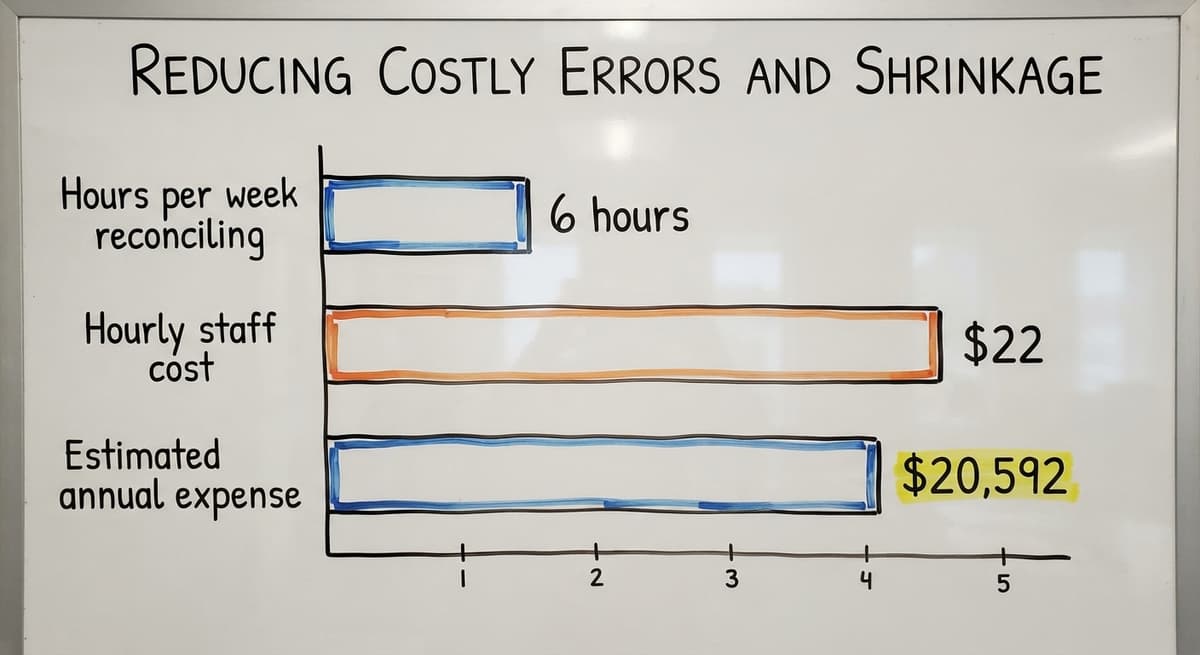
Consider the labor cost alone. If 3 staff members each spend 6 hours a week reconciling counts manually at $22 an hour (near the median for stock clerks tracked by the US Bureau of Labor Statistics), that is $20,592 a year spent on a problem that better records would remove.
Keeping Cash Flow Healthy
Overstocking ties up cash that could fund growth or cover operating costs. Understocking triggers rush orders and premium freight charges that eat into margin. Both problems stem from the same root: not knowing the right quantity to carry.

The US Census Bureau's Monthly Wholesale Trade data tracks the inventories-to-sales ratio across wholesale firms, and even small swings in that ratio represent large capital sitting idle on shelves.
Quality inventory management helps operators stock the right quantities at the right time. Reorder points and lead-time tracking give purchasing a target to hit rather than a gut feeling to act on, and that discipline directly improves how much working capital stays available.
How does poor inventory management hurt cash flow?
Poor inventory management forces two kinds of spending at once: capital locked in overstock that does not sell, and emergency costs from stockouts that need rush freight. Both drain cash. The fix is not spending more. It is knowing your numbers well enough to buy what you need, when you need it.
The comparison is easier when one option is built for you
Off-the-shelf means fitting your process to the software. We do it the other way round, and the first look costs nothing.
Book a callFulfilling Orders Faster and More Accurately
Customers expect fast, accurate shipments. Errors damage relationships and invite chargebacks. The FTC's Mail, Internet, or Telephone Order Merchandise Rule needs sellers to ship by the date promised or notify the buyer. Accurate inventory data is what makes that promise keepable.
When inventory data is clean, pick-and-pack teams work from reliable information. They pull the right item, the right quantity, and the right destination the first time. That cuts reshipment costs and keeps customers coming back.

What Clean Inventory Data Enables at Every Fulfillment Stage
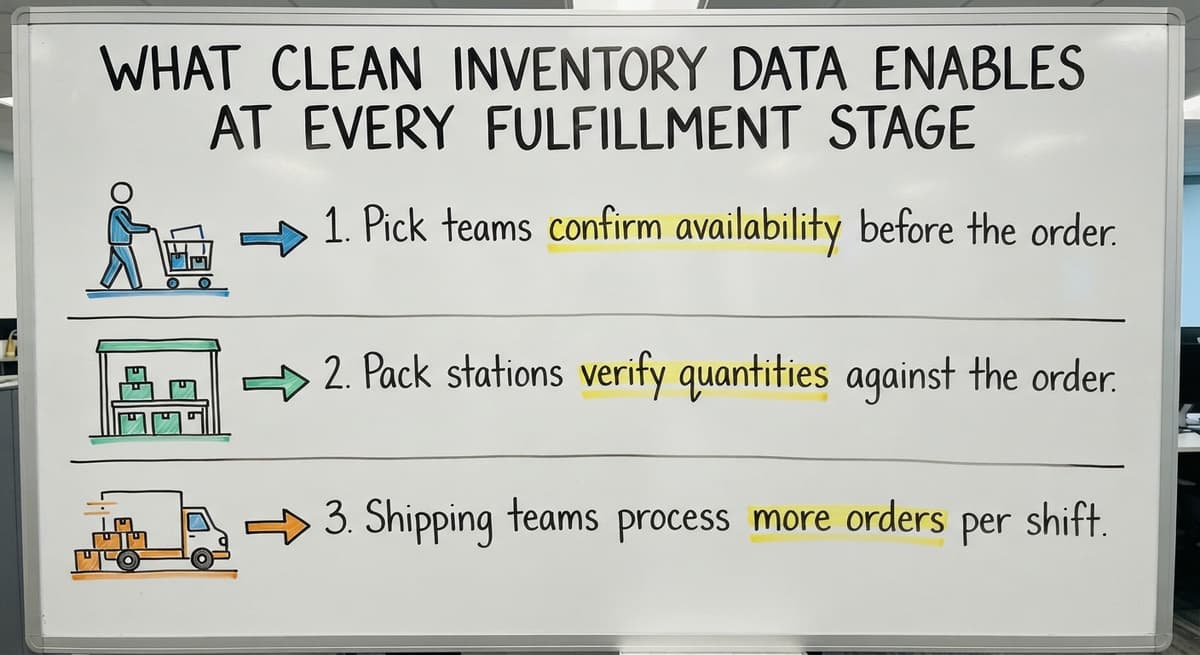
Fulfillment accuracy is a direct competitive advantage for distributors. Here is what clean data enables:
- Pick teams confirm availability before the order leaves the queue, not after a mispick.
- Pack stations verify quantities against the order without a manual recount at the bench.
- Shipping teams process more orders per shift because exceptions drop sharply.
Faster, more accurate fulfillment is not a technology story. It is what happens when your team has trustworthy numbers to work from.
Supporting Smarter Purchasing Decisions
Historical inventory data reveals which SKUs move fast and which sit on the shelf for months. That visibility turns purchasing from a gut-feel exercise into a data-driven process.
Reorder points set a minimum stock level that triggers a buy order automatically, or at least flags the need clearly. Lead-time tracking pairs with that to account for how long a supplier actually takes to deliver, not how long they say they will.
The NIST Manufacturing Extension Partnership offers vendor-neutral guidance on supply chain process, and a consistent theme is that decisions made from historical data outperform decisions made from experience and memory alone.

Putting Data-Driven Purchasing Into Practice
For operations managers who currently rely on what they remember about a supplier or a product's movement, this is the most practical shift quality inventory management enables:
- Fast-moving SKUs get higher reorder points so stockouts stop happening.
- Slow-moving SKUs get smaller buys so overstock stops accumulating.
- Supplier lead times get tracked so rush orders become the exception, not the routine.
When purchasing runs on data instead of instinct, both overbuying and emergency buying drop at the same time.
See it running on your own process first
No build cost. The subscription starts once it is live and doing the job, not before.
Book a callStaying Accurate Without a Big ERP
Many small and mid-size distributors assume good inventory control needs a massive, expensive system and a year of painful migration. That assumption keeps a lot of operations stuck on spreadsheets longer than they need to be.
Custom inventory software built around how your operation already works can deliver the same accuracy without forcing you to abandon your current setup. Your accounting package can stay in place for financials while a purpose-built layer handles the inventory detail, the warehouse locations, and the receiving workflow.
How custom software integrates with your existing accounting software is a common question, and the short answer is: the two systems share data through a clean connection so nothing gets entered twice. Your books stay accurate and your warehouse data stays current.

Why Inventory Records Are a Legal Obligation, Not Just a Best Practice
The IRS is direct on why inventory records matter legally. IRS Publication 538 states: "To figure taxable income, you must value your inventory at the beginning and end of each tax year." That obligation exists whether you use a spreadsheet or a purpose-built system. The question is only how much manual work it takes to meet it.
A system built around your operation removes that manual work without requiring you to change how you buy, sell, or account for goods.
Common Signs Your Inventory Process Needs an Upgrade
Most operations do not decide to improve inventory control because things are going well. They decide because a pattern of small problems becomes impossible to ignore. These are the signs worth recognizing:
- Stock discrepancies surface only after a customer complaint, not during a routine check.
- Inventory data lives in multiple spreadsheets that do not always match each other.
- Purchasing decisions depend on memory or reports printed days ago.
- Orders sit delayed because no one can confirm with certainty what is in the warehouse.
- Cycle counts take an entire weekend because records and reality drift apart between counts.
- New staff cannot learn the system quickly because the system is a collection of workarounds.

What Those Signs Actually Mean for Your Operation
None of these problems mean the team is failing. They mean the process has outgrown the tools. Replacing Excel and Access databases with purpose-built software is not a criticism of how you got here. It is the next logical step for an operation that has grown.
Inventory management software for wholesale distributors does not have to mean a full ERP replacement. It means adding the layer that your current tools were never built to handle.
How Do You Take the Next Step Toward Quality Inventory Control?
The next step is identifying which gap costs you the most right now: visibility, accuracy, cash tied up in overstock, slow fulfillment, or purchasing decisions made without data. Start there, because fixing one gap often closes others at the same time.
Quality inventory management delivers five things: live stock visibility, fewer errors, healthier cash flow, faster fulfillment, and smarter buying. None of them need abandoning the tools you already use or enduring a long rollout.
Custom warehouse software built around your operation is designed for exactly this situation. It fits your workflow, connects to your accounting package, and gives your team reliable data from day one.
If your current process shows any of the signs above, the gap between where you are and where you need to be is smaller than it looks.
Frequently asked questions
Why do we manage inventory?
Inventory management keeps stock levels matched to real demand so a business can fill orders, control costs, and keep accurate financial records. The IRS needs businesses to value inventory at the start and end of each tax year, so accurate records are a legal obligation as well as an working one. Beyond compliance, managing inventory prevents the two most common cash drains: money tied up in overstock and revenue lost to stockouts.
Is inventory management a hard skill?
Yes. Inventory management is a hard skill that includes reading stock reports, setting reorder points, running cycle counts, and reconciling physical counts against system records. It also involves understanding lead times, carrying costs, and how purchasing decisions affect cash flow. These are learnable, specific competencies, not general business sense. Good tools make the skill easier to apply consistently, but the judgment behind the numbers still needs training and practice.
What method of inventory management allows the inventory to respond to demand and is most efficient for managing inventory?
There is no single best method. The right approach depends on your product mix, order volume, and supplier reliability. Demand-driven replenishment, which sets reorder points based on actual sales velocity rather than fixed schedules, works well for operations with consistent order patterns. Just-in-time works where supplier lead times are short and predictable. ABC analysis, which ranks SKUs by revenue contribution, helps focus attention on the items that matter most. Most small distributors benefit from a combination of demand-based reorder points and regular cycle counts rather than any single named method.
What are some effective techniques for controlling inventory?
The most effective techniques for most small distributors are: setting reorder points based on actual sales data rather than estimates; running cycle counts on a rotating schedule instead of one large annual count; using barcode scanning at receiving to catch errors before they enter the system; and keeping a single record of truth rather than multiple spreadsheets. Each technique works better when the others are in place, because accuracy in one part of the process depends on accuracy everywhere else.
Can a small operation achieve accurate inventory control without a large ERP system?
Yes. A purpose-built inventory layer that connects to an existing accounting package gives a small distributor the accuracy of a larger system without the cost or disruption of a full ERP migration. The key is software designed around how the operation actually works, not a generic platform that needs the operation to change its process to fit the software.
How does inventory management affect order fulfillment speed and accuracy?
Clean inventory data lets pick-and-pack teams work from reliable counts the first time. They pull the right item and quantity without stopping to verify against a physical shelf. That removes the most common source of delay and mispicks. Faster, more accurate fulfillment also reduces returns, reshipments, and the customer complaints that follow a wrong or late order.
What is the importance of quality inventory management for a small wholesale distributor?
For a small wholesale distributor, quality inventory management is the difference between knowing what to buy, when to ship, and how much cash is available, versus guessing at all three. It protects revenue by preventing stockouts, controls costs by avoiding overstock, and keeps fulfillment accurate enough to retain customers. At small scale, there is less margin to absorb errors, which makes the discipline more important, not less.
Can your current accounting software stay in place while adding better inventory management?
Yes. A purpose-built inventory system can connect directly to your accounting software so financial records stay current without double entry. The inventory layer handles warehouse locations, receiving, and stock counts while the accounting package handles invoicing and reporting. The two systems share data through a clean integration, so the team gets better warehouse data without changing how the books are kept.
Start with a free first look
A 30 minute call, your operation mapped, and a clear picture of what we would build. No obligation and nothing to install.
Book a callRelated guides
The rest of this guide, for the parts of the job this page does not cover.
Guides
Common questions
- What is Inventory Management and Its Importance
- What is the Difference Between Aggregate and Item Inventory Management
- What is Abc Classification in Inventory Management
- What is Inventory Management and Its Types
- What is the Main Purpose of Inventory Management
- What is Information Technology Inventory Management
- What is Risk Pooling in Inventory Management
- What is Inventory Management Mary Kay
- What is Stock Taking in Inventory Management
- What is Bin Number in Inventory Management
- What is the Goal of Inventory Management Quizlet
- What is the Implication of Proper Inventory Management
- What is Mean by Inventory Management
- What is Inventory Management and Why is It Important
- What is the Management and Non Managerial Human Resources Inventory
- What is Inventory Listing
- What is Inventory
- What is the Best Warehouse Inventory Management System?
- What is the Difference Between Warehousing and Inventory Management
- What is B Type of Inventory in Warehouse Management
- What is Warehousing and Inventory Management
- What is the Best Inventory Management Software for Small Business
- What is the Best Inventory Management System for Small Businesses?