


What Is The Implication Of Proper Inventory Management
Reviewed and updated: October 2026
Proper inventory management means your operation always knows what it has, where it is, and how fast it moves. The implications are direct: fewer stockouts, lower carrying costs, faster order fulfillment, cleaner financial records, and the ability to grow without adding staff at the same rate. For a small wholesale or distribution business, getting this right is one of the highest-return changes you can make.
Book a callWhy Proper Inventory Management Matters More Than Most Operators Realize
Inventory is the core asset of any wholesale, distribution, or warehousing operation. It sits on your balance sheet, moves through your warehouse, and either earns revenue or eats cash. When stock levels are off, the damage spreads fast. Missed orders frustrate customers. Excess stock ties up cash. Staff waste hours chasing counts that should already be in the system.
Most operators feel these problems daily but do not always trace them back to inventory management. This article names each implication clearly so you can see where the real cost is coming from and what a practical fix looks like.
We build it for your operation, and the first look is free
If you would rather not compare products, describe how your operation already works and we build the system around it.
No build cost. You see it running on your own process first, and the monthly subscription starts only once it is live.
Book a callImplication 1: Fewer Stockouts and Fewer Overstock Situations
Stockouts cost you twice. First, you lose the sale. Second, you risk losing the customer. A buyer who orders from you and gets a backorder notice will look elsewhere next time. Overstock is the opposite problem: cash locked in product that is not moving, taking up shelf space and collecting dust.
Proper inventory management keeps stock in the right range. Real-time inventory visibility is the foundation. When your system reflects actual counts at all times, reorder points trigger before shelves run empty. GS1, the global standards body behind barcode systems, states that standardized barcodes are "the foundation for accurate, real-time data exchange across the supply chain," which is exactly the kind of data that prevents both stockouts and overstock.
Why This Balance Matters Most for Multi-Location Distributors
For distributors managing dozens or hundreds of SKUs across multiple locations, this balance is not optional. It is the difference between a reliable operation and a reactive one.
How Does Poor Inventory Management Hurt Cash Flow and Profitability?
Carrying costs eat profit quietly. Every dollar tied up in unsold stock is a dollar you cannot reinvest. Storage space costs money. Insurance covers the inventory sitting in it. Spoilage and obsolescence write off product you already paid for. The opportunity cost, meaning the return you could have earned on that cash elsewhere, is real even if it never shows up as a line item.

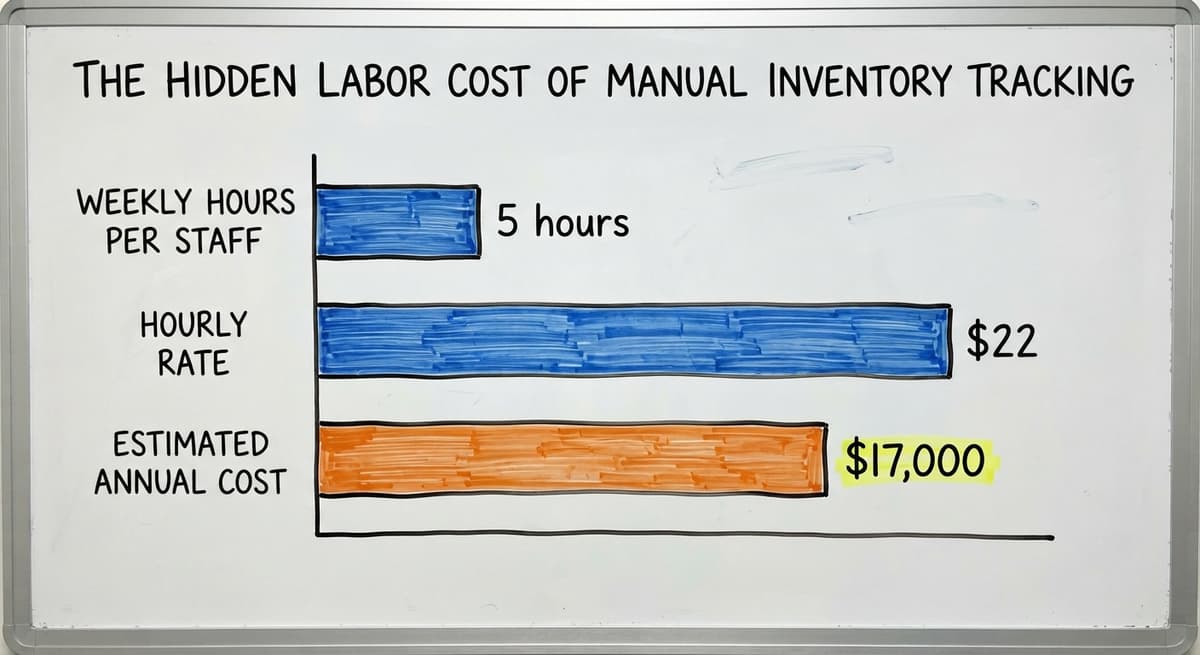
The Hidden Labor Cost of Manual Inventory Tracking
Operations running on spreadsheets and printed sheets often miss these costs entirely because no one is measuring them. 3 staff members spending 5 hours each per week on manual inventory tracking, at $22 an hour (the median rate for stock clerks according to the US Bureau of Labor Statistics), costs your operation over $17,000 a year before you count a single dollar of carrying cost. Accurate data on what you hold and for how long is the first step to bringing both numbers down.
The comparison is easier when one option is built for you
Off-the-shelf means fitting your process to the software. We do it the other way round, and the first look costs nothing.
Book a callImplication 3: Faster, More Accurate Order Fulfillment
Customers expect orders to ship when you said they would. The US Federal Trade Commission needs merchants to ship by the date promised or notify the buyer promptly when that is not possible. An accurate inventory count is what makes that promise keep-able.
When warehouse staff know exactly where items are and how many are on hand, picks go faster and errors drop. Short shipments and wrong items sent trace back almost every time to stale or inaccurate inventory data. Clean, current data turns order fulfillment from a daily scramble into a repeatable process.
What Picking Errors Actually Cost
Every wrong shipment triggers a return, a replacement, and a support interaction. Each one burns staff time and damages trust. When inventory tracking is reliable, picking accuracy rises because the system confirms what is available before the order is released. Fulfillment speed becomes a competitive edge rather than a source of daily stress.
Implication 4: Better Purchasing and Supplier Relationships
Buying decisions improve when they come from real usage data. When you know how fast each SKU moves and where stock currently sits, reorder points can be set so buys trigger automatically before you run short. That removes the scramble for rush orders, which cost more and strain supplier goodwill.

Suppliers respond better to buyers who order consistently and predictably. A purchasing manager with clean inventory data can negotiate volume pricing, plan seasonal buys, and commit to delivery windows with confidence. The NIST Manufacturing Extension Partnership notes that strong supply chain performance depends on reliable internal data flowing to external partners. Your inventory system is where that data starts.
Setting Reorder Points That Actually Work
A reorder point is the stock level that triggers a new buy order. Set it too high and you overstock. Set it too low and you run out. The right number comes from your actual sales velocity and your supplier's lead time. Proper inventory management gives you both figures, automatically, so reorder points stay calibrated as demand shifts.
Implication 5: Cleaner Financial Reporting
Inventory value sits on your balance sheet. Inaccurate counts mean inaccurate books, and inaccurate books create problems at tax time and when owners need a clear picture of what the business owns. The IRS is direct on this point: IRS Publication 538 states, "To figure taxable income, you must value your inventory at the beginning and end of each tax year."
Operations that use an accounting package for financials get the most benefit when the inventory data feeding into it is reliable. Accounting software integration for warehouse operations works well when counts are clean. When they are not, accountants spend hours on manual adjustments and year-end write-offs that should not exist. Proper management reduces that work and gives owners a balance sheet they can trust.

Implication 6: Scalability Without Adding Headcount
As order volume grows, manual inventory tracking breaks down. Staff spend more time chasing counts, correcting errors, and updating spreadsheets than doing work that moves product. The workload scales with volume, but the accuracy does not.
A proper system handles more SKUs and more transactions without requiring proportional staff increases. For operations with 5 to 100 staff, this gap is where controlled growth separates from working chaos. The US Census Bureau's Monthly Wholesale Trade data shows that inventories-to-sales ratios shift across economic cycles, meaning the pressure on your system is not constant. A manual process that barely works in a slow month will collapse in a busy one.
See it running on your own process first
No build cost. The subscription starts once it is live and doing the job, not before.
Book a callWhat Scalability Frees Your People to Do
Automating routine tracking tasks frees your people to do higher-value work: building supplier relationships, improving receiving accuracy, and supporting customers. That is a return on the system investment that shows up in payroll efficiency, not just inventory accuracy.
Replacing Excel and Spreadsheets With Inventory Software
Spreadsheets are not wrong, they are just the wrong tool once your SKU count and transaction volume grow past a certain point. Replacing Excel and spreadsheets with inventory software does not mean throwing out everything you know. It means giving your team a system that updates in real time, flags discrepancies automatically, and does not depend on one person remembering to save the file.

What Proper Inventory Management Looks Like in Practice
A practical system does not need a full ERP overhaul or a months-long rollout. Many distributors and warehouses already use an accounting package for financials. The gap is usually in real-time inventory visibility and day-to-day workflow, not in the financial layer.
The right approach connects what already works with the parts that currently run on email threads, printed pick sheets, and shared spreadsheets. Inventory management software for wholesale distributors built around your existing process is faster to adopt and less disruptive than a platform that forces staff to learn a new way of doing everything.
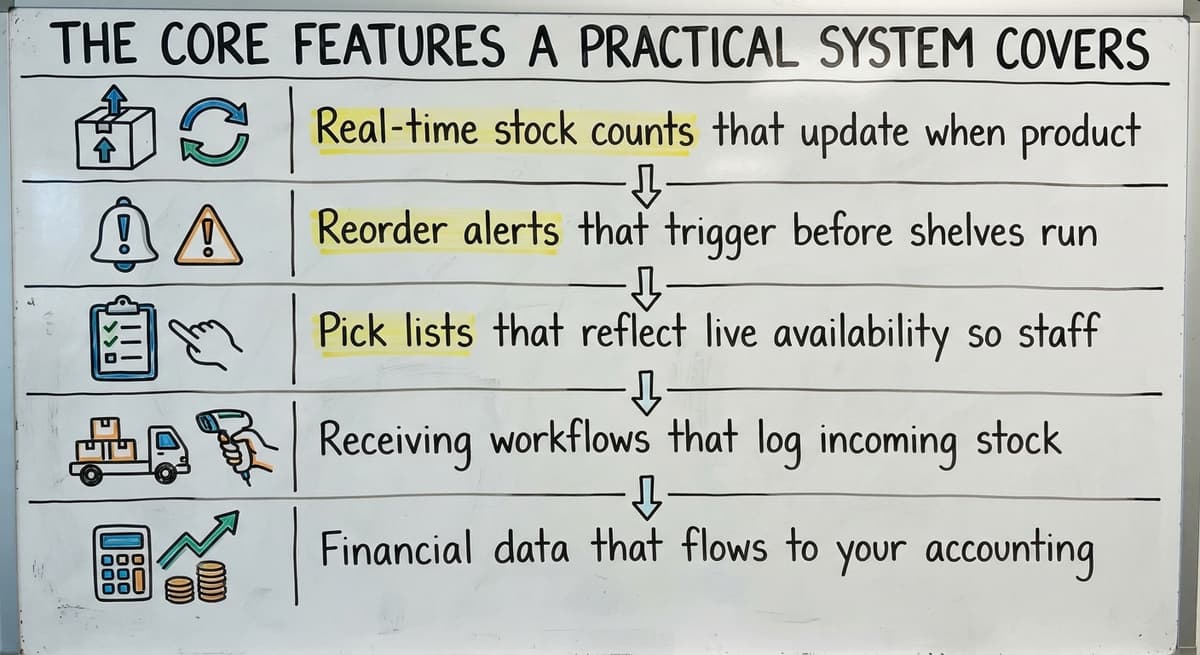
The Core Features a Practical System Covers
Here is what a practical system covers:
- Real-time stock counts that update when product moves, not when someone remembers to enter it
- Reorder alerts that trigger before shelves run empty, based on your actual sales pace
- Pick lists that reflect live availability so staff are not chasing product that is already gone
- Receiving workflows that log incoming stock correctly the moment it arrives
- Financial data that flows to your accounting package without manual re-entry
The goal is accurate data, less manual work, and faster decisions. Complexity is not the measure of a good system. Outcomes are.

How Do You Take the Next Step Toward Proper Inventory Management?
Start by identifying where inventory data currently breaks down in your operation. Common failure points include stockouts that caught you by surprise, overstock that sat for months, picking errors that triggered returns, or financial discrepancies that took hours to reconcile. Each one points to a gap in your current tracking process.
Choosing a Solution That Fits Your Scale and Workflow
The right solution fits your scale and your workflow. Custom working software for warehouses built around how you already operate is faster to implement and easier for staff to adopt than a system that needs you to change everything at once. Warehouse management for small and mid-size operations does not have to mean a platform designed for a 500-person distribution center.
A local, rollout-focused partner can build around your existing processes, connect your accounting package, and close the gaps without replacing what already works. If you can describe where your inventory data breaks down today, that is enough to start a useful conversation about what a better system could look like for your specific operation.
Frequently asked questions
What is the implication of proper inventory management for a small wholesale or distribution business?
For a small wholesale or distribution business, proper inventory management means fewer stockouts, lower carrying costs, faster order fulfillment, and cleaner financial records. It also means the business can handle more orders without adding staff at the same rate, which directly protects profit margins as volume grows.
How does poor inventory management hurt cash flow?
Poor inventory management ties cash up in slow-moving stock, creates carrying costs for storage and insurance, and forces rush buys when items run out unexpectedly. It also generates write-offs at year-end when obsolete product has to be removed from the books. Each of these drains cash that could be reinvested in the business.
What happens to order fulfillment accuracy when inventory data is unreliable?
When inventory data is unreliable, picking errors rise, short shipments increase, and orders go out late or incomplete. Every wrong shipment triggers a return and a replacement, which costs staff time and damages the customer relationship. Clean, current inventory data is the single most effective way to improve fulfillment accuracy.
How does proper inventory management affect purchasing and supplier relationships?
Accurate inventory data lets purchasing managers set reorder points based on real sales velocity rather than guesswork. That means orders go out consistently and predictably, which suppliers respond to with better pricing and priority service. It also removes the cost and friction of emergency rush orders.
Can a small operation with 5 to 100 staff benefit from proper inventory management without a big ERP system?
Yes. Most small operations already have an accounting package handling financials. The gap is usually in real-time stock visibility and day-to-day workflow. A system built around your existing process, rather than one that replaces everything, can close that gap without a long or expensive rollout.
How does inventory management connect to financial reporting in your accounting software?
Inventory value is a balance sheet item. When stock counts are inaccurate, the numbers flowing into your accounting package are inaccurate too. Clean inventory data reduces manual adjustments, removes year-end write-off surprises, and gives owners and accountants a balance sheet they can rely on.
How can a warehouse or fulfillment center scale without constantly adding headcount?
Automating routine inventory tracking tasks means staff spend less time chasing counts and correcting errors. A system that updates in real time handles more SKUs and more transactions without proportional increases in labor. That is how operations grow volume without growing payroll at the same pace.
Start with a free first look
A 30 minute call, your operation mapped, and a clear picture of what we would build. No obligation and nothing to install.
Book a callRelated guides
The rest of this guide, for the parts of the job this page does not cover.
Guides
Common questions
- What is the Difference Between Aggregate and Item Inventory Management
- What is Abc Classification in Inventory Management
- What is Inventory Management and Its Types
- What is the Main Purpose of Inventory Management
- What is Information Technology Inventory Management
- What is Risk Pooling in Inventory Management
- What is Inventory Management Mary Kay
- What is Stock Taking in Inventory Management
- What is Bin Number in Inventory Management
- What is the Goal of Inventory Management Quizlet
- What is Inventory Management and Its Importance
- What is the Importance of Quality Inventory Management
- What is Mean by Inventory Management
- What is Inventory Management and Why is It Important
- What is the Management and Non Managerial Human Resources Inventory
- What is Inventory Listing
- What is Inventory
- What is the Best Warehouse Inventory Management System?
- What is the Difference Between Warehousing and Inventory Management
- What is B Type of Inventory in Warehouse Management
- What is Warehousing and Inventory Management
- What is the Best Inventory Management Software for Small Business
- What is the Best Inventory Management System for Small Businesses?