


What Is Inventory Management And Its Importance
Inventory management is the process of tracking what stock you have, where it sits, and when to order more. It covers every step from receiving goods at the dock to shipping them out the door. The records must match the physical goods at all times. When they do, you avoid stockouts, cut waste, and fill orders on time.
Reviewed and updated: October 2026
Book a callWhat Is Inventory Management
Inventory management is how a business controls the goods it buys, stores, and sells. A distributor receives a pallet, logs it into a location, picks from it when an order comes in, and ships it out. Every move should leave a record. That record is what lets a floor manager know what is actually on hand without walking the aisles. Physical movement and the data that tracks it are two sides of the same job.
We build it for your operation, and the first look is free
If you would rather not compare products, describe how your operation already works and we build the system around it.
No build cost. You see it running on your own process first, and the monthly subscription starts only once it is live.
Book a callThe Core Parts of an Inventory Management System
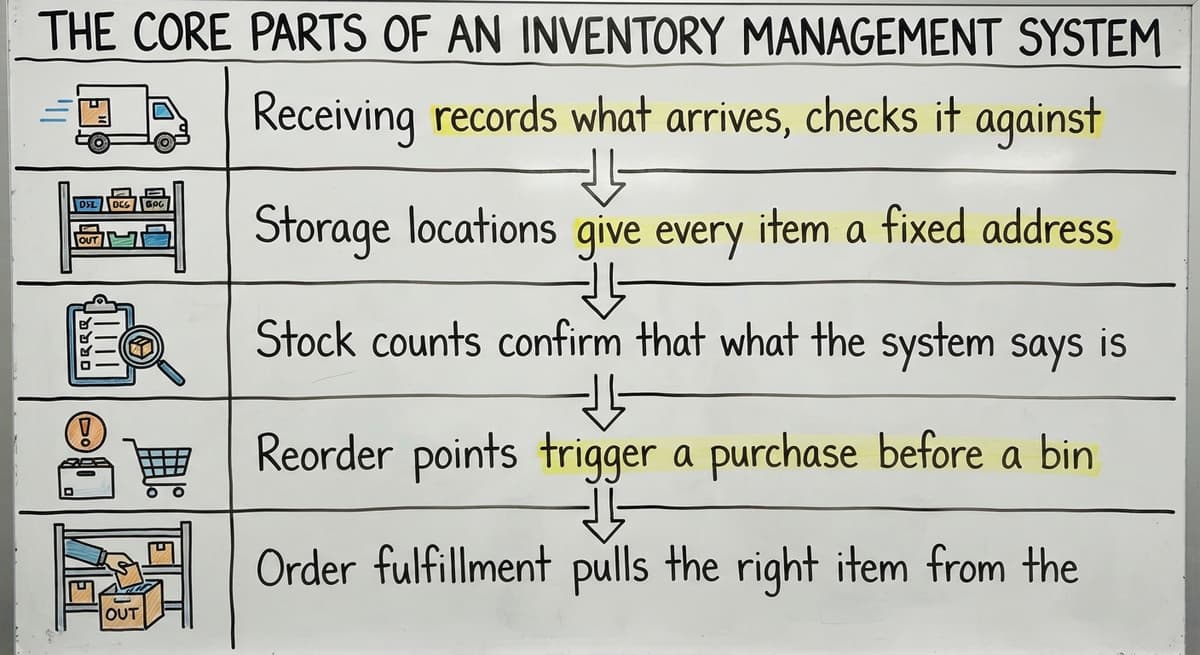
A working inventory system has five connected parts. A gap in any one of them creates errors downstream.
- Receiving records what arrives, checks it against the buy order, and assigns it a location before anything is put away.
- Storage locations give every item a fixed address so pickers do not search and managers can trust the count.
- Stock counts confirm that what the system says is on hand matches what is on the shelf.
- Reorder points trigger a buy before a bin runs empty, not after a customer calls asking where their order is.
- Order fulfillment pulls the right item from the right location and records the reduction in stock automatically.
Why Barcode Standards Make Real-Time Tracking Possible
As GS1 explains, the barcode standards that power scan-based counts are what make real-time stock tracking possible at scale: GS1 Barcode Standards. Without a shared standard, counts drift the moment two people record the same item differently. Each of the five system parts depends on consistent item spotting. A scan at receiving, a scan at the pick location, and a scan at shipment all have to reference the same record for the count to stay accurate.
Why Does Inventory Management Matter for Distributors and Warehouses?
Accurate inventory prevents 2 of the most expensive problems a distributor faces: ordering stock you do not need and running out of stock you do. Both hurt cash flow in opposite directions. Money tied up in slow-moving pallets cannot pay for fast-moving ones. A stockout costs the sale and sometimes the customer relationship.
The comparison is easier when one option is built for you
Off-the-shelf means fitting your process to the software. We do it the other way round, and the first look costs nothing.
Book a call
The Regulatory and Capital Costs of Getting Inventory Wrong
Fulfillment speed and order accuracy are the outcomes customers notice most. A wrong pick reaches the customer as a wrong delivery. A late shipment, under the FTC's Mail, Internet, or Telephone Order Merchandise Rule, must be disclosed and handled at your cost. The US Census Bureau tracks the inventories-to-sales ratio for wholesale firms monthly at Monthly Wholesale Trade, and that ratio shows exactly how much capital the sector has tied up in stock at any given time. Knowing what you have, in real time, is what keeps that ratio from working against you.
The Hidden Cost of Poor Inventory Control
Many small operations run on a spreadsheet, a printed pick sheet, and a chain of emails. That setup feels manageable until it is not.
The costs are real and they compound:
- Lost sales happen when a stockout is invisible until a customer calls. By then, the order may already be going to a competitor.
- Carrying costs rise when overbuying locks cash into slow-moving product that takes up floor space and depreciates.
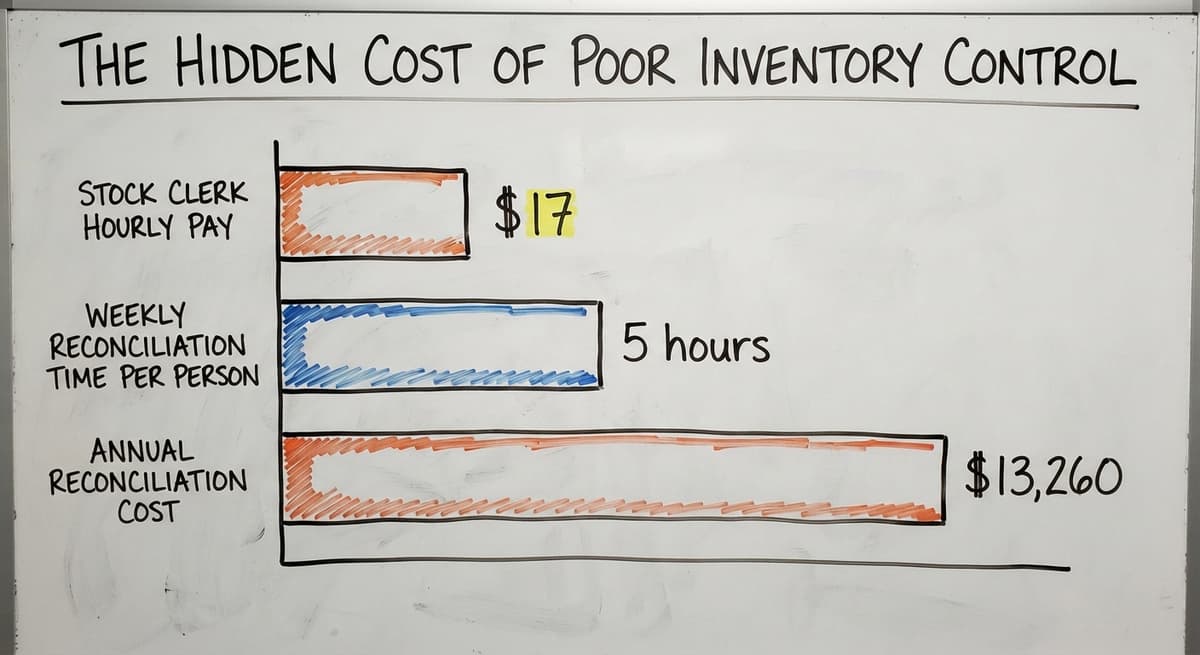
- Staff time spent reconciling counts is expensive. The Bureau of Labor Statistics puts median pay for stock clerks and order fillers near $17 an hour. Three people spending 5 hours a week each on manual matching costs roughly $13,260 a year at that rate, before any errors those counts still contain.

How Manual Inventory Errors Compound Over Time
When an accounting package and a separate spreadsheet fall out of sync, the errors do not cancel out. They stack. A receiving entry missed in one place shows up as a phantom unit in the other. Manual inventory processes do not fail all at once; they drift, slowly, until the damage is visible.
How Inventory Management Connects to Your Other Operations
Inventory data sits at the center of purchasing, fulfillment, and accounting. When stock counts are accurate, a buyer can place the right order at the right time without guessing. When a shipment goes out, the stock record drops automatically, and the invoice can be generated from the same transaction.
See it running on your own process first
No build cost. The subscription starts once it is live and doing the job, not before.
Book a call
Why Inventory Software Sits Alongside Accounting, Not Inside It
Your accounting software handles accounting well. It was not designed to track bin locations, manage reorder points, or flag when a fast-moving SKU is 3 days from empty. As the IRS notes in Publication 538, "To figure taxable income, you must value your inventory at the beginning and end of each tax year." That valuation has to come from somewhere accurate. Inventory management software for small distributors sits alongside the accounting layer, not in place of it. The two systems share data through a clean connection so the accounting package stays current without anyone re-entering numbers. The working layer and the financial layer each do what they were built to do.
Common Inventory Management Methods
Small distributors use a handful of proven methods. Choosing the right one depends on what you sell and how it moves.
Par-Level Replenishment
Par-level replenishment sets a minimum quantity for each item. When stock drops below that number, a buy order is triggered. A janitorial supply distributor might set a par of 50 cases for a fast-moving cleaner. The system flags a reorder before the bin hits zero. Par levels work best when demand is steady and predictable. They need periodic review as sales patterns shift, since a par set during a slow season will trigger unnecessary orders once volume picks up.
FIFO and LIFO
FIFO (first in, first out) means the oldest stock ships first. A food distributor uses FIFO by default because product expires. Most wholesale operations follow FIFO for the same reason: older stock should move before newer stock sits on top of it.
LIFO (last in, first out) works in reverse. It is used in specific tax and accounting situations. For physical warehouse operations, it is far less common.
Cycle Counting vs. Full Physical Counts
Cycle counting means counting a portion of inventory on a rotating schedule, a few bins or SKUs each day, rather than shutting down to count everything at once. A warehouse that cycle counts 20 SKUs daily catches errors before they grow. A full physical count makes sense at year-end or when a cycle count reveals a pattern of discrepancies. Most operations that run cycle counting find they need fewer full counts over time.

Signs Your Current Inventory Process Is Holding You Back
You may not need a consultant to tell you something is wrong. These signs show up on the floor and in the numbers.
- Your staff spends hours each week counting and reconciling instead of picking and shipping.
- Pick errors reach customers often enough that your team expects them.
- A stockout surprises you, even though the item is a regular seller.
- Slow-moving product takes up floor space you need for faster items.
- Your accounting package shows a different quantity than the shelf count, and no one is sure which one to trust.
- Reorders happen reactively, after a problem, rather than automatically, before one.
If more than 2 of these sound familiar, the process is the bottleneck, not the people running it.
Not sure this is the right shape for your operation
Describe how the work runs today. We map it on a call and show you what it would look like built around that, before you spend anything.
Book a callWhat Good Inventory Management Looks Like in a Small Operation
Picture a 40-person wholesale distributor. Orders come in by phone, email, and an online portal. The warehouse runs 2 shifts. Stock counts used to take a full weekend. Now a cycle count runs every morning before the first pick.

How a Small Distributor Transitions Without a Long Rollout
When a shipment arrives, a scan at the dock updates the bin location instantly. When a picker pulls an item, the system records it. The buyer sees current stock without asking anyone. Your accounting software receives the invoice data without anyone typing it twice. Replacing spreadsheets and Access databases with working software did not need a large ERP or a 12-month rollout. The system was built around the workflows already in place. Staff learned it in days, not months. The NIST Manufacturing Extension Partnership offers vendor-neutral guidance on building supply chain processes that fit the operation rather than forcing the operation to fit a platform. A system that matches how your team already works gets used; one that fights your workflow gets worked around.
How Can I Improve Inventory Management Without Disrupting How We Already Work?
Start by mapping what you do now, before looking at any tool. Write down every step from receiving to shipment. Note where data is recorded, by whom, and in what format. That map will show you where the gaps are.
Fix the Biggest Pain Point First, Then Build From There
The biggest pain point is usually stock accuracy or reorder timing. Fix the one that costs you the most first. Warehouse management for fulfillment centers and distributors does not have to mean starting over. Custom software for wholesale distribution operations can be built around your current workflows, keeping your existing accounting software in place and replacing only the manual parts that cause errors. There is no ERP migration, no retraining on a system that works differently from the one your team knows. If you want to talk through your specific operation, what it runs on now and where it breaks down, that conversation costs nothing and often surfaces the fix faster than any demo. The right starting point is your current process, not a vendor's feature list.
Frequently asked questions
What are the four main types of inventory management?
The 4 main types are periodic inventory (counting stock at set intervals), perpetual inventory (updating counts in real time with every transaction), just-in-time inventory (ordering only what is needed when it is needed), and consignment inventory (holding goods owned by a supplier until they are sold). Most small distributors run perpetual inventory because it gives the most accurate picture without waiting for a scheduled count.
What is the 80/20 rule in inventory?
The 80/20 rule, sometimes called ABC analysis, holds that roughly 80% of your sales come from about 20% of your SKUs. In practice, that means a small group of items drives most of your revenue and deserves the tightest stock controls and the most frequent cycle counts. The remaining items can be managed less intensively without much risk to the business.
What are the 5 steps of inventory management?
The 5 steps are: (1) receive goods and record them at the dock, (2) assign each item a storage location, (3) track stock levels as items move in and out, (4) set reorder points so purchasing happens before a bin runs empty, and (5) fulfill orders by picking, packing, and shipping while the system records each reduction automatically. Each step feeds the next, so a gap in one creates errors in all the ones that follow.
Can you give me an example of inventory management?
A wholesale cleaning supply distributor receives 200 cases of a floor cleaner. A scan at the dock logs each case to a specific bin. When a customer orders 10 cases, the picker scans the bin, the system drops the count to 190, and the invoice is generated from the same transaction. When the count hits the reorder point of 50 cases, a buy order is triggered automatically. No one has to check a spreadsheet or remember to reorder.
Do I need a large ERP to manage inventory properly?
No. A large ERP is built for operations with hundreds of users, complex multi-entity accounting, and long rollout timelines. A 10-to-80-person distributor rarely needs that. A custom-built inventory system that connects to your existing accounting package can handle receiving, bin locations, reorder points, and order fulfillment without the cost or disruption of a full ERP migration.
How does inventory management connect to your accounting software?
Your accounting software handles accounting well but was not designed to track bin locations, manage reorder triggers, or count stock in real time. A separate inventory system can sit alongside your accounting software and feed it clean data: when a shipment goes out, the inventory system records the reduction and passes the transaction to your accounting software automatically. That removes the double-entry step that causes most matching errors.
What does poor inventory control actually cost a business?
The costs fall into 3 buckets. Lost sales from stockouts that could have been prevented. Carrying costs from overstock that ties up cash and floor space. Staff time spent reconciling counts that still contain errors. At median warehouse wages near $17 an hour, 3 people spending 5 hours a week each on manual matching runs about $13,260 a year, before accounting for the orders that went wrong or the customers who left.
Start with a free first look
A 30 minute call, your operation mapped, and a clear picture of what we would build. No obligation and nothing to install.
Book a callRelated guides
The rest of this guide, for the parts of the job this page does not cover.
Guides
Common questions
- What is Inventory Management and Its Types
- What is the Importance of Quality Inventory Management
- What is the Difference Between Aggregate and Item Inventory Management
- What is Abc Classification in Inventory Management
- What is the Main Purpose of Inventory Management
- What is Information Technology Inventory Management
- What is Risk Pooling in Inventory Management
- What is Inventory Management Mary Kay
- What is Stock Taking in Inventory Management
- What is Bin Number in Inventory Management
- What is the Goal of Inventory Management Quizlet
- What is the Implication of Proper Inventory Management
- What is Mean by Inventory Management
- What is Inventory Management and Why is It Important
- What is the Management and Non Managerial Human Resources Inventory
- What is Inventory Listing
- What is Inventory
- What is the Best Warehouse Inventory Management System?
- What is the Difference Between Warehousing and Inventory Management
- What is B Type of Inventory in Warehouse Management
- What is Warehousing and Inventory Management
- What is the Best Inventory Management Software for Small Business
- What is the Best Inventory Management System for Small Businesses?