


What Is Inventory Management And Why Is It Important
Reviewed and updated: October 2026
Inventory management means knowing what stock you have, where it sits, and how fast it moves. It covers every step from receiving goods to shipping orders. Without it, you run out of things customers need or you buy too much of things they do not. For any wholesale distributor or warehouse, that gap costs real money.
Book a callWhat Is Inventory Management
Inventory management is the practice of tracking stock from the moment it arrives to the moment it ships. You log what comes in, watch what moves, and act before you run short. It applies to every operation that holds physical goods, from a 5-person distributor working out of one building to a 100-person wholesale operation running multiple locations. The IRS makes it a legal obligation, not just a business preference: "To figure taxable income, you must value your inventory at the beginning and end of each tax year," according to IRS Publication 538. Small and mid-size operations need this just as much as large ones do.
We build it for your operation, and the first look is free
If you would rather not compare products, describe how your operation already works and we build the system around it.
No build cost. You see it running on your own process first, and the monthly subscription starts only once it is live.
Book a callThe Core Parts of an Inventory Management System
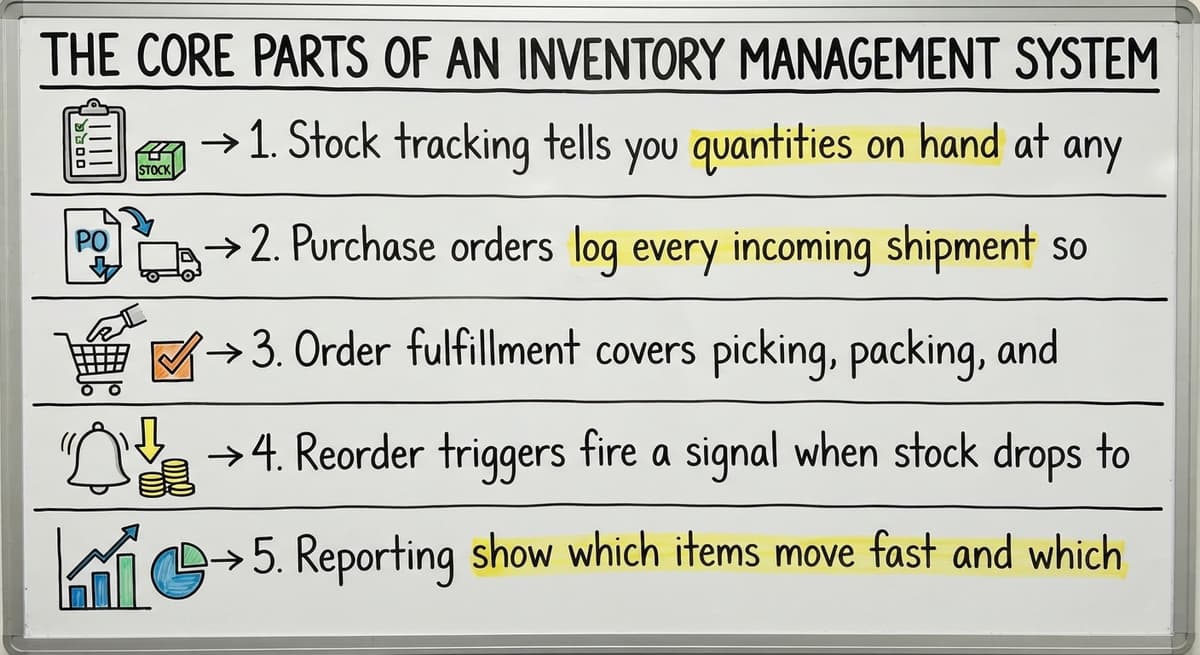
A working inventory system has 5 connected parts. Each one feeds the next.
- Stock tracking tells you quantities on hand at any moment, so no one guesses.
- Buy orders log every incoming shipment so your count stays current when goods arrive.
- Order fulfillment covers picking, packing, and shipping, and each step should reduce your count in real time.
- Reorder triggers fire a signal when stock drops to a set level, called a reorder point, before you run out rather than after.
- Reporting shows which items move fast and which sit, so you buy smarter next cycle.
Scan-based counting ties all 5 parts together. As GS1 explains, "barcodes are the foundation of global supply chain efficiency," and every scan at receiving or at the pick station updates the same count automatically.
Why Is Inventory Management Important for Distributors and Wholesalers?
Inventory management is important for distributors and wholesalers because a wrong count leads directly to lost sales, wasted cash, or broken customer relationships. Stockouts mean a customer orders something you cannot ship. That customer calls a competitor. Overstock means cash sitting on a shelf instead of working. Both problems compound as your order volume grows.
How Inventory Accuracy Drives Purchasing and Growth
Accurate stock levels drive better purchasing decisions. When you know what sold last month, you buy the right amount this month. Faster, accurate order fulfillment builds the kind of trust that turns a first order into a long-term account. The US Census Bureau's Monthly Wholesale Trade data tracks the national inventories-to-sales ratio for wholesale firms, and that ratio moves every month. Operations that track their own numbers can respond to shifts. Operations running on guesswork cannot. Poor inventory visibility is one of the top reasons small distributors struggle to grow past a certain size. The ceiling is not demand. It is the inability to fulfill demand reliably.
What Happens When Inventory Management Breaks Down?
When inventory tracking breaks down, orders ship late, ship wrong, or do not ship at all. Staff spend hours each week reconciling printed pick lists against spreadsheet counts. Your accounting package shows one number and the shelf holds another. Purchasing decisions get made on gut feel because no one trusts the data. Errors that are small at low volume become serious at higher volume. A single wrong shipment might cost a relationship that took years to build. The FTC's Mail, Internet, or Telephone Order Rule needs sellers to ship when promised, and a bad inventory count is the most common reason that promise breaks.
The comparison is easier when one option is built for you
Off-the-shelf means fitting your process to the software. We do it the other way round, and the first look costs nothing.
Book a call
How Most Small Operations Track Inventory Today
Most small distributors use an accounting package for financials and then patch the warehouse gap with whatever is available. The typical stack looks like this: a spreadsheet for stock counts, a printed pick list for the warehouse floor, and email threads to confirm what actually shipped.
Those workarounds slow the team down. Two people update the same spreadsheet and overwrite each other's entries. A pick list printed Monday is wrong by Wednesday. Inventory numbers in your accounting software drift from reality because no one has time to reconcile them daily.
What Manual Reconciliation Actually Costs
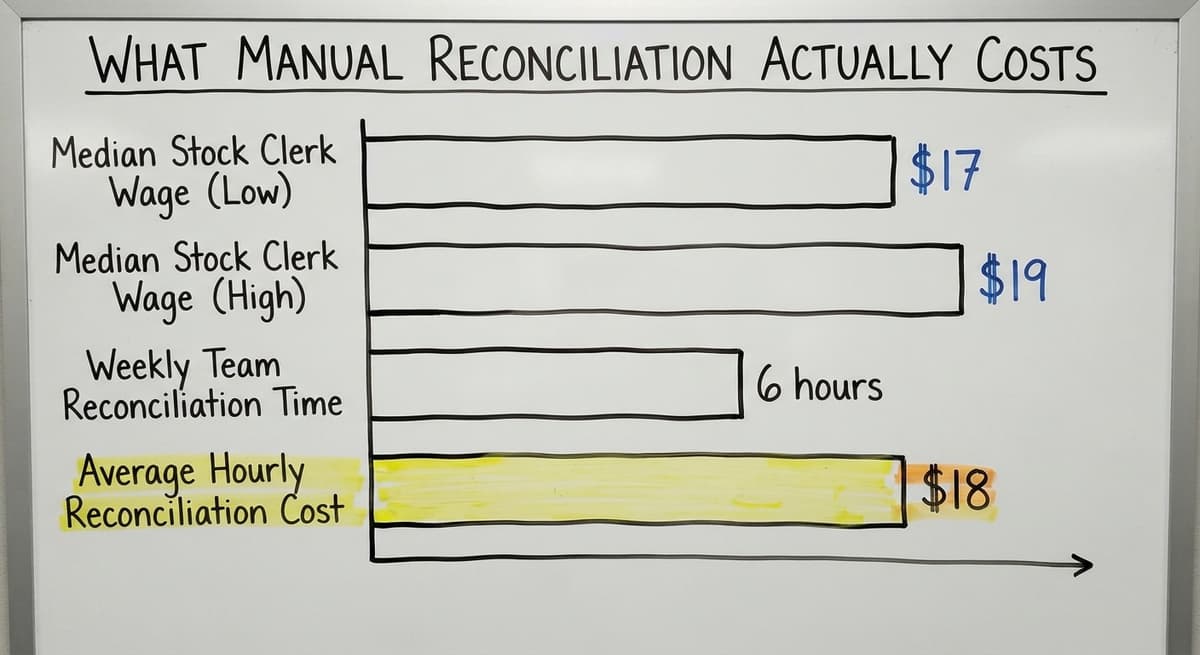
The problem is not the people doing this work. The Bureau of Labor Statistics puts the median wage for stock clerks and order fillers at around $17 to $19 an hour. 3 people spending 6 hours a week on manual matching at $18 an hour costs over $16,800 a year, and that figure does not count the errors those hours still miss. The missing piece is a dedicated inventory layer between the accounting package and the warehouse floor.
Key Inventory Management Methods Explained Simply
Four methods cover most of what a small distributor needs to know. Choose based on what you sell and how your suppliers work.

- FIFO (first in, first out): You sell the oldest stock first. This matters most for perishables, dated goods, or anything with a shelf life. It keeps product fresh and reduces waste.
- LIFO (last in, first out): You sell the newest stock first. This is uncommon in practice and used mainly for certain accounting treatments. Most distributors do not need it.
- Par levels: You set a minimum quantity for each item. When stock drops to that number, you reorder. Simple to run and easy to explain to new staff.
- Just-in-time (JIT): You order only what you need, close to when you need it. This reduces overstock and frees up cash. It works well when suppliers are reliable and lead times are short. It fails fast when they are not.
Which Inventory Method Works Best for Small Wholesale Distributors?
Most small wholesale distributors run best on a combination of FIFO and par levels. FIFO keeps product moving in the right order and reduces waste. Par levels give the team a clear, simple reorder trigger that new staff can learn quickly. JIT is worth adding only after your supplier relationships are stable and lead times are predictable enough to depend on.

Signs Your Operation Has Outgrown Manual Inventory Tracking
Manual tracking has a natural limit. These are the clearest signs you have hit it.
- More than 1 person updates the same spreadsheet, and the version on your screen is not always current.
- Cycle counts, which are regular partial counts of your stock, take days to complete and still come back with errors.
- You have had at least 1 costly stockout or overstock in the past 12 months.
- New staff take weeks to learn where items are stored and how the tracking process works.
- Inventory numbers in your accounting software rarely match what is actually on the shelf.
See it running on your own process first
No build cost. The subscription starts once it is live and doing the job, not before.
Book a callWhat Replacing Manual Tracking Actually Means
Replacing Excel and spreadsheets with custom operations software does not need scrapping what already works. It means adding the layer that manual tools cannot provide: a live, shared count that updates every time someone receives a pallet or ships a box. The NIST Manufacturing Extension Partnership offers vendor-neutral guidance on supply chain process improvement, and a consistent theme across their resources is that visibility problems compound as volume grows.
What Good Inventory Management Looks Like in Practice
A well-run inventory system has one source of truth that every team member can see. When a receiving team scans an inbound pallet, stock levels update without anyone typing a number. When a picker pulls items for an order, the count drops in real time. Reorder alerts fire automatically when a product hits its par level, so purchasing acts before a shelf goes empty.
Custom order fulfillment software handles the warehouse side while the accounting package stays in place for financials. The 2 systems talk to each other, so invoices and cost of goods stay accurate without manual entry. The result is that your team spends time on work that moves orders, not on reconciling data that should have been automatic from the start.

Can I Keep Using My Accounting Software and Still Improve Inventory Management?
Yes. Custom inventory software for wholesale distributors is designed to sit on top of your existing accounting setup, not replace it. Your accounting software stays where it is useful: invoicing, accounts payable, tax reporting. The custom layer handles what your accounting software was never built for: live stock counts, warehouse-level picking, and reorder triggers tied to actual movement.
How Custom Inventory Software Works Alongside Your Accounting Package
Transactions flow from the inventory layer into the accounting package automatically. No double entry. No end-of-month matching sprint. The warehouse team works in a system built around how your operation actually runs, not a generic template designed for a company three times your size. There is no massive ERP migration involved. Warehouse management software for small operations can be built and deployed in stages, so your team is not forced to change everything at once. Local support means the people who built the system are reachable when something needs adjusting. For a 5-to-100-person operation, that matters more than a feature list.
Conclusion: Inventory Control Is an Operational Foundation
Inventory management is not a feature you add when you get big enough. It is the foundation that makes growth possible. Without accurate stock levels, every other part of your operation, purchasing, fulfillment, customer service, runs on incomplete information.

Spreadsheets and printed lists got you here. They will not get you to the next level. The gap between your accounting package and your warehouse floor has a real cost, measured in staff hours, lost orders, and cash tied up in the wrong stock.
If your operation shows any of the signs covered in this article, the next step is a conversation about what a purpose-built inventory layer would look like for your specific workflow. No generic demo, no pressure to abandon what already works. Just an honest look at where the gaps are and what it would take to close them.
Frequently asked questions
What is inventory management in simple terms?
Inventory management means knowing what stock you have, where it is, and how fast it moves. It covers receiving goods, storing them, tracking quantities, and fulfilling orders. The goal is to have the right amount of the right product available at the right time, without running out or buying too much.
What are the main parts of an inventory management system?
The 5 core parts are stock tracking, buy order logging, order fulfillment, reorder triggers, and reporting. Each part feeds the next. Stock tracking tells you what you have. Buy orders update counts when goods arrive. Fulfillment reduces counts when orders ship. Reorder triggers alert you before you run out. Reporting shows what moves and what sits.
Why is inventory management important for small distributors?
A wrong count leads directly to stockouts, which cost sales, or overstock, which ties up cash. Accurate inventory data drives better purchasing, faster fulfillment, and stronger customer relationships. Poor inventory visibility is one of the most common reasons small distributors hit a growth ceiling they cannot explain.
How do I know if my operation has outgrown spreadsheets and manual tracking?
Clear signs include more than 1 person updating the same spreadsheet, cycle counts that take days and still come back wrong, at least 1 costly stockout or overstock in the past year, and inventory numbers in your accounting software that rarely match the shelf. If new staff take weeks to learn the tracking process, that is another strong signal.
What inventory management methods should a small operation know about?
The 4 most practical methods are FIFO (sell oldest stock first), LIFO (sell newest stock first, mainly for accounting purposes), par levels (reorder when stock hits a set minimum), and just-in-time (order only what you need, close to when you need it). Most small distributors do best with FIFO and par levels combined.
What goes wrong when inventory tracking breaks down?
Orders ship late or with wrong items. Staff spend hours reconciling spreadsheets that never fully agree. Purchasing decisions get made on gut feel instead of real data. Errors that are manageable at low volume become costly as order volume grows. A single wrong shipment can end a customer relationship that took years to build.
Do I need a big ERP to manage inventory properly?
No. A purpose-built inventory layer designed for a 5-to-100-person operation handles stock tracking, receiving, fulfillment, and reorder alerts without the cost or complexity of an enterprise system. Your accounting package stays in place. The inventory layer sits on top and feeds it automatically.
What does a well-run inventory system look like day to day?
One shared count updates automatically every time goods arrive or orders ship. Reorder alerts fire before stock runs out. The warehouse team works from a live pick list, not a printed sheet from yesterday. The accounting package receives transaction data without anyone entering it twice. Everyone sees the same numbers at the same time.
Start with a free first look
A 30 minute call, your operation mapped, and a clear picture of what we would build. No obligation and nothing to install.
Book a callRelated guides
The rest of this guide, for the parts of the job this page does not cover.
Guides
- Multi Location Inventory Management Software
- Inventory Management for Multiple Locations
- Inventory Management System for Manufacturing
- Inventory Management Pics
Common questions
- Why is Warehousing and Inventory Management Important
- Why is Inventory Management Important for Small Businesses
- What is the Difference Between Aggregate and Item Inventory Management
- What is Inventory Management and Its Types
- What is the Main Purpose of Inventory Management
- What is Information Technology Inventory Management
- What is Risk Pooling in Inventory Management
- What is Stock Taking in Inventory Management
- What is Bin Number in Inventory Management
- What is the Management and Non Managerial Human Resources Inventory
- What is the Most Important Part of Warehouse Organization
- What is Inventory Listing
- What is Inventory
- Why Warehouse Management System
- What is the Best Warehouse Inventory Management System?
- What is the Difference Between Warehousing and Inventory Management
- What is B Type of Inventory in Warehouse Management
- What is Warehousing and Inventory Management
- What is the Best Inventory Management Software for Small Business
- What is the Best Inventory Management System for Small Businesses?