


What Is The Goal Of Inventory Management Quizlet
What is the goal of inventory management Quizlet? Get the direct answer, then learn why each part of the goal matters in a real warehouse or distribution operation.
Book a callThe Short Answer You Are Looking For
Reviewed October 2026
The goal of inventory management is to have the right product, in the right quantity, in the right place, at the right time, at the lowest reasonable cost. That matches the standard Quizlet definition. You are in the right place.
That is the full answer. The rest of this article explains why each part of that goal matters and what it takes to reach it in a real operation.
We build it for your operation, and the first look is free
If you would rather not compare products, describe how your operation already works and we build the system around it.
No build cost. You see it running on your own process first, and the monthly subscription starts only once it is live.
Book a callWhy the Goal of Inventory Management Has Several Moving Parts
One goal, but several jobs to do at once. Think of a grocery store shelf. The goal is simple: keep the shelf stocked so shoppers can buy what they need. But to do that, the store has to order the right amount, store it without waste, and restock before it runs out. Miss any one of those and the goal fails.
Inventory management works the same way. The single goal breaks into 4 connected jobs: avoid stockouts, avoid overstock, keep costs low, and keep customers happy. Each one supports the others. GS1, the global standards body behind barcode systems, notes that accurate item spotting is the foundation of any reliable count, and you can read their barcode standards at https://www.gs1.org/standards/barcodes. Without that foundation, the other jobs get harder.
What Is a Stockout and Why Does It Matter?
A stockout happens when a customer needs an item and you have none to sell. That single event costs more than the lost sale. The customer may go elsewhere and not come back. An emergency reorder to cover the gap often costs more than a planned one. For a wholesale distributor or fulfillment center, a missed order can end an account relationship entirely. 1 stockout at the wrong moment can undo months of reliable service, which is why avoiding them sits at the center of the goal.
What Is Overstock and What Does It Cost?
Overstock is the opposite problem: too much of an item sitting in the warehouse. Cash is tied up in product that is not moving. Storage space fills up. Perishable goods spoil. Seasonal items go obsolete. Overstock feels safer than a stockout because the shelves look full, but the cost is just as real. It drains cash slowly rather than all at once. A business that avoids stockouts but ignores overstock has only solved half the problem.
Keeping Costs Under Control
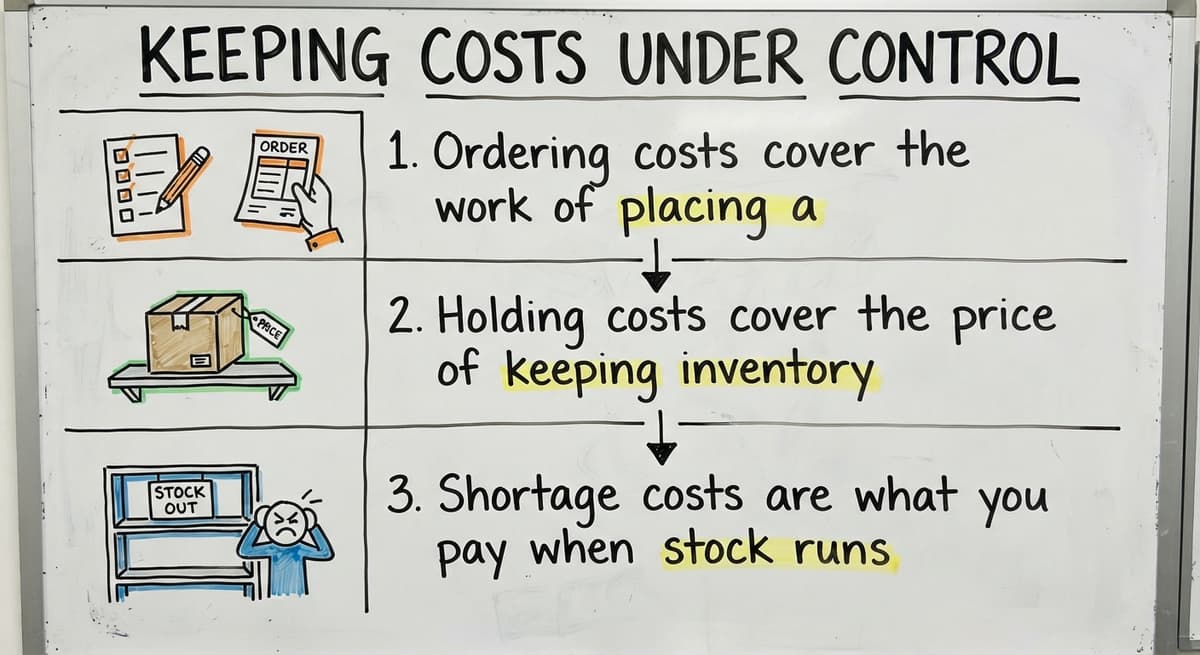
Cost control is built into the goal of inventory management, not added on top of it. There are 3 main cost categories every operation needs to balance.
- Ordering costs cover the work of placing a buy order: staff time, shipping fees, and any minimum-order charges from suppliers.
- Holding costs cover the price of keeping inventory on hand: warehouse space, insurance, and the cash tied up in unsold stock.
- Shortage costs are what you pay when stock runs out: lost sales, rush shipping, and damaged customer trust.
The IRS adds a legal reason to track inventory carefully. IRS Publication 538 states: "To figure taxable income, you must value your inventory at the beginning and end of each tax year," which you can verify at https://www.irs.gov/publications/p538. That alone makes accurate on-hand quantity a legal requirement, not just a best practice. Good inventory management does not minimize one cost category. It balances all 3 so the total stays as low as possible.
The comparison is easier when one option is built for you
Off-the-shelf means fitting your process to the software. We do it the other way round, and the first look costs nothing.
Book a call
How Inventory Management Affects Customer Service
When inventory is managed well, orders ship on time. That is the direct link. For wholesale distributors and warehouses, fill rate, meaning the share of orders shipped complete and on time, is one of the most-watched numbers in the operation.
The US Federal Trade Commission needs sellers to ship by the date they promise or notify the customer of a delay, as outlined at https://www.ftc.gov/business-guidance/resources/business-guide-ftcs-mail-internet-or-telephone-order-merchandise-rule. A poor on-hand quantity record makes that obligation hard to meet. Customer service is not a soft benefit here. A high fill rate protects revenue, and a low one loses accounts.
What Gets in the Way of the Goal
Most operations managers know the goal. The gap is in the systems used to reach it. The most common obstacles are ones that show up in small and mid-size warehouses every day.

- Inventory tracked in a spreadsheet that only one person updates, so the count is always slightly wrong.
- Buy order details spread across email threads and printed sheets, with no single place to check status.
- No real-time view of stock levels, so a reorder point is missed until a customer calls asking where their order is.
- Counts done once a year rather than in rolling cycle counts, so errors build up between checks.
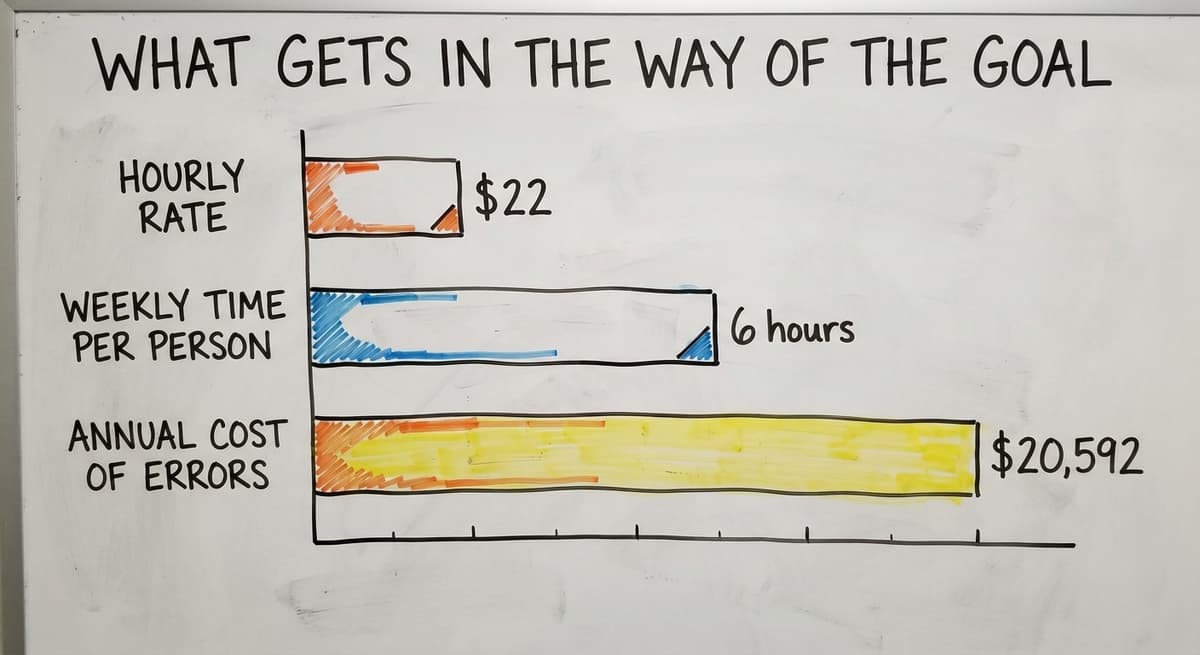
The US Bureau of Labor Statistics reports that stock clerks and order fillers earn a median wage you can check at https://www.bls.gov/oes/current/oes435071.htm. Consider 3 people spending 6 hours a week on manual count matching at $22 an hour. That is $20,592 a year spent fixing data that a better system would keep clean in the first place. The goal is not the problem. The tools are.
Turning the Goal Into Daily Practice
A definition on a flashcard does not move product. These are the daily habits that do.
- Reorder points tell the team exactly when to place a new buy order, before stock runs out rather than after.
- Cycle counts replace the annual wall-to-wall count with small, regular checks so errors surface fast.
- Buy order tracking keeps every open order visible so the team knows what is coming in and when.
- Accurate on-hand quantities give everyone, from the warehouse floor to the sales desk, the same number to work from.
NIST's Manufacturing Extension Partnership offers vendor-neutral guidance on building these habits at https://www.nist.gov/mep/supply-chain. The US Census Bureau tracks the national inventories-to-sales ratio for wholesale firms at https://www.census.gov/wholesale/index.html, which shows how tightly the best operators run their stock relative to what they sell. Operations with 5 to 100 staff can build all of these habits without a large ERP system. The goal becomes real through consistent daily action, not through the size of the software budget.
For teams ready to move beyond spreadsheets, exploring inventory management software for wholesale distributors is a practical next step that does not need starting from scratch.
Does a Custom System Support the Goal Better Than a Generic One?
A custom system supports the goal better when the off-the-shelf option forces the operation to change its process rather than the software changing to fit. Generic tools are built for a wide range of businesses. That means they include features the team will never use and lack the specific workflow the operation already runs on.
A system built around how the warehouse actually works, and one that keeps an existing accounting package in place rather than replacing it, closes the gap between the stated goal and what happens on the floor each day. Teams in Columbus, Ohio and across the country face this same choice: adapt to a tool or find one that adapts to them.
For growing distribution businesses, how to replace spreadsheet-based inventory tracking and how to integrate an existing accounting package for warehouse operations are the two questions worth answering before choosing any platform. Custom operations software for small distribution businesses and buy order management for fulfillment centers are the areas where a tailored build most often outperforms a generic subscription. When the system fits the operation, the goal stops being a definition and starts being a daily result.
If your team is managing inventory across a warehouse or distribution operation and the current tools are not keeping up, a conversation about what a connected system could look like for your specific workflow is a reasonable next step.
Frequently asked questions
What is the primary objective of inventory control?
The primary objective of inventory control is to keep stock at the level that meets customer demand without tying up more cash than necessary. That means having enough on hand to fill orders on time, while avoiding the storage costs and spoilage risk that come with excess stock. In practice, it comes down to setting accurate reorder points and keeping on-hand quantities current.
What is the first step in the strategic management process Quizlet?
The first step is usually identifying the goal or mission. For inventory management specifically, that means stating clearly what the operation is trying to achieve: the right product, in the right quantity, in the right place, at the right time, at the lowest reasonable cost. Every tactic, from reorder points to cycle counts, flows from that starting point.
Is the overall objective of inventory management to achieve satisfactory levels of customer service while keeping inventory costs reasonable?
Yes. That is an accurate restatement of the goal. Customer service and cost control are not competing priorities in inventory management. They are two sides of the same goal. A business that ships orders on time but carries far too much stock is not managing inventory well. Neither is one that keeps costs low by running out of product. Both matter equally.
What are three types of inventory?
The 3 common types are raw materials, work-in-progress, and finished goods. Raw materials are inputs waiting to be used. Work-in-progress is product partway through production. Finished goods are complete items ready to ship. Wholesale distributors and fulfillment centers usually deal almost entirely with finished goods, which is where stockout and overstock risks are most direct.
What is a reorder point and how is it set?
A reorder point is the on-hand quantity at which a new buy order should be placed. It is set by looking at how fast an item sells and how long it takes to arrive after ordering. If an item sells 10 units a day and takes 5 days to arrive, the reorder point is 50 units. Setting it correctly keeps the warehouse from running out before the next shipment lands.
Do you need a large ERP system to manage inventory well?
No. Operations with 5 to 100 staff can reach the core goals of inventory management without a large ERP system. The key practices, accurate on-hand quantities, reorder points, cycle counts, and buy order tracking, can run on a system built to fit the operation rather than a platform designed for a much larger business. The right fit matters more than the size of the tool.
What is the difference between a stockout and overstock?
A stockout means you have run out of an item a customer needs. Overstock means you have more of an item than you can sell in a reasonable time. Both hurt the business, just in different ways. A stockout costs a sale and can damage a customer relationship. Overstock ties up cash and consumes warehouse space. Good inventory management avoids both at the same time.
What are holding costs in inventory management?
Holding costs are the expenses that come from keeping inventory in a warehouse. They include the cost of the space itself, insurance on the stock, and the cash tied up in product that has not sold yet. Holding costs rise as overstock grows, which is why balancing them against ordering costs and shortage costs is central to the goal of inventory management.
Start with a free first look
A 30 minute call, your operation mapped, and a clear picture of what we would build. No obligation and nothing to install.
Book a callRelated guides
The rest of this guide, for the parts of the job this page does not cover.
Guides
Common questions
- What is the Difference Between Aggregate and Item Inventory Management
- What is Abc Classification in Inventory Management
- What is Inventory Management and Its Types
- What is the Main Purpose of Inventory Management
- What is Information Technology Inventory Management
- What is Risk Pooling in Inventory Management
- What is Inventory Management Mary Kay
- What is Stock Taking in Inventory Management
- What is Bin Number in Inventory Management
- What is the Implication of Proper Inventory Management
- What is Inventory Management and Its Importance
- What is the Importance of Quality Inventory Management
- What is Mean by Inventory Management
- What is Inventory Management and Why is It Important
- What is the Management and Non Managerial Human Resources Inventory
- What is Inventory Listing
- What is Inventory
- What is the Best Warehouse Inventory Management System?
- What is the Difference Between Warehousing and Inventory Management
- What is B Type of Inventory in Warehouse Management
- What is Warehousing and Inventory Management
- What is the Best Inventory Management Software for Small Business
- What is the Best Inventory Management System for Small Businesses?