


What Is Management Inventory In Hrm
Reviewed October 2026
The obligation behind all of this is not optional. IRS Publication 538 states: “To figure taxable income, you must value your inventory at the beginning and end of each tax year.” A figure nobody trusts makes that number a guess.
A management inventory in HRM is a structured record of the skills, experience, and leadership potential of employees who are in or near management roles. It goes deeper than a staff list. It tells you who is ready to step up, who needs development, and who should be on your succession plan. Human resource management (HRM) is the function that owns this record.
Book a callWhat Is Management Inventory in HRM and What Data Does It Hold?
A management inventory is a profile, not a data row. Each entry captures the full picture of a person's readiness to lead. That depth is what separates it from a basic employee roster and makes it useful for planning rather than just record-keeping.
Typical fields in each profile include:
- Current role and how long the person has held it
- Years of relevant work experience inside and outside the business
- Education and any formal credentials
- Skills, including those not used in the current role
- Performance history across recent review cycles
- Leadership training completed and dates
- A readiness rating: ready now, ready in 1 year, or needs development
We build it for your operation, and the first look is free
If you would rather not compare products, describe how your operation already works and we build the system around it.
No build cost. You see it running on your own process first, and the monthly subscription starts only once it is live.
Book a callWhy Consistent Data Structure Makes a Management Inventory Actionable
Standards bodies note that consistent data structure is what makes any record set actionable. As GS1 explains when describing structured data standards, a shared, consistent format is what allows different systems and people to read the same record and reach the same conclusion. The same logic applies here: if 2 managers rate readiness differently because they use different criteria, the inventory is not a planning tool, it is a collection of opinions.
The value of a management inventory comes from its consistency, not its size.
How Is a Management Inventory Different From a Skills Inventory?
A skills inventory covers every employee and focuses on technical abilities: who can operate the forklift, who is certified in hazmat handling, who speaks a second language. A management inventory focuses specifically on leadership capacity and succession potential. It asks a different question: not what can this person do today, but who can this person become?

Both can live inside the same HR system. A warehouse running 30 people might keep a skills inventory to schedule shifts and a management inventory to plan for the day a shift supervisor leaves. The skills inventory answers an working question. The management inventory answers a strategic one.
For a small or mid-size operation, the distinction matters because the 2 tools drive different decisions. Mixing them produces a record that is too broad to act on.
Keep them separate so each one stays sharp enough to use.
Why Businesses Use Management Inventory in HRM
Operations managers and owners use a management inventory for 4 connected reasons.
- Succession planning gives you a documented answer to "who steps up" before the question becomes urgent
- Promotion decisions rest on recorded evidence rather than memory or preference
- Training gaps become visible early, before they slow the operation down
- Internal development reduces the cost of outside hiring, which matters when institutional knowledge is hard to replace
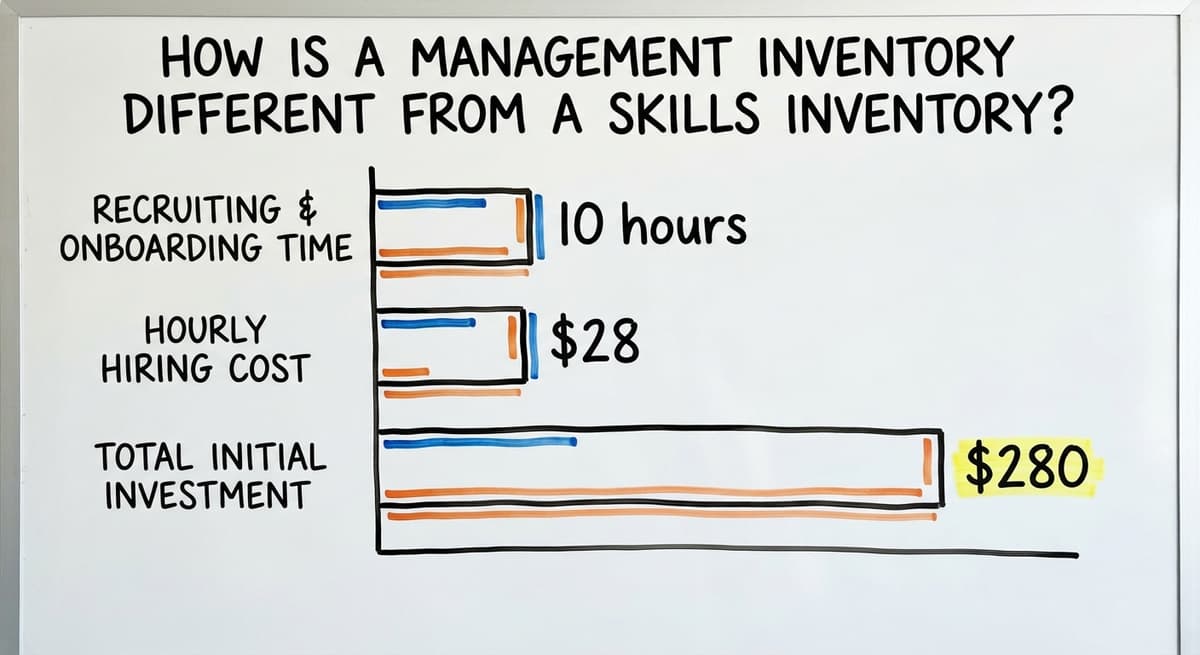
In a warehouse or distribution center, one manager departure can stall a shift. A person spending 10 hours recruiting and onboarding an outside hire at $28 an hour spends $280 before that person knows where anything is. A documented internal candidate cuts that cost and keeps the floor moving.
A management inventory turns "we should have a plan" into a plan that already exists.
The comparison is easier when one option is built for you
Off-the-shelf means fitting your process to the software. We do it the other way round, and the first look costs nothing.
Book a callManagement Inventory and Succession Planning
Succession planning means deciding who takes over a key role when someone leaves or moves up. Without a management inventory, that decision happens under pressure, from memory. With one, it is already documented.

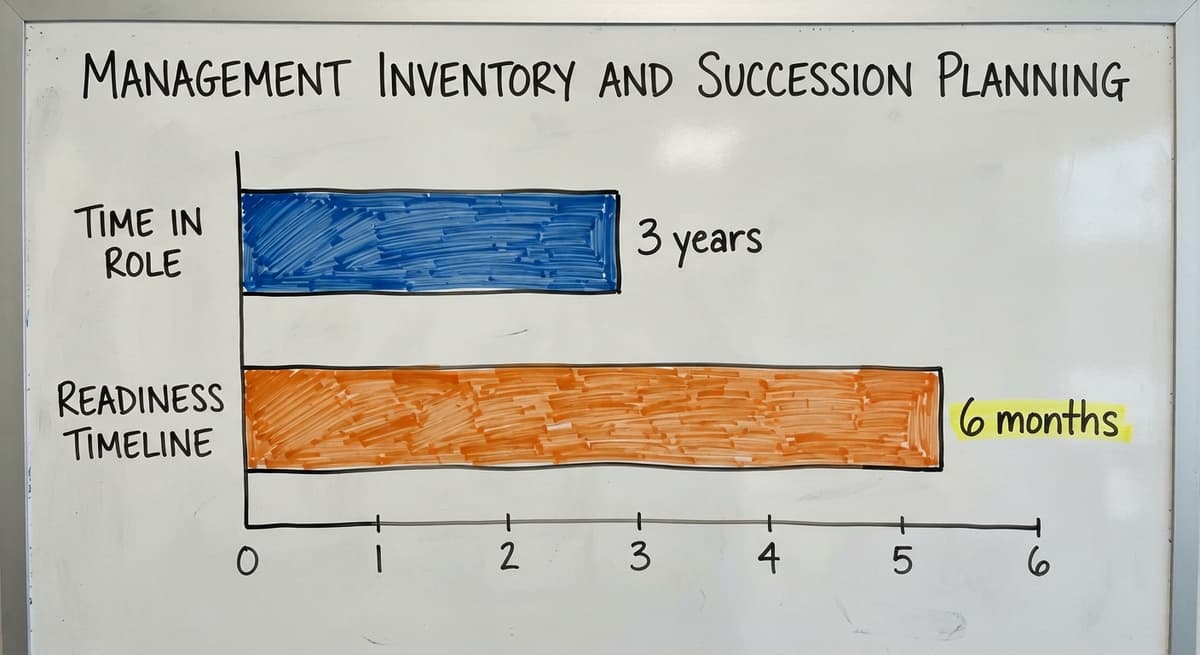
Here is a simple example. A warehouse shift supervisor has been in the role for 3 years. Her profile shows strong performance scores, a completed leadership course, and a readiness rating of "ready in 6 months." When the operations manager announces a departure, there is no scramble. The path is already mapped.
This matters most on small teams. A 15-person fulfillment operation has no depth chart to fall back on. One departure can disrupt every shift until the gap is filled. A management inventory makes succession planning concrete rather than theoretical, and it protects the operation from decisions made in a panic.
Documented readiness is the difference between a transition and a crisis.

How to Build a Management Inventory From Scratch
Building a management inventory does not need an HR department. It needs consistency. Follow these 4 steps.
- Identify which roles qualify. Decide which positions count as management or near-management in your operation. A shift lead, a team lead, and a department head all belong. A picker who shows leadership potential may also belong, even without a formal title.
- Collect consistent data. Use the same fields for every person. Inconsistent records cannot be compared, and comparison is the whole point.
- Rate readiness with a simple scale. Three levels work well: ready now, ready within 12 months, and needs development. Add a note explaining the rating so the next person who reads it understands the reasoning.

Why a Regular Review Schedule Is Non-Negotiable
Updating every profile at least once a year, or after any major performance event, is not optional. The IRS notes in Publication 538 that records tied to business value must be reviewed at regular intervals to remain accurate, and the same discipline applies to people records.
A management inventory built on 4 consistent steps outperforms a complex system that nobody updates.
Common Mistakes That Make a Management Inventory Useless
Small teams run lean on HR processes. That is a reality, not a criticism. These mistakes are common and fixable.
- Stale data creates false confidence. An inventory that has not been updated in 2 years may list someone who has already left, or miss someone who is now clearly ready.
- Too many fields means no one fills them in. Start with 6 to 8 fields. Add more only when the team is actually using what it already has.
- No clear owner means no updates. Assign one person to keep the record, even if that person is the owner.
- Skipping lower-level employees who show leadership potential means the inventory only reflects who already has a title, not who is ready to earn one.
The most dangerous inventory is one that looks complete but has not been touched in 18 months.
See it running on your own process first
No build cost. The subscription starts once it is live and doing the job, not before.
Book a call
Does a Small Warehouse or Distribution Operation Really Need a Management Inventory?
Yes, and the smaller the team, the higher the stakes. Formal HRM tools can feel like overhead built for companies with a dedicated HR floor. A management inventory is not that. It is a planning habit that fits on a shared drive or inside an existing system.
Why Institutional Knowledge Makes This Tool Worth It for Distributors
Wholesale distributors and fulfillment centers promote from within because institutional knowledge is hard to hire. The person who knows the quirks of the receiving dock, the vendor who needs a call before every order, and the route that always runs late is worth developing. A simple, well-maintained workforce planning record captures that value and protects it. The system does not need to be complex. It needs to be consistent and accessible to whoever makes promotion and hiring decisions. Even a structured document with 8 fields and a clear update schedule does the job.
Working continuity is not an enterprise concern. It belongs to every team that cannot afford to lose a key person without a plan.
How Does Management Inventory Connect to the Rest of Your Operations?
A management inventory does not live in isolation. It connects to hiring plans, training budgets, and working continuity. When your people data and your operations data share the same source, planning becomes less reactive.
For businesses running on a mix of an accounting package, spreadsheets, and manual processes, the gap between HR records and working records is where decisions go wrong. Someone gets promoted based on memory. A training budget gets cut because no one documented the gap it was filling. A departure surprises a team that had the answer sitting in a file no one looked at.
How a Connected System Turns a People Record Into an Operational Tool
Replacing spreadsheets with a connected operations system brings these records together without a full rebuild. The goal is not a new platform for its own sake. The goal is one place where the people making decisions can see the workforce plan and the operations plan at the same time.
When your management inventory connects to how the business actually runs, it stops being an HR document and starts being an working tool.
If your operation is outgrowing manual processes and you want a system that fits how you already work, that is a conversation worth having. A custom workflow built around your existing data can make a management inventory part of how decisions get made every day, not just once a year.
Frequently asked questions
What does management inventory mean in human resource management?
A management inventory in HRM is a structured record of the skills, experience, and leadership potential of employees who are in or near management roles. It tells decision-makers who is ready to step up, who needs development, and who belongs on a succession plan.
What data is included in a management inventory?
A typical management inventory includes current role, years of experience, education, skills, performance history, leadership training completed, and a readiness rating for advancement. Each entry is a full profile, not just a name and title.
How is a management inventory different from a skills inventory?
A skills inventory covers all employees and tracks technical abilities. A management inventory focuses specifically on leadership capacity and who is ready to move into a management role. Both can exist in the same HR system but answer different planning questions.
How does management inventory support succession planning?
A management inventory makes succession planning concrete. Each profile includes a readiness rating, so when a manager leaves, the team already knows who is prepared to step in. This is especially valuable on small teams where one departure can disrupt the whole operation.
Why would a small business need a management inventory?
Small businesses face higher risk from a single departure because there is less depth on the team. A management inventory documents who is ready to step up before the need becomes urgent, reducing scramble time and the cost of outside hiring.
How do you build a management inventory from scratch?
Start by identifying which roles count as management or near-management. Collect the same fields for every person. Rate readiness on a simple 3-level scale. Review and update every profile at least once a year. Consistency matters more than complexity.
What are the most common mistakes businesses make with management inventory?
The most common mistakes are letting data go stale, tracking too many fields and never using them, having no clear owner for the record, and overlooking lower-level employees who show leadership potential.
Does a management inventory have to be a formal HR system?
No. A structured document with 6 to 8 consistent fields and a clear update schedule does the job for most small operations. The key is that it is accessible to whoever makes promotion and hiring decisions, and that it gets reviewed on a regular schedule.
Start with a free first look
A 30 minute call, your operation mapped, and a clear picture of what we would build. No obligation and nothing to install.
Book a callRelated guides
The rest of this guide, for the parts of the job this page does not cover.
- What is the Difference Between Aggregate and Item Inventory Management
- What is Jit Inventory Management
- What is Kanban System of Inventory Management
- What is the Definition of Inventory Management
- What is an Important Factor in Inventory Management
- What is Abc Classification in Inventory Management
- What is Inventory Management in Working Capital
- What is Poor Inventory Management
- What is Inventory Management and Its Types
- What is the Main Purpose of Inventory Management
- What is Inventory Management in Pharmacy
- What is Effective Inventory Management
- What is Information Technology Inventory Management
- What is Inventory Management in Tally
- What is Risk Pooling in Inventory Management
- What is Inventory Management Mary Kay
- What is Stock Taking in Inventory Management
- What is Hospital Inventory Management
- What is Bin Number in Inventory Management
- What is the Scope of Inventory Management
- What is the Goal of Inventory Management Quizlet
- What is the Implication of Proper Inventory Management
- What is Omni-channel Inventory Management
- What is Inventory Management and Its Importance