

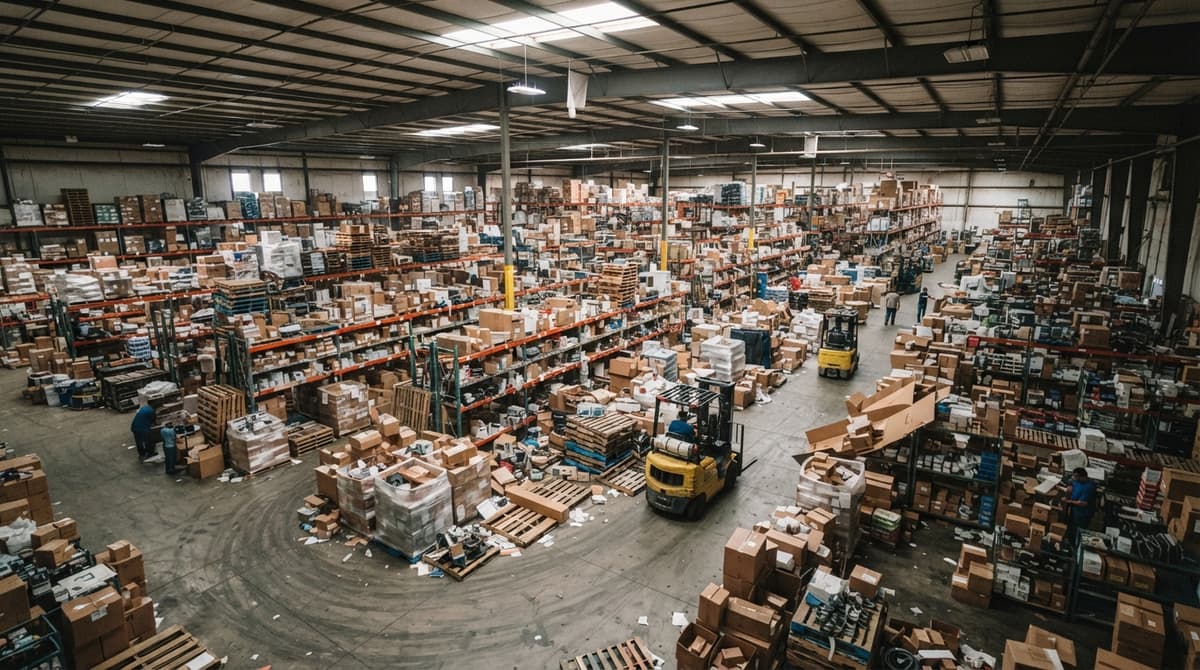
What Is Poor Inventory Management
Reviewed and updated: October 2026
Poor inventory management means not knowing what you have, where it is, or when you will run out. It is not just a storage problem. It hits your orders, your cash flow, and the trust your customers place in you. When the count is wrong, every decision downstream is wrong too.
Book a callWhat Is Poor Inventory Management, in Plain Terms?
Poor inventory management is the gap between what your records say and what is actually on the shelf. Your system shows 40 units. The picker finds 12. That gap is the problem. It is not caused by one bad day. It builds slowly, through manual processes, missed updates, and data that lives in too many places at once. By the time you feel it, customers are already waiting on orders you cannot fill.
The IRS makes the stakes clear. IRS Publication 538 states: "To figure taxable income, you must value your inventory at the beginning and end of each tax year." An accurate count is not optional. It is a legal baseline, and poor inventory management puts that baseline at risk every single day.
We build it for your operation, and the first look is free
If you would rather not compare products, describe how your operation already works and we build the system around it.
No build cost. You see it running on your own process first, and the monthly subscription starts only once it is live.
Book a callCommon Signs Your Inventory Management Is Failing
Some warning signs are obvious. Others hide until a customer calls to ask where their order is. Here are the patterns that show up most often in small wholesale and distribution operations.
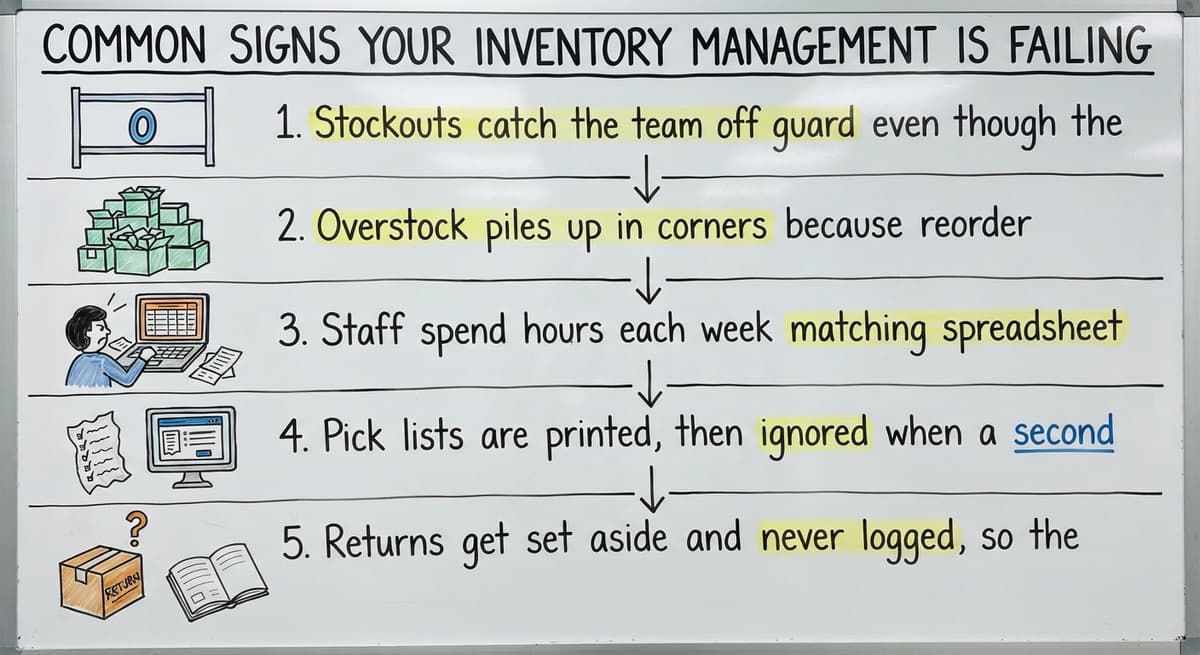
- Stockouts catch the team off guard even though the item showed as available in the system an hour ago.
- Overstock piles up in corners because reorder points were set once and never touched again.
- Staff spend hours each week matching spreadsheet numbers against a physical count, and the two never agree cleanly.
- Pick lists are printed, then ignored when a second order comes in and the sheet is already stale.
- Returns get set aside and never logged, so the count climbs on paper while the shelf stays the same.
What These Warning Signs Mean Together
Accurate barcoding is one of the fastest ways to close the gap between what the system says and what is on the shelf. GS1, the global standards body for barcodes, notes that "GS1 standards are the most widely used supply chain standards in the world," which is why scan-based receiving cuts manual entry errors at the source.
When these signs appear together, the operation is not just disorganized. It is losing money on every cycle.
The Spreadsheet Version of This Problem
Many small distributors run on a mix of an accounting package and a shared spreadsheet. The spreadsheet feels like a solution until 3 people are editing it at once. Then it becomes the source of the problem.
Why Do Spreadsheets and Printed Sheets Make Inventory Problems Worse?
Spreadsheets and printed sheets make inventory problems worse because they have no single live version. Every person who opens the file sees a snapshot from the last save. That snapshot is already wrong.
One person updates a count at 9 a.m. A second person pulls the file at 9:15 and works from the old number. A third person prints a pick list at 9:30 based on that same old number. By the time the picker reaches the shelf, the list is wrong. No one made a mistake on purpose. The tool just cannot keep up with a moving operation.
Many small distributors run on a mix of an accounting package and a shared spreadsheet. The spreadsheet feels like a solution until 3 people are editing it at once. Then it becomes the source of the problem. Printed sheets go stale the moment a second order lands. Email threads used as a record system mean decisions get made on whatever someone remembered to forward. Operations running on an accounting package plus spreadsheet overflow feel this most. The accounting package is doing its job. The inventory layer around it is not.
Why the Fix Is Not a New Accounting Package
The fix is not to abandon the accounting package. It is to stop asking a spreadsheet to do a job it was never built for.
Inline FAQ: Why can't I just keep using a spreadsheet for inventory?
A spreadsheet has no live update. Two people working from different saves will always produce a different count, and a printed pick list is out of date before the ink dries.
The comparison is easier when one option is built for you
Off-the-shelf means fitting your process to the software. We do it the other way round, and the first look costs nothing.
Book a callHow Poor Inventory Management Hurts Cash Flow
Inventory is cash sitting on a shelf. When it is managed poorly, that cash either disappears into overstock or evaporates through lost sales.
Overstock ties up money that could pay a vendor, cover payroll, or fund a new product line. It also costs space, handling time, and insurance. Those carrying costs add up quietly. A pallet that sits for 90 days costs more than the buy price once you count the floor space it occupies and the labor used to move it twice.
Stockouts create a different kind of loss. An emergency buy to fill a gap usually costs more per unit than a planned order. If the item cannot be sourced fast enough, the sale is gone. The customer goes elsewhere, and they may not come back.

The Hidden Labor Cost of Correcting a Broken System
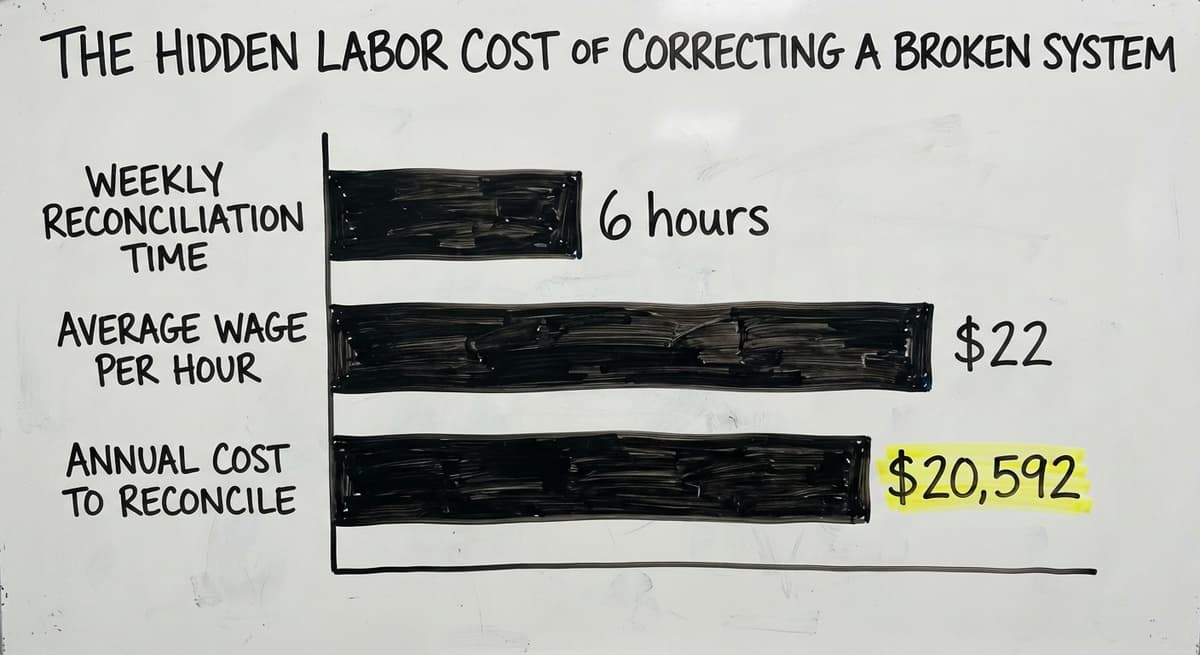
Consider a small warehouse with 3 staff members each spending 6 hours a week reconciling counts at an average wage of $22 an hour. That is $20,592 a year spent on correcting a system that should not need correcting. That figure does not include the cost of the errors those staff members find too late to fix.
The US Bureau of Labor Statistics tracks wages for stock clerks and order fillers, the roles doing most of this manual work. When those hours go to matching instead of fulfillment, the operation is paying twice: once for the work and once for the errors the work uncovers.
Carrying Costs Are Easy to Undercount
Most operators think of carrying costs as just the buy price of unsold goods. The real number includes the floor space, the labor to move and recount, and the shrinkage that happens when no one is tracking closely. Poor inventory accuracy inflates all three.
Inline FAQ: How does overstock hurt cash flow if I already paid for the goods?
The buy price is only part of the cost. Every month that stock sits on the shelf, you are paying for the space it occupies, the labor to manage it, and the opportunity cost of the cash you cannot spend elsewhere.
The Ripple Effect on Your Customers and Team
Late or wrong shipments erode customer trust fast in wholesale and distribution. A retail buyer who receives the wrong SKU does not just return it. They call to complain, they adjust their next order down, and they start looking at your competitors.
The US Federal Trade Commission needs sellers to ship within the time they promise or notify the customer and offer a refund. Poor inventory accuracy makes that promise hard to keep, because you cannot promise a ship date you cannot verify.
See it running on your own process first
No build cost. The subscription starts once it is live and doing the job, not before.
Book a callHow Inventory Problems Wear Down the Team Inside the Warehouse
Inside the warehouse, the damage is just as real. Staff who lose confidence in the system start keeping their own shadow records: a notebook by the dock, a personal tally on a phone. Those shadow records diverge from the main system at once. Now the operation has 3 counts and none of them match.

Operations managers end up fielding complaints instead of planning. Warehouse workers spend their shift firefighting rather than filling orders. The team is working hard and still falling behind, which wears people down in a way that turnover numbers eventually reflect.
When the system cannot be trusted, the people carrying it pay the price.
Shadow Records Are a Symptom, Not a Solution
When a warehouse worker keeps a personal tally, they are not being difficult. They are compensating for a system that has let them down. The right response is to fix the system, not to ask the worker to stop.
Inline FAQ: Why do warehouse workers keep their own records if there's already a system?
They keep shadow records because the main system has been wrong too many times. It is a rational response to an unreliable tool, and it is a clear signal that the inventory layer needs to be rebuilt.
Root Causes That Are Easy to Miss
Poor inventory management is almost never a people problem. It is a systems problem. These are the structural gaps that cause the most damage.
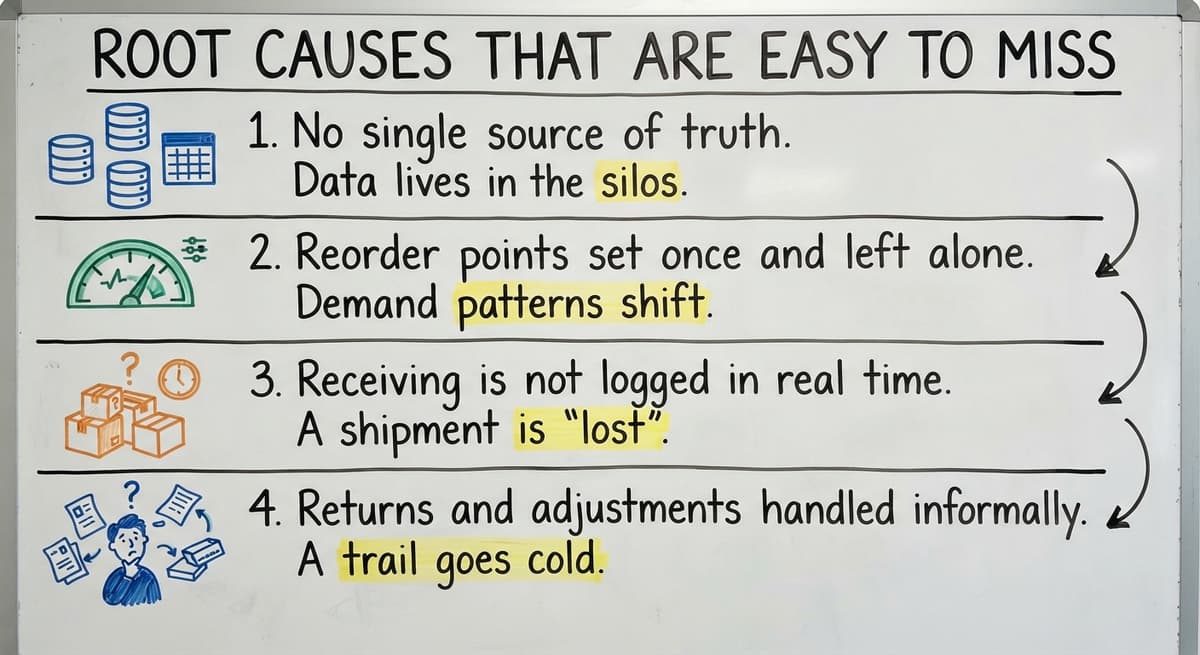
- No single source of truth. Data lives in the accounting package, a spreadsheet, and someone's memory. Each source drifts from the others over time, and there is no way to know which one is right.
- Reorder points set once and left alone. Demand changes with seasons, promotions, and supplier lead times. A reorder point set at the start of the year is often wrong by March.
- Receiving is not logged in real time. A shipment arrives, gets stacked on the dock, and gets entered into the system hours later. The count is always behind the physical reality.
- Returns and adjustments handled informally. A customer sends back 6 units. They get shelved. No one logs the return. The count climbs by 6 on paper while the shelf already reflects them.

Where to Focus First When Fixing the Root Causes
The NIST Manufacturing Extension Partnership provides vendor-neutral guidance on supply chain process, and its core message is consistent: visibility gaps at the receiving and returns stage are where most inventory accuracy problems begin.
Fix the process at those 2 points and the rest of the system becomes easier to trust.
Why Reorder Points Go Stale
A reorder point is only as good as the demand data behind it. When that data is not reviewed, the point becomes a guess dressed up as a rule. Stockouts and overstock are often the same root cause: a reorder point that no longer matches how the product actually moves.
What Good Inventory Management Actually Looks Like
Good inventory management gives everyone in the operation the same accurate number at the same time. That is the whole goal. Everything else follows from it.
Here is what that looks like in practice for a small distributor.
- One count, visible to everyone in real time. No spreadsheet to sync, no version to check. The number on screen matches the shelf because it was updated the moment the last transaction happened.
- Reorder alerts that fire on actual movement. When a SKU drops below its threshold, the system flags it automatically. The threshold is reviewed regularly against real sales data, not set once and forgotten.
- Receiving logged at the dock, not at a desk two hours later. The count updates the moment goods are scanned in, so the system never lags behind the physical floor.
- Adjustments recorded at the moment they happen. Returns, damaged goods, and cycle count corrections go in at once. Nothing sits in a queue waiting for someone to find time.

How Good Inventory Management Connects to Financial Performance
The accounting package stays in place for financial reporting. The inventory layer connects to it rather than replacing it. The goal is accuracy at the point of action, not a new platform to learn.
The US Census Bureau's Monthly Wholesale Trade data tracks the inventories-to-sales ratio for wholesale firms nationally. Operations that manage that ratio well tend to carry less dead stock and turn faster. The ratio is a lagging indicator, but it reflects whether the inventory layer is working.
Inline FAQ: Does good inventory management mean replacing my accounting package?
No. The accounting package handles financials well. Good inventory management adds an accurate, real-time count layer that feeds into it, rather than replacing it.
Not sure this is the right shape for your operation
Describe how the work runs today. We map it on a call and show you what it would look like built around that, before you spend anything.
Book a callWhen a Custom System Fits Better Than an Off-the-Shelf One
Off-the-shelf inventory tools are built around an assumed workflow. That workflow works for the operation the vendor imagined when they built the product. It may not match the way your warehouse actually moves.
A standard tool might expect receiving to happen at one dock, with one scanner, by one person following a fixed sequence. Your operation might have 2 docks, a seasonal crew, and a returns process that does not fit any of the tool's preset categories. Forcing your team to conform to the tool's assumptions creates friction. That friction usually shows up as workarounds, which are just manual processes with extra steps.
How a Custom System Is Built Around Your Operation
A custom-built system follows the warehouse as it already operates. It handles the edge cases that matter to your specific mix of products, customers, and staff. Small operations, those running with 5 to 100 staff, do not need enterprise-scale complexity or the cost that comes with it.
Inventory management software for small distributors works best when it is shaped around the real operation rather than a template. The accounting package stays where it works. The manual parts that break down get replaced with something built for the way the team actually works.
This is not about technology for its own sake. It is about removing the specific friction points that cost the most time and money in your operation. How custom warehouse software works alongside your accounting software is a practical question, and the answer starts with mapping where the count actually breaks down before writing a single line of code.
The right system is the one that fits the operation, not the one with the longest feature list.
Signs Your Operation Has Outgrown Its Current Tools
Signs your operation has outgrown spreadsheets include: matching taking more than 2 hours a week, stockouts happening despite items showing as in stock, and new staff unable to trust the count on their first day. Each of those signals points to the same gap: the tool cannot keep up with the volume or complexity of the work.
Wholesale distribution software built for small teams should reduce the time spent on counts, not add to it.
What Should You Do First If You Suspect Inventory Problems?
Start with an audit of where your count actually lives right now. That is the first step, and it costs nothing.
Walk through the operation and answer 3 questions. Where does the count live: in the accounting package, a spreadsheet, on paper, or in all three? Where does the count break down: at receiving, at picking, at returns, or somewhere else? And what is the single most painful break point: stockouts that lose sales, overstock that ties up cash, or fulfillment errors that cost customer relationships?

How to Move Forward Once You Name the Break Point
Once you can name the break point, you can fix it. You do not need to overhaul the whole operation at once. Fix the one thing that hurts the most, measure the result, and move from there.
If you are in the Columbus, Ohio area or running a small distribution operation anywhere and you want to talk through what a custom-built inventory layer would look like for your specific workflow, reach out. The conversation starts with how your operation works, not with a product demo. The goal is a system that fits the way you already move goods, not one that asks you to change how you work to fit the software.
Frequently asked questions
What is poor inventory management in simple terms?
Poor inventory management means your records do not match your shelves. You think you have 40 units. The picker finds 12. That gap causes stockouts, overstock, late shipments, and cash tied up in goods you cannot account for.
What are the most common signs that inventory management is failing?
The clearest signs are stockouts that surprise the team, overstock that piles up without a clear reason, staff spending hours reconciling counts that never match, and pick lists that are wrong before the picker reaches the shelf.
How does poor inventory management affect cash flow?
Overstock locks up cash in goods that are not moving. Stockouts force emergency buys at higher cost or lose the sale entirely. A team of 3 spending 6 hours a week on manual matching at $22 an hour costs $20,592 a year before counting the errors they find too late.
Why do warehouse workers keep their own records if there's already a system?
They keep shadow records because the main system has been wrong too many times. It is a rational response to an unreliable tool, and it is a clear signal that the inventory layer needs to be rebuilt.
Does good inventory management mean replacing my accounting package?
No. The accounting package handles financials well. Good inventory management adds an accurate, real-time count layer that feeds into it rather than replacing it. Your accounting software stays in place; the inventory layer connects to it.
Why can't I just keep using a spreadsheet for inventory?
A spreadsheet has no live update. Two people working from different saves will always produce a different count, and a printed pick list is out of date before the ink dries. The tool cannot keep up with a moving operation.
When does a custom inventory system make more sense than an off-the-shelf tool?
When the standard tool's assumed workflow does not match how your warehouse actually operates. Off-the-shelf tools are built for a generic operation. A custom system is built for yours, which means fewer workarounds and a count the team can actually trust.
Is there a legal reason to keep accurate inventory records?
Yes. IRS Publication 538 states: 'To figure taxable income, you must value your inventory at the beginning and end of each tax year.' An accurate count is a legal requirement, not just an working preference.
Start with a free first look
A 30 minute call, your operation mapped, and a clear picture of what we would build. No obligation and nothing to install.
Book a callRelated guides
The rest of this guide, for the parts of the job this page does not cover.
- What is the Difference Between Aggregate and Item Inventory Management
- What is Jit Inventory Management
- What is Kanban System of Inventory Management
- What is the Definition of Inventory Management
- What is an Important Factor in Inventory Management
- What is Abc Classification in Inventory Management
- What is Inventory Management in Working Capital
- What is Inventory Management and Its Types
- What is the Main Purpose of Inventory Management
- What is Inventory Management in Pharmacy
- What is Effective Inventory Management
- What is Information Technology Inventory Management
- What is Risk Pooling in Inventory Management
- What is Inventory Management Mary Kay
- What is Stock Taking in Inventory Management
- What is Bin Number in Inventory Management
- What is the Goal of Inventory Management Quizlet
- What is the Implication of Proper Inventory Management
- What is Omni-channel Inventory Management
- What is Inventory Management and Its Importance
- What is the Importance of Eoq in Inventory Management
- What is the Importance of Quality Inventory Management
- What is Inventory Management in Restaurant
- What is Inventory Management Explain Techniques of Inventory Management