


What Is Inventory Management In Tally
Inventory management in Tally is the set of built-in tools that let a business track stock levels, record stock movement, and tie those records to buy and sales transactions. Tally is an accounting platform first. Its inventory features work well for basic stock tracking, but they were not built to run a warehouse floor.
Reviewed: October 2026
Book a callWhat Inventory Management in Tally Actually Tracks
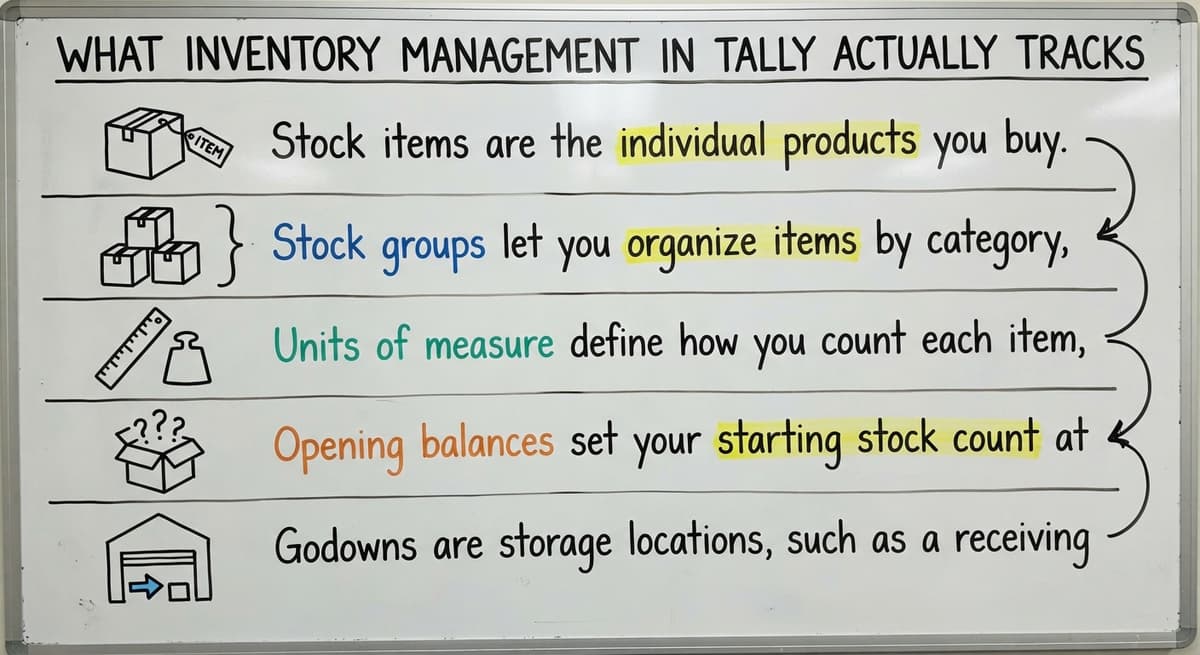
Tally records several core data points for every item you stock. Each one connects directly to your books, so a buy order that adds 50 cases of product also adds a dollar value to your asset ledger.
The main data points Tally captures:
- Stock items are the individual products you buy and sell
- Stock groups let you organize items by category, such as dry goods or frozen
- Units of measure define how you count each item, whether by case, pallet, or unit
- Opening balances set your starting stock count at the beginning of a period
- Godowns are storage locations, such as a receiving dock or a pick aisle
GS1, the global standards body behind supply chain barcodes, notes that "barcodes are the most widely used automatic spotting technology in the world" at gs1.org/standards/barcodes. Tally records the items those barcodes identify, but it does not scan them natively.
Every invoice or buy order you post updates the stock count for the items on it automatically.
We build it for your operation, and the first look is free
If you would rather not compare products, describe how your operation already works and we build the system around it.
No build cost. You see it running on your own process first, and the monthly subscription starts only once it is live.
Book a callHow Does Stock Movement Work in Tally?
Stock moves in Tally through 3 core document types, each of which updates your count and your ledger at the same time. A goods receipt note increases stock when product arrives. A delivery note decreases it when product ships. A stock journal moves quantity between godowns without changing the total on hand.
Think of it the way you would explain it to a new receiving clerk. When a truck pulls in and you post the receipt, Tally adds those cases to the dock godown. When the picker pulls them and you post the delivery, Tally removes them. The ledger records the dollar value of both moves.
The IRS is direct about why this matters: "To figure taxable income, you must value your inventory at the beginning and end of each tax year," per IRS Publication 538. Tally makes that valuation automatic, which is one of its genuine strengths.
Internal transfers between locations use a stock journal rather than a sales or buy document, keeping the accounting clean.
Valuation Methods Tally Supports
Tally offers 4 costing methods: FIFO (first in, first out), LIFO (last in, first out), weighted average, and standard cost. The choice matters because it changes the cost of goods sold figure on your income statement.
For a wholesale distributor, FIFO usually produces the most accurate picture of actual cost when prices shift. LIFO can reduce taxable income in a rising-cost environment, but it is not permitted under international accounting rules. Weighted average smooths out price swings, which suits businesses with high transaction volume and stable margins.
Where Tally Inventory Falls Short for Distributors
Tally handles basic stock tracking tied to accounting entries well. For a small trading company with 1 or 2 locations and a modest SKU count, that is often enough. The gaps show up when warehouse operations get more complex.

Structural limits that matter to wholesale and distribution teams:
- Barcode scanning is not built in. Tally records items but does not connect to a scanner on the floor, so receiving and picking still need manual entry.
- There is no pick-pack-ship workflow. The steps a picker follows, from pulling a list to confirming a shipment, happen outside the system.
- Lot and serial number tracking is minimal, which creates problems for businesses that need to trace product by batch.
- Multi-warehouse bin-level visibility is weak. Godowns mark a location, but Tally does not track which bin inside that location holds the stock.
These are not flaws in Tally's design. They are the natural result of an accounting platform doing double duty as a warehouse tool. The platform was built to keep your books accurate, and it does that reliably.
Distributors with high SKU counts or volume that demands fast, automated updates tend to hit these limits quickly. The NIST Manufacturing Extension Partnership recommends that businesses evaluate whether their inventory process matches the actual flow of goods, not just the accounting record, which is a useful test to apply here.
The comparison is easier when one option is built for you
Off-the-shelf means fitting your process to the software. We do it the other way round, and the first look costs nothing.
Book a callWho Fits Tally Inventory Well, and Who Outgrows It
Tally inventory management fits a specific business profile. Small trading companies that need stock counts tied directly to their books, operate from 1 or 2 locations, and do not need real-time warehouse floor visibility get real value from it. The accounting and inventory live in one place, which cuts matching work.

The profile that tends to outgrow it looks different. Distributors with more than a few hundred active SKUs, multiple storage locations, or picking volume that demands speed find that Tally's manual entry model slows the operation. When the warehouse floor moves faster than the system can record, the stock count drifts from reality.
The US Census Bureau Monthly Wholesale Trade data shows that wholesale inventories shift month to month at a scale that demands accurate, timely counts. A system that lags the floor creates real business risk, not just a bookkeeping inconvenience.

Why Distributors End Up Running Excel Alongside Tally
The most common workaround is familiar to most operations managers. Tally handles the accounting. A spreadsheet tracks live stock. Printed pick lists run the warehouse floor. Phone calls or email fill the gaps between all three.
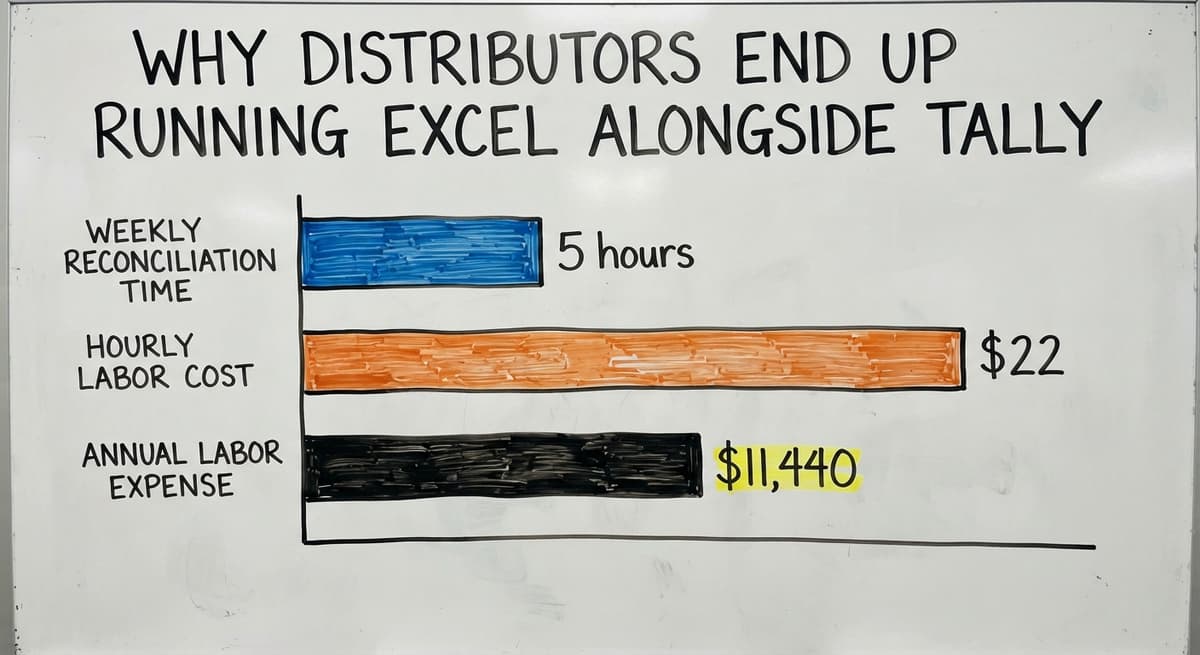
The real cost of manual inventory tracking adds up fast. Consider 2 staff members each spending 5 hours a week reconciling Tally against a spreadsheet. At the Bureau of Labor Statistics median wage for stock clerks of around $22 an hour, that is $11,440 a year in labor alone, before counting the errors that slip through.
When a Custom Inventory System Makes More Sense
Some distributors reach a point where stretching an accounting tool into a warehouse system costs more than building the right layer for the job. A purpose-built inventory system does not have to replace the accounting software that already works. It can sit alongside your accounting software or another accounting package, handle the warehouse workflow, and push the financial records across automatically.

Custom inventory management software for wholesale distributors built around an actual operation looks different from a packaged product. It is shaped to the specific SKU count, location count, and picking workflow of that business, rather than forcing the operation to adapt to software defaults.
This approach avoids a full ERP rollout. The accounting stays where it is. The warehouse gets tools built for how it actually runs: scanning at receiving, directed picking, bin-level visibility, and lot tracking where the product demands it. Inventory management software for small warehouses built this way scales with the business rather than requiring a replacement when volume grows.
A Columbus, Ohio team that builds around how the operation already works can close the gap between what Tally records and what the warehouse floor actually needs, without forcing a platform change across the whole business.
What Does This Mean for Your Operation?
Here is the honest summary. Inventory management in Tally is a solid accounting-linked stock tracking tool for small trading businesses. It records what you bought, what you sold, and what remains, and it keeps that tied to your books automatically.
Key points to carry forward:
- Tally tracks stock items, godowns, units of measure, and opening balances linked to every transaction
- Stock valuation methods including FIFO and weighted average affect both reported profit and tax position
- The platform was not built for warehouse floor operations, and barcode scanning, pick-pack-ship workflows, and bin-level tracking need something else
- Distributors that outgrow Tally often end up with a spreadsheet running parallel, which creates the errors and delays that hurt fulfillment
- A custom inventory layer that integrates with existing accounting software is a practical middle ground between a spreadsheet and a full ERP
If your operation has outgrown what Tally's inventory features can do, the next step is a conversation about how to replace manual inventory spreadsheets with a custom system built around your actual workflow. Reach out to explore whether a purpose-built inventory layer fits what your warehouse already does.
Frequently asked questions
How to do inventory management in Tally?
Set up stock items, stock groups, and godowns first. Then assign units of measure and enter opening balances. From that point, every buy order and sales invoice you post will update stock counts automatically. Use goods receipt notes to record incoming stock and delivery notes to record outgoing stock. Stock journals handle transfers between locations.
What is inventory management in simple terms?
Inventory management means knowing what stock you have, where it is, and what it is worth at any given moment. It covers receiving product, storing it, picking and shipping it, and keeping the count accurate throughout. Good inventory management means you can fill an order without guessing and value your stock correctly at tax time.
What are the 5 steps of inventory management?
The core steps are: 1) receive and count incoming goods, 2) store them in a known location, 3) pick and pack for outgoing orders, 4) ship and record the reduction in stock, and 5) reconcile the count against the system record on a regular cycle. The right tool for each step depends on the volume and complexity of the operation.
What does "inventory" mean in Tally?
In Tally, inventory refers to the stock items a business buys and sells, along with the records of how those items move. Each item has a name, a unit of measure, a storage location called a godown, and a value based on the costing method you choose. Every buy or sales transaction updates the inventory record automatically.
What valuation methods does Tally support for inventory costing?
Tally supports FIFO, LIFO, weighted average, and standard cost. FIFO is most common for distributors because it reflects actual cost flow when prices change. Weighted average suits high-volume businesses with stable margins. The method you choose affects your reported profit and your tax position, so it is worth reviewing with your accountant before you start.
Can a business keep its existing accounting software and still improve inventory tracking?
Yes. A custom inventory layer can sit alongside an existing accounting package, handle the warehouse workflow, and push financial records across automatically. This avoids replacing software that already works well for bookkeeping. It is a practical option for distributors that need warehouse features without a full ERP rollout.
Why do many distributors end up using spreadsheets alongside Tally?
Tally does not offer real-time floor scanning, pick lists, or bin-level tracking. When the warehouse moves faster than manual entry can keep up, staff create a spreadsheet to track live stock. The problem is that two systems quickly produce two different answers, and reconciling them takes time and creates errors that affect order accuracy.
Start with a free first look
A 30 minute call, your operation mapped, and a clear picture of what we would build. No obligation and nothing to install.
Book a callRelated guides
The rest of this guide, for the parts of the job this page does not cover.
- What is the Difference Between Aggregate and Item Inventory Management
- What is Jit Inventory Management
- What is Kanban System of Inventory Management
- What is the Definition of Inventory Management
- What is an Important Factor in Inventory Management
- What is Abc Classification in Inventory Management
- What is Inventory Management in Working Capital
- What is Poor Inventory Management
- What is Inventory Management and Its Types
- What is the Main Purpose of Inventory Management
- What is Inventory Management in Pharmacy
- What is Effective Inventory Management
- What is Information Technology Inventory Management
- What is Risk Pooling in Inventory Management
- What is Inventory Management Mary Kay
- What is Stock Taking in Inventory Management
- What is Hospital Inventory Management
- What is Bin Number in Inventory Management
- What is the Scope of Inventory Management
- What is the Goal of Inventory Management Quizlet
- What is the Implication of Proper Inventory Management
- What is Omni-channel Inventory Management
- What is Inventory Management and Its Importance
- What is the Importance of Eoq in Inventory Management