


What Is An Important Factor In Inventory Management
Accurate stock visibility is the single most important factor in inventory management. Without knowing exactly what you have, where it is, and what condition it is in, every other decision becomes a guess. Reorder points, demand forecasting, supplier lead times, and warehouse organization all matter too, but they only work when your stock counts are right.
Reviewed and updated: October 2026
Book a callWhy Inventory Management Factors Matter
Poor inventory control is one of the top reasons distributors and warehouses lose money. Stockouts push customers to competitors. Overstock ties up cash and fills shelves with product that is not moving. Slow order fulfillment damages the trust it took years to build.
Small and mid-sized operations feel these problems harder than large ones. A big company can absorb a bad quarter. A 10-person distributor cannot. Getting the key factors right is not a theory exercise. It is how you stay profitable and keep customers coming back.
We build it for your operation, and the first look is free
If you would rather not compare products, describe how your operation already works and we build the system around it.
No build cost. You see it running on your own process first, and the monthly subscription starts only once it is live.
Book a callAccurate Stock Visibility Is the Single Most Important Factor in Inventory Management
Real-time, accurate stock visibility is the foundation every other factor depends on. Without it, reorder decisions, picking, and shipping are all guesswork.
Knowing a SKU exists is not the same as knowing its exact quantity, location, and condition. A spreadsheet might show 200 units of a product. The shelf might hold 140, with 30 of those damaged. That gap costs you money every time someone places an order.
Spreadsheets and printed pick sheets create a dangerous lag between what is recorded and what is actually on the shelf. Every manual update is a chance for error.
GS1, the global standards body behind barcode systems, states that "barcodes are the most widely used automatic spotting technology in the world," and their standards for scan-based counting are documented at gs1.org/standards/barcodes. Scan-based receiving and picking close the gap between the record and the shelf almost instantly.
Accurate counts are not a nice-to-have. They are the starting point for every smart inventory decision.
Why Spreadsheets Break Down at Scale
A spreadsheet works when 1 person manages 50 SKUs. Add a second warehouse, a second employee, or a seasonal rush, and the errors multiply. Two people editing the same file at different times will always end up with different numbers. There is no audit trail, no timestamp, and no alert when a count drifts.
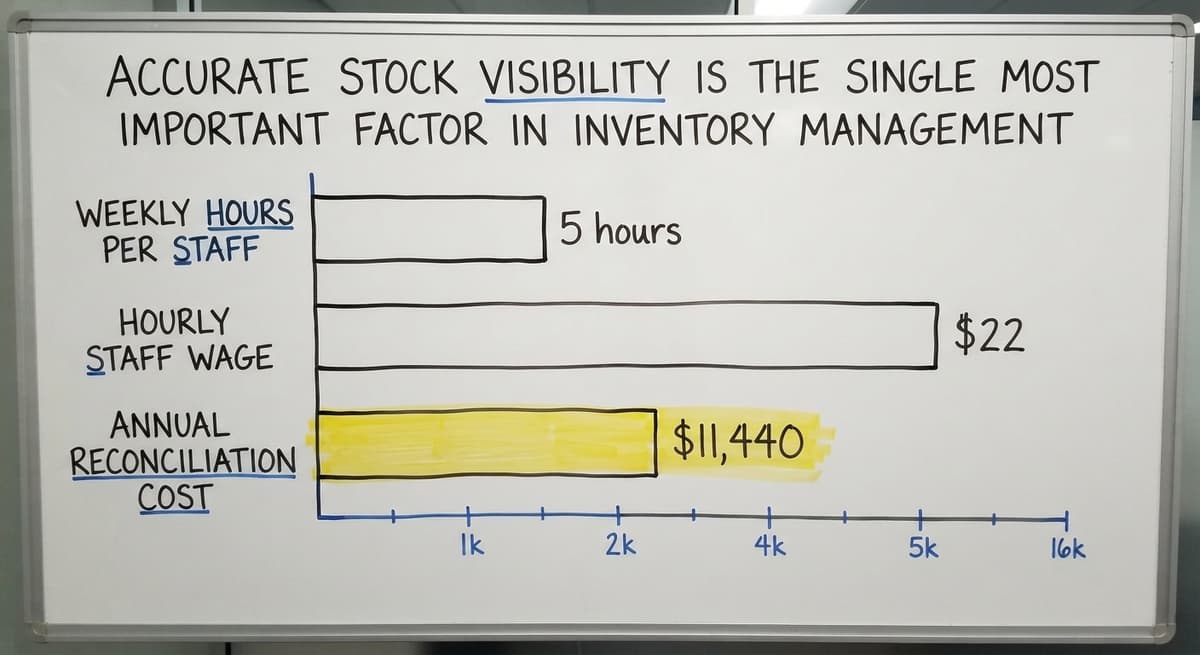
Operations that track inventory manually spend real money on the problem. Consider 2 staff members spending 5 hours a week each reconciling counts at $22 an hour. That is $11,440 a year, just to keep a spreadsheet close to accurate, and it is still wrong some of the time.
How Does Demand Forecasting Help Distributors Avoid Stockouts and Overstock?
Demand forecasting uses past sales data and seasonal patterns to predict what you will need and when. Without it, you are buying on gut feel, which works until it does not.
Overstock ties up cash and warehouse space. Understock means missed orders and customers who will not wait. Even basic trend analysis beats pure instinct when you are managing hundreds of SKUs across multiple product lines.
Reliable forecasting depends on clean, consistent data flowing from both sales and receiving. If your sales records are incomplete or your receiving logs are late, the forecast will be wrong before you even run it.
The US Census Bureau tracks inventories-to-sales ratios for wholesale firms at census.gov/wholesale, which gives a useful benchmark for how much stock your peers are carrying relative to what they sell.
A forecast built on clean data lets you buy with confidence instead of buying defensively.
The comparison is easier when one option is built for you
Off-the-shelf means fitting your process to the software. We do it the other way round, and the first look costs nothing.
Book a callReorder Points and Safety Stock Prevent Costly Gaps
A reorder point is the inventory level that triggers a new buy order before stock runs out. Setting one correctly keeps product flowing without forcing you to watch counts all day.
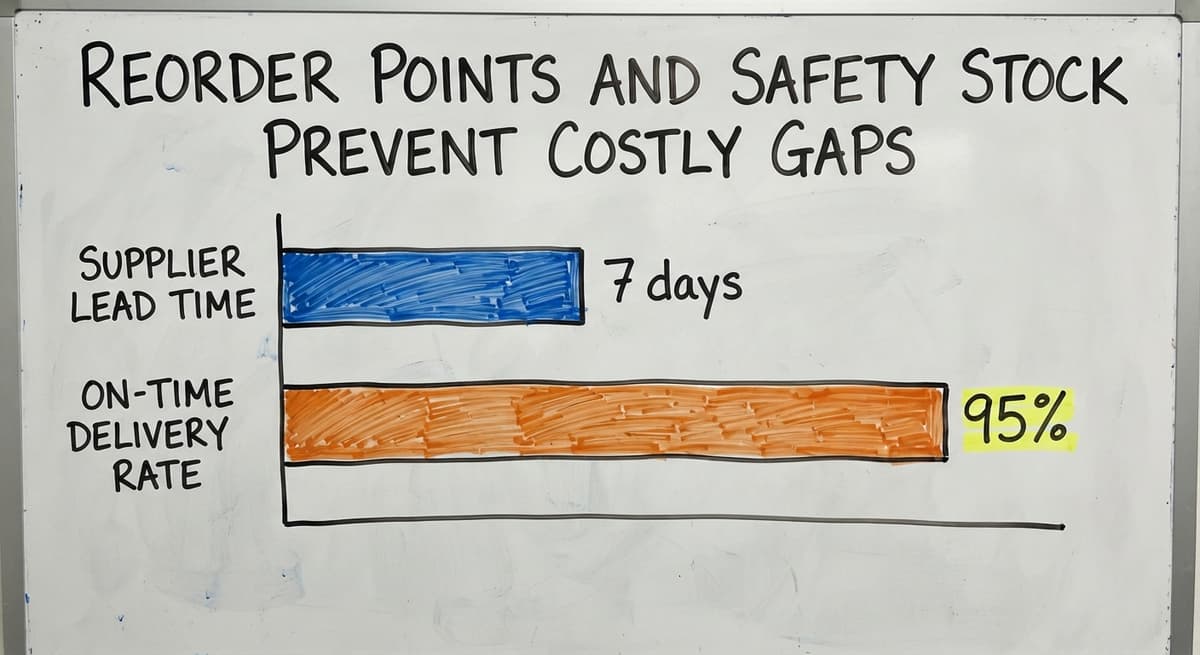
The basic formula: multiply your average daily usage by your supplier lead time in days. If you sell 20 units a day and your supplier takes 7 days to deliver, your reorder point is 140 units.
Safety stock is a small buffer kept on hand to cover supplier delays or unexpected demand spikes. Add it on top of your reorder point, not instead of it.
These numbers must be reviewed regularly. A reorder point set in January may be wrong by March if your sales pace changes or your supplier's delivery time shifts. Set a calendar reminder to check them at least quarterly.
How to Think About Safety Stock Levels
Safety stock is not a fixed percentage. It depends on how variable your demand is and how reliable your supplier is. A supplier who delivers on time 95% of the time needs less buffer than one who misses dates regularly. Track actual delivery dates against promised ones, and let that data drive your buffer size.
Supplier Lead Times Directly Affect Inventory Decisions
Lead time is the gap between placing a buy order and receiving the goods. Longer or less predictable lead times force you to carry more safety stock, which costs money.

Tracking actual versus promised lead times gives you two advantages. First, you can negotiate better when you have data showing a supplier is consistently late. Second, you can plan smarter because your reorder points reflect what really happens, not what the supplier's sales rep promised.
Distributors working with multiple suppliers need this data in one place. Scattered across emails and spreadsheets, it is invisible. Organized in a single system, it becomes a buying advantage.
The NIST Manufacturing Extension Partnership offers vendor-neutral guidance on supply chain process at nist.gov/mep/supply-chain, including how smaller operations can build better supplier tracking habits without enterprise-level tools.
The distributor who knows their real lead times carries less stock and spends less money doing it.
Inventory Valuation Methods Affect Costs and Reporting
How you value inventory changes your cost of goods sold and your reported profit. The 3 common methods are FIFO (first in, first out), LIFO (last in, first out), and weighted average cost.
FIFO matches how most physical products actually move, especially perishables or time-sensitive goods. LIFO can reduce taxable income when costs are rising, but it is not permitted under international accounting rules. Weighted average smooths out price swings.
The IRS is direct on why this matters: "To figure taxable income, you must value your inventory at the beginning and end of each tax year," as stated in IRS Publication 538. Switching methods mid-year creates accounting headaches, especially when your books run through an accounting package.
Pick the method that matches how product moves through your warehouse, then stick with it.
See it running on your own process first
No build cost. The subscription starts once it is live and doing the job, not before.
Book a callWarehouse Organization Speeds Up Picking and Reduces Errors
Where items are stored and how locations are labeled directly affects how fast your team picks orders and how often they pick the wrong thing.
Logical slotting puts fast-moving items close to the shipping area and slow movers farther back. This cuts the travel time your pickers spend walking the floor on every order. Less walking means more orders shipped per shift.
Clear bin and shelf labels reduce mis-picks. A mis-pick causes a return, a credit, and a customer who questions whether to order again. Good physical organization also amplifies whatever software system you use to track inventory. A system that says "bin A-14" only helps if bin A-14 is clearly marked and consistently maintained.
- Fast movers near the shipping dock cut average pick time on high-volume SKUs
- Consistent labeling lets new staff pick correctly without memorizing the floor
- Zone-based layouts reduce congestion when multiple pickers work at the same time
- Regular slotting reviews keep the layout aligned as your product mix changes
A well-organized warehouse makes every other inventory factor easier to manage.
How Software Ties All These Factors Together
Manual tracking in spreadsheets or on paper cannot keep up with all these factors at once. Stock counts drift. Reorder triggers get missed. Lead time data sits in an inbox no one checks.
Inventory management software connects stock visibility, reorder triggers, lead time data, and warehouse locations in one system. When a pick happens, the count updates. When a count hits a reorder point, the system flags it. When a buy order goes out, the expected delivery date is tracked.
For operations already running on an accounting package, the right software adds the working layer that accounting packages were never designed to handle, without replacing the financial records your accountant depends on. Integrating a dedicated inventory platform with your existing accounting software keeps the two systems in sync so your books reflect what is actually on the shelf.
Warehouse management software for small and mid-sized operations does not have to mean a six-figure enterprise platform. Custom workflow rollout can match the exact process already in place rather than forcing your team to change how they work. That matters when your staff has years of experience in a workflow that mostly works and just needs better tools around it.
The US Bureau of Labor Statistics shows that stock clerks and order fillers earn a median wage documented at bls.gov/oes/current/oes435071.htm. When manual processes consume hours of that labor each week, the cost of doing nothing is measurable and real.
The right software does not replace your team or your accounting package. It gives both of them better information to work with.
What Are the Most Important Inventory Management Factors to Fix First?
Accurate visibility is the most important single factor, but it works best alongside forecasting, reorder rules, lead time tracking, and solid warehouse organization. These factors reinforce each other. A good forecast is useless if your counts are wrong. A reorder point is useless if you do not know your real lead time.

Start with the factor causing the most pain right now. If you are constantly running out of stock, look at your reorder points and forecasting first. If orders are shipping wrong, start with warehouse organization and pick accuracy. If your buying decisions feel like guesswork, fix your stock visibility before anything else.
Operations that get these factors right ship faster, carry less excess stock, and make better buying decisions week after week. The US Federal Trade Commission's guidance on order fulfillment at ftc.gov is a reminder that shipping when you said you would is not just good service. It is a legal obligation, and accurate inventory is what makes it possible.
If your current setup is a mix of spreadsheets, email threads, and an accounting package doing double duty as an inventory system, you already know what is breaking. The question is what to fix first and how to build a system that holds together as you grow.
Frequently asked questions
What are the key factors that affect inventory management?
The key factors are accurate stock visibility, demand forecasting, reorder points, safety stock, supplier lead times, inventory valuation, and warehouse organization. Accurate stock counts are the foundation. Without them, every other factor produces unreliable results. The factors work together: a good forecast needs clean data, a reorder point needs a known lead time, and warehouse organization makes picking faster and more accurate.
What is the 80/20 rule in inventory?
The 80/20 rule in inventory, sometimes called ABC analysis, holds that roughly 20% of your SKUs generate about 80% of your sales volume. Those high-volume items deserve tighter tracking, better slotting in the warehouse, and more careful reorder management. The remaining 80% of SKUs, which drive a smaller share of revenue, can be managed with less frequent review. The exact split varies by business, but the principle helps you focus effort where it produces the most return.
What are the three key measures of inventory?
The 3 key measures are inventory turnover (how many times you sell and replace stock in a period), days on hand (how many days of supply you are carrying at current sales rates), and stockout rate (how often an item is unavailable when a customer orders it). Together these 3 numbers tell you whether you are carrying too much, too little, or about the right amount of stock for your current sales pace.
What are five reasons why inventory management is important?
First, accurate inventory prevents stockouts that lose sales and damage customer relationships. Second, it avoids overstock that ties up cash and warehouse space. Third, it keeps order fulfillment accurate and on time, which the FTC needs when you have committed to a ship date. Fourth, it supports correct financial reporting, which the IRS needs at tax time. Fifth, it gives buyers the data they need to negotiate better terms with suppliers based on real usage patterns rather than guesswork.
Can inventory management software work alongside your accounting package instead of replacing it?
Yes. An accounting package handles the financial side of the business well. What it was not built to do is manage real-time stock counts, reorder triggers, warehouse locations, or buy order tracking at the working level. The right inventory management software adds that working layer and syncs with your accounting package so your financial records stay accurate without requiring your team to do double entry. This approach keeps what already works and fixes what does not.
What is a reorder point and how do you set one?
A reorder point is the stock level that triggers a new buy order before you run out. To set one, multiply your average daily sales for a SKU by your supplier's lead time in days. If you sell 15 units a day and your supplier takes 8 days to deliver, your reorder point is 120 units. Add safety stock on top of that to cover delays or demand spikes. Review these numbers at least quarterly as your sales pace and supplier performance change.
What are the signs that manual inventory tracking is no longer working?
Common signs include frequent stockouts on items you thought you had in stock, overstock on slow-moving products no one flagged, pick errors that cause returns, reorder decisions made on gut feel rather than data, and staff spending several hours a week reconciling counts that still do not match. If any 2 of these describe your operation, manual tracking is already costing you more than a better system would.
Start with a free first look
A 30 minute call, your operation mapped, and a clear picture of what we would build. No obligation and nothing to install.
Book a callRelated guides
The rest of this guide, for the parts of the job this page does not cover.
- What is Inventory Management and Why is It Important
- What is the Difference Between Aggregate and Item Inventory Management
- What is Abc Classification in Inventory Management
- What is Inventory Management in Working Capital
- What is Inventory Management and Its Types
- What is the Main Purpose of Inventory Management
- What is Information Technology Inventory Management
- What is Risk Pooling in Inventory Management
- What is Inventory Management Mary Kay
- What is Stock Taking in Inventory Management
- What is Bin Number in Inventory Management
- What is the Goal of Inventory Management Quizlet
- What is the Implication of Proper Inventory Management
- What is Omni-channel Inventory Management
- What is Inventory Management and Its Importance
- What is the Importance of Eoq in Inventory Management
- What is the Importance of Quality Inventory Management
- What is Inventory Management Explain Techniques of Inventory Management
- What is Mean by Inventory Management
- What is Inventory Management Meaning in Hindi
- What is the Rationale for Inventory Management Quizlet
- What is the Purpose of Inventory in Operations Management
- What is Inventory Management Whiteboard Wednesday
- What is Fluctuation Stock in Inventory Management