


What Is Omni-Channel Inventory Management
Reviewed and updated: October 2026
Omni-channel inventory management means tracking and controlling stock across every sales channel from one connected system. A single accurate count updates in real time no matter where an order arrives. Wholesale distributors, warehouse operators, and multi-channel sellers use it to stop overselling, cut manual work, and keep customers on schedule.
Book a callThe Simple Definition of Omni-Channel Inventory Management
Omni-channel inventory management is one system that watches all your stock across all your selling paths at the same time. Your warehouse shelf, your online storefront, your wholesale portal, your third-party marketplace listing, and your retail counter all read from and write to the same number.
When a buyer orders 10 cases through your B2B portal, the available quantity drops by 10 everywhere else instantly. No one has to update a spreadsheet. No channel shows stock that is already gone. The goal is simple: one accurate number, always current, no matter where the order came from.
We build it for your operation, and the first look is free
If you would rather not compare products, describe how your operation already works and we build the system around it.
No build cost. You see it running on your own process first, and the monthly subscription starts only once it is live.
Book a callHow Omni-Channel Inventory Differs from Single-Channel Tracking
Single-channel inventory tracking is straightforward. One warehouse ships to one type of buyer, and one spreadsheet or system keeps the count. That works until you add a second sales path.
Before: A distributor sells only to retail chains. Stock lives in one spreadsheet. The count is almost always right because only one team touches it.
After: That same distributor adds a B2B portal and a direct online store. Now 3 channels can sell the same SKU at the same time. Without a connected system, each channel keeps its own count. The spreadsheet goes stale within hours.
The result is overselling, stockouts, and hours spent each week comparing three different reports to find the real number. As GS1 notes in its barcode standards records, consistent product spotting across every point in the supply chain is the foundation of accurate counts. You can read that guidance at gs1.org/standards/barcodes. Without that foundation, multi-channel inventory falls apart fast.
Single-channel tracking is a solved problem. Multi-channel inventory without a connected system is not.
What Are the Core Components of an Omni-Channel Inventory System?
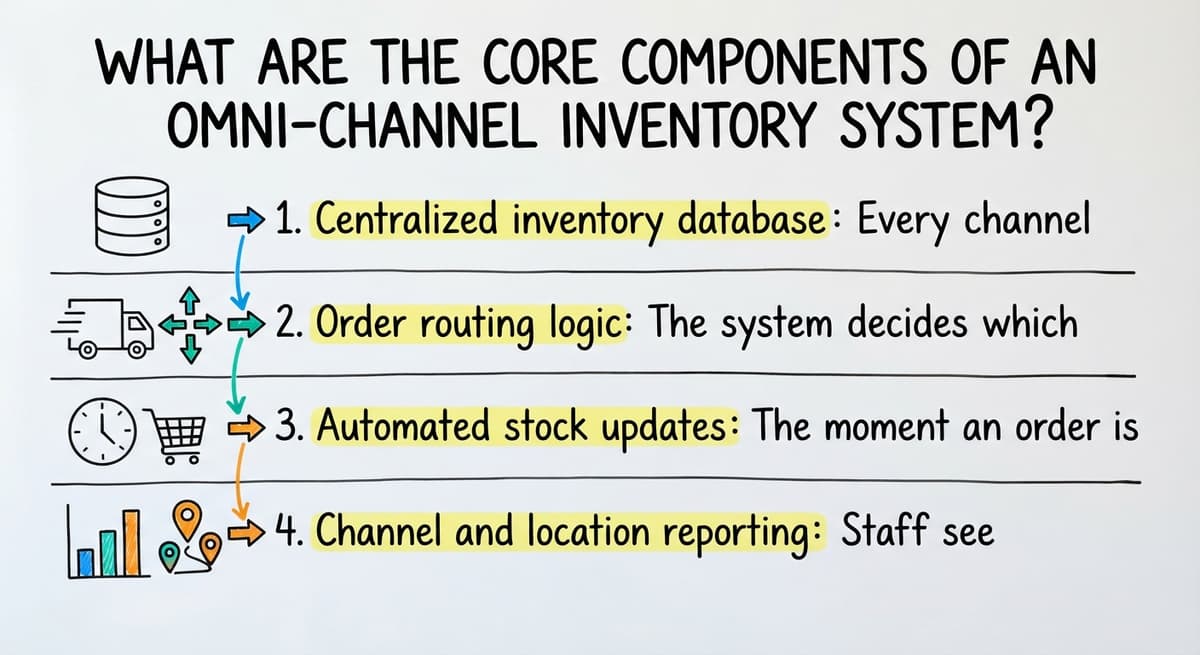
A working omni-channel inventory system has 4 moving parts that must operate together, and each one handles a distinct job.
- Centralized inventory database: Every channel reads from and writes to one record, so no channel ever works from a stale copy.
- Order routing logic: The system decides which warehouse or fulfillment location ships each order based on stock levels, location, and cost.
- Automated stock updates: The moment an order is placed, the system reduces or reserves that quantity so no other channel can sell it.
- Channel and location reporting: Staff see inventory position by SKU, by channel, and by physical location without logging into separate systems.
These 4 components are not optional add-ons. A system missing any one of them will still produce the manual matching headaches that omni-channel inventory management is designed to remove.
FAQ: What does omni-channel inventory management mean in plain language?
It means one system keeps your stock count accurate across every place you sell, in real time, so no 2 channels can sell the same unit twice.
The comparison is easier when one option is built for you
Off-the-shelf means fitting your process to the software. We do it the other way round, and the first look costs nothing.
Book a callWhy Wholesale Distributors and Warehouses Need Omni-Channel Inventory Management
Distributors feel this pain more sharply than most. A typical mid-size distributor serves retail chain buyers, direct B2B accounts, and an online channel at the same time. All 3 can place orders in the same hour.
One oversell does not stay small. A retail chain that receives a short shipment may issue a chargeback. A B2B buyer that hits a stockout may move their account to a competitor. An emergency reorder costs more than the margin on the original sale.
The US Census Bureau tracks the inventories-to-sales ratio for wholesale firms at census.gov/wholesale, and the data shows how tight that ratio runs. Distributors carry inventory precisely calibrated to expected demand. A sync delay between channels breaks that calibration fast.
Manual processes cannot keep up when orders arrive from multiple directions at once. Email threads and spreadsheets were built for one person updating one record. They were not built for 3 channels writing to the same SKU count in parallel. A connected system is not a luxury for a distributor at this stage. It is the only way the count stays right.
FAQ: Why do wholesale distributors need omni-channel inventory management?
Because distributors serve multiple buyer types at the same time, and a single oversell or stockout can trigger chargebacks, lost accounts, and costly emergency reorders that a spreadsheet cannot prevent.
Where Your Accounting Software Fits Into an Omni-Channel Inventory Setup
Many small distributors already rely on their accounting software for accounting and have no desire to replace it. That is a reasonable position. Your accounting software handles invoicing, accounts payable, and financial reporting well.

What your accounting software was not designed to do is manage real-time inventory sync across multiple sales channels. It does not natively watch a B2B portal, a warehouse pick queue, and an online storefront at the same time and keep a single live count across all 3.
The practical answer is a custom working layer that sits alongside your accounting software. That layer handles inventory logic: reserving stock, routing orders, and updating quantities in real time. It then feeds clean, completed transaction data back into your accounting software so the books stay accurate. Accounting software integration for distributors built this way means the accounting team keeps working exactly as before, and the warehouse team gets the real-time control they need.
Replacing familiar tools is not required. Adding the right layer around them is.
Common Problems Omni-Channel Inventory Management Solves
These are the specific failures that a connected system is built to prevent. Each one costs real time and real money.
- Overselling: Two channels sell the last unit at the same time because neither saw the other's order. The result is a short shipment and an unhappy buyer.
- Phantom inventory: The system shows stock that is already committed to an open order or physically missing from the shelf. Staff pick to an empty bin.
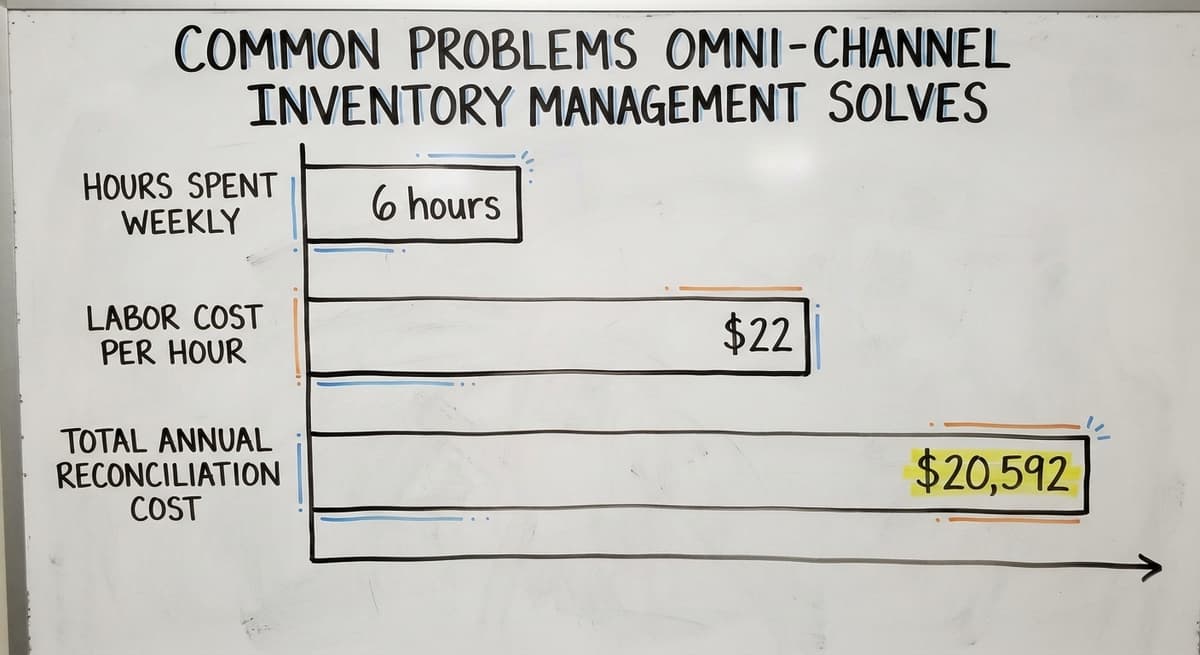
- Manual matching: Staff spend hours each week comparing channel reports to find the true on-hand count. According to the US Bureau of Labor Statistics, stock clerks and order fillers earn a median wage you can check at bls.gov/oes/current/oes435071.htm. Three people spending 6 hours a week on matching at $22 an hour costs $20,592 a year in labor alone, before errors.
- Delayed fulfillment: Orders sit in a queue while staff call around to find which location actually has the product in stock.
Each problem on this list is a symptom of the same root cause: channels that do not share a live count.
FAQ: What problems does omni-channel inventory management solve?
It removes overselling, phantom inventory, manual matching, and fulfillment delays, all of which trace back to channels that do not share a live stock count.
What Good Omni-Channel Inventory Management Looks Like in Practice
Picture a normal afternoon at a mid-size distribution warehouse.

At 2:00 p.m. a retail buyer places an order through the B2B portal for 50 units of a fast-moving SKU. The system at once reduces the available quantity in the warehouse pick queue. The online storefront and the wholesale portal both reflect the new count within seconds. No staff member has to touch anything.
At 2:15 p.m. that SKU drops below its reorder threshold across all channels combined. A reorder trigger fires automatically and sends a buy request to the supplier. No one has to notice the low count and no one has to remember to act.
At end of shift, the warehouse supervisor checks one dashboard. Stock levels by location, open orders by channel, and items below threshold are all visible in one view. There is no logging into 3 separate systems and no comparing printouts.
That is what order management for fulfillment centers looks like when the inventory layer is working correctly.
See it running on your own process first
No build cost. The subscription starts once it is live and doing the job, not before.
Book a callSigns Your Operation Is Ready for Omni-Channel Inventory Management
These questions are a quick self-check. A yes to any one of them is a signal worth taking seriously.
- Do you sell through more than 1 channel but reconcile stock counts manually at the end of the week?
- Has your team experienced at least 1 oversell or stockout caused by a delay between channel updates?
- Do staff spend meaningful time each week correcting inventory counts rather than fulfilling orders?
- Are you adding a new sales channel and already know the current process will not handle the added volume?
- Does your team log into separate systems to get a complete picture of what is in stock and where?
If you answered yes to 2 or more, the manual process is already costing more than a connected system would. The IRS needs accurate inventory valuation: Publication 538 states directly that "to figure taxable income, you must value your inventory at the beginning and end of each tax year," as noted at irs.gov/publications/p538. A count that drifts between channel syncs is not just an operations problem. It is a compliance exposure.
FAQ: How do I know if my operation is ready for omni-channel inventory management?
If you sell through more than one channel, reconcile stock manually, or have experienced an oversell caused by a sync delay, the manual process is already costing you more than a connected system would.
Can a Small Distributor Use Omni-Channel Inventory Management Without a Big ERP System?
Yes, and this is the question most small and mid-size distributors need answered before they act. Enterprise platforms are built for large companies. They come with long rollout timelines, high licensing costs, and a requirement to change how your team works to fit the software.
A custom-built system takes a different approach. It is scoped to the channels and workflows the business actually uses today. Inventory management software for wholesale distributors built at this scale does not force a team to learn a system designed for a company 10 times their size.
Custom warehouse management systems can be built around existing processes. The warehouse team keeps picking the way they pick. The accounting team keeps using the tools they know. The new layer handles the inventory logic that the existing tools cannot.
Local rollout support matters here. A builder who walks the warehouse floor understands the operation in a way that a remote support ticket cannot replicate. The NIST Manufacturing Extension Partnership offers vendor-neutral guidance on supply chain process at nist.gov/mep/supply-chain, and that guidance consistently points toward fit-to-process over force-fit-to-platform.
A custom system scoped to your actual operation is a realistic path forward without a costly migration.
The Right Next Step
Omni-channel inventory management is not a concept reserved for large retailers or enterprise buyers. It is the practical answer to a problem that every multi-channel distributor hits once they grow past a single sales path.
The core idea is simple: one accurate count, shared in real time, across every channel. The technology to deliver that does not have to be expensive or disruptive. It does have to fit the way your operation actually works.
If your team is spending hours each week reconciling counts, if you have had an oversell that cost you a customer, or if you are about to add a new channel and know the current process will not hold, a connected inventory system is the fix. It can sit alongside your accounting software, match your existing workflows, and be scoped to your size rather than a Fortune 500 budget.
Talk to a builder who will walk your operation before writing a line of code. That conversation costs nothing and usually surfaces the 2 or 3 specific points where your current process is breaking down.
Frequently asked questions
What does omni-channel inventory management mean in plain language?
It means one system keeps your stock count accurate across every place you sell, in real time, so no two channels can sell the same unit twice. When an order arrives through any channel, the available quantity updates at once everywhere else.
Why do wholesale distributors need omni-channel inventory management?
Distributors serve multiple buyer types at the same time. A single oversell or stockout can trigger chargebacks, lost accounts, and costly emergency reorders. Manual spreadsheets and email threads cannot keep a live count accurate when three channels are placing orders in the same hour.
What problems does omni-channel inventory management solve?
It removes overselling, phantom inventory, manual matching, and fulfillment delays. All four problems trace back to channels that do not share a live stock count. A connected system fixes the root cause rather than patching each symptom individually.
How do I know if my operation is ready for omni-channel inventory management?
If you sell through more than one channel, reconcile stock manually, or have experienced an oversell caused by a sync delay, the manual process is already costing more than a connected system would. Adding a new sales channel is another clear trigger.
How is omni-channel inventory management different from regular inventory tracking?
Regular inventory tracking works fine when one team manages one sales path. Omni-channel inventory management is required when the same SKU can sell through multiple channels at the same time. Without a shared live count, each channel works from its own stale copy and oversells become inevitable.
How does your accounting software fit into an omni-channel inventory setup?
Your accounting software handles accounting well but was not designed to sync inventory across multiple live sales channels. A custom working layer can sit alongside it, managing real-time stock levels and order routing, then feeding clean transaction data back into your accounting software so the books stay accurate without any change to the accounting workflow.
Can a small distributor use omni-channel inventory management without a big ERP system?
Yes. A custom-built system can be scoped to the channels and workflows the business actually uses today. It does not need a long enterprise rollout or a change to existing processes. The right system fits around how the team already works rather than forcing them to adapt to software built for a much larger operation.
What are the core components of an omni-channel inventory system?
Four components must work together: a centralized inventory database all channels share, order routing logic that assigns fulfillment to the right location, automated stock updates that reserve quantities the moment an order is placed, and reporting that shows inventory position by channel, location, and SKU in one view.
Start with a free first look
A 30 minute call, your operation mapped, and a clear picture of what we would build. No obligation and nothing to install.
Book a callRelated guides
The rest of this guide, for the parts of the job this page does not cover.
- What is the Difference Between Aggregate and Item Inventory Management
- What is an Important Factor in Inventory Management
- What is Abc Classification in Inventory Management
- What is Inventory Management in Working Capital
- What is Inventory Management and Its Types
- What is the Main Purpose of Inventory Management
- What is Information Technology Inventory Management
- What is Risk Pooling in Inventory Management
- What is Inventory Management Mary Kay
- What is Stock Taking in Inventory Management
- What is Bin Number in Inventory Management
- What is the Goal of Inventory Management Quizlet
- What is the Implication of Proper Inventory Management
- What is Inventory Management and Its Importance
- What is the Importance of Eoq in Inventory Management
- What is the Importance of Quality Inventory Management
- What is Inventory Management Explain Techniques of Inventory Management
- What is Mean by Inventory Management
- What is Inventory Management Meaning in Hindi
- What is Inventory Management and Why is It Important
- What is the Rationale for Inventory Management Quizlet
- What is the Purpose of Inventory in Operations Management
- What is Inventory Management Whiteboard Wednesday
- What is Fluctuation Stock in Inventory Management