


What Is The Scope Of Inventory Management
Reviewed and updated: October 2026
The scope of inventory management covers every step a product takes inside your operation. It starts when goods arrive at the dock and ends when the right item ships to the right customer. That includes receiving, storage, location tracking, demand forecasting, pick and pack, cycle counts, and reporting. It is not just counting stock. It is controlling the flow of product through your entire warehouse or distribution operation.
Book a callDefining the Scope of Inventory Management
Most people think inventory management means knowing how many units you have. That is one part of it. The full scope of inventory management runs from the buy order through to the customer's door. For a wholesale distributor, that means managing dozens of moving pieces at once: vendor lead times, bin locations, reorder points, pick lists, and shrinkage. Each piece connects to the next. A gap in one creates a problem downstream. The scope is wider than most teams expect when they first sit down to map it.
We build it for your operation, and the first look is free
If you would rather not compare products, describe how your operation already works and we build the system around it.
No build cost. You see it running on your own process first, and the monthly subscription starts only once it is live.
Book a callReceiving and Intake
Inventory management starts the moment goods arrive at the dock. A receiving team checks quantities against the buy order, logs the condition of each item, and assigns a storage location. That sounds simple. In practice, it is where most errors enter the system.
A case counted wrong at intake shows up as a phantom unit weeks later. A damaged item logged as good becomes a customer complaint. Manual receiving on paper or in spreadsheets makes these errors hard to trace. Barcode scanning at the dock closes that gap. As GS1 explains on its barcode standards page, "GS1 standards are the most widely used supply chain standards system in the world," underpinning the scan-based workflows that make accurate receiving possible at scale.
Errors at intake are the cheapest errors to fix, because catching them at the dock costs nothing compared to a customer return.
Storage and Location Tracking
Where does every SKU live in your warehouse, and who keeps that current?
Location tracking answers the core question of where every SKU lives. Knowing where every SKU lives is not optional for a warehouse running more than a few hundred items. When a picker cannot find a bin location, they guess. Guessing drives errors. Bin, shelf, and zone assignments need to stay current as stock moves, not just when a new item arrives.
Spreadsheets break down fast here. Staff turns over. Someone updates a location in one tab and not another. A zone gets reorganized and the sheet never catches up. A purpose-built system ties the location record to the item record, so any move updates both at once. Accurate location data cuts pick time and reduces the errors that drive returns.
Demand Forecasting and Reorder Points
The scope of inventory management includes predicting what you will need before you run out. That is what reorder points and safety stock levels do. A reorder point is the stock level that triggers a new buy order. Safety stock is the buffer you hold to cover delays or demand spikes.
Getting these numbers right draws on 3 inputs: sales history, vendor lead times, and seasonal patterns. Operations running only on an accounting package often skip this layer entirely. They reorder when someone notices the shelf is low. That is reactive. The result is stockouts on fast movers and overstock on slow ones. Both cost money. Forecasting turns that reactive habit into a scheduled, data-driven process.
The comparison is easier when one option is built for you
Off-the-shelf means fitting your process to the software. We do it the other way round, and the first look costs nothing.
Book a callWhat Reactive Reordering Actually Costs
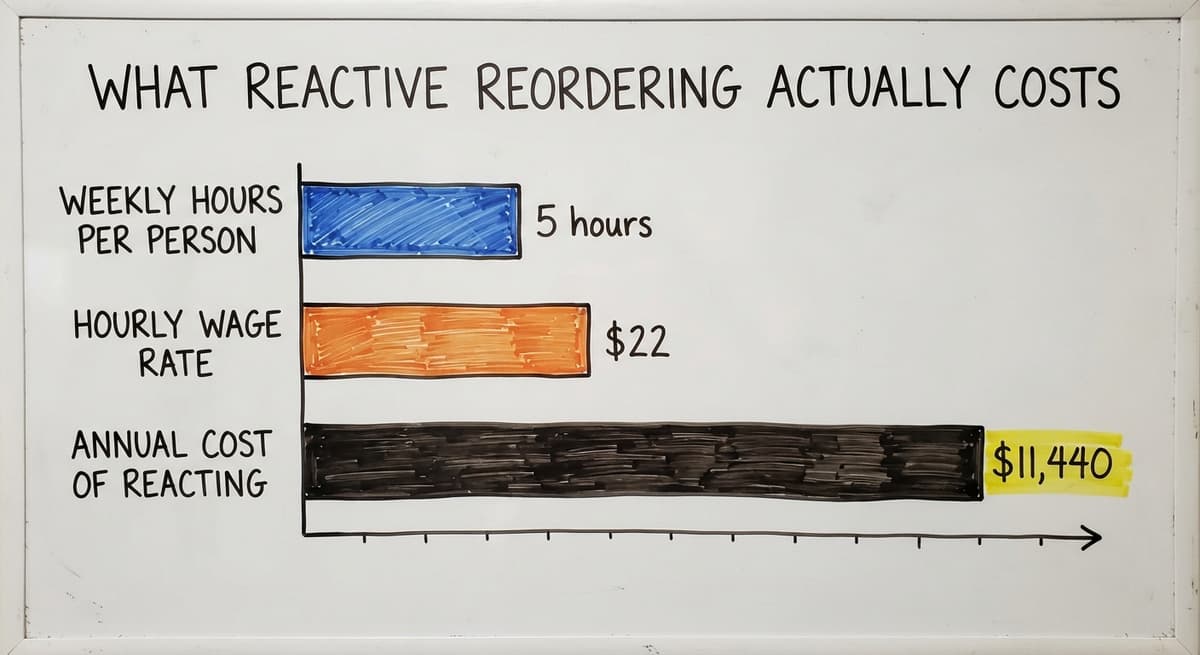
Consider a team of 2 people spending 5 hours a week each chasing stockouts and emergency orders at $22 an hour. That is $11,440 a year spent reacting to a problem a reorder point would have prevented.
Order Fulfillment and Picking
Picking, packing, and shipping are part of inventory management. They are not a separate department that inventory hands off to. Accurate pick lists depend on real-time stock counts. If the count in the system is wrong, the picker either pulls the wrong item or cannot find the right one.
Fulfillment errors cost more than the fix. A wrong shipment means a return, a replacement, a customer call, and a damaged relationship. The US Federal Trade Commission's mail and internet order rule needs sellers to ship within the time promised or notify the customer. An accurate count is what makes that promise keepable.
Custom software can generate pick lists that match your actual warehouse layout, routing pickers in the most efficient path rather than a generic sequence. That alone cuts pick time on a busy shift.
Inventory Counting and Reconciliation
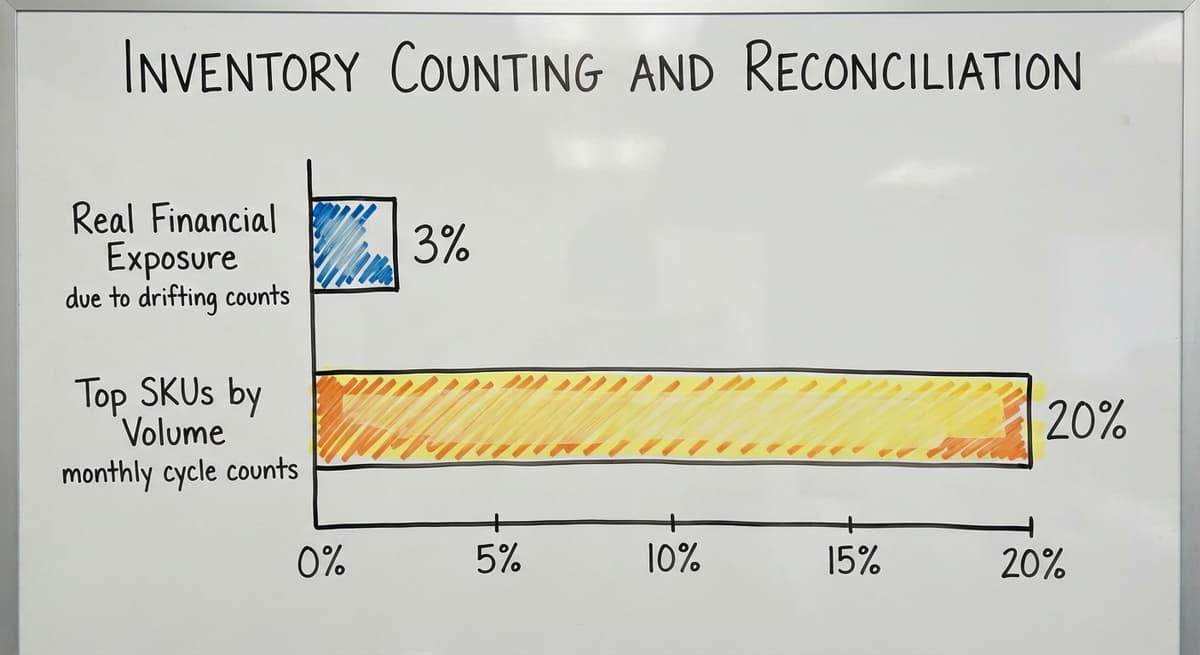
Cycle counts are short, frequent counts of a rotating subset of SKUs. They keep records aligned with reality without shutting the warehouse down for a full physical count. Shrinkage, damage, and data entry errors cause counts to drift over time, and a count that drifted 3% across 500 SKUs is a real financial exposure.

The IRS is direct about why counting matters. IRS Publication 538 states: "To figure taxable income, you must value your inventory at the beginning and end of each tax year." That is a legal obligation, not a best practice. Matching connects the warehouse count back to the accounting records so both agree. Frequent small counts are easier to manage than one large annual count, and they catch problems while they are still small enough to fix.
How often should a distributor run cycle counts?
For most wholesale distributors, counting the top 20% of SKUs by volume every month and the rest quarterly keeps records close enough to reality to be useful. The exact schedule depends on how fast stock moves and how many SKUs you carry. The point is to make counting a routine, not a crisis.
Reporting and Visibility
Inventory visibility means having current, accurate data on stock levels, slow movers, turnover rates, and fill rates, available without building a report from scratch each time. Owners and operations managers who lack this data make decisions on gut feel. Gut feel is expensive when you are buying $200,000 in stock each quarter.
The US Census Bureau's Monthly Wholesale Trade data tracks the national inventories-to-sales ratio for wholesale firms, which shows how much stock distributors carry relative to what they sell. A business with no internal visibility cannot benchmark against that or spot its own trend.
Good reporting turns inventory management from reactive to proactive. A system built around your operation surfaces the numbers your team actually uses, not a generic dashboard built for a different kind of business.
Where Your Accounting Software Ends and Inventory Management Begins
Your accounting software handles financials well. It was built to track money, not to manage warehouse operations in real time. It records a sale. It does not tell a picker where the item is, flag a low bin before the stockout happens, or route a receiving team through a check-in process.
Most distributors fill that gap with spreadsheets, printed sheets, and email threads. That works until it does not. The NIST Manufacturing Extension Partnership notes that supply chain process gaps drive cost and risk in ways that are hard to see until a failure surfaces. Blind spots in receiving, location tracking, and replenishment are exactly that kind of gap.
See it running on your own process first
No build cost. The subscription starts once it is live and doing the job, not before.
Book a callHow Custom Software Bridges the Gap Without Replacing Your Accounting Package
Custom software can sit alongside your accounting software, handling the working side without replacing the accounting. It captures what happens on the floor and passes the financial result to the accounting package. The 2 systems each do what they were built to do. That is a faster path to control than replacing your accounting software with a full enterprise platform most small distributors do not need.
How do wholesale distributors manage inventory without a big ERP system?
Many distributors run a lean stack: an accounting package for financials and a purpose-built working layer for everything the warehouse floor needs. That second layer handles receiving, location tracking, pick lists, cycle counts, and reorder alerts. It connects to the accounting package so records stay in sync. The result is working control without the cost or complexity of a full enterprise system.
Inventory management software for wholesale distributors built this way scales with the business. Adding a new warehouse, a new product line, or a new team does not need a new platform.
How Can a Small Distributor Get Better Inventory Control Without a Long Implementation?
The right place to start is the most painful gap, not the most complete solution. A 5-person distributor has different needs than a 50-person fulfillment center. Starting with the specific problem that costs the most time or money, whether that is receiving errors, stockouts, or a cycle count that takes a full day, delivers visible results fast.
Replacing Excel-based inventory tracking with purpose-built software does not have to mean a 12-month rollout. A system built around how your operation already works needs less retraining and less disruption. Staff adopt tools that match their actual workflow. How custom warehouse software works alongside your accounting software matters here: the goal is to add control to what already runs, not to rebuild from scratch.
How Purpose-Built Software Scales and Pays for Itself
Fulfillment center operations software built to your process scales as the business grows. That means adding users, locations, or SKU categories without forcing a migration to a platform built for a company 10 times your size. The Bureau of Labor Statistics reports that stock clerks and order fillers earn a median wage that makes manual process time a real line item. A system that saves 3 people 4 hours a week at $20 an hour returns $12,480 a year. That math makes the case for starting now rather than waiting for the operation to grow into the problem.

Start With the Costliest Gap and Build From There
The scope of inventory management is wide, but you do not have to cover all of it on day one. Cover the part that is costing you the most, build from there, and let the system grow with the business.
Ready to map the gaps in your current setup? Describe how your operation runs today and where the friction is. A system built around your workflow, not a vendor template, is the fastest path to real control.
Frequently asked questions
What is inventory in operations management?
In operations management, inventory is any stock a business holds to meet future demand. That includes raw materials, work in progress, and finished goods. Managing inventory means controlling how that stock moves through the operation: when it arrives, where it is stored, how it is picked, and when it is replenished. It is a core function because too much stock ties up cash and too little causes stockouts.
Is inventory management part of SCM?
Yes. Inventory management is one layer inside supply chain management (SCM). SCM covers the full chain from raw material supplier to end customer. Inventory management focuses on the stock a business holds at any point in that chain. It overlaps with purchasing, warehousing, and fulfillment, but it is a distinct discipline with its own tools, metrics, and processes.
Is inventory a good job?
Inventory roles offer steady demand across wholesale, retail, and manufacturing. The work is working and detail-oriented. Entry-level positions focus on counting, receiving, and data entry. Senior roles involve forecasting, system management, and process design. Whether it is a good fit depends on the person. Those who like structured, measurable work and problem-solving tend to stay in the field long-term.
What is the job of an inventory manager?
An inventory manager oversees the full flow of stock through a warehouse or distribution operation. Day-to-day tasks include setting reorder points, running or scheduling cycle counts, reviewing receiving accuracy, managing storage locations, and producing reports on stock levels and turnover. The role connects warehouse operations to purchasing and accounting, so it needs both floor knowledge and comfort with data.
What parts of inventory management does an accounting package not handle well?
An accounting package records financial transactions but was not built to manage warehouse operations in real time. It usually does not track bin locations, generate pick lists, guide a receiving team through a check-in process, or trigger reorder alerts based on live stock levels. Those working functions need a system built for the warehouse floor, not the general ledger.
What are the biggest gaps when teams rely on spreadsheets and printed sheets for inventory?
Spreadsheets do not update in real time, so two people working from the same file can create conflicting records. Printed sheets go stale the moment stock moves. Neither flags a low bin before the stockout happens, enforces a receiving process, or connects location data to pick lists. The result is errors that are hard to trace back to their source and counts that drift away from reality over time.
How does demand forecasting fit into the scope of inventory management?
Demand forecasting is the layer of inventory management that prevents stockouts and overbuying. It uses sales history, vendor lead times, and seasonal patterns to calculate reorder points and safety stock levels. Without it, teams reorder by feel, which leads to running out of fast movers and sitting on too much of the slow ones. Forecasting turns that reactive habit into a scheduled, data-driven process.
Where does inventory management start and end in a warehouse or distribution operation?
Inventory management starts when a buy order is placed and goods are expected at the dock. It ends when the right item ships to the right customer and the transaction is recorded. Every step in between, including receiving, storage, location tracking, picking, packing, cycle counting, and reporting, falls inside the scope. Nothing in that chain is separate from inventory management; each step depends on the accuracy of the one before it.
Start with a free first look
A 30 minute call, your operation mapped, and a clear picture of what we would build. No obligation and nothing to install.
Book a callRelated guides
The rest of this guide, for the parts of the job this page does not cover.
- What is the Difference Between Aggregate and Item Inventory Management
- What is Jit Inventory Management
- What is Kanban System of Inventory Management
- What is the Definition of Inventory Management
- What is an Important Factor in Inventory Management
- What is Abc Classification in Inventory Management
- What is Inventory Management in Working Capital
- What is Poor Inventory Management
- What is Inventory Management and Its Types
- What is the Main Purpose of Inventory Management
- What is Inventory Management in Pharmacy
- What is Effective Inventory Management
- What is Information Technology Inventory Management
- What is Risk Pooling in Inventory Management
- What is Inventory Management Mary Kay
- What is Stock Taking in Inventory Management
- What is Hospital Inventory Management
- What is Bin Number in Inventory Management
- What is the Goal of Inventory Management Quizlet
- What is the Implication of Proper Inventory Management
- What is Omni-channel Inventory Management
- What is Inventory Management and Its Importance
- What is the Importance of Eoq in Inventory Management
- What is the Importance of Quality Inventory Management