


What Is Inventory Management In Pharmacy
Pharmacy inventory management means tracking every medication and supply your operation holds, from the moment a shipment arrives to the moment a product leaves the shelf. It covers receiving, storage, dispensing, and reordering. Get it right and patients get what they need on time. Get it wrong and the cost shows up fast, in expired stock, emergency orders, and counts that never match.
Reviewed and updated: October 2026
Book a callThe Short Answer: What Is Inventory Management in Pharmacy?
Pharmacy inventory management is the process of tracking what medications and supplies are on hand, on order, and going out. It covers every step from receiving a shipment to dispensing a product to triggering a reorder at the right time. Unlike general retail, pharmacy inventory must also track lot numbers, expiration dates, and controlled substance records. The goal is simple: the right product in the right place at the right count, every time.
We build it for your operation, and the first look is free
If you would rather not compare products, describe how your operation already works and we build the system around it.
No build cost. You see it running on your own process first, and the monthly subscription starts only once it is live.
Book a callWhat Gets Tracked in a Pharmacy Inventory
Pharmacy inventory goes well beyond counting boxes. Every item in the system carries multiple data points that must stay accurate across the full cycle.
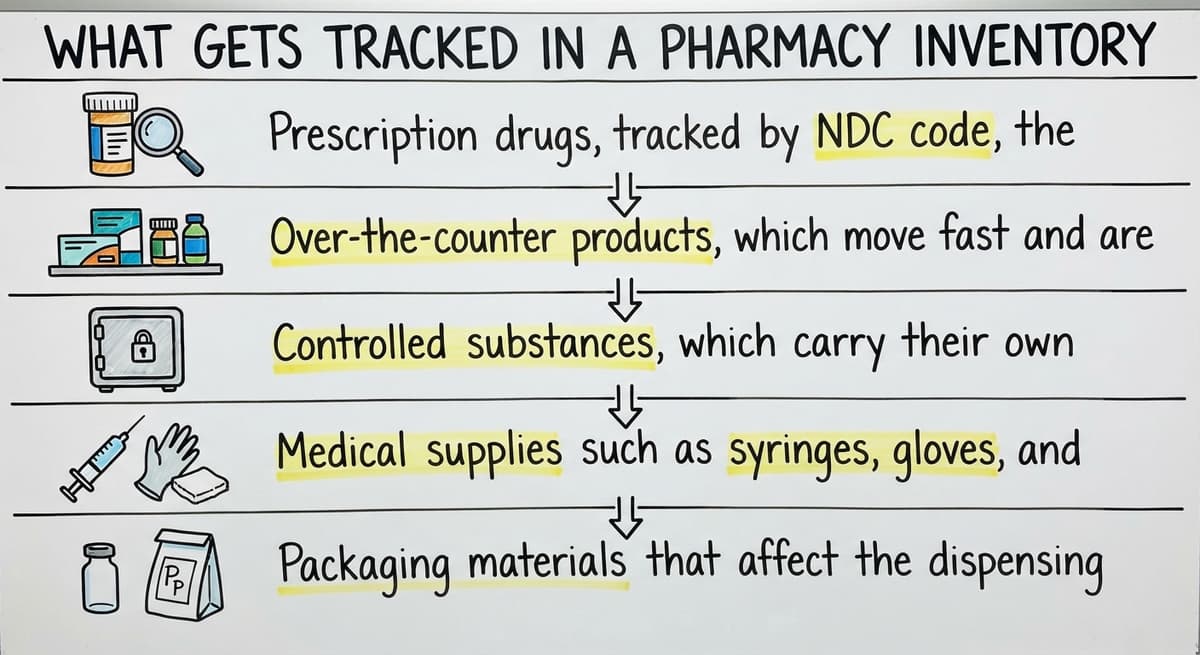
The core categories tracked in any pharmacy include:
- Prescription drugs, tracked by NDC code, the National Drug Code that identifies the exact product, strength, and package size
- Over-the-counter products, which move fast and are easy to undercount
- Controlled substances, which carry their own strict count and record requirements
- Medical supplies such as syringes, gloves, and testing materials
- Packaging materials that affect the dispensing process
Why Lot Numbers and Expiration Dates Change Everything
Lot numbers and expiration dates attach to every item. Those 2 data points are what make pharmacy inventory different from a hardware store shelf count. As GS1 notes, barcode standards exist specifically to carry product identity, lot, and expiry data in a single scannable label, so every scan at receiving or dispensing captures the full record without manual entry.
When any one of these data points drifts out of sync, the error compounds at every step that follows.
Why Is Pharmacy Inventory Management More Complex Than General Retail?
Pharmacy inventory is more complex than general retail because a stockout is not just a lost sale. It can interrupt a patient's treatment or put an operation out of compliance with federal rules.
General warehouses deal with demand swings and carrying costs. Pharmacies deal with all of that, plus:
- Expiration windows that can be as short as weeks for certain compounded or specialty products
- Controlled substance regulations that need a documented count at every transfer
- Narrow reorder windows, because many medications have limited supplier availability
- Patient-specific orders that cannot be substituted the way a general SKU can
The Downstream Consequences of a Pharmacy Inventory Error
The working stakes are higher because the downstream effect of an error is not a refund or a backorder notice. It is a patient who cannot fill a prescription, or an audit finding that puts a license at risk. That difference in consequence is what drives every design choice in a pharmacy-specific inventory system.
The Core Steps in the Pharmacy Inventory Process
Pharmacy inventory management runs as a cycle. Each step feeds the next, and a gap in any one step creates errors that are hard to trace later.
The standard cycle works like this:
- Buy ordering: A reorder point, the stock level that triggers a new order, is set for each item. When stock falls to that level, a buy order goes out.
- Receiving and check: Incoming shipments are checked against the buy order. Lot numbers and expiration dates are captured at this step.
- Storage and location tracking: Products are placed in a designated location. The system records where each lot sits so it can be found and rotated correctly.
- Dispensing: When a product leaves the shelf, the system deducts it from the count. Controlled substances need a witnessed record at this step.
- Matching: Actual counts are compared to system counts on a set schedule. Discrepancies are investigated before they grow.
Why Every Step in the Cycle Depends on the One Before It
Every step produces data. Manual gaps at receiving mean bad lot records downstream. Bad lot records mean failed matching. The chain is only as strong as its weakest entry point.
The comparison is easier when one option is built for you
Off-the-shelf means fitting your process to the software. We do it the other way round, and the first look costs nothing.
Book a callCommon Problems That Signal a Broken System
Broken pharmacy inventory systems show up in patterns, not single events. The symptoms below are process failures, not staff failures.
- Expired product found on shelves signals that lot rotation was never enforced or tracked at storage
- Frequent emergency orders from secondary suppliers suggest reorder points were never set or are set too low
- Counts that do not match the system after a physical count point to receiving or dispensing steps that are not captured in real time
- Staff spending hours each week on manual matching is a sign that the system cannot close its own gaps
- Controlled substance discrepancies that take days to trace back indicate the dispensing record is incomplete
Why These Problems Require a Structural Fix, Not a Retraining Session
None of these problems start with a bad employee. They start with a process that asks people to hold information in their heads or on paper, then expects the numbers to be right. A system that produces these symptoms needs a structural fix, not a retraining session.

Manual Tracking vs. a Dedicated Inventory System
Spreadsheets and paper logs can work when a pharmacy carries 50 SKUs and fills a small daily order volume. At that scale, one person can hold the picture in their head and catch errors before they compound.
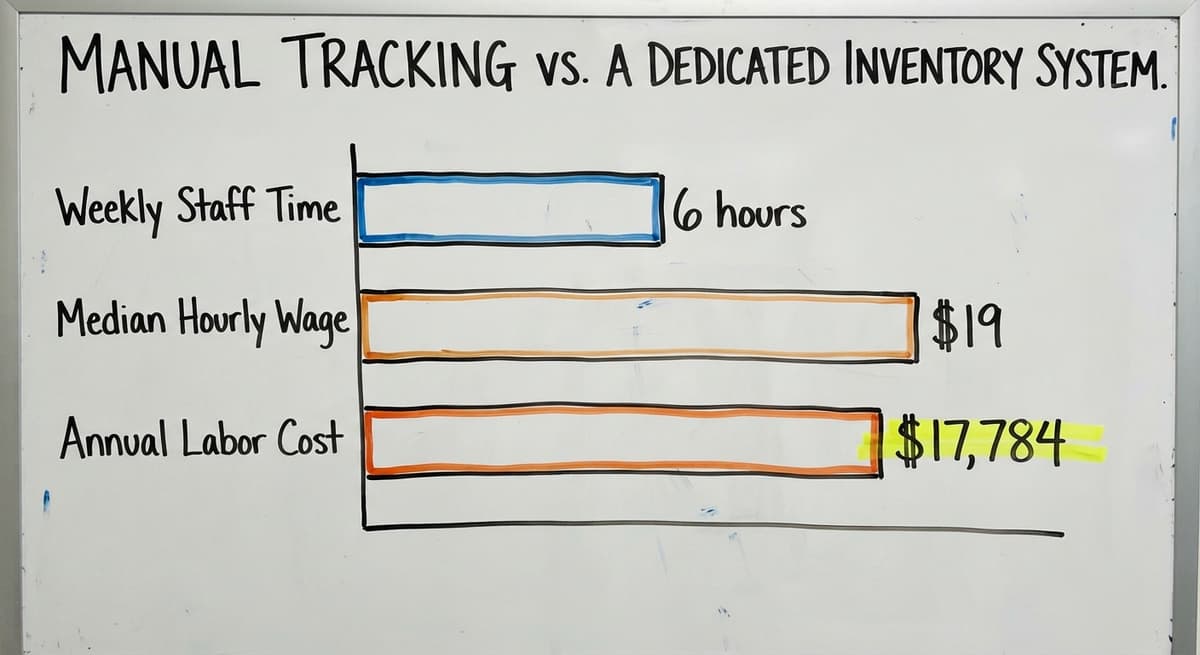
The problem is that scale changes the math fast. Consider a team of 3 staff members each spending 6 hours a week on manual counts and matching, at the Bureau of Labor Statistics median wage for stock clerks of around $19 an hour. That is $17,784 a year in labor, before counting the cost of a single error that leads to an emergency order or a compliance finding.
The Real Cost of Manual Tracking Is the Errors, Not the Hours
As the IRS states in Publication 538, "To figure taxable income, you must value your inventory at the beginning and end of each tax year." That obligation exists whether the count is done on paper or in a system. The difference is how long it takes and how often it is wrong.
Manual methods do not fail because people are careless. They fail because the real cost of manual tracking is not the time spent, it is the errors that compound over time and become harder to unwind the longer they go uncaught.
What a Good Pharmacy Inventory System Does
A purpose-built inventory system for pharmacy operations handles the tasks that break down in manual workflows. The core functions that matter most are:
- Real-time stock visibility so any staff member can see what is on hand without a physical count
- Automated reorder triggers that fire when stock hits a set reorder point, removing the need to watch levels manually
- Expiration date tracking with alerts before a product reaches its window, so rotation happens proactively
- Controlled substance logs that are built into the dispensing step, not added as a separate task
- Audit-ready reporting that pulls a complete record without manual assembly
See it running on your own process first
No build cost. The subscription starts once it is live and doing the job, not before.
Book a call
How Integration Determines Whether a System Actually Works
A good system fits the way the pharmacy already operates. Staff should not have to rebuild every process to use it. Integration with existing accounting or purchasing tools matters here. When the inventory system talks to the accounting package already in place, there is no duplicate entry and no gap between what was ordered and what was paid.
The measure of a good system is whether it reduces the decisions staff have to hold in their heads, not whether it has the most features.
How Wholesale and Distribution Operations Fit In
Pharmacy distributors and wholesale suppliers face the same inventory challenges that a single pharmacy faces, at a volume that makes every gap more expensive.
A distribution center supplying 40 pharmacies carries thousands of SKUs. It manages the same expiration date tracking, the same lot-level records, and the same reorder logic, but across a warehouse floor rather than a single dispensary. The US Census Bureau's Monthly Wholesale Trade data tracks inventories-to-sales ratios across wholesale sectors, and pharmaceutical wholesale consistently runs tighter than general merchandise wholesale, meaning there is less buffer to absorb a receiving error.
Why Pharmacy-Specific Requirements Travel With the Product Through the Whole Chain
The principles do not change at higher volume. Accurate receiving still drives everything downstream. Location tracking still work out whether a picker pulls the right lot. Reorder logic still prevents the stockout that cascades to the pharmacy that cannot fill a prescription.
Inventory management software for wholesale distributors applies the same cycle at scale, with the added layer of multi-location tracking and supplier-level reporting. The pharmacy-specific requirements, lot numbers, expiration dates, controlled substance records, travel with the product regardless of where in the chain it sits.
Medication Inventory and Controlled Substances: A Separate Track
Controlled substance inventory sits inside the broader pharmacy inventory process but runs on its own rules. Every unit must be counted, every transfer must be recorded, and any discrepancy must be explained.
This is not a compliance checkbox. It is a data discipline that the rest of the inventory system can learn from. A controlled substance log that is accurate to the unit, in real time, is the model for what medication inventory tracking should look like across all categories.
Operations that treat controlled substance records as a separate paper process end up with 2 versions of the truth: the system count and the paper count. When those diverge, the matching work is measured in hours, not minutes. Building controlled substance tracking into the same system that handles all stock means one record, one count, and one place to look when something does not add up.
Expiration Date Tracking as an Operational Discipline
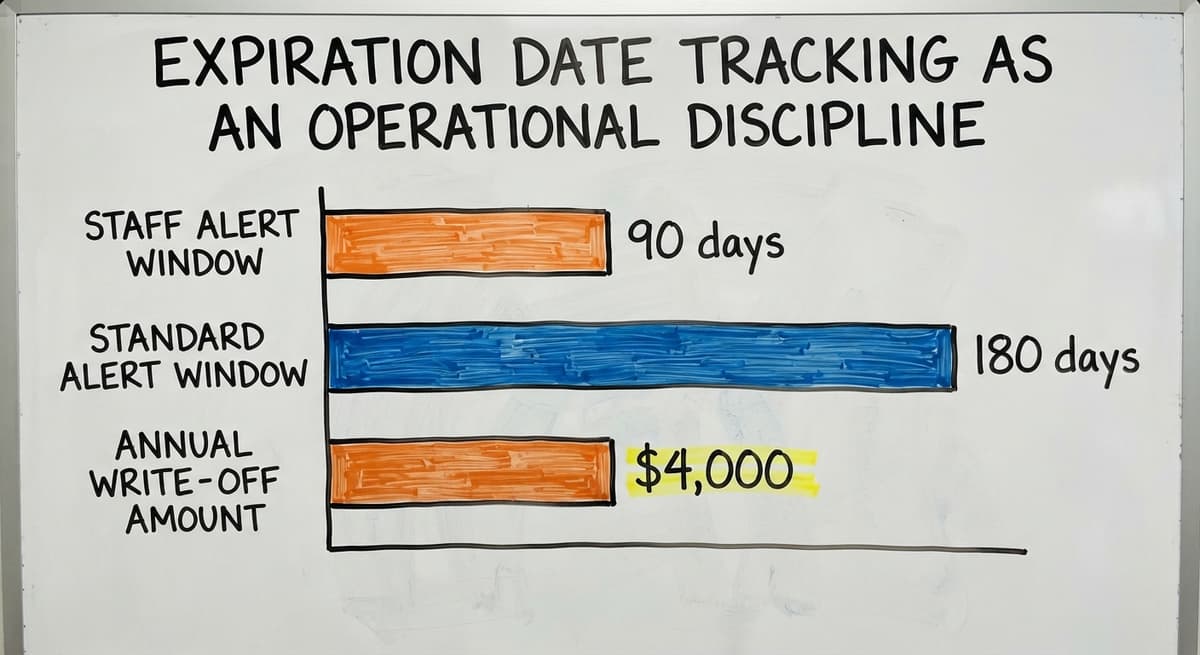
Expiration date tracking is the feature most pharmacy operations ask for first, and the one most manual systems handle worst. A spreadsheet can hold an expiration date. It cannot alert a staff member 90 days before that date arrives, and it cannot enforce first-expiry-first-out rotation at the shelf level.
The working discipline behind expiration tracking has 3 parts:
- Capture the expiration date at receiving, tied to the lot number and storage location
- Set an alert window, usually 90 to 180 days out, that flags product before it becomes a write-off
- Enforce rotation rules so the oldest lot ships or dispenses first
A pharmacy that writes off $4,000 in expired product twice a year is not facing a purchasing problem. It is facing a tracking problem. Fix the tracking and the write-offs shrink without changing what gets ordered.
Reorder Points and Stock Tracking: Getting the Numbers Right
A reorder point is the stock level at which a new order should go out. Set it too high and capital sits on the shelf. Set it too low and the stockout arrives before the order does.
The right reorder point for any item accounts for 3 inputs:
- Average daily usage over a recent period, not a guess
- Supplier lead time, meaning how many days between placing an order and receiving it
- A safety buffer for demand spikes or supplier delays
For a medication used 10 units a day with a 5-day lead time and a 2-day safety buffer, the reorder point is 70 units.

Why Real-Time Stock Tracking Is the Input That Makes Every Calculation Correct
That arithmetic is simple. The hard part is keeping the usage figure accurate, which requires that every dispensing event is recorded in the system at the time it happens.
Stock tracking that lags by hours or days produces reorder points based on old data. Old data produces stockouts. Real-time stock tracking is not a luxury feature; it is the input that makes every other calculation in the system correct.
Not sure this is the right shape for your operation
Describe how the work runs today. We map it on a call and show you what it would look like built around that, before you spend anything.
Book a callPharmacy Operations and the Cost of Getting It Wrong
Pharmacy operations run on thin margins and tight schedules. An emergency order from a secondary supplier costs more per unit and arrives slower than a planned order. A compliance finding from a controlled substance discrepancy costs staff time and, in serious cases, more than that.
The NIST Manufacturing Extension Partnership frames supply chain accuracy as a foundation for working efficiency, not a separate compliance function. That framing fits pharmacy well. Inventory accuracy is not a back-office task. It is what allows the front of the operation to run without interruption.
When inventory management in pharmacy is working, the staff filling prescriptions are not thinking about stock levels. The system is handling that. When it is not working, stock questions pull staff away from patient-facing work, and the cost is measured in time, errors, and missed fills.
Replacing Manual Spreadsheets With a Purpose-Built System
Replacing manual spreadsheets with a purpose-built system does not have to mean rebuilding every process from scratch. The operations that make this transition smoothly start by documenting what they already do, not what they wish they did.
A spreadsheet that has been used for 3 years contains real institutional knowledge about reorder points, supplier lead times, and which products move fastest. That knowledge should transfer into the new system, not get discarded.

How Staff Knowledge Carries Forward Into the New System
Warehouse and distribution inventory tracking solutions built around existing workflows carry that knowledge forward. The staff who built the spreadsheet become the staff who configure the system, because they already know the rules. The system just enforces those rules automatically instead of relying on someone to remember to check the file.
The transition works when the new system solves the problems the old one created, without asking staff to learn a new way of thinking about their own operation.
How Do You Improve Pharmacy Inventory Management Without a Disruptive Overhaul?
Start by documenting the current process, step by step, before touching any system. The places where data is lost or delayed will show up clearly once the process is written down.
Practical first steps look like this:
- Write out every step from buy order to dispensing record
- Mark the steps where data is entered manually or transferred between tools
- Identify what the new system must connect to, whether that is an accounting package, a purchasing tool, or a supplier portal
- Set a short list of problems the system must solve in the first 90 days
Why Starting With Your Current Process Is Faster Than Starting With a Product Demo
Custom working software that works alongside your accounting tool means the inventory data and the financial data stay in sync without a separate export step. Nothing has to be rebuilt from scratch.
A system built around how the operation already works is faster to adopt and faster to trust. If you want to talk through what that looks like for your specific operation, that conversation starts with your current process, not a product demo.

Conclusion
Pharmacy inventory management is the working backbone that keeps medications available, counts accurate, and compliance records clean. The principles are consistent whether the operation is a single dispensary or a wholesale distribution center supplying dozens of accounts: accurate receiving, real-time stock tracking, enforced rotation, and automated reorder logic.
Manual systems work until they do not. The point at which they stop working is usually visible in the symptoms: expired product, emergency orders, and counts that never quite match. A purpose-built system removes the manual steps that produce those symptoms, and it does so without forcing a complete rebuild of what already works.
The right starting point is an honest look at where data is lost today. Everything else follows from that.
Frequently asked questions
What does inventory management in pharmacy mean?
Pharmacy inventory management means tracking every medication and supply from the moment it arrives to the moment it leaves. It covers receiving, storage, dispensing, and reordering. It also includes tracking lot numbers, expiration dates, NDC codes, and controlled substance records, which are requirements that general retail inventory does not carry.
What types of products are tracked in a pharmacy inventory?
A pharmacy inventory tracks prescription drugs by NDC code, over-the-counter products, controlled substances, medical supplies, and packaging materials. Each item carries a lot number and expiration date that must stay accurate from receiving through dispensing. Controlled substances also need a documented count at every transfer point.
What are the signs that a pharmacy inventory system is not working?
The clearest signs are expired product found on shelves, frequent emergency orders from secondary suppliers, physical counts that do not match system counts, and staff spending several hours each week on manual matching. These are process failures, not staff failures. Each one points to a step in the cycle where data is not being captured in real time.
What is the difference between manual tracking and a dedicated inventory system?
Manual tracking, whether on paper or in a spreadsheet, works at low volume but breaks down as SKU count and order frequency grow. The real cost is not the time spent on data entry. It is the errors that go undetected and compound over time. A dedicated system captures data at each step automatically, so discrepancies surface before they become compliance or patient-care problems.
What should a pharmacy inventory system be able to do?
A pharmacy inventory system should provide real-time stock visibility, trigger reorders automatically when stock hits a set level, alert staff before products reach their expiration window, log controlled substance movements as part of the dispensing step, and produce audit-ready reports without manual assembly. It should also connect to existing accounting or purchasing tools so there is no duplicate data entry.
How do wholesale distributors handle pharmacy inventory differently from a single pharmacy?
Wholesale distributors apply the same inventory principles at much higher volume and across more SKUs. They track the same lot numbers, expiration dates, and controlled substance records, but across a warehouse floor supplying multiple accounts. Multi-location tracking and supplier-level reporting become necessary at that scale. The pharmacy-specific data requirements travel with the product regardless of where in the supply chain it sits.
How is a reorder point calculated in pharmacy inventory?
A reorder point is calculated from 3 inputs: average daily usage over a recent period, supplier lead time in days, and a safety buffer for demand spikes or delays. For a product used 10 units a day with a 5-day lead time and a 2-day buffer, the reorder point is 70 units. The calculation only stays accurate if every dispensing event is recorded in the system at the time it happens.
How do you improve pharmacy inventory management without disrupting current operations?
Start by documenting the current process step by step and identifying where data is lost or delayed. Then decide what the new system must connect to, such as an accounting package or purchasing tool. A system built around existing workflows carries institutional knowledge forward rather than discarding it. The transition is faster when the new system solves specific problems the old one created, rather than replacing everything at once.
Start with a free first look
A 30 minute call, your operation mapped, and a clear picture of what we would build. No obligation and nothing to install.
Book a callRelated guides
The rest of this guide, for the parts of the job this page does not cover.
- How to Manage Pharmacy Inventory
- What is the Difference Between Aggregate and Item Inventory Management
- What is Jit Inventory Management
- What is Kanban System of Inventory Management
- What is the Definition of Inventory Management
- What is an Important Factor in Inventory Management
- What is Abc Classification in Inventory Management
- What is Inventory Management in Working Capital
- What is Poor Inventory Management
- What is Inventory Management and Its Types
- What is the Main Purpose of Inventory Management
- What is Effective Inventory Management
- What is Information Technology Inventory Management
- What is Risk Pooling in Inventory Management
- What is Inventory Management Mary Kay
- What is Stock Taking in Inventory Management
- What is Bin Number in Inventory Management
- What is the Goal of Inventory Management Quizlet
- What is the Implication of Proper Inventory Management
- What is Omni-channel Inventory Management
- What is Inventory Management and Its Importance
- What is the Importance of Eoq in Inventory Management
- What is the Importance of Quality Inventory Management
- What is Inventory Management in Restaurant