


What Is Inventory Management In Working Capital
Reviewed and updated: October 2026
Inventory management in working capital means controlling how much cash sits locked inside stock on your shelves. Working capital is your current assets minus your current liabilities. It is the cash available to run daily operations. For most wholesale distributors, inventory is the largest current asset. Manage it well and cash flows. Manage it poorly and the checking account runs dry.
Book a callThe Short Answer: What Is Inventory Management in Working Capital?
Working capital is simple arithmetic. Take everything the business owns that converts to cash within a year (current assets) and subtract everything it owes within a year (current liabilities). The result is working capital. For a wholesale distributor or warehouse operation, inventory is usually the biggest item on the asset side. Inventory management in working capital is the practice of keeping that asset lean enough that cash stays available for payroll, vendors, and growth.
We build it for your operation, and the first look is free
If you would rather not compare products, describe how your operation already works and we build the system around it.
No build cost. You see it running on your own process first, and the monthly subscription starts only once it is live.
Book a callWhy Inventory Is a Working Capital Problem
Every unit sitting on a shelf is cash that cannot pay a vendor, cover payroll, or fund a new buy order. Overstocking inflates current assets on paper but drains real cash from the bank. Understocking causes stockouts, lost sales, and emergency reorders that cost more per unit than a planned order would have.
For a 5-to-100-person distributor running on an accounting package, these swings show up fast in the checking account. The US Census Bureau tracks this pressure at the national level through its Monthly Wholesale Trade report, which monitors the inventories-to-sales ratio across wholesale firms. When that ratio climbs, cash is getting stuck in stock across the industry.
Why Accurate Stock Counts Are the Starting Point
Barcode scanning is one of the fastest ways to keep counts accurate and catch those swings early. As GS1 explains, "GS1 standards enable businesses to identify, capture and share information about products, locations and assets," which is exactly what an accurate stock count depends on. Without a reliable count, every reorder decision is a guess, and every guess carries the risk of tying up cash in stock the business does not need or running short of stock it does.
How Does the Inventory-to-Cash Cycle Work?
The inventory-to-cash cycle answers a question every operations manager feels but rarely names: where did the money go between paying the supplier and getting paid by the customer?
The cycle runs in 5 steps:
- Cash leaves the business to pay a supplier for goods.
- Goods arrive and sit as inventory on hand.
- A customer places an order and the warehouse fulfills it.
- An invoice goes out to the customer.
- The customer pays and cash returns to the business.
The comparison is easier when one option is built for you
Off-the-shelf means fitting your process to the software. We do it the other way round, and the first look costs nothing.
Book a callWhy Cycle Speed Determines Working Capital Health
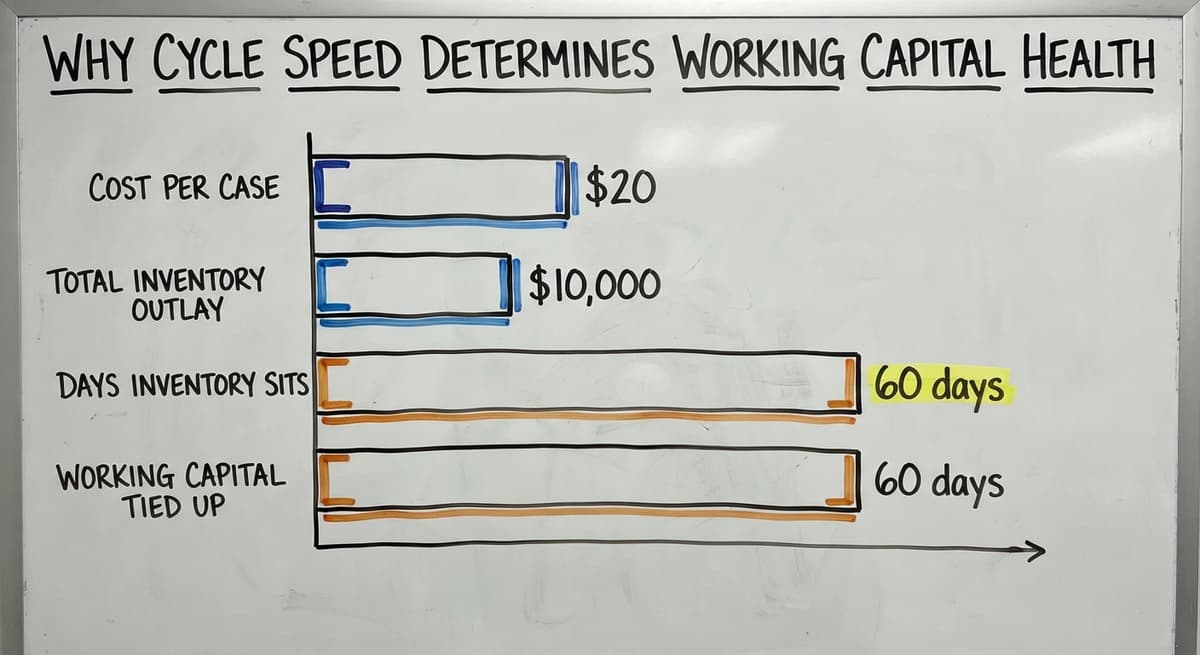
Consider a concrete example. A beverage distributor buys 500 cases at $20 each. That is $10,000 out the door. If those cases sit for 60 days before shipping, the business runs 60 days without that $10,000. Cut the sit time to 30 days and $10,000 returns twice as fast. A shorter cycle means healthier working capital, because cash spends less time trapped inside a pallet.
Key Metrics That Connect Inventory to Working Capital
Three numbers tell an operations manager exactly how inventory is affecting cash. Each one is simple enough to calculate on a lunch break.
Inventory turnover measures how many times stock sells and gets replaced in a set period. Divide cost of goods sold by average inventory value. A higher number means stock moves fast and cash cycles back quickly. A low number means product is sitting, and cash is sitting with it.
Inventory Turnover
Inventory turnover measures how many times stock sells and gets replaced in a set period. Divide cost of goods sold by average inventory value. A higher number means stock moves fast and cash cycles back quickly. A low number means product is sitting, and cash is sitting with it.
Days Inventory Outstanding
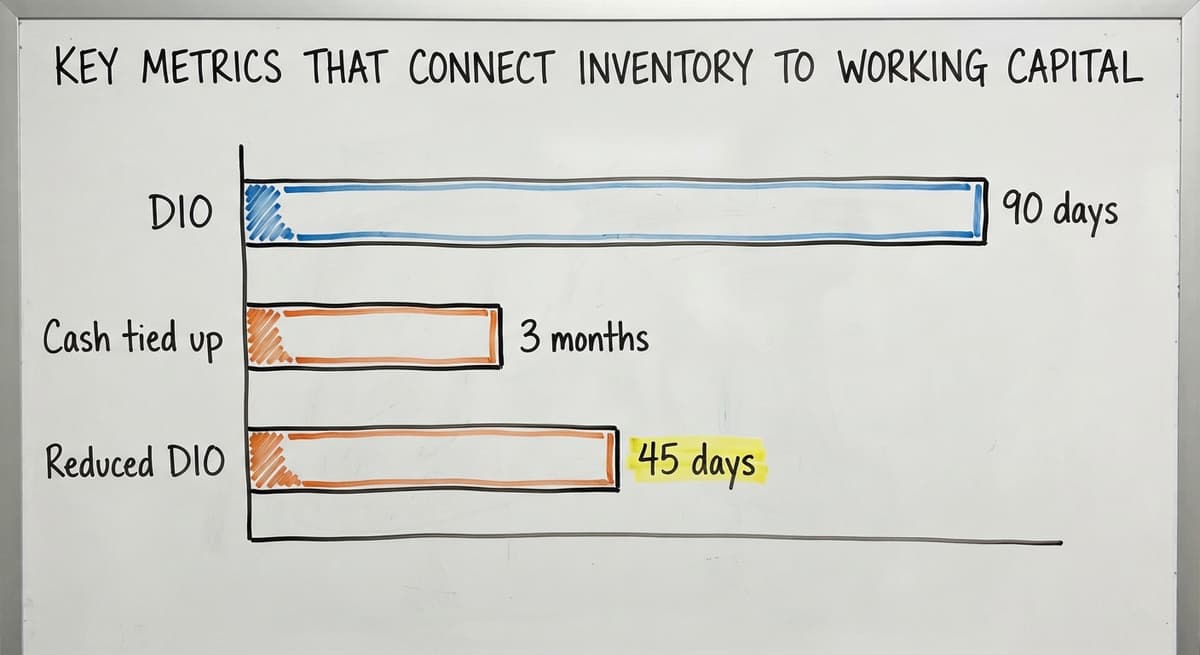
Days inventory outstanding (DIO) is the average number of days stock sits before it sells. Divide average inventory by daily cost of goods sold. A lower DIO means faster cash recovery. A distributor with a DIO of 90 days has cash tied up for 3 months per unit. Cut DIO to 45 days and that same cash works twice as often.
Current Ratio
The current ratio divides current assets by current liabilities. A ratio above 1 means the business can cover its short-term debts. Because inventory sits inside current assets, bloated stock inflates this ratio on paper while the actual bank balance tells a different story. Watching all 3 numbers together gives a clearer picture than any single figure alone.

Common Inventory Mistakes That Hurt Working Capital
Most cash-flow problems in small distribution businesses trace back to a short list of repeatable mistakes. None of them need a finance degree to fix.
- Ordering by habit rather than demand data locks cash into stock that moves slowly or not at all.
- No reorder point system means the team either runs out of a fast seller or doubles up on a slow one, both of which cost money.
- Tracking stock in spreadsheets that lag real warehouse activity produces counts that are wrong before the file is even saved.
- Holding slow-moving or obsolete SKUs ties up cash for months with no return.
The Compliance Risk Behind an Inaccurate Count
The IRS adds a legal dimension to this problem. IRS Publication 538 states: "To figure taxable income, you must value your inventory at the beginning and end of each tax year." That obligation exists whether the count is accurate or not. An inaccurate count creates both a cash problem and a compliance risk. The businesses that fix these habits first are the ones that stop feeling cash-squeezed at the end of every month.
See it running on your own process first
No build cost. The subscription starts once it is live and doing the job, not before.
Book a callHow Better Inventory Management Frees Up Cash
Improving inventory management is an working change, not a finance project. The gains show up in the checking account, not just on a spreadsheet.
Accurate real-time stock counts stop over-ordering before it starts. When the system shows 200 units on hand, no one orders another 200 out of habit. Automated reorder points trigger a buy only when stock drops to a defined level, at the right quantity, based on actual sales history rather than a manager's best guess.

The Hidden Cost of Manual Inventory Work
Faster receiving and fulfillment shortens the inventory-to-cash cycle directly. Every day shaved off the time between goods arriving and an invoice going out is a day less that cash sits idle. Visibility into slow-moving SKUs lets a manager run a clearance push before stock becomes dead weight.
Consider the manual cost alone. 3 staff members spending 6 hours a week on manual counts, at the BLS median wage for stock clerks of around $22 an hour, costs roughly $20,592 a year before a single ordering mistake is counted. That figure does not include the cost of the wrong decisions those inaccurate counts produce.
Where Does an Accounting Package End and the Gap Begin?
An accounting package handles debits, credits, and tax reporting well. It is not built to manage live warehouse inventory in real time. Most small distributors fill the gap with spreadsheets, shared drives, or email threads.
That gap is where working capital leaks. Counts go stale between updates. Reorders get guessed. Cash disappears into excess stock because no one had a clean number at the moment the buy order was placed.
Why Manual Tracking Breaks Down as Volume Grows
This is not a criticism of how these businesses operate. It is the natural limit of tools built for accounting rather than warehouse management. The NIST Manufacturing Extension Partnership offers vendor-neutral guidance on supply chain process, and a consistent theme is that manual tracking breaks down as order volume grows, not because the team is careless, but because the tool was not designed for that job. Recognizing the gap is the first step toward closing it.
The Spreadsheet Problem in Numbers
A single spreadsheet updated once a day means every decision made in that day runs on yesterday's data. For a warehouse shipping 50 orders a day, that is 50 decisions made on stale information. Multiply that by 250 working days and the compounding effect on stock accuracy, reorder timing, and cash is large. No spreadsheet solves that problem, regardless of how well it is built.
Not sure this is the right shape for your operation
Describe how the work runs today. We map it on a call and show you what it would look like built around that, before you spend anything.
Book a call
What a Custom Inventory System Does Differently
A system built around an existing workflow replaces only the manual parts. The accounting package stays for accounting. Live inventory counts feed directly from receiving and fulfillment activity, so the number on screen matches the number on the shelf.
Reorder rules, low-stock alerts, and demand history are configured to match how the business actually buys. If a product sells in seasonal spikes, the reorder point reflects that. If a supplier has a 10-day lead time, the alert fires 10 days early.
How a Custom System Works Alongside Your Accounting Package
This is what inventory management software for wholesale distributors does that a spreadsheet cannot: it acts on data the moment the data changes. No batch update. No manual entry step where errors enter.
For operations already using an accounting package, the question of how custom working software works alongside your existing accounting software matters more than any feature list. The answer is that the two systems handle different jobs. The inventory system manages stock movement. The accounting package records the financial result. Neither replaces the other.
Warehouse management for small and mid-size operations does not need a large ERP or a months-long rollout. A system sized to the operation can be live in weeks. Replacing spreadsheets with a custom operations system removes the manual entry step, closes the data lag, and gives every reorder decision a clean number to stand on. The result is not a technology upgrade; it is a working capital improvement that shows up in cash.
Is Your Inventory Hurting Your Working Capital?
The answer is probably yes if any of these describe a normal week. Stock counts happen manually, on a clipboard or in a spreadsheet. Reorders happen when someone notices a shelf looks low. Cash gets tight near payroll even when sales look fine on paper.
Each of those patterns points to the same root cause: inventory management in working capital is not being managed, it is being guessed. The good news is that none of these need a finance team or a large software budget to fix.
The Next Step for Operations Running on Guesswork
If this describes your operation, the practical next step is a review of how stock moves through your warehouse today, from receiving to fulfillment, and where the manual steps are creating lag. A system aligned to that workflow, rather than forcing the workflow to fit the software, is what closes the gap without disrupting the business that is already running.
The US Federal Trade Commission's Mail, Internet, or Telephone Order Rule needs businesses to ship when they say they will. Accurate stock counts are what make that promise possible to keep. Inventory management is not just a cash-flow tool. It is what keeps the business reliable to its customers.
Frequently asked questions
What is the role of inventory in working capital?
Inventory is usually the largest current asset for a wholesale distributor. It sits inside the working capital calculation as part of current assets. The more cash tied up in unsold stock, the less cash is available for payroll, vendor payments, and new orders. Managing inventory well keeps working capital liquid rather than locked on a shelf.
What are the 5 stages of the inventory management process?
The 5 stages are: (1) purchasing, where goods are ordered from a supplier; (2) receiving, where goods arrive and are counted into the system; (3) storage, where stock is held in the warehouse; (4) fulfillment, where orders are picked, packed, and shipped; and (5) reordering, where stock levels trigger a new buy based on demand data and reorder points. Each stage affects how fast cash moves through the cycle.
What are the 5 elements of working capital management?
The 5 elements are: (1) cash management, keeping enough liquid cash to meet daily obligations; (2) accounts receivable, collecting what customers owe as fast as possible; (3) inventory management, keeping stock lean so cash is not locked in unsold goods; (4) accounts payable, managing when supplier bills are paid to protect cash on hand; and (5) short-term financing, using credit lines when the cycle creates a temporary gap. Inventory management is often the element with the most room to improve.
What are the four types of inventory management?
There is no single right answer, because the best type depends on the operation. The 4 common approaches are: (1) periodic counting, where stock is counted on a set schedule such as monthly; (2) perpetual tracking, where every movement updates the count in real time; (3) just-in-time ordering, where stock arrives only when needed to minimize holding; and (4) ABC analysis, where items are ranked by value and managed with different levels of attention. Most small distributors benefit most from moving toward perpetual tracking, because it closes the data lag that causes most ordering mistakes.
How does excess inventory drain cash from a wholesale business?
Excess inventory drains cash in 3 ways. First, the cash used to buy that stock is no longer available for other uses. Second, holding costs such as storage space and handling add up over time. Third, slow-moving stock risks becoming obsolete, which means it may sell below cost or not at all. The result is a business that looks asset-rich on paper but feels cash-poor at the bank.
What is inventory turnover and why does it matter for cash flow?
Inventory turnover measures how many times stock sells and gets replaced in a period. A higher turnover means cash cycles back to the business more often. A low turnover means cash sits idle in unsold goods for longer. For a distributor, improving turnover by even a few cycles per year can free up tens of thousands of dollars in working capital without changing sales volume at all.
What is days inventory outstanding and how is it calculated?
Days inventory outstanding (DIO) is the average number of days stock sits before it sells. Calculate it by dividing average inventory value by daily cost of goods sold. A DIO of 60 means stock sits for 60 days on average before generating cash. Cutting that number shortens the inventory-to-cash cycle and keeps working capital healthier.
Can a small distributor improve inventory management without replacing their accounting software?
Yes. An accounting package handles financial records and tax reporting. A separate inventory system handles live stock counts, reorder alerts, and fulfillment tracking. The two systems work alongside each other rather than one replacing the other. This means a small distributor can gain real-time stock control without a large ERP migration or disrupting the accounting workflow already in place.
Start with a free first look
A 30 minute call, your operation mapped, and a clear picture of what we would build. No obligation and nothing to install.
Book a callRelated guides
The rest of this guide, for the parts of the job this page does not cover.
- What is the Difference Between Aggregate and Item Inventory Management
- What is an Important Factor in Inventory Management
- What is Abc Classification in Inventory Management
- What is Inventory Management and Its Types
- What is the Main Purpose of Inventory Management
- What is Information Technology Inventory Management
- What is Risk Pooling in Inventory Management
- What is Inventory Management Mary Kay
- What is Stock Taking in Inventory Management
- What is Bin Number in Inventory Management
- What is the Goal of Inventory Management Quizlet
- What is the Implication of Proper Inventory Management
- What is Omni-channel Inventory Management
- What is Inventory Management and Its Importance
- What is the Importance of Eoq in Inventory Management
- What is the Importance of Quality Inventory Management
- What is Inventory Management Explain Techniques of Inventory Management
- What is Mean by Inventory Management
- What is Inventory Management Meaning in Hindi
- What is Inventory Management and Why is It Important
- What is the Rationale for Inventory Management Quizlet
- What is the Purpose of Inventory in Operations Management
- What is Inventory Management Whiteboard Wednesday
- What is Fluctuation Stock in Inventory Management