


What Is Hospital Inventory Management
Updated October 2026. This article was reviewed for accuracy and completeness this month.
Hospital inventory management is the process of tracking, ordering, storing, and using medical supplies, equipment, and medications across a healthcare facility. The goal is simple: have the right item in the right place at the right time. Done well, it prevents stockouts, cuts waste, and keeps patient care on track.
Book a callWhat Is Hospital Inventory Management?
Hospital inventory management covers everything from bandages and gloves to surgical equipment and controlled pharmaceuticals. A good system logs what comes in, tracks what gets used, and triggers new orders before stock runs out. Without a system, staff rely on manual counts, paper logs, and guesswork. That leads to shortages, expired supplies, and wasted budget. The core purpose is reliable supply at the point of care, every time.
As the IRS notes in Publication 538, "To figure taxable income, you must value your inventory at the beginning and end of each tax year." That legal obligation applies to hospitals too, making accurate counts a compliance requirement, not just a best practice.
We build it for your operation, and the first look is free
If you would rather not compare products, describe how your operation already works and we build the system around it.
No build cost. You see it running on your own process first, and the monthly subscription starts only once it is live.
Book a callWhy Hospital Inventory Management Is Different from Other Industries
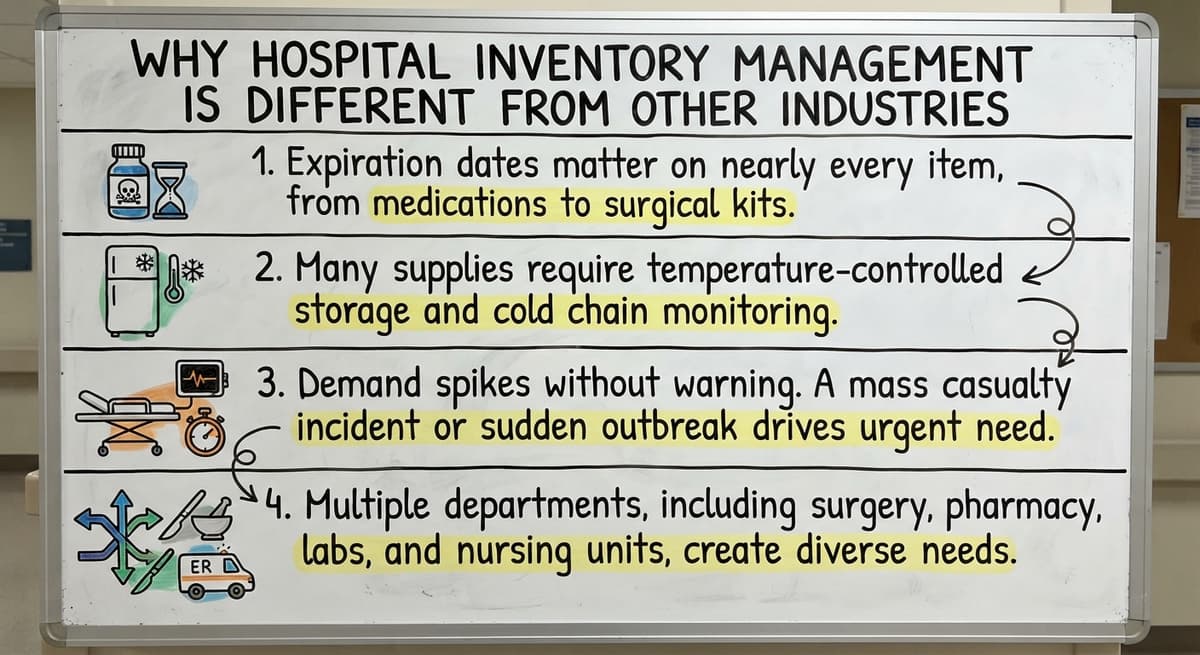
In most industries, a missing item delays a shipment. In a hospital, it can affect a patient mid-procedure. That difference in stakes changes everything about how inventory must be managed.
Several factors make hospital inventory control uniquely complex:
- Expiration dates matter on nearly every item, from medications to sterile dressings.
- Many supplies need temperature-controlled storage and documented chain of custody.
- Demand spikes without warning. A mass casualty event or a flu surge can change what is needed within hours.
- Multiple departments, including surgery, pharmacy, the emergency room, and housekeeping, all draw from shared stock levels.
Why a Common Item Language Matters Across Hospital Departments
Coordination across those departments is critical. GS1, the global standards body behind barcode systems, notes that "barcodes are the most widely used automatic spotting technology in the world," and healthcare has adopted them precisely because shared visibility across departments depends on a common language for every item. Without that shared language, duplicate orders and blind spots are inevitable.
What Does a Hospital Inventory System Actually Track?
A hospital inventory system tracks far more than syringes and gloves. It covers every category of supply that moves through the facility, each with its own rules.
The main categories include:
- Medical and surgical supplies: gloves, syringes, dressings, tubing, and procedure kits, each tied to a specific stock location.
- Pharmaceuticals: medications tracked by lot number, expiration date, and controlled-substance regulations that need an audit trail.
- Durable medical equipment: beds, patient monitors, IV pumps, and wheelchairs, which need location tracking as well as quantity tracking.
- Support supplies: linen, housekeeping products, and food service items, which often fall under the same inventory umbrella.
Each category carries different reorder rules, storage requirements, and approval steps. A single platform that handles all of them gives operations managers one source of truth instead of 4 separate spreadsheets. Unified tracking is what turns raw counts into useful data.
The Core Functions of Hospital Inventory Management
Every hospital inventory management system, whether paper-based or software-driven, performs 5 core functions. The difference between a weak system and a strong one is how well each function works.
- Receiving: Staff log new stock as it arrives and confirm it matches the buy order. Errors caught here do not become problems later.
- Storage: Items go to assigned locations under the right conditions, whether refrigerated, locked, or on an open shelf.
- Tracking: Real-time tracking shows quantities on hand so any staff member can check stock levels without a phone call.
- Reordering: Automated reorder points trigger buy orders when stock falls below a set threshold, removing the need for someone to notice the shortage first.
- Reporting: Usage data, waste rates, and cost figures give leadership the information needed to make smarter buying decisions.
The comparison is easier when one option is built for you
Off-the-shelf means fitting your process to the software. We do it the other way round, and the first look costs nothing.
Book a callThe Real Labor Cost of Managing Hospital Inventory Manually
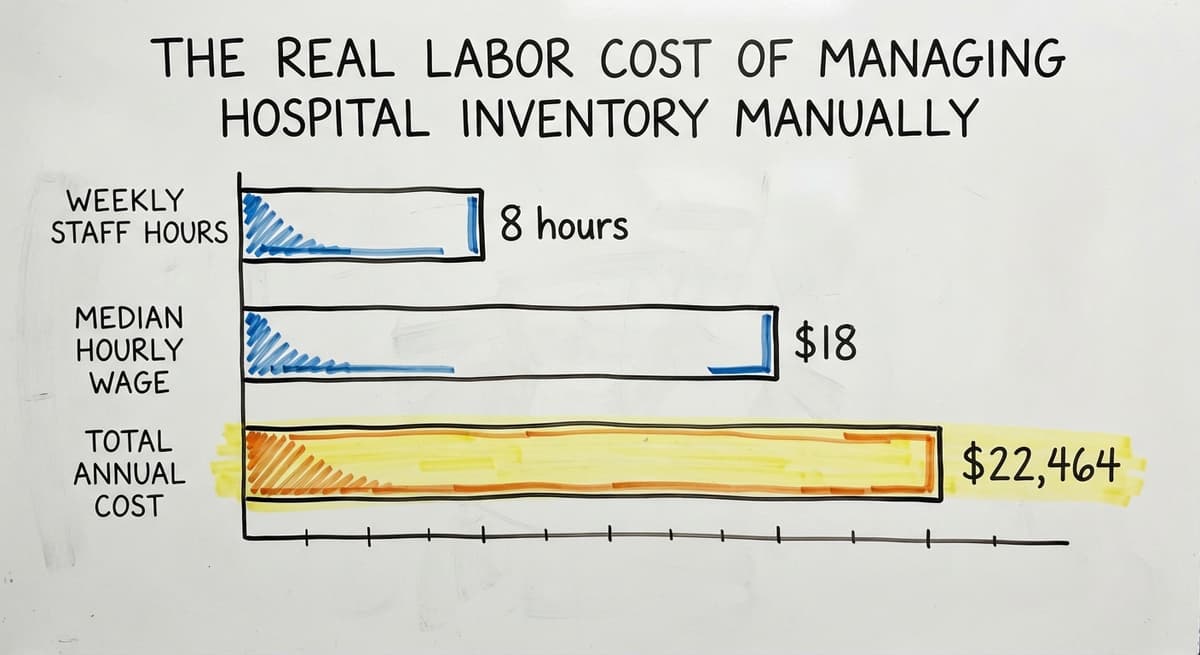
Consider the labor cost of doing these functions manually. If 3 staff members each spend 8 hours a week on manual counts and paper logs, and the Bureau of Labor Statistics puts the median wage for stock clerks near $18 an hour, that is roughly $22,464 a year spent on counting alone, before factoring in errors. Automating does not remove those roles; it redirects that time to higher-value work.

Common Problems When Hospitals Lack a Proper System
Poor inventory control creates predictable, recurring problems. None of them are rare, and all of them cost money.
Stockouts happen when a critical supply runs out mid-procedure because no one caught the low count in time. Staff scramble, procedures slow down, and patient care suffers.
Overstocking is the opposite failure. Departments hoard supplies out of fear of running out. Budget gets tied up in excess stock, and items expire on the shelf before they are ever used.
Duplicate orders occur when 2 departments each order the same item because neither can see what the other has. The result is excess inventory in one area and a shortage in another.
How Manual Errors Compound Every Other Inventory Problem
Manual errors compound all of the above. Counts done by hand on clipboards or in spreadsheets are slow and prone to mistakes. A transposed number or a missed row can trigger a wrong order or mask a real shortage.
These problems add up. Waste, duplicate spend, and emergency purchasing all pull from the same operating budget. The cost of a poor system is not abstract; it shows up in the monthly supply line.
How Does Inventory Management Software Improve Hospital Operations?
Inventory management software replaces the manual steps that cause most errors, and it does so without requiring staff to learn an entirely new way of working.
The practical gains are concrete:
- Real-time tracking means any staff member can check current stock levels from any terminal, removing the lag between a physical count and a recorded number.
- Automated reorder points trigger buy orders before a stockout happens, so supply chain disruptions are caught early rather than discovered mid-shift.
- Barcode scanning at receiving and dispensing points cuts the manual entry step that causes most data errors. Staff scan an item rather than typing a number.
- Expiration tracking flags items approaching their use-by date so they can be used first or returned before they become waste.
- Reporting tools surface usage trends, showing which items turn over fastest, which expire most often, and where purchasing decisions could save money.

Why Data Visibility Is the Foundation of Hospital Supply Chain Improvement
The NIST Manufacturing Extension Partnership offers vendor-neutral guidance on supply chain improvement and consistently points to data visibility as the foundation of any effective process. A system that shows you what you have, where it is, and when it needs to be replaced removes the guesswork that drives most supply problems.
See it running on your own process first
No build cost. The subscription starts once it is live and doing the job, not before.
Book a callKey Metrics a Good Hospital Inventory System Should Track
Tracking the right numbers turns a record-keeping tool into a decision-making tool. These are the metrics that matter most.
| Metric | What It Tells You |
|---|---|
| Stock turnover rate | How quickly inventory is used and replaced; a low rate signals overstocking |
| Days on hand | How long current stock will last at the current usage rate |
| Waste and expiration rate | The share of items that expire before use, measured as a percentage |
| Order accuracy | Whether what was received matches what was ordered |
| Cost per procedure | Supply spend in context, so leadership can compare across departments |
Cost per procedure is often the metric that gets leadership's attention, because it connects supply spending directly to clinical activity rather than treating it as a fixed overhead line.
Choosing the Right Approach for Your Operation
Large hospital networks often need enterprise platforms with deep integration across finance, HR, and clinical systems. Smaller facilities and specialty clinics have different needs, and a system built for a 600-bed academic medical center is rarely the right fit for a 40-bed community hospital.
When evaluating options, focus on a few practical questions:
- Does the system connect to your existing financial tools, or does it need replacing them?
- Can staff learn the daily tasks quickly, or does adoption need weeks of training?
- Does the reporting match the decisions your leadership actually makes?

Why Staff Adoption Determines Whether Any Inventory System Succeeds
A system that fits how your team already works gets adopted faster and delivers results sooner. Custom working software for small operations can fill specific gaps without forcing a wholesale change to every existing workflow. That matters because the best system is the one staff will actually use every day, not the one with the longest feature list.
Replacing manual spreadsheet workflows with software is often the first and most impactful step. Even a focused improvement to receiving and reorder tracking can reduce duplicate orders and cut expiration waste within the first quarter. The right fit depends on your size, your team, and the specific problems costing you the most.
How Should a Hospital Get Started with Better Inventory Control?
Start by mapping your current process before buying anything. Walk the path that a supply item takes from receiving dock to point of use, and note every place where something breaks down.
A practical starting sequence looks like this:
- Map the current flow: where does inventory arrive, where does it go, and where do things go wrong?
- Identify your 2 or 3 biggest pain points, whether that is stockouts, expiration waste, or manual counting, and focus there first.
- Choose a solution that addresses those specific problems rather than one that promises to fix everything at once.
- Run a phased rollout. Start with 1 department or 1 supply category, measure the results, and expand from there.
- Work with a team that builds the system around your operation so staff spend less time adjusting and more time using it.
Why Small Inventory Gains Compound Into Meaningful Budget and Staff Savings
Small gains compound quickly. Cutting expiration waste by 15% in a single department, or reducing manual count time by half, frees up both budget and staff hours that can be redirected to patient care. Inventory management software for distributors and healthcare operations alike proves that the barrier to entry is lower than most administrators expect. The goal is not a perfect system from day one; it is a better system than the one you have now, running in the hands of the people who need it.
Frequently asked questions
What is inventory management in a pharmacy?
Pharmacy inventory management is the process of tracking medications by lot number, expiration date, and quantity on hand. It includes controlled-substance logging, which needs a documented record of every unit dispensed. A good pharmacy system flags items nearing expiration, triggers reorders at set stock levels, and produces the audit trail that regulators need. The rules are stricter than general supply tracking because the consequences of an error, a wrong dose or a missing controlled substance, are clinical, not just working.
What is KPI for inventory control?
A KPI, or key performance indicator, for inventory control is a number that tells you how well your system is working. The most useful ones in a hospital setting are stock turnover rate, days on hand, expiration and waste rate, order accuracy, and cost per procedure. Stock turnover rate shows whether you are buying too much or too little. Days on hand tells you how long current supply will last. Expiration rate shows how much budget is lost to items that go unused. Together, these numbers give leadership a clear picture of where supply spending is working and where it is not.
What is the best inventory management software for a medical store?
There is no single best answer. The right software depends on the size of the facility, the types of items tracked, and how the team already works. A small clinic may do well with a focused inventory app that handles reorder points and expiration tracking. A mid-size hospital may need a cloud platform that connects to its accounting system. A large network may need a fully custom build. The criteria that matter most are ease of adoption for daily users, integration with existing financial tools, and reporting that matches the decisions leadership actually makes. A system staff will not use is not better than a spreadsheet.
What is an inventory management system?
An inventory management system is software, or a set of processes, that tracks what a facility has in stock, where it is stored, and when it needs to be reordered. In a hospital, that means logging every item from receipt to use, setting automatic reorder points so stock does not run out, and producing reports that show usage trends and costs. The system can be as simple as a shared spreadsheet or as complex as a cloud platform with barcode scanning and real-time dashboards. The right level of complexity depends on the size of the operation and the problems it needs to solve.
Why is inventory management in hospitals more complex than in other industries?
Hospitals deal with expiration dates, temperature-sensitive storage, controlled-substance regulations, and unpredictable demand, all at once. A surge of patients can change what is needed within hours. Multiple departments draw from shared stock, so a shortage in one area can affect another without anyone noticing until it is too late. In most industries, a missing item delays a delivery. In a hospital, it can interrupt patient care. That difference in consequence is what makes hospital inventory control a clinical concern, not just an operations one.
How does barcode scanning improve hospital inventory accuracy?
Barcode scanning removes the manual entry step that causes most receiving and dispensing errors. When a staff member scans an item rather than typing a number, the system records the correct product, quantity, and location automatically. That reduces data entry mistakes, speeds up the receiving process, and creates a reliable audit trail. Scanning also supports expiration tracking, because many barcodes carry lot number and date information that the system can read and flag without any extra steps from staff.
What is the difference between a stockout and overstocking in a hospital?
A stockout happens when a supply runs out before a new order arrives. In a hospital, that can mean a missing item during a procedure or a delay in patient care. Overstocking is the opposite: too much of an item sits on the shelf, tying up budget and risking expiration before the supply is used. Both problems often exist in the same facility at the same time, because without real-time tracking, different departments cannot see each other's stock levels. A proper inventory system addresses both by setting reorder points that keep supply in a usable range, not too low and not too high.
How do smaller hospitals or specialty clinics choose the right inventory system?
Smaller facilities should start by identifying their most painful problems, whether that is manual counting, stockouts, or expiration waste, and choose a system that solves those first. A full enterprise platform is rarely the right fit for a 40-bed hospital or a specialty clinic. Look for a solution that connects to your existing accounting tools, needs minimal training for daily users, and produces reports that match the decisions your team actually makes. A phased approach, starting with one department or one supply category, reduces disruption and makes it easier to measure whether the system is working before expanding it.
Start with a free first look
A 30 minute call, your operation mapped, and a clear picture of what we would build. No obligation and nothing to install.
Book a callRelated guides
The rest of this guide, for the parts of the job this page does not cover.
Guides
Common questions
- What is the Difference Between Aggregate and Item Inventory Management
- What is Jit Inventory Management
- What is Kanban System of Inventory Management
- What is the Definition of Inventory Management
- What is an Important Factor in Inventory Management
- What is Abc Classification in Inventory Management
- What is Inventory Management in Working Capital
- What is Poor Inventory Management
- What is Inventory Management and Its Types
- What is the Main Purpose of Inventory Management
- What is Inventory Management in Pharmacy
- What is Effective Inventory Management
- What is Information Technology Inventory Management
- What is Risk Pooling in Inventory Management
- What is Inventory Management Mary Kay
- What is Stock Taking in Inventory Management
- What is Bin Number in Inventory Management
- What is the Scope of Inventory Management
- What is the Goal of Inventory Management Quizlet
- What is the Implication of Proper Inventory Management
- What is Omni-channel Inventory Management
- What is Inventory Management and Its Importance
- What is the Importance of Eoq in Inventory Management