

What is Procurement and Inventory Management
What is procurement and inventory management? Procurement buys the goods. Inventory management tracks them. Learn the steps and how to fix manual gaps.
Book a callWhat Is Procurement and Inventory Management?
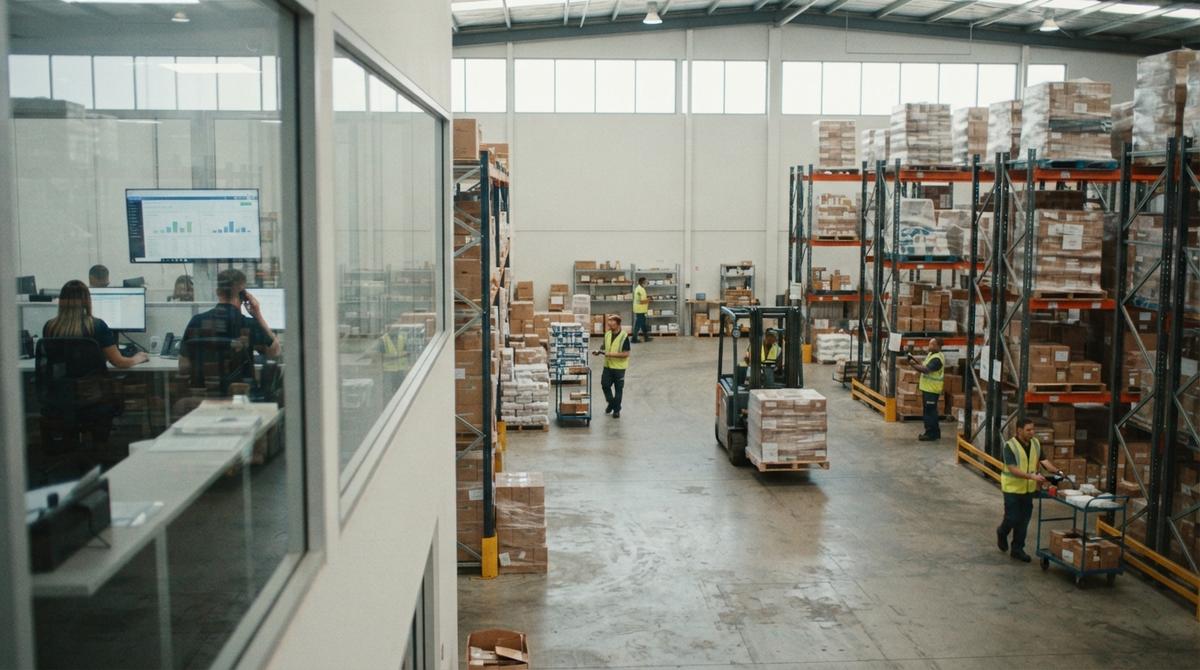
Procurement is buying the goods a business needs. Inventory management is tracking and controlling those goods once they arrive. Together, procurement and inventory management answer two questions: what do we need to buy, and what do we already have? Procurement looks outward at suppliers. Inventory management looks inward at the shelves. A wholesale distributor needs both. Without the first, shelves run empty. Without the second, nobody knows they are empty.
We build it for your operation, and the first look is free
If you would rather not compare products, describe how your operation already works and we build the system around it.
Reviewed November 2026.
No build cost. You see it running on your own process first, and the monthly subscription starts only once it is live.
Book a callThe Two Halves of the Work
Each half has its own job, tools, and daily habits. Here is how they differ.
What is procurement?
Procurement is the whole job of getting goods into your building. It starts with finding suppliers and comparing prices. Then the buyer places buy orders, which are written requests to buy set items at set prices. Last, the team receives the goods. Procurement also covers payment terms, lead times (the days between order and delivery), and follow-up when a supplier runs late.
Here is a wholesale example. A fast-selling item has 2 cases left. The buyer reorders before the shelf is empty. Good barcodes help here. GS1 calls its standards "the global language of business", and that shared language lets a supplier and a warehouse scan the same item the same way.
What is inventory management?
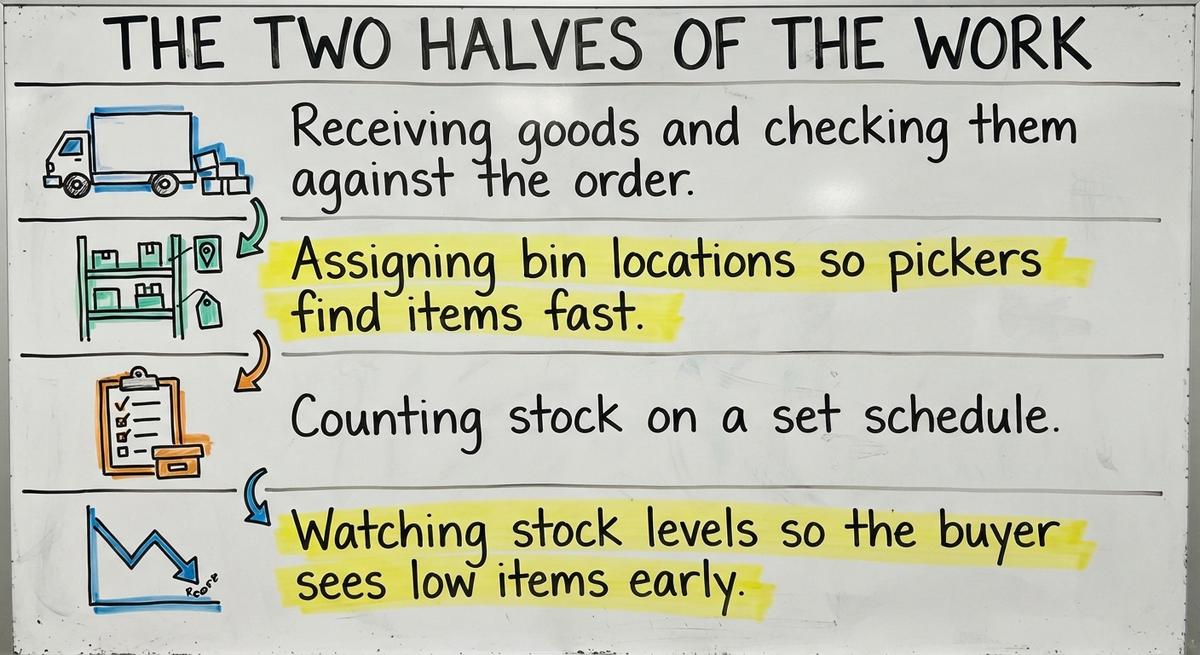
Inventory management is knowing what is on hand, where it sits, and how fast it sells. The goal is enough stock to fill orders without cash tied up in items that sit. The work covers four tasks:
- Receiving goods and checking them against the order.
- Assigning bin locations so pickers find items fast.
- Counting stock on a set schedule.
- Watching stock levels so the buyer sees low items early.
The law also asks for it. The IRS says in Publication 538: "To figure taxable income, you must value your inventory at the beginning and end of each tax year." A count is a duty, not a choice.

How the Two Work Together in Six Steps
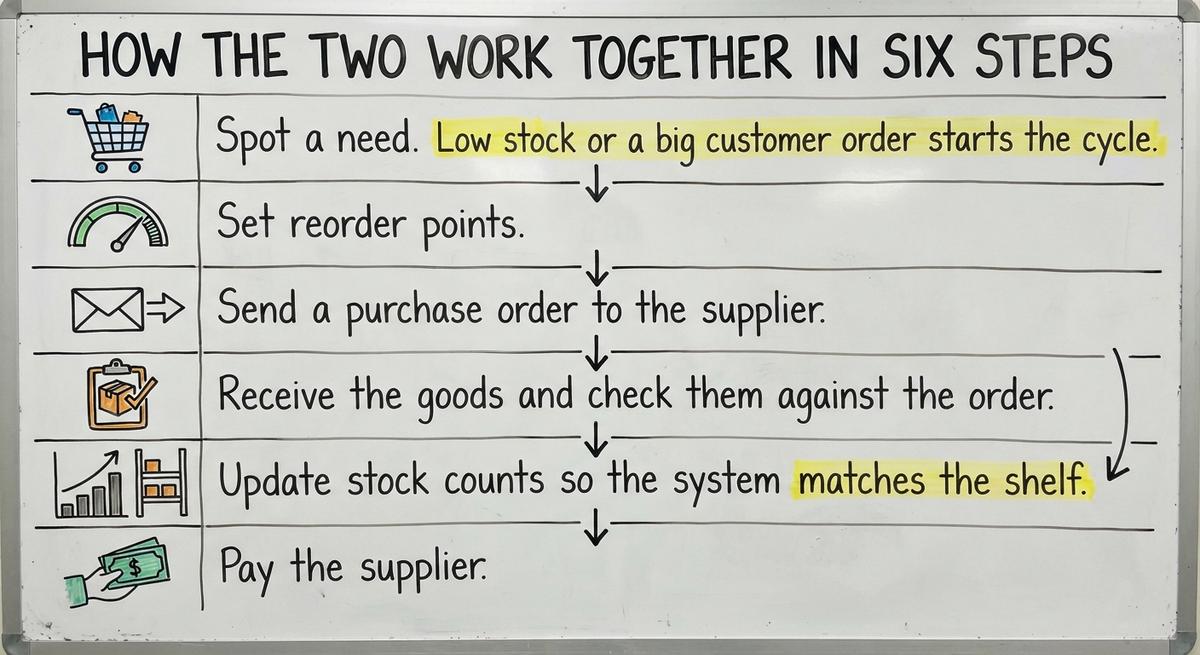
Inventory data triggers buys, and buys refill inventory. The loop is simple: sell, count, reorder, receive, shelve. When the two are not connected, buyers guess and the shelves show it. The procurement process runs in six steps:
- Spot a need. Low stock or a big customer order starts the cycle.
- Set reorder points. A reorder point is the stock level that tells you to buy again.
- Send a buy order to the supplier.
- Receive the goods and check them against the order.
- Update stock counts so the system matches the shelf.
- Pay the supplier. This hands the work back to the accounting system.
Every step feeds the next one. A weak link at step 5 ruins step 1 on the next loop.
Not sure this is the right shape for your operation
Describe how the work runs today. We map it on a call and show you what it would look like built around that, before you spend anything.
Book a callWhy It Matters, and What Goes Wrong by Hand
Good tracking protects both orders and cash. Manual tracking breaks that protection in predictable ways.

Why does inventory accuracy matter for a distributor?
Accurate counts keep orders flowing and cash free. A stockout loses an order. Overstock ties up cash in boxes that do not move. Right counts mean faster picking and fewer shipping mistakes. They also protect your word. The FTC's Mail, Internet, or Telephone Order Merchandise Rule expects you to ship when you said you would. A clear buy history also gives you proof when you negotiate with suppliers.
What breaks when tracking is manual?
The time adds up. Say 2 people spend 5 hours a week retyping orders at $22 an hour. That is 2 x 5 x 22 x 52, or $11,440 a year. Worse, nobody is sure which number is right.
Manual tracking spreads one truth across many places. Counts sit in accounting software inventory, spreadsheet files, desktop database files, printed sheets, and email. They disagree. Reorder choices live in one person's memory. Buy orders get retyped, and every retype adds errors.
Do You Need a Big ERP to Manage Both?
No. Most small operations only need the manual parts fixed. An ERP is a large system that runs every part of a company from one package. For a team of 5 to 100 people, it often brings a forced move and a long rollout.

Another path is to keep your accounting software for accounting and add custom tools for purchasing and stock. Those tools read and write the same data your team already uses. They send buy orders, watch reorder points, and update counts. Software built around how your staff already works avoids a risky migration. People keep their habits, and the gaps close one at a time. The NIST Manufacturing Extension Partnership offers vendor-neutral guidance on supply chain and inventory process if you want a second view.
So yes, the accounting software can stay in place while purchasing and stock tracking improve.
How Do You Know It Is Time to Improve Your System?
Your inventory system needs improvement when your team spends more effort fixing numbers than using them. Watch for these signs:
- Stockouts happen often on items you thought were safe.
- Surprise overstock shows up on shelves nobody planned for.
- Staff recount the same bins again and again.
- Workers keep side spreadsheets because they do not trust the main one.
Start by listing every place your team types the same data twice. Each one is a spot where errors enter. A local Columbus team can map your current process and replace only the manual parts. The Software Society builds custom workflows that fit how your warehouse already runs. Ask for a process map and see where your first fix belongs.
Frequently asked questions
What is the purpose of inventory management in supply chain management?
The purpose is to keep the right amount of stock on hand. Enough stock fills orders on time. Not too much stock keeps cash free. Inventory management also gives buyers the counts they need to reorder at the right moment.
What is the difference between procurement and inventory management?
Procurement buys goods from suppliers. Inventory management tracks those goods after they arrive. One looks at what to buy. The other looks at what you already have.
What are the main steps in the procurement process?
Spot a need, set reorder points, send a buy order, receive and check goods, update stock counts, and pay the supplier. Payment hands the work back to accounting.
How do procurement and inventory management work together?
Stock counts tell the buyer when to reorder. Each buy refills the shelves. The loop is sell, count, reorder, receive, shelve. When the two are linked, buyers stop guessing.
Can a small business manage both without an ERP?
Yes. Many small teams only need to fix the manual steps, such as retyped buy orders and scattered counts. A spreadsheet, an off-the-shelf tool, or a custom build can all work. Team size, order volume, and how much you rely on current habits decide the choice.
Can the accounting software stay in place while purchasing and stock tracking improve?
Yes. You can keep your accounting software for accounting and add tools for buy orders, reorder points, and stock levels. The new tools share data with it, so staff do not retype numbers.
What is the best system for warehouse inventory?
No single system is best. The right choice depends on your order volume, number of locations, staff size, and the tools you already use. A spreadsheet suits very small stock. An off-the-shelf tool suits standard needs. A custom build suits a team with unusual steps.
Start with a free first look
A 30 minute call, your operation mapped, and a clear picture of what we would build. No obligation and nothing to install.
Book a callRelated guides
More on the same work.
Guides
- Distribution Inventory Management
- Inventory Management Software for Distribution
- Warehouse Inventory Management Software
- Warehouse Inventory Management Systems
- Quickbooks Inventory Management Software
- Inventory and Warehouse Management Software
- Custom Inventory Management Software
- Warehouse Inventory Management System
- Retail Inventory Management
- Multi Location Inventory Management Software
- Inventory Management for Multiple Locations
- Manufacturing Inventory Management Software
- Cost of Inventory Management Software
- Manufacturing Inventory Management
- Retail Inventory Management Systems
- Inventory Management Software Freeware
Common questions
- What is Vendor Management Inventory
- How to Manage Wholesale Inventory
- What is the Distributor
- Why is Warehousing and Inventory Management Important
- What is the Difference Between Aggregate and Item Inventory Management
- How to Manage Inventory in a Warehouse
- What is the Best Warehouse Inventory Management System?
- What is the Difference Between Warehousing and Inventory Management