


Additional Inventory
Additional inventory is any stock you hold beyond what current orders or near-term demand needs. It shows up as overstock on a shelf, safety stock in a back corner, or surplus from a cancelled order. The fix is better visibility, not a bigger warehouse. This article covers why it builds up, what it costs, and how a small distributor can get it under control without replacing QuickBooks.
Reviewed September 2026. Figures are worked from the assumptions stated beside them, so you can substitute your own and the arithmetic still holds.
Reviewed and updated: June 2025
Book a callWhat Additional Inventory Means for Wholesale Distributors
Additional inventory is stock beyond what you need right now. It is a normal part of running a wholesale or fulfillment center operation. The term covers several situations:
- Overstock left after a slower-than-expected season
- Safety stock held on purpose to cover a supplier delay
- Surplus from a customer order that was cut or cancelled
- Units received because a supplier minimum forced a larger buy
Not all of it is a problem. Safety stock is planned. True surplus is not. Knowing which is which is the first step to managing it well. A warehouse that cannot tell the difference will either carry too much or run short at the wrong moment.
We build it for your operation, and the first look is free
If you would rather not compare products, describe how your operation already works and we build the system around it.
No build cost. You see it running on your own process first, and the monthly subscription starts only once it is live.
Book a callWhy Additional Inventory Keeps Building Up
Surplus stock rarely appears for one reason. Several small forces push in the same direction at once.
Supplier minimum order quantities force buyers to take more than current demand needs. A forecast that misses by 10 percent leaves extra units sitting. Cancelled customer orders put product back on the shelf with no home. Seasonal peaks and valleys make the right quantity hard to call. Each of these forces is manageable on its own. Together, they compound fast.
How Poor Warehouse Tracking Turns a Small Surplus Into a Bigger One
Poor warehouse inventory tracking across locations leads teams to reorder stock that already exists somewhere in the building. Barcode scanning is one of the clearest ways to close that gap. As GS1 notes, its barcode standards exist specifically to give every item a unique, scannable identity that any system can read. Without that, a count is only as good as the last person who updated a spreadsheet row.
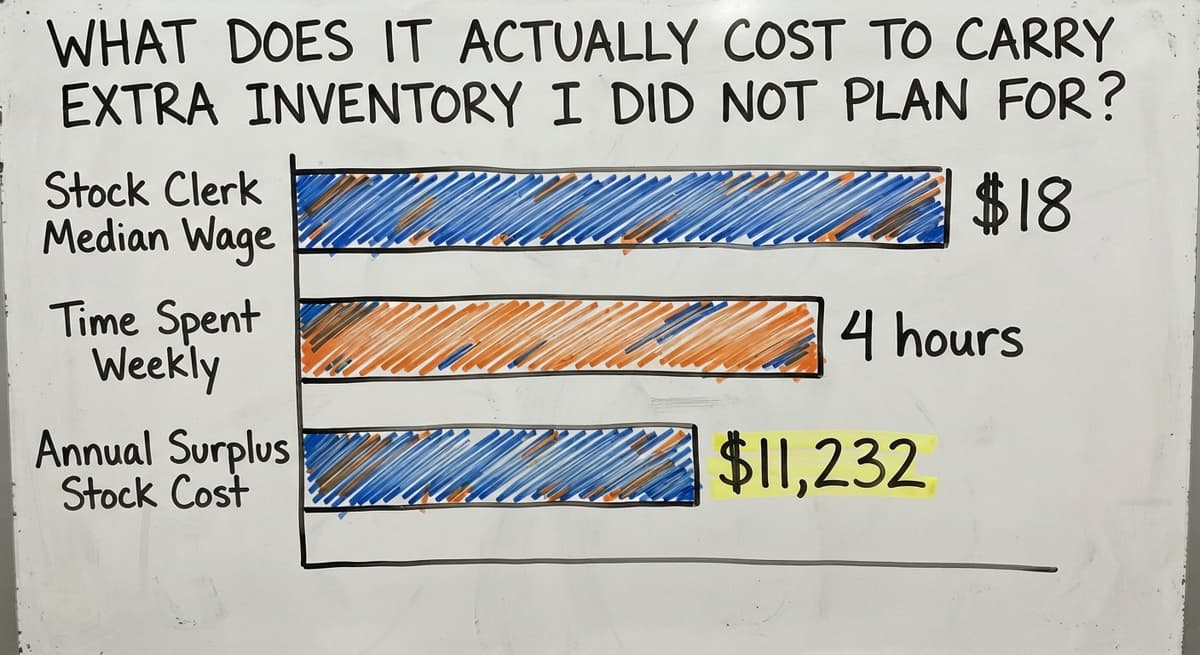
What Does It Actually Cost to Carry Extra Inventory I Did Not Plan For?
Unplanned surplus costs money in at least 4 ways, and most small distributors undercount the total.
First, warehouse space costs real dollars per square foot. Every pallet of slow-moving stock blocks space a fast mover could fill. Second, insurance premiums cover the value of goods on hand, so more stock means a higher bill. Third, handling labor touches that stock on every count, every move, and every write-off. The Bureau of Labor Statistics reports that stock clerks and order fillers earn a median wage around $18 per hour. Three people spending 4 hours a week managing surplus stock costs roughly $11,232 a year, and that is before a single unit is written off.

The Hidden Costs That Never Show Up on a Balance Sheet
Fourth, cash tied up in excess stock cannot fund a faster-moving buy. A pallet of obsolete product sitting in aisle 7 is a loan you made to yourself at zero return. Spoilage, damage, and obsolescence risk all climb the longer stock sits. Slow movers block shelf space that faster SKUs could occupy, which is an opportunity cost that never shows up on a balance sheet but shows up in margin.
The IRS is direct about why this matters at tax time: IRS Publication 538 states, "To figure taxable income, you must value your inventory at the beginning and end of each tax year." Carrying surplus you have not identified inflates that value and your tax bill with it.
The total cost is almost always higher than the buy price of the goods.
The comparison is easier when one option is built for you
Off-the-shelf means fitting your process to the software. We do it the other way round, and the first look costs nothing.
Book a callHow Do I Know If I Have an Additional Inventory Problem Right Now?
The clearest sign is a gap between what your system says and what your team finds on the floor. Most distributors with a surplus problem see several of these at once:
- Warehouse staff regularly discover products they did not know were on hand
- Write-offs for expired or obsolete goods appear every quarter, not just at year-end
- Purchasing reorders items already sitting in a back corner because no one checked
- Customer orders get delayed while the team searches for stock that should be easy to find
- Month-end counts never match what QuickBooks shows
Any one of these is a flag. All five together mean the operation is running on guesswork.

What National Data Says About Inventory Growing Faster Than Orders
The US Census Bureau's Monthly Wholesale Trade data tracks the inventories-to-sales ratio across wholesale firms nationally. When that ratio climbs, it signals that stock is growing faster than orders, which is exactly what surplus looks like at scale. If your team spends time hunting for product instead of shipping it, the problem is already costing you.
Safety Stock vs. Excess Stock: Knowing the Difference
Both show up as additional inventory on hand, but they need different responses.
Safety stock is planned. A manager sets it deliberately to cover a demand spike or a supplier delay. It earns its shelf space. Excess stock is unplanned surplus that accumulated without a clear reason. It costs the same to store but returns nothing.
Good inventory management software separates the two. It tags a quantity as safety stock based on a rule the manager sets, and flags anything above that level as surplus. Without that separation, a buyer looking at a high on-hand number cannot tell whether to reorder less or leave it alone. Acting on the wrong signal makes the problem worse.
Knowing which pile you are looking at is what turns a count into a decision.

How Spreadsheets and QuickBooks Fall Short
QuickBooks tracks financial transactions well. It was built for that. It was not built to show real-time bin-level stock quantities across a warehouse floor. That is not a criticism; it is just the wrong tool for the job.
Spreadsheets fill the gap for a while, then create their own problems. An Excel file goes stale the moment someone forgets to update a row. Multiple people editing the same file create version conflicts. There are no automatic alerts when a SKU crosses a reorder threshold in either direction. No one gets notified when stock climbs too high, only when it runs out and a customer complains.
See it running on your own process first
No build cost. The subscription starts once it is live and doing the job, not before.
Book a callWhy Connected Systems Beat Manual Data Entry for Inventory Visibility
The NIST Manufacturing Extension Partnership recommends that distributors use connected systems to track inventory across the supply chain rather than relying on manual data entry. A spreadsheet is manual data entry with extra steps. QuickBooks is worth keeping. The gap to fill is inventory visibility, not accounting.

Setting Reorder Points and Using Purchase Order Controls to Limit Surplus
A reorder point is the on-hand quantity that triggers a new buy order. Set it too low and you stock out. Set it too high and you build surplus. Most small distributors set one number and leave it alone, which is how a SKU that sells fast in Q3 ends up overstocked in Q1.
Inventory management software calculates reorder points using 3 inputs: lead time from the supplier, average daily usage, and the service level the manager wants to hit. The formula updates when any input changes. A manager can adjust a single SKU without touching a spreadsheet, and the system recalculates overnight.
Can I Stop Surplus Before It Arrives?
Yes, and the best place to stop it is at the buy order. Software ties a PO to actual demand signals rather than a buyer's estimate. Approval workflows need a manager sign-off before an order goes out. Visibility into open POs prevents a second buyer from ordering the same SKU the first buyer already covered. Supplier minimum quantity fields help buyers plan around constraints or negotiate better terms.
The FTC's Mail and Telephone Order Rule needs sellers to ship when promised. Accurate PO controls protect that commitment by making sure stock arrives when needed, not in quantities that overwhelm the shelf.
Fewer surprise receipts means less unplanned additional inventory piling up at the dock.
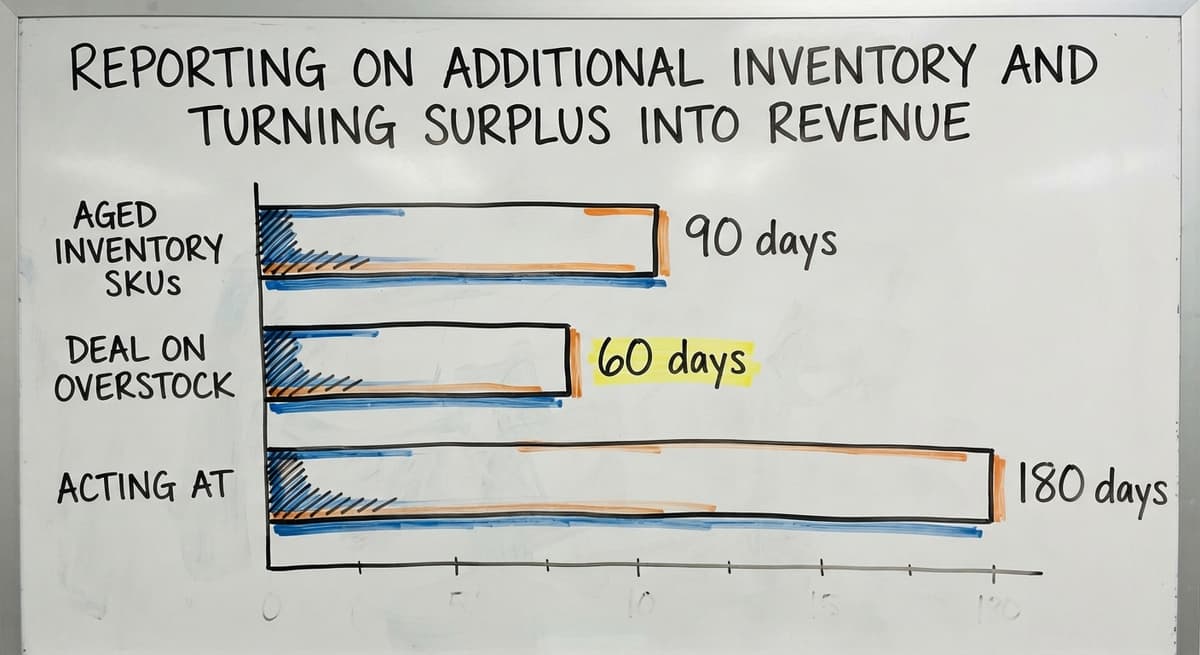
Reporting on Additional Inventory and Turning Surplus Into Revenue
Running a manual count to find surplus is slow. By the time the count is done, the data is already old. Software replaces that cycle with scheduled reports.
Aged inventory reports show which SKUs have not moved in 30, 60, or 90 days. Overstock alerts notify a manager before a slow mover becomes a write-off. Reports run automatically and land in an inbox each morning. No spreadsheet assembly required; data comes straight from live transactions.
Acting on What the Report Shows
Identifying slow stock early is only useful if someone acts on it. Options include:
- Discount the item before it becomes dead stock and margin disappears entirely
- Bundle surplus units with a fast mover to clear shelf space without a price cut
- Offer existing customers a deal on overstock before going to a liquidator
- Use buy history data to find which customers buy similar products and could absorb the surplus
Acting at 60 days preserves most of the margin. Acting at 180 days usually means selling at a loss. Speed is the variable a manager controls, and the report is what makes speed possible.

Multi-Location Visibility and Additional Inventory
Distributors running more than one warehouse often hold duplicate stock at each site. One location is overstocked while another is running low, and no one has a single screen that shows both.
A transfer order moves surplus from the overstocked site to the one that needs it. Software shows combined on-hand across all locations in one view. A buyer checking stock before placing a buy order can see that the units already exist at another site and skip the order entirely.
For multi-site operations, this single ability can cut total additional inventory significantly without changing a supplier relationship or renegotiating a minimum order quantity. The stock was already there. The problem was not finding it.
Not sure this is the right shape for your operation
Describe how the work runs today. We map it on a call and show you what it would look like built around that, before you spend anything.
Book a callCan I Get Better Inventory Control Without Replacing QuickBooks?
Yes. Replacing QuickBooks is not required. A custom inventory system can sync with QuickBooks so financials stay accurate. Warehouse teams work in the inventory system. Accounting stays in QuickBooks. No duplicate data entry and no expensive migration to a full ERP.
This is the practical middle ground most small distributors are looking for. Off-the-shelf inventory tools are built for an average operation. A custom build maps to the way your team already receives, picks, and counts. Fields, workflows, and alerts match your product categories and supplier terms. There are no features to ignore and no missing pieces that need a second tool.
QuickBooks integration for distributors keeps the financial record intact while adding the warehouse visibility QuickBooks was never designed to provide.
How Long Does It Take to Implement Inventory Software for a Small Team?
A focused custom build for a 5-to-50-person operation can go live in weeks, not months. The team starts with the single highest-pain workflow, so value shows up fast rather than at the end of a long rollout.
Training is hands-on and built around actual SKUs and processes the staff already know. There is no generic demo data to translate. The system fits the operation from day one.
Ongoing changes come from the same team that built the system, so a new supplier term or a new product category does not need a support ticket to a national call center. Custom warehouse software solutions are built to change when the operation changes.
A Practical Plan to Get Additional Inventory Under Control
The questions to ask before choosing any software are simple and direct:
- Does it connect to QuickBooks or need a full migration?
- Can it match our receiving and picking process without heavy customization?
- How does it handle overstock alerts and aged inventory reports?
- Who do we call when something breaks or needs to change?
- What does rollout actually look like for a team our size?
Once those are answered, the action plan runs in 5 steps:
- Run an aged inventory report to find what has not moved in 60-plus days.
- Separate safety stock from true surplus using demand history.
- Set or review reorder points for your top 20 SKUs by volume.
- Identify which manual process causes the most unplanned surplus.
- Talk to a software partner about automating that one process first.
Start narrow. Fix the most painful thing. Expand from there.
Next Steps for Wholesale Distributors Ready to Take Control
Additional inventory is a manageable problem. The tools exist. The data is already in your operation. What most small distributors lack is visibility, not product.
A custom system built around your existing workflows, synced to QuickBooks, and supported by a local team is the practical path forward. It does not need a long ERP rollout or a big budget. It needs a clear picture of where the pain is and a partner who builds to fit.
The Software Society works with wholesale distributors and fulfillment centers to build exactly that kind of system. We are based in Columbus, Ohio, and we work with regional operations that want a real partner, not a national SaaS subscription. If you want a no-pressure conversation about your specific operation, reach out and tell us where the problem shows up first.
Frequently asked questions
What do you call extra inventory?
Extra inventory goes by several names depending on why it exists. Overstock refers to units beyond what current demand needs. Surplus inventory is a broader term for any stock without a clear order to fill. Dead stock describes goods that are no longer sellable. Safety stock is the planned portion held on purpose to cover delays or demand spikes. All of these fall under the general label of additional inventory.
What are three types of inventory?
The three most common types are raw materials, work-in-progress, and finished goods. For wholesale distributors, finished goods are the primary concern. Within finished goods, inventory is often further split into cycle stock (what you sell through regularly), safety stock (held as a planned buffer), and excess stock (surplus that accumulated beyond what was planned).
Can you give me an example of excess inventory?
A distributor orders 500 units of a seasonal product based on last year's sales. Demand comes in 20 percent lower. After the season ends, 100 units remain on the shelf with no near-term orders to fill them. Those 100 units are excess inventory. They cost money to store, tie up cash, and risk becoming unsellable if the product changes or expires.
Can you give me an example of inventory?
Inventory is any goods a business holds for sale or use in its operations. For a wholesale distributor, inventory includes every SKU on the warehouse floor: boxed products waiting to ship, pallets in receiving, and items held as safety stock. A fulfillment center's inventory is everything tracked between receipt from a supplier and delivery to a customer.
What is additional inventory and how is it different from safety stock?
Additional inventory is any stock held beyond what current orders need. Safety stock is a planned portion of that total, set deliberately to cover supplier delays or demand spikes. True excess stock is unplanned surplus with no clear purpose. Both show up as on-hand quantity, but safety stock earns its shelf space while excess stock is a cost without a return.
What does inventory management software do that Excel cannot?
Inventory management software records every receipt, pick, and adjustment in real time. It sends automatic alerts when stock crosses a threshold, prevents duplicate orders by showing open buy orders, and generates aged inventory reports without anyone building a spreadsheet. Excel needs manual updates, has no alert logic, and breaks down the moment two people edit the same file at the same time.
How do I turn surplus inventory into revenue before it becomes a write-off?
Start by running an aged inventory report to find SKUs that have not moved in 60 or more days. At that point, margin is still recoverable. Options include discounting the item, bundling it with a faster mover, or offering it directly to customers who buy similar products. Waiting past 90 to 120 days usually means selling at a loss or writing the stock off entirely.
Start with a free first look
A 30 minute call, your operation mapped, and a clear picture of what we would build. No obligation and nothing to install.
Book a callRelated guides
The rest of this guide, for the parts of the job this page does not cover.
Guides
- Classification of Inventory
- Excess Inventory
- Closed for Inventory
- Multi Location Inventory Management Software
- Inventory Management for Multiple Locations
- Costing Inventory
- Is Inventory a Long-term Asset
- Inventory Management System for Manufacturing
- Inventory Fixed Assets
- Inventory Management Pics
- Excel Inventory Template
- Push and Pull Inventory
- Consumable Inventory
- B2b Inventory Management
- Jewelry Inventory Management
- Dental Inventory Management
- The Objective of Inventory Management is To
- Qr Code for Inventory Management
- Inventory Metrics
- Inventory Formulas
- Hvac Inventory Management Software