


How to Track Missing Inventory
To track missing inventory, recount the item, compare the count to your records, trace each move, and check common causes. Then log the fix and stop the cause. It works with the tools you already have.
Book a callWhat Is Missing Inventory and How Do You Spot It?
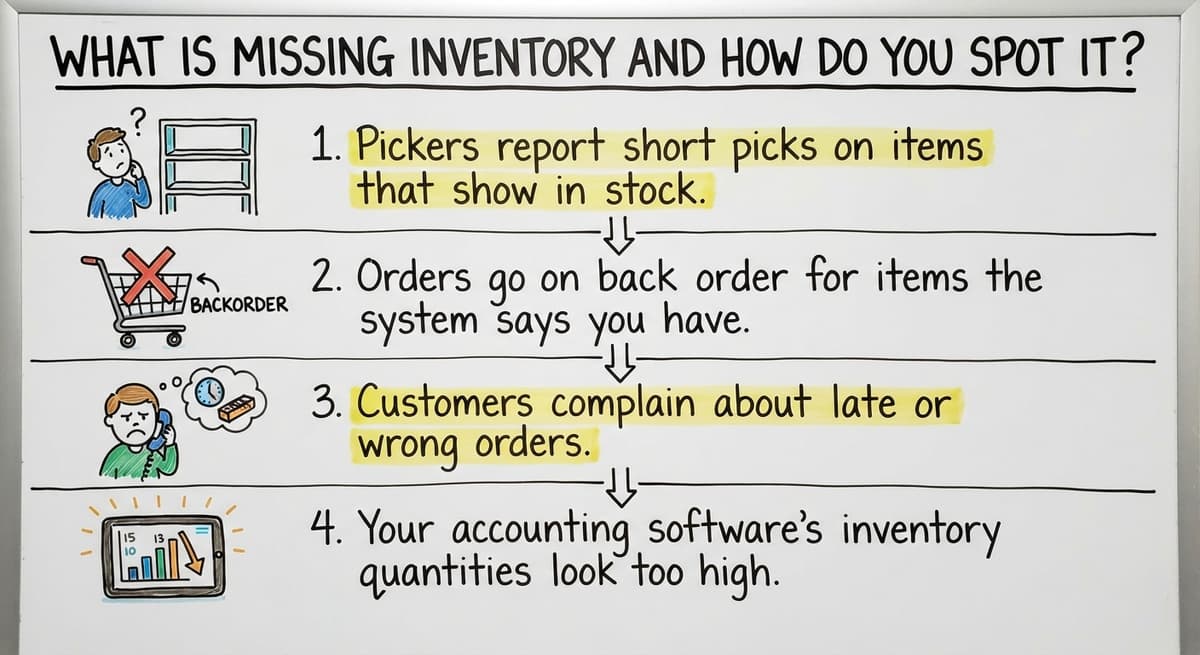
Missing inventory is the gap between what your records say and what sits on the shelf. That gap is an inventory discrepancy. Some stock is truly gone. Other stock is in the wrong bin or typed in wrong. Most gaps come from small errors, not theft. Loss from theft or damage is called inventory shrinkage.
Reviewed October 2026.
Watch for these warning signs:
- Pickers report short picks on items that show in stock.
- Orders go on back order for items the system says you have.
- Customers complain about late or wrong orders.
- Your accounting software's inventory quantities look too high or too low.
We build it for your operation, and the first look is free
If you would rather not compare products, describe how your operation already works and we build the system around it.
No build cost. You see it running on your own process first, and the monthly subscription starts only once it is live.
Book a callHow Can a Spot Count Confirm the Gap?
Run a quick spot count on a few items and match it to the records. A gap found early is easier to trace. Barcodes help here. As GS1 says of its standards, they give each item an identity that any scanner can read. Spot counts catch drift before it grows.
How Do You Recount and Compare Stock?
Recount first, then compare. A recount rules out a simple miss before you chase a loss.
Step 1: Why recount the stock?
A recount is the fastest way to prove a gap is real. Count in a quiet window. Have a second person check. Write down the date, the counter, and the location. Then look in nearby bins, staging areas, and the dock. Items often sit 10 feet from where they belong.
Step 2: Compare your count to your records
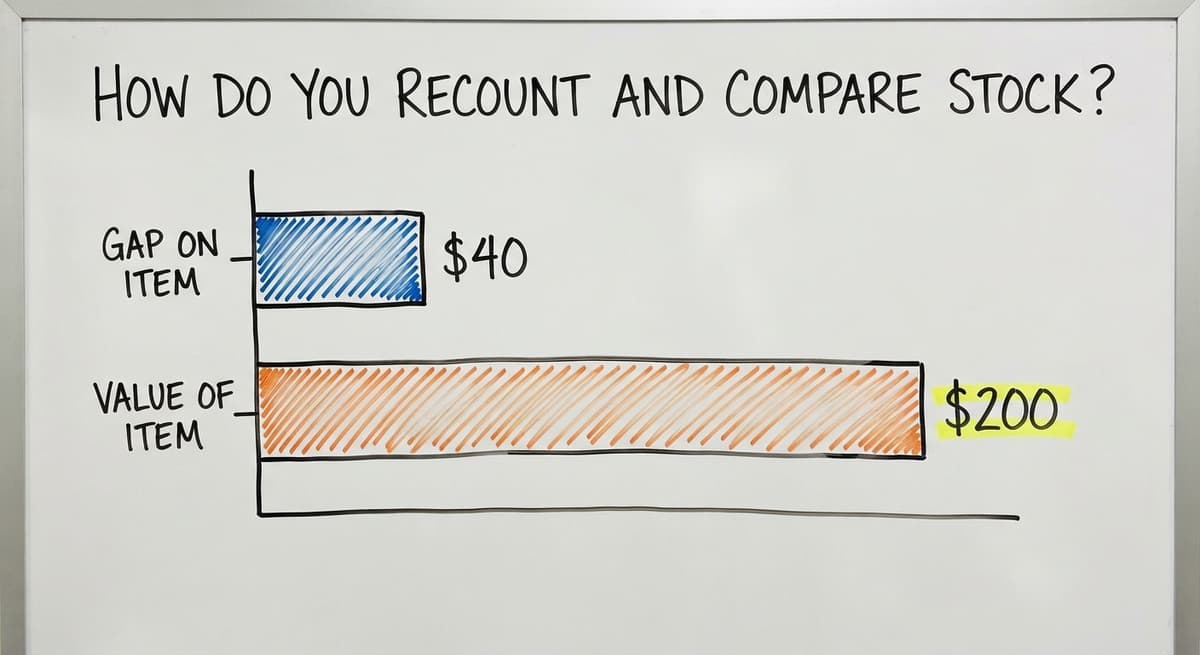
Line up the physical inventory count against your accounting software, spreadsheets, or printed pick sheets. Build a simple table with 4 columns: item, expected, counted, and difference. Then rank the gaps by dollar value. A $40 gap on a $200 item matters more than a 3 unit gap on a 10 cent screw. Check the biggest dollar gaps first.
How Do You Trace Missing Inventory and Find the Cause?
Trace the item through every handoff, then test the common causes. The goal is to find the last point where the record and the shelf agreed.
Step 3: Trace every move
Follow the item in this order:
- Buy order
- Receiving
- Put-away
- Picking
- Packing
- Shipping
Read the paper trail at each handoff. Check each document against the one before it, so you can see where the records stop agreeing. The gap began after the last step that matched.
Step 4: Check for common causes
What causes inventory to go missing? Simple errors come first. Rule these out before you suspect theft:
- A delivery arrived with the wrong count or the wrong item.
- A picker took the wrong item, or a bin has the wrong label.
- Cases were logged as single units, or the reverse.
- A return was never logged.
- Damaged goods were never written off.
- Someone moved stock with no record.
Theft or loss is the last check. Most gaps end at one of the first 6.
Not sure this is the right shape for your operation
Describe how the work runs today. We map it on a call and show you what it would look like built around that, before you spend anything.
Book a call
Why Do Spreadsheets and Paper Make Tracking Harder?
Spreadsheets and paper split your data into many copies. One count lives in Excel. Another sits in an Access file, an email, or a clipboard. Nobody knows which copy is right.
Typing the same data twice invites errors. Say 2 people spend 5 hours a week fixing typos at $22 an hour. That is $11,440 a year. Files also show no history of who changed a number and when. These tools work for a small shelf. They strain once volume grows.
How Do You Record Inventory Adjustments the Right Way?
Log every adjustment with the date, item, amount, reason, and person. Inventory adjustments fix the record once you know the truth. They are not casual edits.
Use a short list of reason codes:
- Damaged
- Miscount
- Returned
- Unknown
Keep adjustments apart from daily edits so the history stays clean. Clean records also matter for taxes. IRS Publication 538 states, "To figure taxable income, you must value your inventory at the beginning and end of each tax year." A clear adjustment log makes that value easy to defend.

How Do You Stop Inventory From Going Missing Again?
Fix the cause you found, not just the number. A corrected count with the same habit brings the gap back.
How often should you count inventory?
Cycle counting is the habit of counting a small part of the warehouse each day or week. It beats one big yearly count because errors get found while they are still small and the trail is fresh. Count fast-moving and high-value items more often. Track your accuracy rate each month to see if it improves.
What else prevents repeat losses?
A few simple habits keep the same gaps from coming back:
- Label bins clearly so pickers cannot guess.
- Name one owner for each area.
- Write simple receiving rules.
- Review variances weekly and share results with the team.
Owned areas get counted, and counted areas stay accurate.

How Can Barcodes and Custom Software Help?
Scanning at receiving, picking, and shipping creates a record at every step. Warehouse inventory tracking then flags a mismatch the moment it happens. Nobody has to wait for the next count.
Can you track missing inventory in your accounting software and a spreadsheet? Yes. Use them for the steps above. When is it time to move off spreadsheets? Move when the same losses return, counts take days, or data lives in many files.
You do not need a big ERP or a long move. The Software Society, based in Columbus, Ohio, builds custom tools for small to mid-size operations. The software replaces only the manual parts. Your accounting software stays for accounting. Talk to the team about a simple tracking system built around how your staff already works.
Frequently asked questions
How do you track missing inventory?
Recount the item, compare the count to your records, trace each move from buy order to shipping, and check common causes. Then log an adjustment with a reason.
What causes inventory to go missing?
Most gaps come from receiving errors, picking mistakes, mislabeled bins, unit mix-ups, unlogged returns, and unrecorded moves. Theft is the last check.
How often should you count inventory?
Count a small section each day or week. Count fast-moving and high-value items more often than slow ones.
Can you track missing inventory in your accounting software and a spreadsheet?
Yes. Compare your physical count to the quantities in each tool, list the differences, and log adjustments with reasons. Manual entry raises the error risk as volume grows.
When is it time to move off spreadsheets for inventory tracking?
Move when the same losses keep returning, counts take days, or your data lives in many files.
Start with a free first look
A 30 minute call, your operation mapped, and a clear picture of what we would build. No obligation and nothing to install.
Book a callRelated guides
More on the same work.
- How to Keep Track of Inventory
- How to Create an Inventory Tracking System?
- How to Keep Track of Inventory on Clover
- How to Keep Track of Computer Inventory
- How to Keep Track of Consignment Inventory
- How to Keep Track of Alcohol Inventory
- How to Keep Track of Product Inventory
- How to Keep Track of Ebay Inventory
- How to Keep Track of Poshmark Inventory
- How to Track Inventory for Home Staging
- How to Keep Track of Dental Inventory
- How to Keep Track of Boutique Inventory
- How to Keep Track of Vaccine Inventory
- How to Keep Track of Liquor Inventory
- How to Track Inventory Qbo
- How to Track Non Inventory Items
- How to Keep Track of Grocery Inventory
- How to Track Inventory in Salesforce
- How to Keep Track of Lularoe Inventory
- How to Keep Track of Freezer Inventory
- How to Track Ps5 Inventory
- How to Keep Track of Cigarette Inventory
- How to Keep Track of Inventory on Etsy
- How to Keep Track of Inventory Electronically