

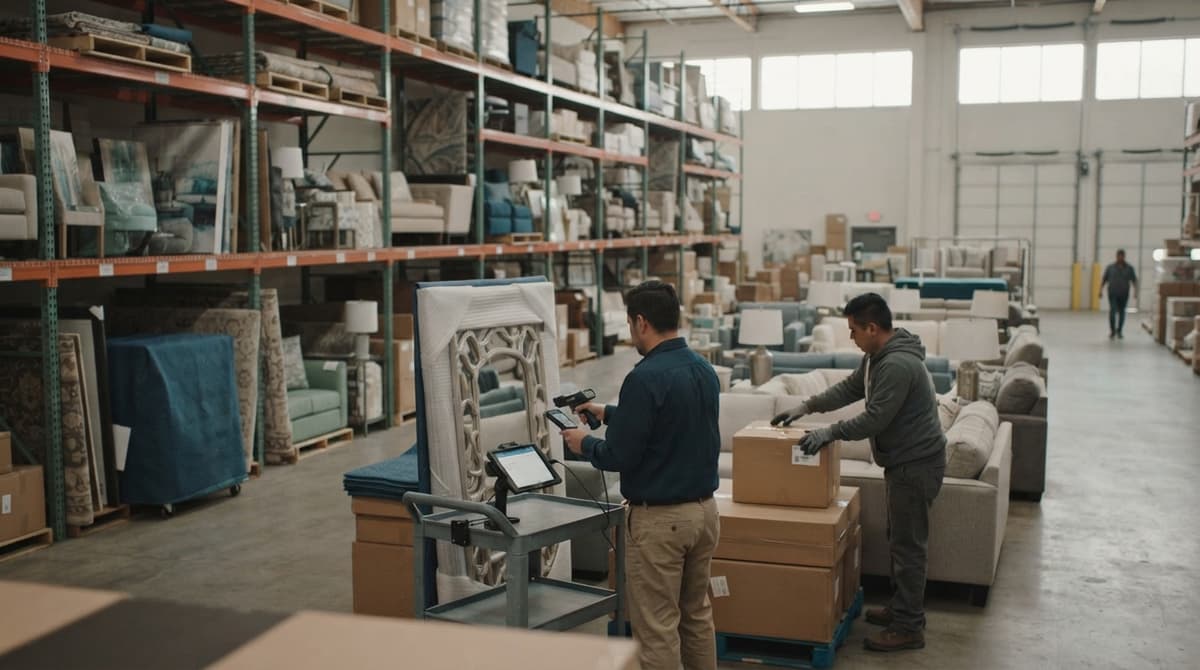
How to Track Inventory for Home Staging
Give each item a unique ID, log where it is and what shape it is in, and update the log each time it moves. Staging stock goes out and comes back. Reviewed October 2026.
Book a callHow do you track inventory for home staging?
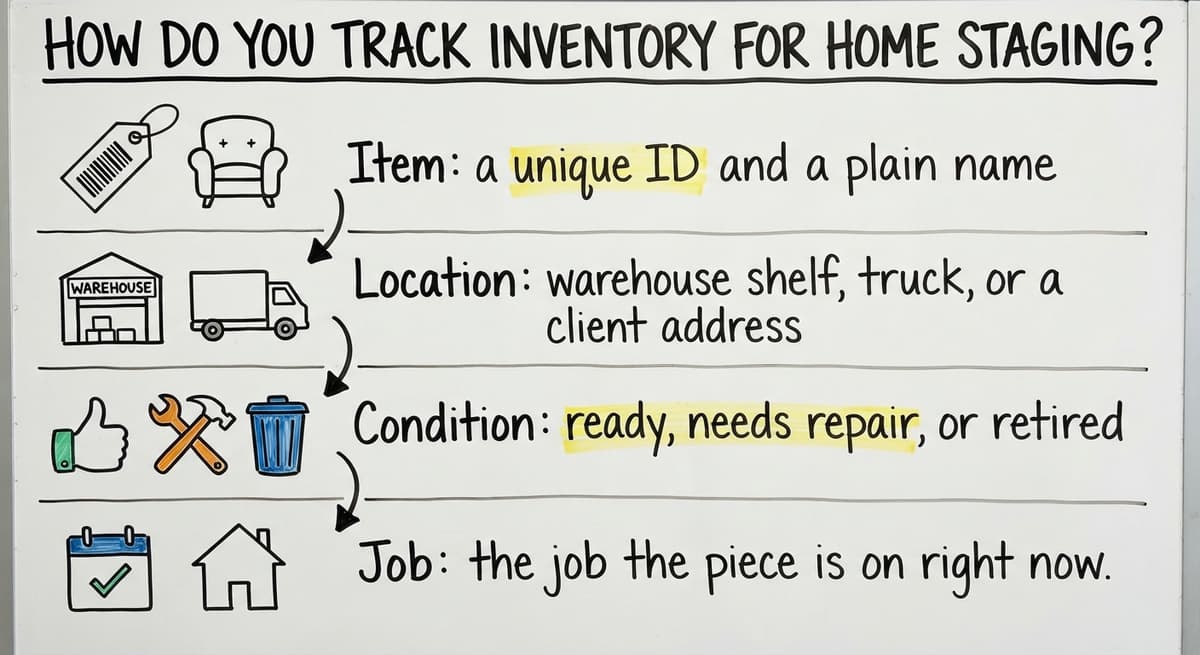
Home staging inventory is tracked with 4 fields: item, location, condition, and job. Every sofa, lamp, and rug gets one record. The record changes each time the piece moves.
Staging stock is like rental stock. A sofa is not sold once and gone. It goes out, comes back, and goes out again.
- Item: a unique ID and a plain name.
- Location: warehouse shelf, truck, or a client address.
- Condition: ready, needs repair, or retired.
- Job: the job the piece is on right now.
Four fields answer the only question that matters: where is this piece, and can it work today?
We build it for your operation, and the first look is free
If you would rather not compare products, describe how your operation already works and we build the system around it.
No build cost. You see it running on your own process first, and the monthly subscription starts only once it is live.
Book a callWhy is staging inventory harder to track than regular stock?
Staging inventory is harder to track because each piece leaves and returns many times. One sofa can sit on 3 jobs in a single month. Stock is split across a warehouse, a truck, and several homes at once.
Sets get mixed and matched. Small damage and missing parts go unnoticed without a record. GS1, the standards body behind barcodes, calls its standards "the global language of business", and a shared ID is what lets every crew member speak the same language about one piece.
A single ID per piece is what keeps a moving item from turning into a lost one.
What should you record for every staging item?
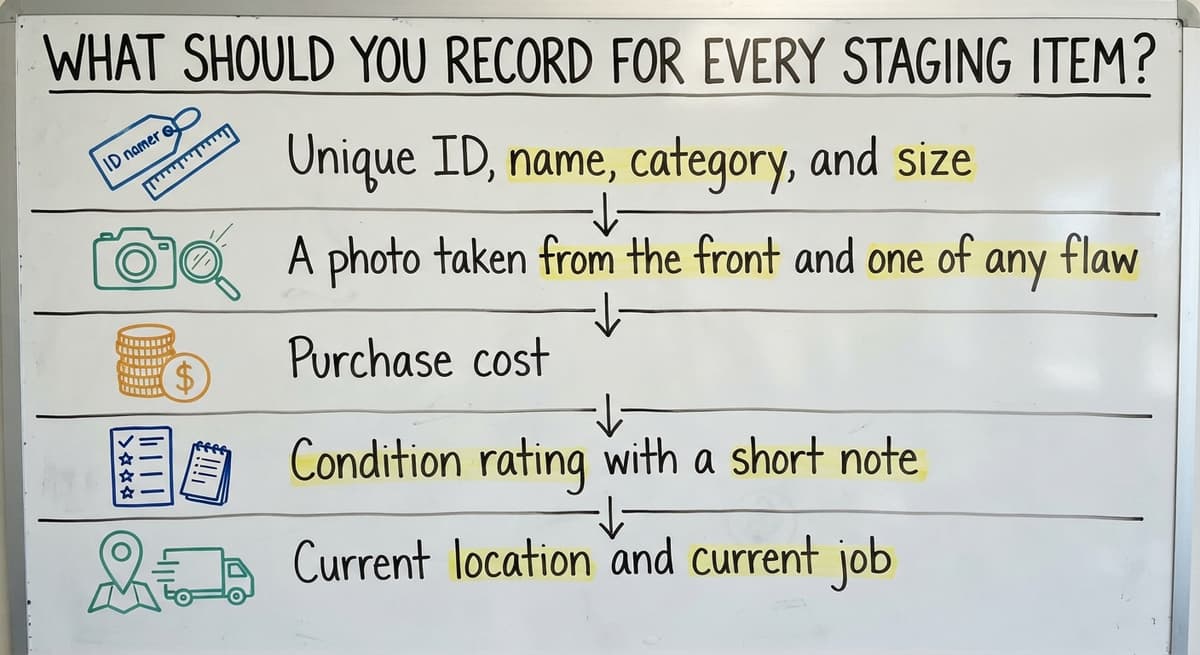
A staging item record needs 8 short entries, and the crew can fill them in under a minute. Keep the list short so people finish it. A long form gets skipped.
- Unique ID, name, category, and size.
- A photo taken from the front and one of any flaw.
- Buy cost, such as $600, and replacement cost, which may now be $750.
- Condition rating with a short note.
- Current location and current job.
This is the list a staging inventory list needs. The photo is the cheapest proof you will ever own when a client disputes a stain.
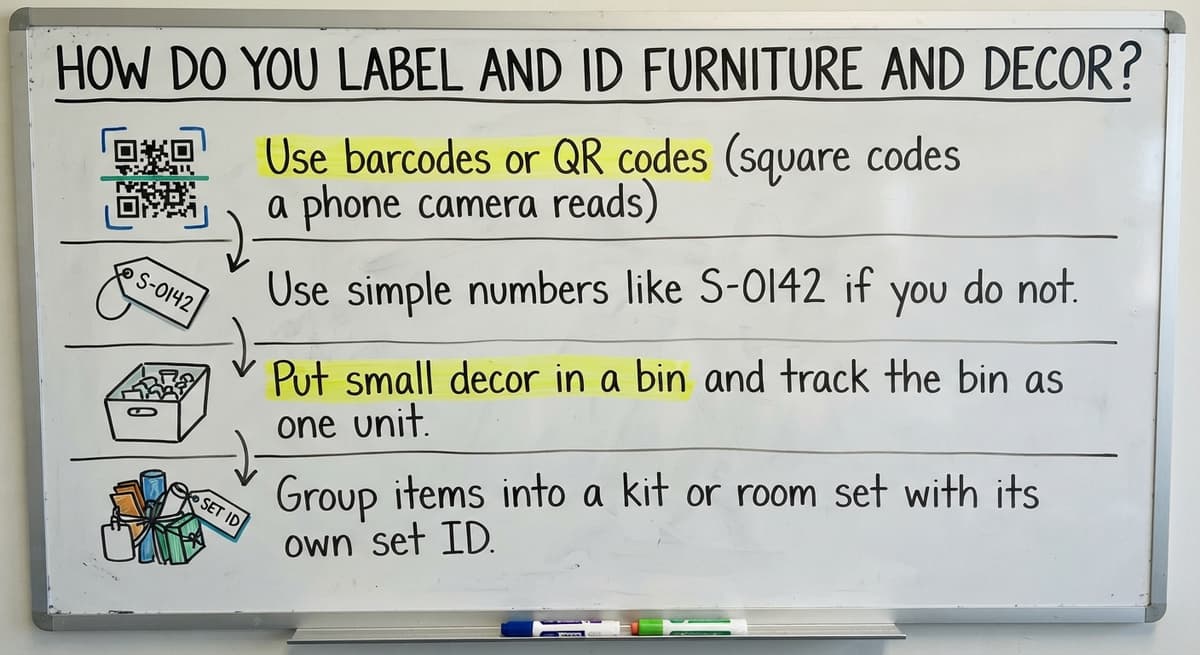
How do you label and ID furniture and decor?
Furniture gets a durable tag on the underside or back, where a client will not see it. Pick the tag to fit the way you count.
- Use barcodes or QR codes (square codes a phone camera reads) if you scan.
- Use simple numbers like S-0142 if you do not.
- Put small decor in a bin and track the bin as one unit.
- Group items into a kit or room set with its own set ID.
A set ID lets a crew pull a full living room with one scan. Tag once, and the tag works for years.
Not sure this is the right shape for your operation
Describe how the work runs today. We map it on a call and show you what it would look like built around that, before you spend anything.
Book a call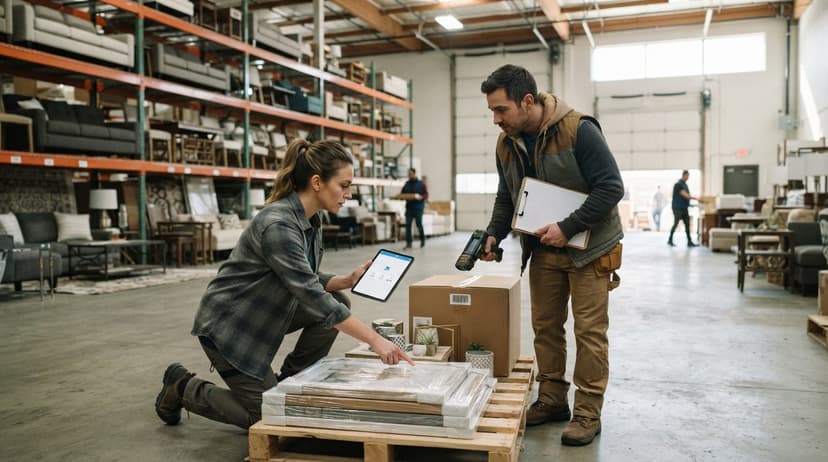
How do you track items going out to a job?
A job starts with a pick list, which is a list of every piece headed to one home. Check out each piece against the job name and address. The record then shows where the piece went. This is the check-in and check-out loop, and it keeps your count honest.
Confirm the count at load-in
Have a second person count at the door, or take one photo of the staged room. Then log a planned pickup date.
- Build the pick list from the job.
- Check out each item to the job address.
- Count again at load-in.
- Set the planned pickup date.
The second count is where a lost lamp gets caught, while the crew is still on site.

How do you check items back in?
Every return is checked against the same pick list used on the way out. Each missing piece shows up at once. Check each item for damage, stains, and loose or missing parts.
Give each piece one of three marks
- Ready: clean, whole, and back on its shelf.
- Needs repair: held in a repair area, off the available list.
- Retired: removed from stock and sold or donated.
Put the item in its set storage spot, then update the location field. A piece is not back until its record says so.
How do you organize a staging warehouse or storage unit?
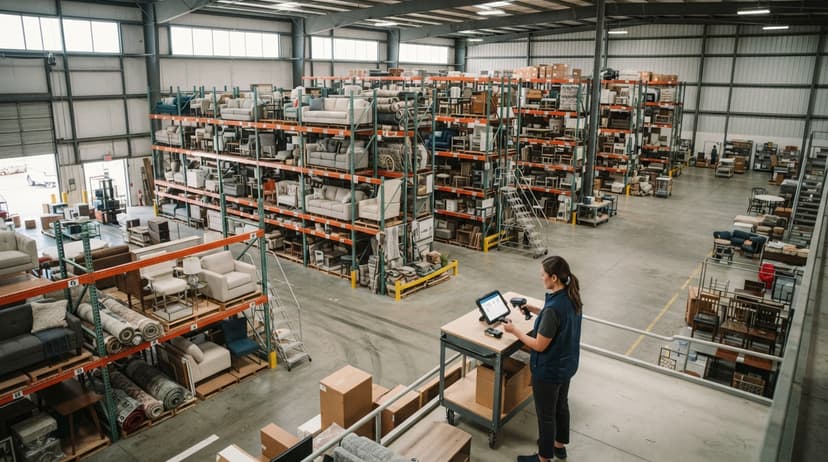
A staging warehouse works best with zones by room type or category, such as living room, bedroom, and decor. Shelf and bin labels must match the location field in the record. If the label says B-4, the record says B-4. Keep fast-moving pieces near the door. The same rules apply when you work out how to keep track of inventory in warehouse space of any size.

Count a little each month
A cycle count is a short count of one zone, such as a single shelf row or storage area, rather than the whole stock. Do one zone a month instead of one big count a year. Each count stays small enough to fit around normal work. Small counts find drift early, so a gap between the records and what is on the shelf is caught while it is still easy to trace.
The comparison is easier when one option is built for you
Off-the-shelf means fitting your process to the software. We do it the other way round, and the first look costs nothing.
Book a callCan a spreadsheet track staging inventory?
Yes, an inventory spreadsheet works at the start. Use columns for ID, location, condition, and job. Excel and similar sheets cost little and take an afternoon to set up. This is the simplest answer to how to keep track of inventory small business owners ask about.

Where spreadsheets break
A shared spreadsheet is easy to start with, but it fails in predictable ways once several people rely on it. These four problems are the most common, and each one makes the numbers harder to trust.
- Two people edit at once and one overwrites the other.
- Versions get mixed up across email threads.
- A printed sheet is out of date the moment a truck leaves.
- No history shows who moved what, and when.
Signs it is time to move on
A few warning signs show when a spreadsheet is costing more than it saves. Watch for double-booked items, lost pieces, and hours spent hunting. Say 3 people lose 2 hours a week at $20 an hour. That is $120 a week, or $6,240 a year.
When the hunting costs more than a fix, the sheet has done its job.
How do you avoid double-booking the same items?
You avoid double-booking by recording planned dates, not just current location. A sofa in the warehouse today may be promised to a job next Tuesday. The record must show that.
- Reserve items for upcoming jobs so they show as unavailable.
- Check availability before you quote a new job.
- Tie each reservation to a job record.
A reservation turns a promise into a record anyone on the team can see.

How do you measure whether your inventory is paying off?
Staging stock pays off when each piece earns more than it costs. Track three numbers.
- Use: how many days a piece is out versus idle.
- Loss and damage rate: the share of pieces lost or damaged per quarter.
- Cost against revenue: what the piece cost against the fees it helped bring in.
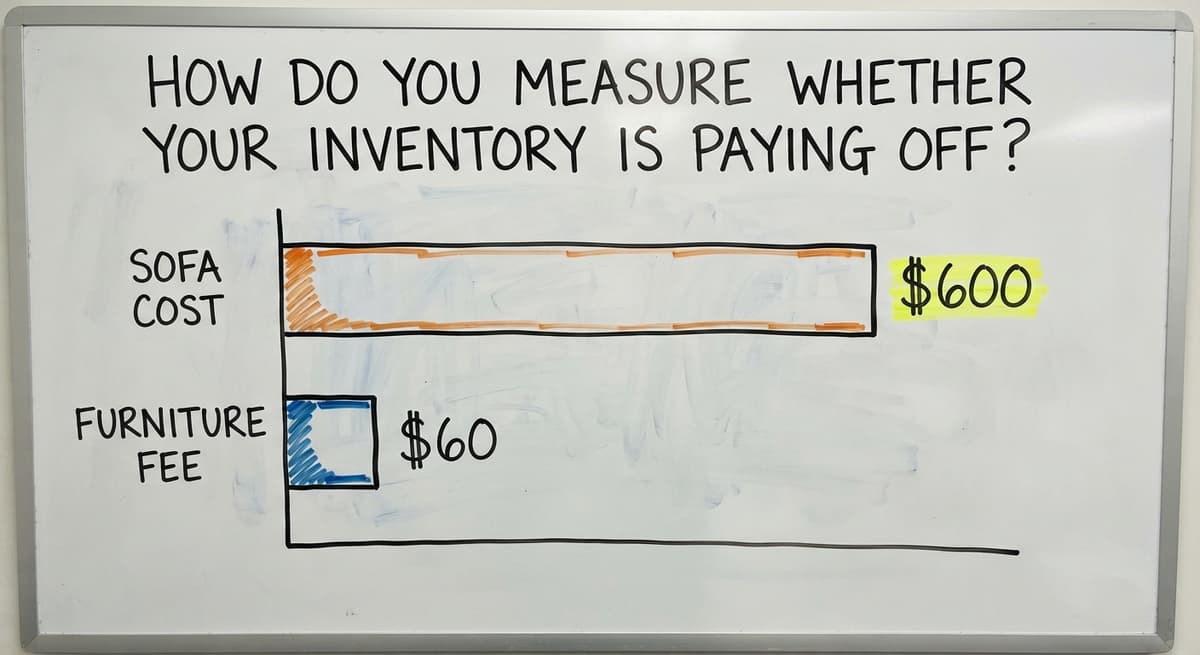
A $600 sofa on 10 jobs at $60 of furniture fee each has brought in $600. Use the numbers to decide what to buy, repair, or sell. Idle pieces are cash sitting on a shelf.
When does a custom inventory system make sense?
Custom inventory software makes sense when you have outgrown spreadsheets but do not want a big ERP, which is a large system that runs a whole company. Software built around how your crew already works asks them to change less. You skip the painful migration.
Your accounting stays where it is. 1. Your accounting software can keep your books, while the new system replaces only the manual parts: check-out, check-in, and reservations.
Such a system works at small scale, not just for big firms. IRS Publication 538 says "To figure taxable income, you must value your inventory at the beginning and end of each tax year." Good records make that task easy.
What are the first steps to get started?
You can start this week with 4 steps. Pick the ones that match your stock and your crew.
- Count and tag what you own.
- Set up the four core fields.
- Run one job from start to finish with check-out and check-in.
- Review what slowed the crew down and fix it.
The Software Society, local to Columbus, Ohio, can build an inventory tracking system around your process. Start with one job, and let the results show you what to build next.
Frequently asked questions
What should a staging inventory list include?
A staging inventory list needs a unique ID, name, category, size, photo, buy and replacement cost, condition, current location, and current job. Keep it short so crews fill it in.
How do you label furniture for staging?
Put a durable tag or label on the underside or back of each piece. Use a barcode or QR code if you scan, or a simple number if you do not. Track small decor by bin.
How do you stop items from getting lost between jobs?
Check every item out against a pick list and check it back in against the same list. Count at load-in with a second person or a photo. Update the location each time.
Can I use Excel to track staging inventory?
Yes, at the start. Use columns for ID, location, condition, and job. Limits appear when two people edit at once, versions mix, and no history shows who moved what.
How do you avoid double-booking staging pieces?
Record planned dates and reserve items for each upcoming job so they show as unavailable. Check availability before you quote a new job.
When should a staging company move beyond a spreadsheet?
Move on when items get double-booked, pieces go missing, or the crew spends hours hunting for stock. Those signs mean the sheet costs more than a better system.
Do I need to replace my accounting software to track staging stock?
- No. A custom system can replace only the manual tracking steps. Your accounting software can stay in place for your books.
Start with a free first look
A 30 minute call, your operation mapped, and a clear picture of what we would build. No obligation and nothing to install.
Book a callRelated guides
More on the same work.
- How to Keep Track of Inventory
- How to Create an Inventory Tracking System?
- How to Keep Track of Inventory on Clover
- How to Keep Track of Computer Inventory
- How to Keep Track of Consignment Inventory
- How to Keep Track of Alcohol Inventory
- How to Keep Track of Product Inventory
- How to Keep Track of Ebay Inventory
- How to Keep Track of Poshmark Inventory
- How to Keep Track of Dental Inventory
- How to Keep Track of Boutique Inventory
- How to Keep Track of Vaccine Inventory
- How to Keep Track of Liquor Inventory
- How to Track Non Inventory Items
- How to Keep Track of Grocery Inventory
- How to Keep Track of Lularoe Inventory
- How to Keep Track of Freezer Inventory
- How to Keep Track of Cigarette Inventory
- How to Keep Track of Inventory Electronically
- How to Keep Track of Paparazzi Inventory
- How to Keep Track of Fba Inventory
- How to Track Inventory with Qr Code
- How to Track Inventory in Real-time
- How to Record Inventory on Hand