

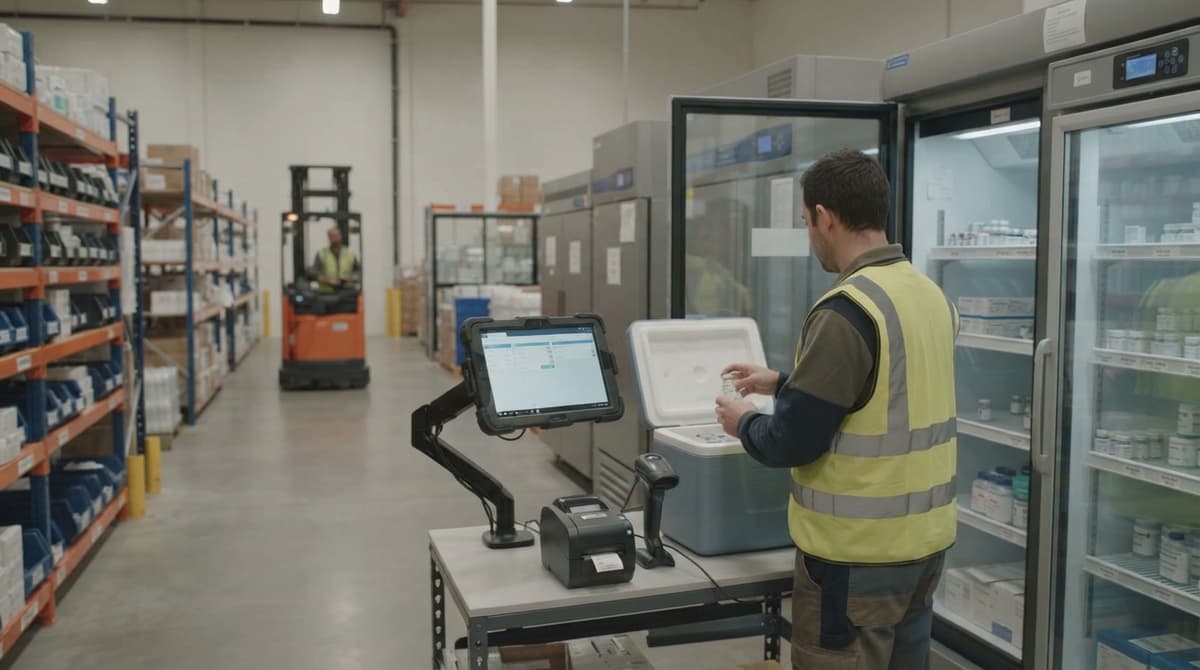
How to Keep Track of Vaccine Inventory
To keep track of vaccine inventory, log each vaccine by product, lot number, expiration date and storage spot. Then update the record each time stock moves.
Four habits make that work. Receive and log. Store with care. Count on a schedule. Ship the soonest-expiring stock first.
It is for wholesale and warehouse teams of 5 to 100 staff. Many of them run on spreadsheets, paper and accounting software.
The steps here are general operations advice. Follow the manufacturer's label and the rules that cover your own business. Each section answers one question, so you can jump to the part you need.
Later sections show where manual tracking breaks. They also show how custom software can replace only those parts. You do not need an ERP, a large all-in-one business system.
Book a callHow Do You Keep Track of Vaccine Inventory?
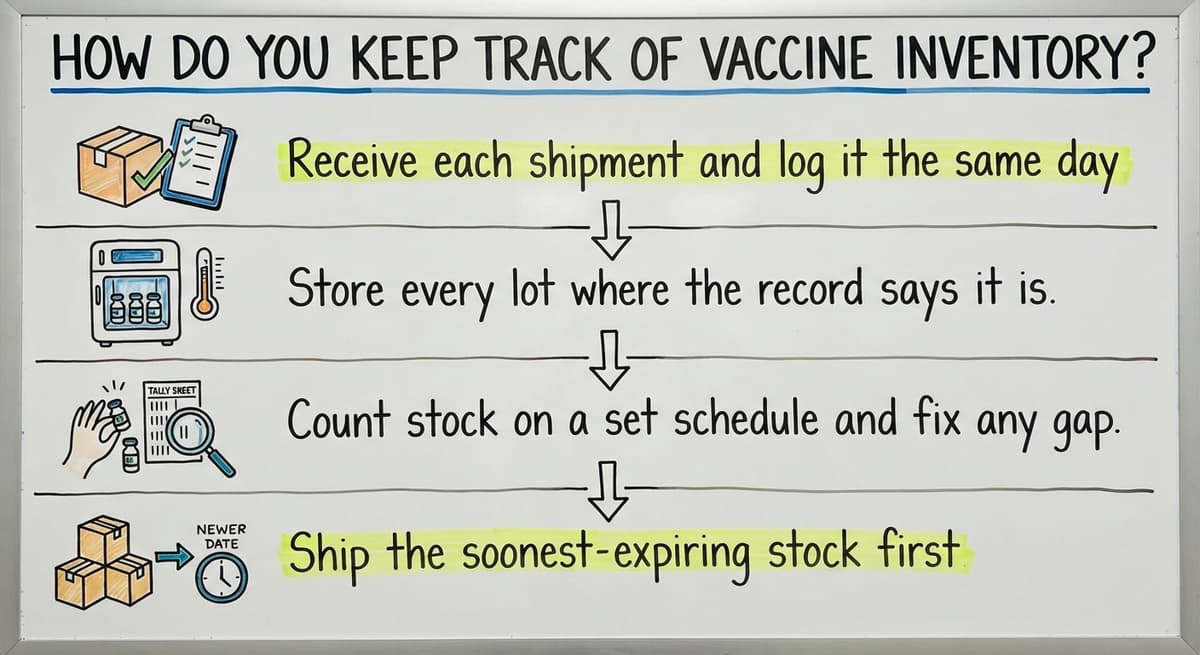
You keep one record for every vaccine. It lists the product, lot number, expiration date and storage location. You update it each time stock comes in, goes out or moves to a new shelf.
Four habits hold the system up:
- Receive each shipment and log it the same day.
- Store every lot where the record says it is.
- Count stock on a set schedule and fix any gap.
- Ship the soonest-expiring stock first.
Treat this as general operations advice. Follow the manufacturer's label and the rules for your own business. A record that matches the shelf is the goal.
We build it for your operation, and the first look is free
If you would rather not compare products, describe how your operation already works and we build the system around it.
No build cost. You see it running on your own process first, and the monthly subscription starts only once it is live.
Book a callWhy Is Vaccine Inventory Harder to Track Than Regular Stock?
Vaccines are harder to track because they expire, need cold storage and must be traced by lot. A plain count by SKU, the item code you sell by, is not enough. Each box needs a lot and a date.
GS1 gives every product a "Global Trade Item Number" in its barcode standards, and a scan can carry the lot and date with it. A slip means wasted product, a recall scramble or a customer who cannot get an order. Lot and date are what set a vaccine record apart from a record for any other box on the shelf.
What Details Should You Record for Every Vaccine?
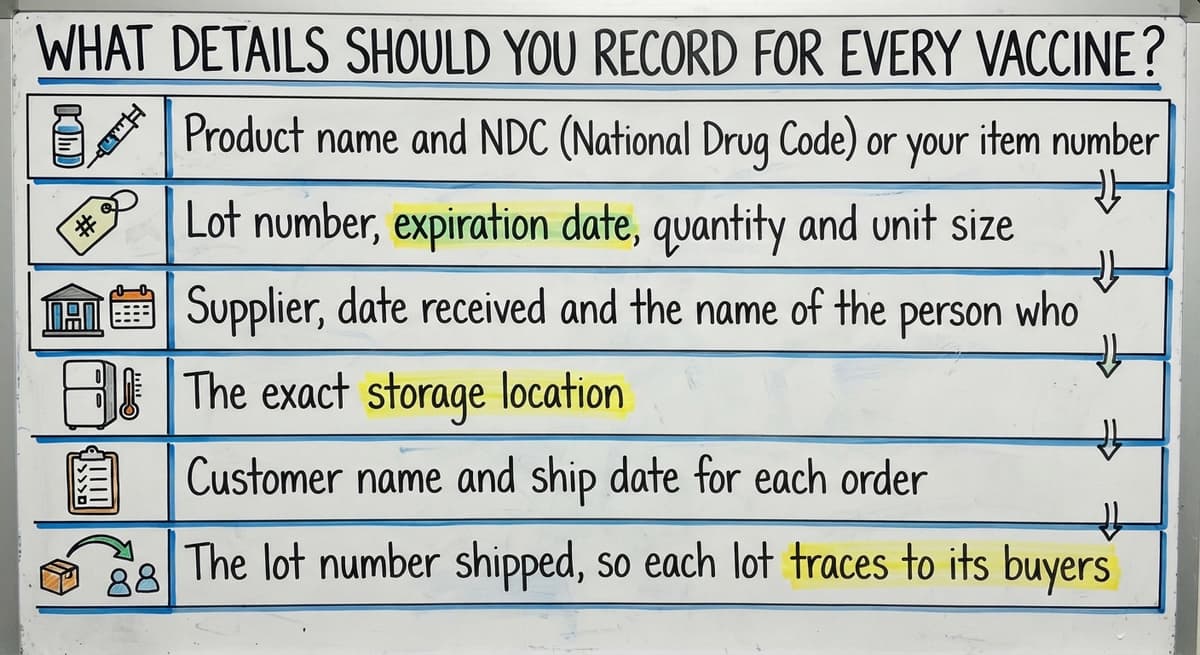
Record the product, lot, expiration, quantity, supplier and storage spot for every vaccine. Add the customer and ship date on the way out. Keep the same fields each time.
Fields for incoming stock
Every time stock arrives, the receiving record should capture the same set of fields. Recording them at the moment of receipt is what makes a later lot search or recall check possible, because the details are still fresh and the product is in front of you.
- Product name and NDC (National Drug Code) or your item number.
- Lot number, expiration date, quantity and unit size.
- Supplier, date received and the name of the person who received it.
- The exact storage location.
Keep the same fields in the same order on every entry so records stay consistent and easy to search.
Fields for outgoing stock
Every outgoing entry should record the same details, so you can see where each product went. Capturing them at the time of shipping keeps the record accurate and complete.
- Customer name and ship date for each order.
- The lot number shipped, so each lot traces to its buyers.
Same fields in the same order, every entry, is what makes a later lot search simple.
Not sure this is the right shape for your operation
Describe how the work runs today. We map it on a call and show you what it would look like built around that, before you spend anything.
Book a callHow Do You Log Vaccines When They Arrive?
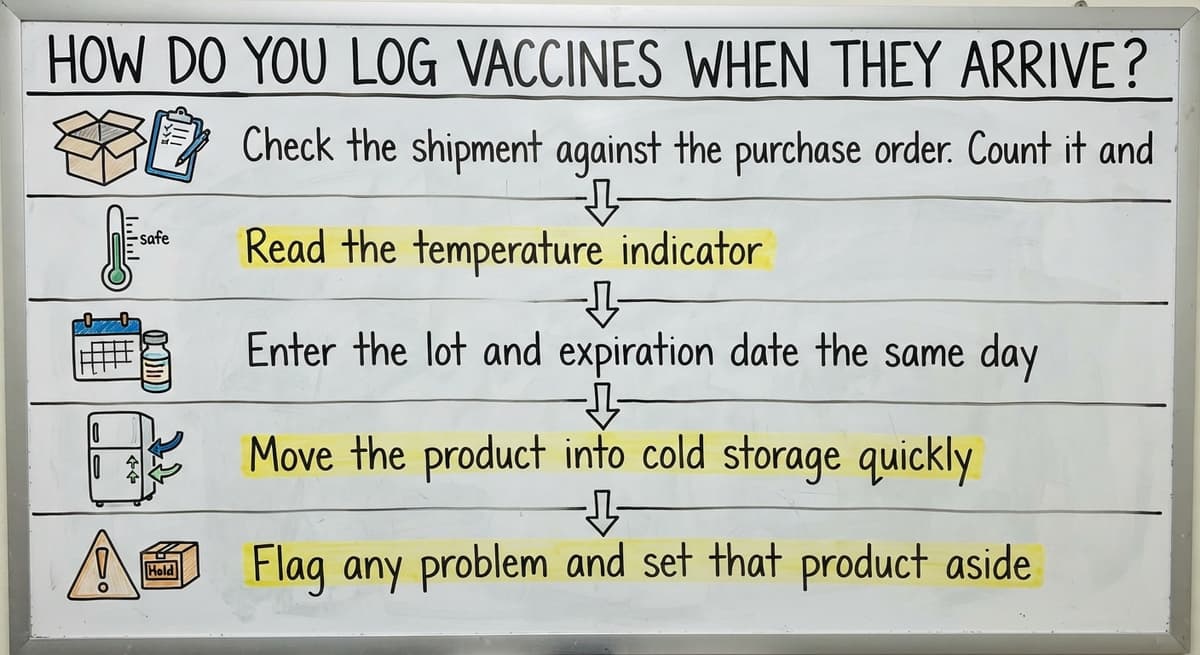
Log every shipment in 5 steps on the day it arrives. Cold storage inventory starts at the dock, not at the shelf.
- Check the shipment against the buy order. Count it and look for damage.
- Read the temperature indicator that came with the box. Write down the result.
- Enter the lot and expiration date the same day.
- Move the product into cold storage quickly.
- Flag any problem and set that product aside.
A shipment is not stock until someone has counted it, checked it and logged it.

How Should You Organize Vaccine Storage?
Organize storage so the record and the shelf match. Give each product and lot a labeled spot. Keep different lots apart. Put the soonest-expiring stock in front.
Follow the storage range printed on the manufacturer's label. Write each location into the inventory record, such as "Unit 2, shelf B, bin 3." Guides on how to keep track of inventory in warehouse settings share this habit. Cold storage adds a stricter label to obey.
A picker should find any lot by reading the record alone.

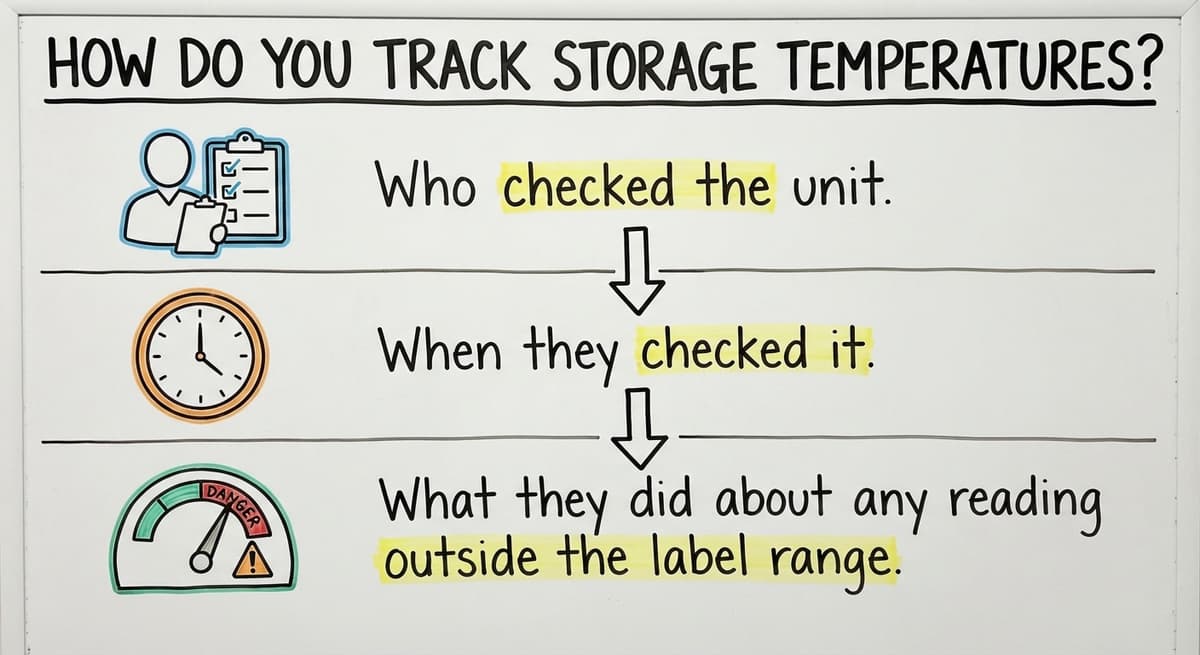
How Do You Track Storage Temperatures?
Log temperatures on a set schedule and keep the log beside the inventory records. Any device works if it records readings you can read back later.
Each log entry needs three facts:
- Who checked the unit.
- When they checked it.
- What they did about any reading outside the label range.
Link each cold unit to the lots stored inside it. A bad reading then points straight to the affected stock. Nobody has to walk the shelves to guess.

How Do You Use First-Expired, First-Out?
First expired, first out (FEFO) means you ship the vaccine that expires soonest first. First in, first out ships the oldest arrival instead. A newer box can carry an earlier date, so arrival order misleads.
Sort pick lists by expiration date, not by arrival date. Set a warning window, such as 90 days out. Stock inside the window gets sold, moved or offered to a buyer first.
Expiration date tracking only pays off when the pick list obeys the dates.
The comparison is easier when one option is built for you
Off-the-shelf means fitting your process to the software. We do it the other way round, and the first look costs nothing.
Book a call
How Often Should You Count Vaccine Stock?
Count fast movers on a short cycle and count everything on a longer, set one. Weekly for fast movers and monthly for a full count are common starting points. Your own rules and volume decide the final schedule.
Count by lot, not just by product. Compare the count to the record. Find the cause of any gap before you change the number.
The Census Bureau posts monthly wholesale inventory and sales data. Use it to see how your stock level compares with sales across the trade.

What Does a Counting Gap Cost?
A wrong count costs money, time and trust. IRS Publication 538 states: "To figure taxable income, you must value your inventory at the beginning and end of each tax year."
Time adds up too. 2 staff spending 4 hours a week on manual recounts at $20 an hour is $160 a week, or $8,320 a year. Check your own rate against BLS pay data.
The FTC's rule on mail, internet and phone orders expects you to ship when you said you would. An accurate count protects the books, the budget and that promise.

What Is Lot Number Tracking?
Lot number tracking ties every unit to the batch the maker produced it in. A lot number is a code printed on each box from one batch. Record it on the way in and again on the way out.
When a maker recalls a lot, you search that lot and see which customers got it. Keep the expiration date in its own field, never in a notes cell.
Good lot data turns a recall from a week of guessing into a short search.

Can Spreadsheets Track Vaccine Inventory?
Yes, a spreadsheet can handle vaccine inventory tracking at small volume. The weak spots show as you grow.
Where spreadsheets break
- Copies drift out of sync when 2 people edit different files.
- No alert fires when a date draws near.
- Typos slip in with no check.
- Lot data ends up in email or on printed sheets.
Keep your accounting software for the money side. It tracks quantity and value well. Lot and expiration fields need a different home.
A spreadsheet is a fine start and a weak long-term home for lot data.
See it running on your own process first
No build cost. The subscription starts once it is live and doing the job, not before.
Book a callWhen Should You Move Beyond Spreadsheets and Paper?
Move on when the same problems keep returning. Watch for these four signs:
- You find expired stock by surprise.
- A lot lookup takes too long.
- Staff enter the same data twice, once in spreadsheets and once in the accounting software.
- One person holds all the knowledge.
A big ERP is not the only next step. NIST's Manufacturing Extension Partnership offers vendor-neutral supply chain guidance. A small, targeted tool can fix just the manual parts.
What Does Custom Inventory Software Add?
Custom inventory software adds the fields and alerts a spreadsheet lacks. We build it around how your warehouse already works. A local Columbus, Ohio team builds it, and it works at small scale.
What changes
The software adds lot-level tracking and date awareness to the way you already handle stock. Each change below targets a manual step where expired product or missing lot records can cause problems, and each one is built into the everyday record rather than added as a separate task.
- Lot and expiration fields sit on every record.
- Expiry alerts warn you before stock ages out.
- FEFO pick lists put the soonest date first.
- Lot trace reports show which customers got which lot.
FEFO means first expired, first out.
What stays
The accounting software stays in place for accounting, and an integration passes totals across, so your finance records and your existing reporting keep working as they do today. We replace only the manual parts of the process. Good inventory management software fits your process and does not force a new one.
What Is a Simple Plan to Get Started This Week?
Start with 5 steps, and finish them in a week.
- List every vaccine on hand.
- Record the lot and expiration date for each box.
- Label every shelf and bin.
- Set a count schedule for fast movers and a full count.
- Pick an expiry warning window, such as 90 days.
The same steps work for how to keep track of product inventory of any kind. If your current process feels too manual, talk it through with our Columbus, Ohio team. We will help you find the parts worth replacing first.
Frequently asked questions
What is on a vaccine inventory log?
A vaccine inventory log lists the product name, NDC or item number, lot number, expiration date, quantity, supplier, date received, storage location and who received it. Outgoing lines add the customer and ship date.
How do you track lot numbers and expiration dates?
Give each one its own field on every record. Enter both when stock arrives and again when it ships. Then a search by lot shows the stock left and every customer who received it.
What is FEFO and why does it matter?
FEFO stands for first expired, first out. You ship the vaccine with the soonest expiration date first. It matters because a newer box can expire sooner than an older one.
Can you use a spreadsheet or accounting software to track vaccine inventory?
A spreadsheet works at small volume. Accounting software handles quantity and value well but does not fit lot and expiration work. Many teams keep it for accounting and add a tool for lots.
What is a good count schedule for vaccines?
Count fast movers on a short, regular cycle and run a full count on a longer set one. Count by lot. Pick a pace that fits your volume and your own rules.
When is it time to use custom inventory software?
Start looking when you find expired stock by surprise, lot lookups run slow, staff enter data twice or one person holds all the knowledge.
Do I need an ERP to track vaccine lots?
No. An ERP is a large all-in-one business system. A small custom tool with lot fields, expiry alerts and FEFO pick lists can replace only the manual parts.
Start with a free first look
A 30 minute call, your operation mapped, and a clear picture of what we would build. No obligation and nothing to install.
Book a callRelated guides
More on the same work.
- How to Keep Track of Inventory
- How to Keep Track of Inventory on Clover
- How to Keep Track of Computer Inventory
- How to Keep Track of Consignment Inventory
- How to Keep Track of Alcohol Inventory
- How to Keep Track of Product Inventory
- How to Keep Track of Ebay Inventory
- How to Keep Track of Poshmark Inventory
- How to Keep Track of Dental Inventory
- How to Keep Track of Boutique Inventory
- How to Keep Track of Liquor Inventory
- How to Keep Track of Grocery Inventory
- How to Keep Track of Lularoe Inventory
- How to Keep Track of Freezer Inventory
- How to Keep Track of Cigarette Inventory
- How to Keep Track of Inventory Electronically
- How to Keep Track of Paparazzi Inventory
- How to Keep Track of Fba Inventory
- How to Create an Inventory Tracking System?
- How to Track Inventory for Home Staging
- How to Track Non Inventory Items
- How to Track Inventory with Qr Code
- How to Track Inventory in Real-time
- How to Keep Track of Inventory in Warehouse