

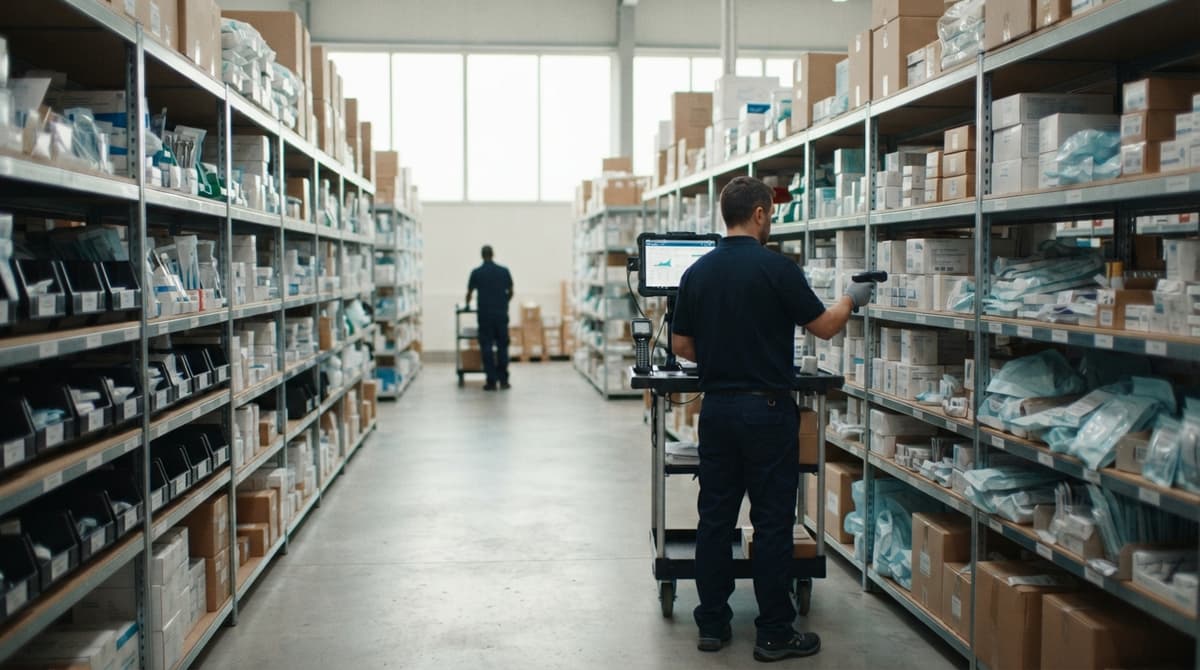
How to Keep Track of Dental Inventory
To keep track of dental inventory, count every item, give each one a SKU and a bin, record lot numbers and expiration dates at receiving, and set reorder points. Check short-dated stock every week. Reviewed October 2026 for distributors and warehouses that ship dental supplies to practices.
Book a callWhat Does It Mean to Keep Track of Dental Inventory?
Dental inventory tracking means knowing what you have, where it sits, how much is left, and when it expires. A distributor needs all four answers for every item. Dental supply inventory covers gloves, anesthetics, composites (tooth-colored filling material), impression materials, and small disposables like bibs and suction tips. Each item has a name, a count, and a spot on a shelf. Some also carry a lot number and a date. If you can answer all four questions in under a minute, you track well.
We build it for your operation, and the first look is free
If you would rather not compare products, describe how your operation already works and we build the system around it.
No build cost. You see it running on your own process first, and the monthly subscription starts only once it is live.
Book a callWhy Is Dental Inventory Harder to Track Than Other Stock?
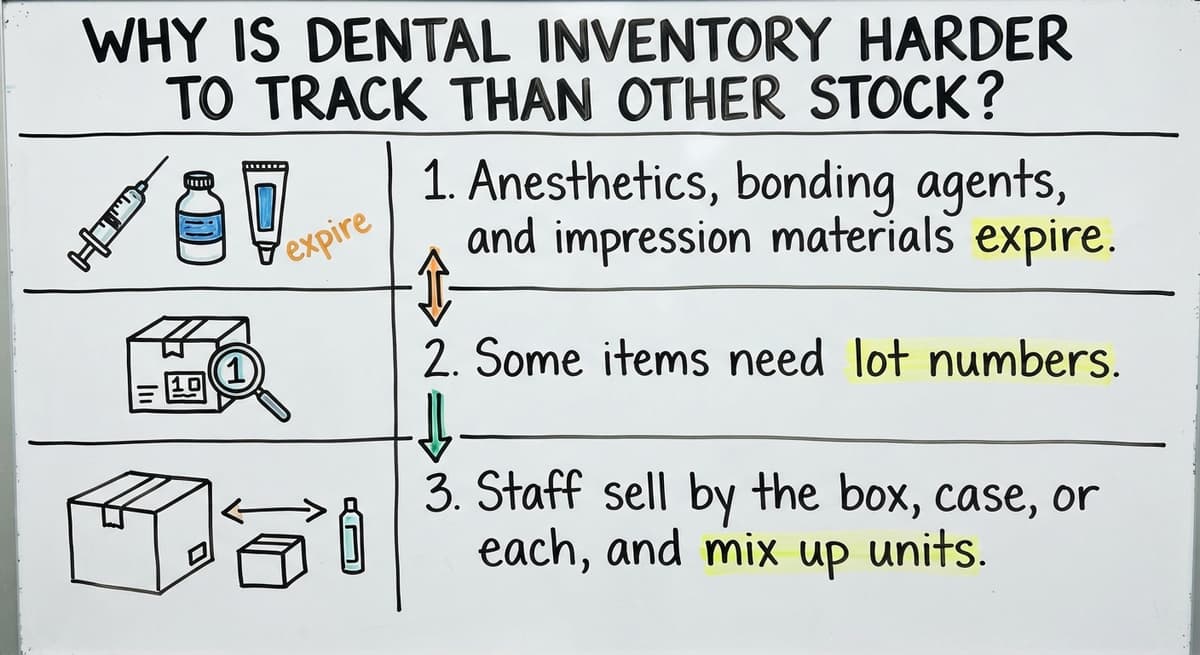
Dental stock is hard to track because it mixes many tiny items with strict date rules. A single glove line can have 4 sizes and 3 pack counts. A composite line adds shades. That is dozens of SKUs (stock keeping units, the codes for each item) for one product family.
- Anesthetics, bonding agents, and impression materials expire.
- Some items need lot numbers so a recall can be traced to the exact orders.
- Staff sell by the box, case, or each, and mix up units.
Barcodes help with all of this. GS1 lists its barcode standards on a page titled "Barcodes", and those standards sit behind most scan-based counts. Small items with many variants need clean, scannable codes.
What Is the First Step to Track Dental Inventory?
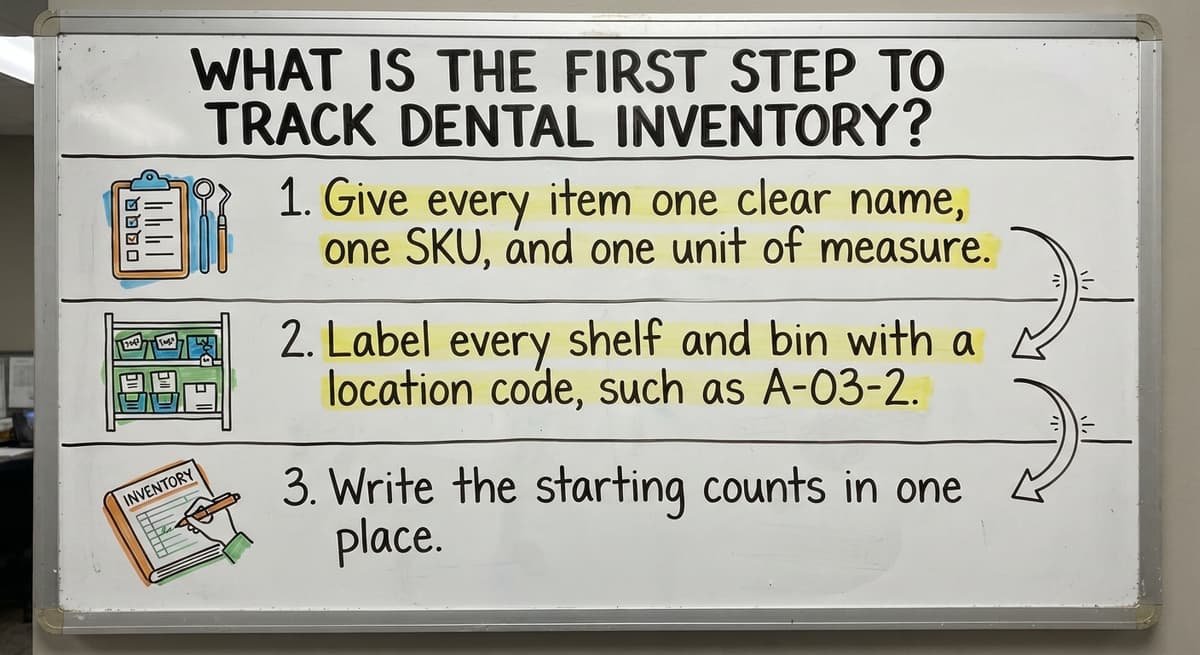
The first step to track dental inventory is a full physical count of everything in the building. Close the warehouse for a short window and count each shelf by hand. Then set the base.
- Give every item one clear name, one SKU, and one unit of measure.
- Label every shelf and bin with a location code, such as A-03-2.
- Write the starting counts in one place.
IRS Publication 538 says, "To figure taxable income, you must value your inventory at the beginning and end of each tax year." A clean starting count serves that rule too. One shared sheet beats five private ones.
How Should You Organize Dental Supplies in the Warehouse?
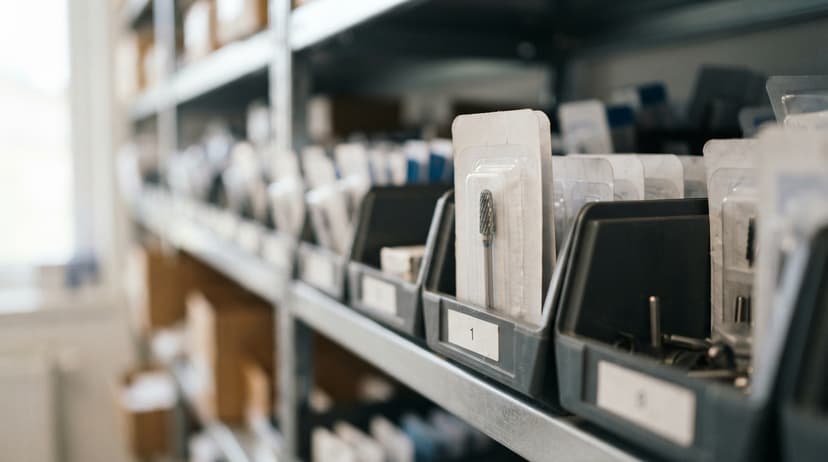
Organize dental supplies by product family, and give each item one fixed bin. Put all glove sizes together. Put all composite shades together. A picker then knows where to walk without asking.
- Keep cold or heat-sensitive items in the spot the label calls for.
- Keep fast sellers, like exam gloves, close to the pack area.
- Use first-expired, first-out (FEFO). The lot that expires soonest ships first.
FEFO differs from first-in, first-out. A newer lot can carry an earlier date. Put the older date at the front of the bin and mark it. Staff then ship the right box without checking every label. Good bins make wrong picks rare.
Not sure this is the right shape for your operation
Describe how the work runs today. We map it on a call and show you what it would look like built around that, before you spend anything.
Book a call
How Do You Track Lot Numbers and Expiration Dates?
Track lot numbers and expiration dates by writing both down the moment stock arrives. A lot number is the batch code a maker prints on a box. A recall names lots, so you must know which customers got which lot.
At Receiving
Scan or type the lot and the date for each item. Do it before the box goes to its bin.
At Shipping
Link the lot to each order line. When a maker recalls lot 4417, you pull a list of buyers in minutes.
Every Week
Run a short-dated list. Show items that expire within 90 days, and move them to the front.
A plain spreadsheet breaks here. Staff type dates wrong or skip them. Two people edit one file and one overwrites the other. Expired product then turns up late, or not until a customer calls.
What Are Par Levels and Reorder Points?
A par level is the amount you want on hand. A reorder point is the count that triggers a new buy order. Both come from two facts: how fast an item sells and how long the supplier takes to deliver.
Take one glove size. It sells 20 boxes a week. The supplier needs 1 week to deliver. You will sell 20 boxes while you wait. Add 10 boxes as a buffer. Your reorder point is 30 boxes. When the count hits 30, you order.
Set your par level above that point. If you buy 40 boxes per order, the par level is 70. Review both numbers each quarter, because sales shift. Good par levels cut stockouts without piling up dated stock.

How Often Should You Count Dental Inventory?
Count dental inventory every week in small pieces. This is cycle counting: you count one section on a set day instead of shutting down for one huge count. Monday is gloves. Tuesday is anesthetics. In a month, you have covered the building.
- Count high-value and fast-moving items more often, such as every 2 weeks.
- When a count is off, find the cause and write it down.
- Keep a simple count log with the date, item, expected count, actual count, and who counted.
The log shows patterns. If one bin is off every month, the problem is the bin, not the count. Steady small counts catch errors while they are still small.
Can a Spreadsheet or Accounting Package Track Dental Inventory?
A spreadsheet or accounting package works at first, and for a small shelf count it is fine. Your accounting software's inventory tools are good for bookkeeping and basic item counts. Many distributors start there, and that is a sound choice.
The strain shows up as the business grows. These jobs are hard to do well:
- Lot and expiration tracking for each receipt and each order
- Bin locations for pickers
- Several people editing the same sheet
- Printed pick lists
- Orders that arrive by email and get re-typed
Watch for three signs of trouble. Counts do not match the shelf. Stockouts hit items you thought you had. Expired product is found late. Any one of those signals that the tool has hit its limit.
The comparison is easier when one option is built for you
Off-the-shelf means fitting your process to the software. We do it the other way round, and the first look costs nothing.
Book a call
What Common Mistakes Cause Dental Inventory Errors?
The most common dental inventory errors come from loose habits, not bad software. Four habits cause most of them.
- Staff name the same item three ways, or mix box and case counts.
- Receipts wait a day or two before anyone records them.
- Someone changes a count and writes no reason.
- The same data lives in several files, and the files disagree.
The fix for each is a rule. One name per item. Record receipts at the dock. Every adjustment gets a note. One file is the source of truth. The FTC's mail, internet, or telephone order rule expects you to ship when you said you would. A wrong count breaks that promise.
When Does Custom Software Make Sense for Dental Inventory?
Custom software makes sense when manual steps eat more time than the stock itself. Look for these signs:
- Staff re-key the same data into 2 or 3 places.
- Someone checks dates by hand each week.
- The sheets live on one person's computer.
Put a price on it. Say 2 people spend 5 hours a week on re-keying at $20 an hour. That is 2 x 5 x $20 x 52, or $10,400 a year. The Bureau of Labor Statistics publishes pay data for stock clerks, so you can use your own local rate.
Custom software can follow how your team already works. It can keep your accounting software for bookkeeping and replace only the manual parts. You do not need a big ERP (a large all-in-one business system) or a long, costly move. The point is to remove re-keying, not to rebuild the company.
What Should a Simple Dental Inventory System Include?
A simple dental inventory system holds five things. Each one removes a common error.
- An item list with SKU, unit of measure, and bin location for each product
- Lot and expiration fields filled in at receiving
- Low-stock alerts tied to each reorder point
- Count history with a note on every adjustment
- A link to your accounting software so data is entered once
The NIST Manufacturing Extension Partnership offers vendor-neutral supply chain guidance if you want to compare process ideas. The Census Bureau also tracks wholesale inventories and sales, a useful gauge for how much stock firms hold. Any tool that covers these five items will serve a distributor well.
How Can You Get Started This Month?
You can start this month with five steps:
- Count every item on the shelf.
- Clean up item names and units.
- Label every bin.
- Set a reorder point for your top 20 sellers.
- Start a weekly expiration check.
Pick the one task that costs the most time and fix it first. For many warehouses, that is the date check. If you want to talk through your current process, The Software Society, a local Columbus, Ohio team, will walk through it with you. Bring your sheets and your pain points.
Frequently asked questions
How to keep track of dental shadowing hours?
This is a different topic from supply stock, so here is a short, honest answer. Log each visit with the date, start and end time, the dentist or office, and what you saw. Ask the dentist or office staff to sign or initial each entry. A spreadsheet, a paper log, or an app all work. What decides between them is whether your school or program asks for a set form. Check that first.
How do you keep track of dental inventory?
Start with a full count. Give each item one name, SKU, unit, and bin. Record lot numbers and expiration dates at receiving. Set reorder points, run weekly date checks, and count a small section every week.
How do you track expiration dates and lot numbers on dental supplies?
Record both at receiving, before the box goes to its bin. Link the lot to every order line that ships. Run a short-dated list each week and ship the soonest-expiring lot first.
What are par levels and reorder points for dental supplies?
A par level is the amount you want on hand. A reorder point is the count that triggers a buy order. If a glove size sells 20 boxes a week with a 1 week lead time, and you add a 10 box buffer, the reorder point is 30 boxes.
How often should dental inventory be counted?
Count a small section every week, so the whole building is covered each month. Count fast-moving and high-value items more often. Log each count and note the cause of any gap.
Is a spreadsheet or accounting software enough to track dental inventory?
Both work for small shelves and basic counts. They strain on lot and expiration tracking, bin locations, shared edits, and pick lists. Counts that do not match, stockouts, and late expired finds are the signs to move on.
When should a distributor move to custom inventory software?
Move when staff re-key the same data, date checks are manual, or the sheets live on one person's computer. Custom software can replace those manual parts and keep your accounting software for bookkeeping.
Start with a free first look
A 30 minute call, your operation mapped, and a clear picture of what we would build. No obligation and nothing to install.
Book a callRelated guides
More on the same work.
Guides
Common questions
- How to Keep Track of Inventory
- How to Keep Track of Inventory on Clover
- How to Keep Track of Computer Inventory
- How to Keep Track of Consignment Inventory
- How to Keep Track of Alcohol Inventory
- How to Keep Track of Product Inventory
- How to Keep Track of Ebay Inventory
- How to Keep Track of Poshmark Inventory
- How to Keep Track of Boutique Inventory
- How to Keep Track of Vaccine Inventory
- How to Keep Track of Liquor Inventory
- How to Keep Track of Grocery Inventory
- How to Keep Track of Lularoe Inventory
- How to Keep Track of Freezer Inventory
- How to Keep Track of Cigarette Inventory
- How to Keep Track of Inventory Electronically
- How to Keep Track of Paparazzi Inventory
- How to Keep Track of Fba Inventory
- How to Create an Inventory Tracking System?
- How to Track Inventory for Home Staging
- How to Track Non Inventory Items
- How to Track Inventory with Qr Code
- How to Track Inventory in Real-time