

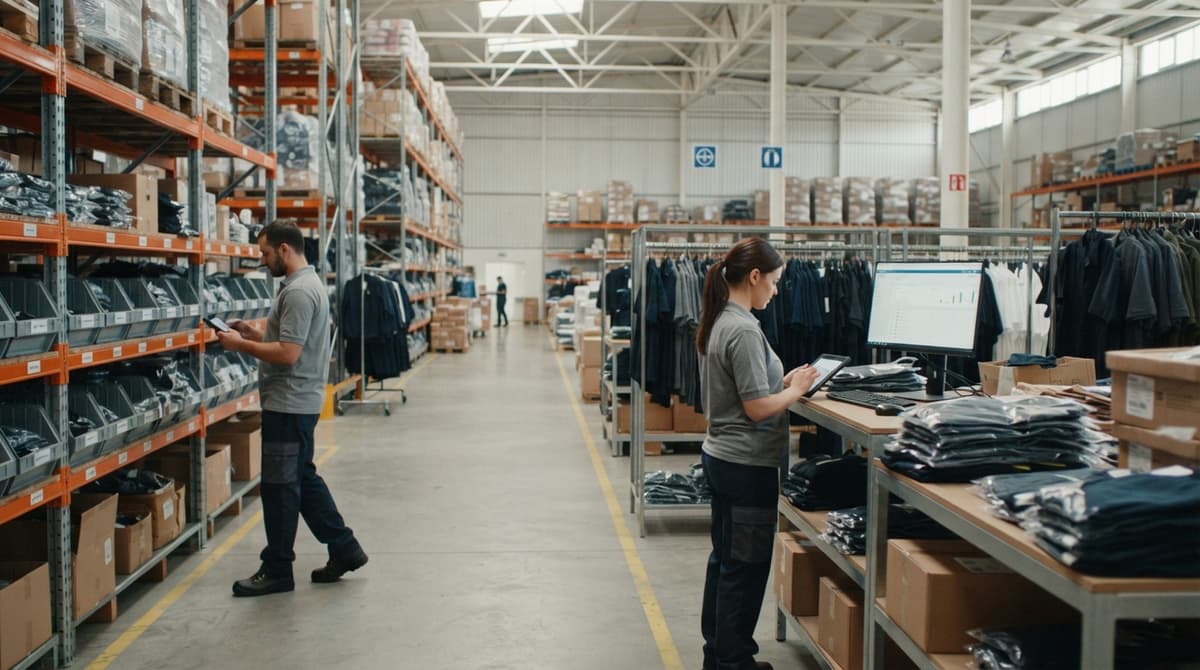
How to Track Uniform Inventory
To track uniform inventory, give each style, size and color its own SKU, count everything once, and label where each item sits. Then log every item out and back in. Set reorder points and count a few SKUs each week. A SKU is a short code for one exact item.
Book a callHow Do You Track Uniform Inventory?
Uniform inventory tracking means knowing 3 things: what you hold, what went out, and what came back. Uniforms are hard to count. One shirt comes in 6 sizes and 4 colors. Items leave and return all week. Stock sits on shelves, in bins and on trucks. Paper sheets and loose spreadsheets fall behind fast.
We build it for your operation, and the first look is free
If you would rather not compare products, describe how your operation already works and we build the system around it.
Reviewed October 2026.
No build cost. You see it running on your own process first, and the monthly subscription starts only once it is live.
Book a callWhat Is the Best Way to Track Uniforms by Size?
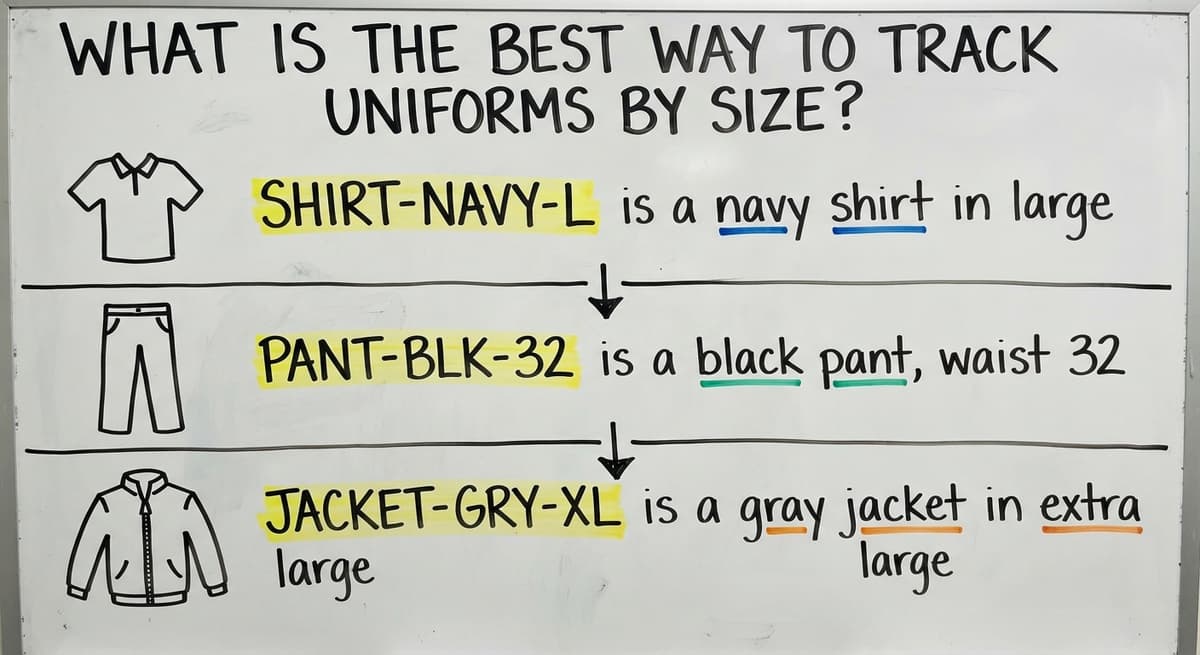
The best way is one SKU for every style, size and color. Never count "large shirts." That label hides navy, gray and white, and you cannot reorder from it. Build uniform SKUs by size with a simple pattern.
- SHIRT-NAVY-L is a navy shirt in large.
- PANT-BLK-32 is a black pant, waist 32.
- JACKET-GRY-XL is a gray jacket in extra large.
Use the same SKU in your accounting package and your stock list. If you use your accounting software, match its item names to your SKUs. Then the two never disagree. One SKU means one count, and one count means one answer.
Do a Full Starting Count
Count every SKU and write down where it sits. Use 2 people, or check a sample of 10% of the SKUs. Pick a quiet time, such as a Sunday, so stock does not move. This count is your baseline. Every later number builds on it.
Give Each Item a Home
Label shelves and bins with short codes, such as A-2-3 for aisle A, shelf 2, bin 3. Keep each SKU in one main spot. Pickers then find items fast and grab the wrong size less. Add a separate spot for returns that wait to be checked. Good labels turn a 10 minute hunt into a 1 minute pick.
How Do You Track Uniforms Issued to Employees or Customers?
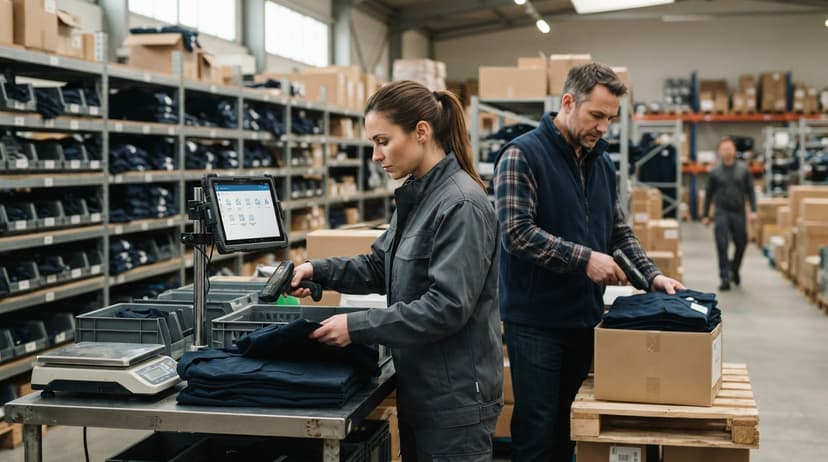
Track issued uniforms with one log, filled in at the moment of hand-off. Do not wait until the end of the day. Memory fails and counts drift. Keep the log in one place, not in email and paper notes.
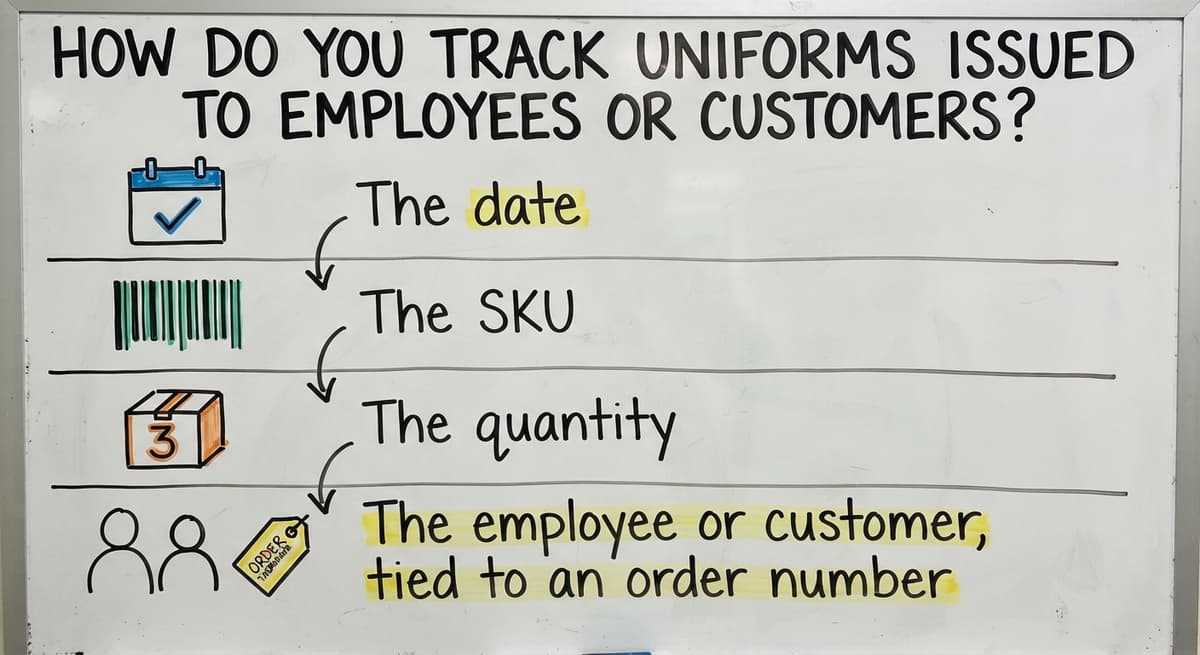
Each line needs 4 facts:
- The date.
- The SKU.
- The quantity.
- The employee or customer, tied to an order number.
Returns need the same care. Log each returned item and add good ones back to stock. Mark worn or stained items as damaged, and keep them apart. Treat an exchange as 1 item out and 1 item in. Skip a return and you get phantom stock: the sheet says 8, the shelf holds 3. A log that covers both directions is the core of warehouse inventory tracking.

How Often Should You Count Uniform Inventory?
Count a small group of SKUs every week instead of everything once a year. These are cycle counts: short, rolling counts of a few items. Count fast sellers more often than slow ones. Compare each count to the records and fix the gap. When the same SKU is off twice, find the cause. A missed log or a mixed-up bin is common.
Set Reorder Points for Each Size
A reorder point is the stock level that triggers a new order. Base it on weekly sales times supplier lead time, plus a small cushion. Say you sell 12 navy large shirts a week. Your supplier needs 2 weeks. Keep a cushion of 6. The math is 12 x 2 + 6 = 30. Order when 30 are left. Common sizes such as M and L need higher points than 3XL.
Not sure this is the right shape for your operation
Describe how the work runs today. We map it on a call and show you what it would look like built around that, before you spend anything.
Book a call
Can You Track Uniform Inventory in Excel?
Yes, a spreadsheet works at small scale. One person must own it, and the SKU list must stay short. Trouble starts with several users, many sizes and many locations. Copies multiply. Nobody knows which file is right.
An accounting package such as your accounting software tracks stock value well. It often lacks size-level issue and return detail. It will tell you what the stock is worth. It will not tell you who holds 4 medium jackets. Barcodes help with counts, and GS1 publishes the standards behind them. For process help, the NIST Manufacturing Extension Partnership offers vendor-neutral supply chain guidance. Pair that with how to create an inventory tracking system? and start small.
When Should You Move From a Spreadsheet to Custom Software?
Move when the manual work costs more than the fix. Watch for 3 signs:
- You recount often because nobody trusts the sheet.
- Common sizes run out before you reorder.
- Data lives in many files.
Put a price on it. Say 2 people spend 3 hours a week on recounts at $20 an hour. That is 2 x 3 x 20 x 52 = $6,240 a year. A custom tool can match how your team already works. It keeps your accounting software as your books and replaces only the manual steps. You need no big ERP rollout and no forced move. The Software Society is a local Columbus, Ohio team that builds this kind of workflow.
Mistakes to Avoid
Five habits break most uniform counts. Fix these first.
- Tracking by style only and not by size.
- Skipping the log when things get busy.
- Not recording returns.
- Keeping more than one version of the stock list.
- Never counting and trusting the records alone.
A team that avoids these 5 habits has a count it can trust.
Start With One Habit This Week
Pick one step and do it now. Write your SKUs, or count 10 of them. Then book a short call with The Software Society if manual work keeps winning.
Frequently asked questions
How do you track uniform inventory?
Give each style, size and color its own SKU. Do a full starting count and label every storage spot. Log each item that goes out and each return. Set reorder points and run weekly cycle counts.
What is the best way to track uniforms by size?
Use one SKU per style, size and color, such as SHIRT-NAVY-L. A SKU that exact lets you count, reorder and pick without guessing.
How do you track uniforms issued to employees or customers?
Log the date, SKU, quantity and recipient at the moment of hand-off. Tie each line to an order or employee, and keep one log in one place.
How often should you count uniform inventory?
Count a small group of SKUs each week. Count fast sellers more often. Compare each count to the records and fix any gap.
Can you track uniform inventory in Excel?
Yes, at small scale with one person updating it. Problems grow with several users, many sizes and many locations.
Can an accounting package track uniform inventory by size?
It tracks stock value well. It often lacks size-level issue and return detail, so many teams add a simple size-level log or a custom tool.
When should you move from a spreadsheet to custom software?
Move when you recount often, run out of common sizes, or keep data in many files. A custom tool can keep your accounting package and replace only the manual parts.
Start with a free first look
A 30 minute call, your operation mapped, and a clear picture of what we would build. No obligation and nothing to install.
Book a callRelated guides
More on the same work.
- How to Keep Track of Inventory
- How to Create an Inventory Tracking System?
- How to Keep Track of Inventory on Clover
- How to Keep Track of Computer Inventory
- How to Keep Track of Consignment Inventory
- How to Keep Track of Alcohol Inventory
- How to Keep Track of Product Inventory
- How to Keep Track of Ebay Inventory
- How to Keep Track of Poshmark Inventory
- How to Track Inventory for Home Staging
- How to Keep Track of Dental Inventory
- How to Keep Track of Boutique Inventory
- How to Keep Track of Vaccine Inventory
- How to Keep Track of Liquor Inventory
- How to Track Inventory Qbo
- How to Track Non Inventory Items
- How to Keep Track of Grocery Inventory
- How to Track Inventory in Salesforce
- How to Keep Track of Lularoe Inventory
- How to Keep Track of Freezer Inventory
- How to Track Ps5 Inventory
- How to Keep Track of Cigarette Inventory
- How to Keep Track of Inventory on Etsy
- How to Keep Track of Inventory Electronically