


Inventory Consumables
Inventory consumables are items your operation uses up during the workday that are never sold to a customer. Tape, labels, gloves, and stretch wrap are common examples. They are real inventory with real cost, and poor tracking of them leads to stockouts, emergency orders, and wasted cash. This page explains how to track them well, reviewed July 2025.
Book a callWhat Are Inventory Consumables?
Inventory consumables are items used up during operations that never appear on a customer invoice. A roll of stretch wrap, a box of thermal labels, a pair of nitrile gloves: each one costs money, gets used, and must be replaced. They are not the product you sell. They are not a fixed asset like a forklift. They sit in a category of their own, and that in-between status is exactly why they get ignored.
Reviewed September 2026. Figures are worked from the assumptions stated beside them, so you can substitute your own and the arithmetic still holds.
Ignoring them has a price. When a packing station runs out of poly bags mid-shift, someone has to stop work, find a manager, and wait for a solution. That delay costs more than the bag.
How Consumables Differ From Raw Materials and Finished Goods
Raw materials become part of the product. A box of bolts a manufacturer buys ends up inside the thing they sell. Consumables are used during the work and disappear without becoming part of anything. Finished goods are what you ship to a customer. Consumables support that shipment but never ride along in it.
GS1, the global standards body behind supply chain barcodes, notes that scan-based tracking depends on consistent item spotting, and you can read their barcode standards at https://www.gs1.org/standards/barcodes. That same logic applies to consumables: if an item has no record, no scan can find it.
Some items shift categories depending on the business. Bubble wrap is a consumable for a distributor but a finished good for the company that makes it.
| Item | Distributor | Manufacturer |
|---|---|---|
| Cardboard box | Consumable | Finished good |
| Stretch wrap | Consumable | Finished good |
| Barcode label | Consumable | Consumable |
| Cleaning rags | Consumable | Consumable |
We build it for your operation, and the first look is free
If you would rather not compare products, describe how your operation already works and we build the system around it.
No build cost. You see it running on your own process first, and the monthly subscription starts only once it is live.
Book a callWhat Types of Consumables Do Warehouses and Distributors Use?
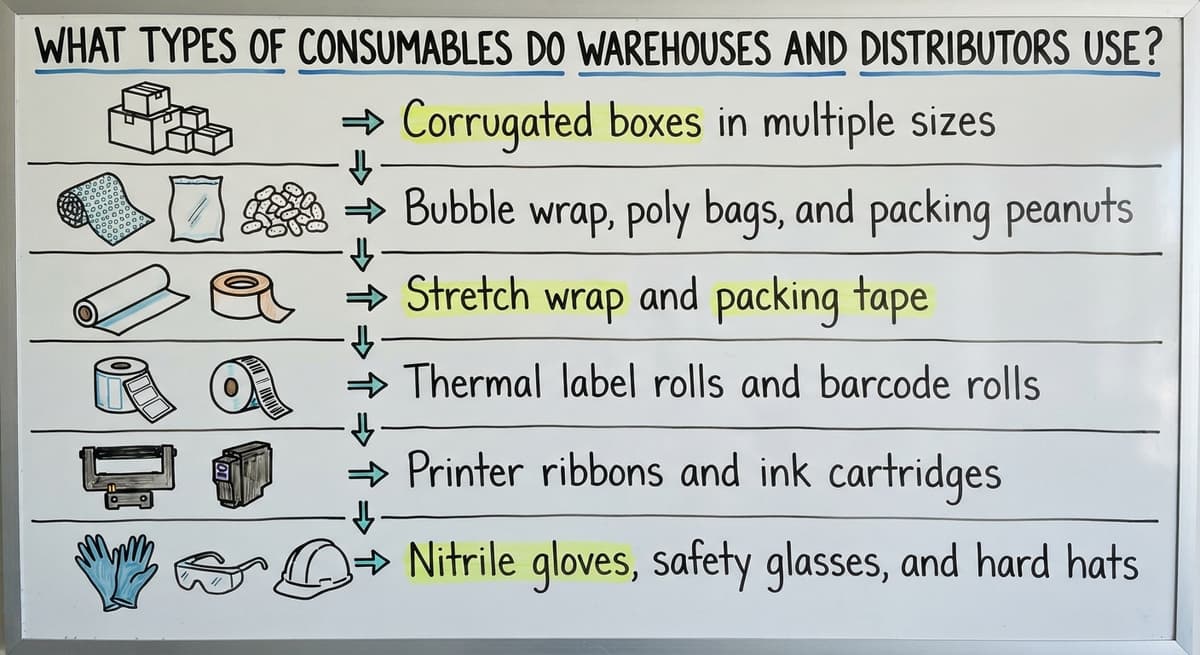
What are the most common inventory consumables found in a warehouse or distribution center? The list is longer than most operations realize until they do their first full audit.
Packaging materials make up the largest share for most distributors:
- Corrugated boxes in multiple sizes
- Bubble wrap, poly bags, and packing peanuts
- Stretch wrap and packing tape
Labeling supplies keep shipments moving:
- Thermal label rolls and barcode rolls
- Printer ribbons and ink cartridges
Safety and PPE protect your team:
- Nitrile gloves, safety glasses, and hard hats
Cleaning and maintenance keep equipment running:
- Rags, cleaning solution, and lubricants
Equipment supplies power the floor:
- Forklift propane, pallet jack batteries
Each category has its own usage rate and its own lead time from the supplier. Treating them all the same leads to shortages in fast-moving items and overstock in slow ones.
Why Consumables Get Overlooked and What That Costs
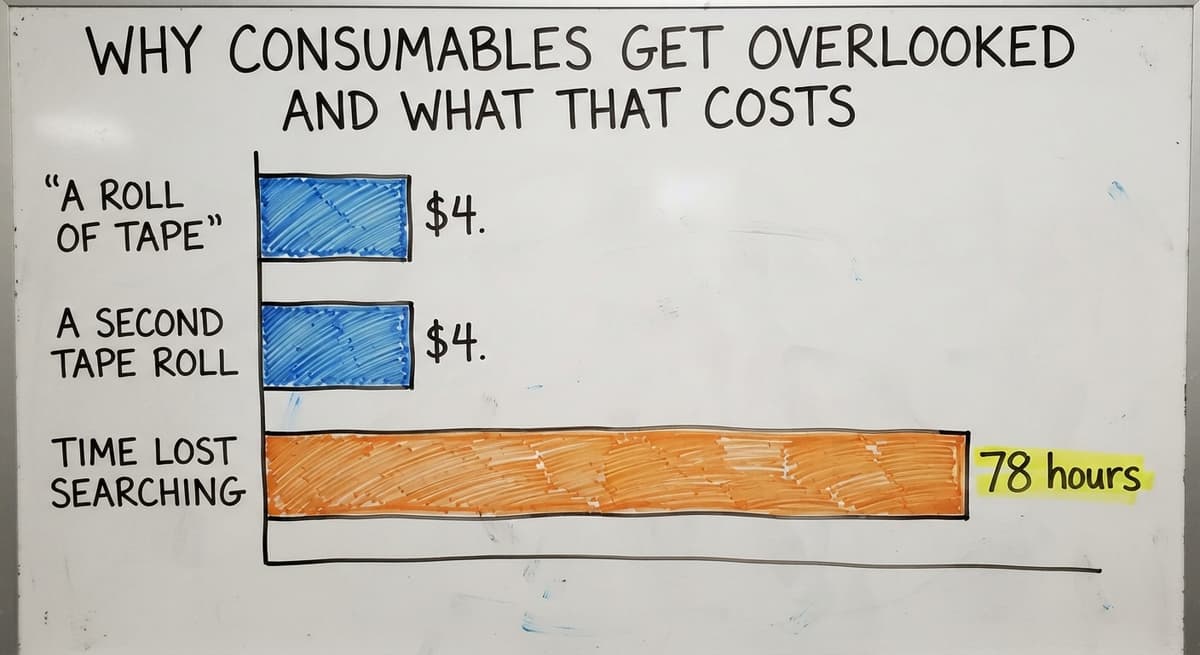
Low unit cost is the main reason consumable inventory tracking falls apart. A roll of tape costs $4. Nobody writes a buy order for $4. Instead, whoever notices the shelf is empty runs to the supply closet, grabs the last roll, and mentions it to someone who may or may not remember to reorder. This informal system works until it doesn't.
The IRS makes clear that inventory must be counted and valued: "To figure taxable income, you must value your inventory at the beginning and end of each tax year," per IRS Publication 538. Consumables are part of that obligation even when they feel too small to matter.
The real cost shows up in 4 places:
- Emergency reorders cost more per unit and often need rush shipping that wipes out any bulk discount.
- Stockouts slow fulfillment. A missing supply at the packing station can delay a customer shipment. The FTC's Mail and Internet Order Rule needs merchants to ship when promised, so a delay caused by a missing label roll is a compliance risk, not just an inconvenience.
- Overstocking ties up cash and takes up shelf space that could hold sellable product.
- Shrinkage goes unnoticed when there is no count to compare against.
Small amounts add up fast. If 3 staff members each spend 30 minutes a week searching for supplies or waiting on an emergency delivery, that is 78 hours a year. At the median warehouse worker wage tracked by the Bureau of Labor Statistics, that time has a real dollar value your spreadsheet never captures.
How Most Small Operations Track Consumables Today
If your current system is a clipboard near the supply closet or a spreadsheet someone updates when they remember, you are in good company. Most 10-to-60-person distributors run consumable tracking exactly that way. Verbal reminders between staff, reactive buying when a bin hits empty, and occasional bulk orders based on gut feel are the norm, not the exception.
The problem is not the people. The problem is that spreadsheets are not updated in real time. Multiple staff members may carry different versions. There is no alert when stock drops below a safe level. Buy history is buried in email threads or paper invoices. By the time someone checks the count, it is already wrong.
A spreadsheet tells you what the count was. It cannot tell you what the count is right now.
The comparison is easier when one option is built for you
Off-the-shelf means fitting your process to the software. We do it the other way round, and the first look costs nothing.
Book a call
How Do You Set a Reorder Point for a Consumable Item?
A reorder point is the quantity at which you place a new order before you run out. The formula is simple: multiply average daily usage by lead time in days, then add a small safety buffer.
Here is a plain example. Your team uses about 2 rolls of stretch wrap per day. Your supplier takes 5 days to deliver. Your reorder point is (2 x 5) + 2 = 12 rolls. When the count hits 12, you order more. You never hit zero.
Reorder points should be reviewed at least twice a year. Order volume changes with seasons, and a point set in January may be too low by October. The NIST Manufacturing Extension Partnership recommends reviewing supply chain thresholds whenever demand patterns shift, which for most distributors means at least quarterly.
A minimum stock level is the floor below which you should never fall. The reorder point sits above it. Both numbers belong in your tracking system, not in someone's memory.
What Good Consumable Inventory Tracking Looks Like
Good consumable inventory tracking has 5 features that make it usable by any staff member without special training.
- A central item record with current on-hand count, location, and supplier
- Minimum quantity alerts that notify someone before the shelf runs empty
- Buy history per item so you know the last price paid and which vendor filled it
- Usage logs that show how fast each item moves so reorder points stay accurate
- A simple intake process so receiving a new shipment takes under 2 minutes
Organize consumables by where they are used: receiving dock, packing station, office. Assign a bin or shelf code to each item. Location data speeds up cycle counts and shows where usage is highest, which is often where waste is highest too.
Cycle Counting Consumables Without Stopping Operations
Cycle counting means counting a small group of items on a rotating schedule instead of shutting down for a full physical count. For consumables organized by location, a single zone count takes 10 to 15 minutes. Assign a different area each day or week. Compare the count to the system record and adjust on the spot.
This keeps records accurate year-round without the disruption of an annual shutdown. It also catches shrinkage early, before a small discrepancy becomes a large one.
Assigning Consumable Costs to Jobs or Departments
Some operations need to know how much packaging went into a specific order or client account. Fulfillment centers that bill clients for materials need this. Even a simple cost assigning by department helps identify where spending is rising. Linking usage to a work order or transaction does not need a complex system. It needs a field in your tracking tool and a habit of filling it in.

Should Consumables Be Tracked in QuickBooks?
Many small distributors already use QuickBooks for accounts payable, and that is the right tool for paying bills. QuickBooks does not track quantity on hand for consumables in a useful way. It has no minimum quantity alert, no usage log, and no reorder alert. You can enter consumables as inventory items, but the system will not tell you when to reorder or how fast items are moving.
The answer is not to abandon QuickBooks. A connected system can log a consumable buy into your inventory tracking tool while QuickBooks handles the bill. The two records stay in sync. You get the financial record in one place and the working count in another, and neither system is cluttered with data it was not built to manage.
Mixing consumables into your main order management system creates a different problem. Your main inventory software is built around SKUs, customer orders, and pick lists. Consumables are internal. They do not belong on a customer-facing pick list, and adding them creates noise that slows down order fulfillment. A separate module or lightweight system dedicated to consumable supplies keeps things clean while sharing data with your main tools.
See it running on your own process first
No build cost. The subscription starts once it is live and doing the job, not before.
Book a callWhat to Look for in Software That Handles Inventory Consumables
The right tool for consumable inventory tracking does not have to be expensive or complex. Look for these features before you commit to anything.
- Minimum quantity alerts with automatic reorder alerts sent to the right person
- Simple receiving intake so any staff member can log a new shipment in under 2 minutes
- Bin and location tracking so cycle counts are fast and searches are short
- Buy history per item and per vendor so price comparisons are easy when reordering
- Vendor records with lead times and backup suppliers so you are never stuck with one source
- QuickBooks integration that fills the gap QuickBooks leaves rather than replacing it
- Plain enough for non-technical staff to use every day without a manual
Why a Large ERP Is Usually the Wrong Answer
Enterprise systems are built for complexity that most small distributors do not have. A full ERP takes months to set up and costs more than the consumable problem is worth. Staff resist systems that do not match how the operation actually works, and a system nobody uses solves nothing.
Off-the-shelf inventory software has a similar issue: it forces you to change your process to match the software. Custom inventory software is built around your existing workflow, your locations, your item names. Staff adopt it faster because it looks familiar. Changes can be made as the operation grows. For distributors and warehouses in the Columbus, Ohio area, a local software partner can build around your current QuickBooks setup without a migration or a long rollout.

How Do I Do a Consumable Inventory Audit?
A consumable inventory audit is the fastest way to see exactly where you stand. It takes a few hours and at once shows the gaps in your current system.
- Walk the facility and list every consumable item currently in use, room by room.
- Note the location, current quantity on the shelf, and the supplier for each item.
- Estimate average weekly usage based on recent buy receipts or invoices.
- Set a minimum quantity for each item based on that usage rate and supplier lead time.
- Choose a system to hold the list, set alerts, and log future buys.
The audit itself is not the hard part. The hard part is choosing a system that keeps the list current after the audit is done. A list that sits in a binder and is never updated is a clipboard by another name.
Frequently Asked Questions About Inventory Consumables
What are inventory consumables? Inventory consumables are items a business uses during its operations that are never sold to a customer. Tape, labels, gloves, cleaning supplies, and packaging materials are all consumables. They cost money, get used up, and must be replaced, but they are not part of the product you sell.
What are examples of consumables? Common examples include stretch wrap, packing tape, thermal label rolls, nitrile gloves, safety glasses, printer toner, cleaning rags, lubricants, and forklift propane. Any item your team uses regularly that disappears through normal use is a consumable.
Can you give me a list of consumable items? Here is a practical list for a warehouse or distribution setting: corrugated boxes, poly bags, bubble wrap, packing peanuts, barcode label rolls, printer ribbons, packing tape, stretch wrap, nitrile gloves, hard hats, safety glasses, cleaning solution, rags, lubricants, printer paper, toner cartridges, pens, forklift propane, and pallet jack batteries.
What are some examples of consumable store items? In a retail or supply store context, consumables include cleaning products, paper goods, ink and toner, batteries, light bulbs, food items, and personal care products. Any item sold for single use or that gets used up over time qualifies.
How often should consumable counts be done? Weekly or bi-weekly cycle counts work well for most operations. Fast-moving items like labels and tape may need a weekly check. Slower items like hard hats or lubricants can be counted monthly.
Do I need separate software for consumables? A dedicated module or lightweight tracking system is usually more practical than mixing consumables into your order management software. The two can share data without being the same system, and keeping them separate avoids clutter on customer-facing pick lists.

Next Steps for Better Consumable Inventory Control
Inventory consumables are small individually and large collectively. A missing roll of labels or a stockout of stretch wrap at the wrong moment costs more than the item itself. The fix does not need a large ERP or a long setup process.
Start with the audit. List what you have, where it lives, and how fast it moves. Then choose a system that keeps that list current and alerts you before a shelf runs empty. If you already use QuickBooks, a connected tool can fill the gap it leaves without replacing anything you rely on.
If you want to talk through your current setup with a local software partner, The Software Society builds around existing workflows rather than asking you to migrate. Reach out and describe what you are working with. That conversation costs nothing and usually surfaces a clearer path forward than any generic software comparison will.
Frequently asked questions
What are inventory consumables?
Inventory consumables are items a business uses during operations that are never sold to a customer. Tape, labels, gloves, cleaning supplies, and packaging materials are all consumables. They cost money, get used up, and must be replaced, but they are not part of the product you sell.
What are examples of consumables?
Common examples include stretch wrap, packing tape, thermal label rolls, nitrile gloves, safety glasses, printer toner, cleaning rags, lubricants, and forklift propane. Any item your team uses regularly that disappears through normal use is a consumable.
Can you give me a list of consumable items?
A practical list for a warehouse or distribution setting includes: corrugated boxes, poly bags, bubble wrap, packing peanuts, barcode label rolls, printer ribbons, packing tape, stretch wrap, nitrile gloves, hard hats, safety glasses, cleaning solution, rags, lubricants, printer paper, toner cartridges, pens, forklift propane, and pallet jack batteries.
What are some examples of consumable store items?
In a retail or supply store context, consumables include cleaning products, paper goods, ink and toner, batteries, light bulbs, food items, and personal care products. Any item sold for single use or that gets used up over time qualifies.
Should consumables be tracked in QuickBooks?
QuickBooks handles the bill payment side well but does not track quantity on hand, set reorder alerts, or log usage rates for consumables. A connected inventory tracking tool fills that gap without replacing QuickBooks.
How do you set a reorder point for a consumable item?
Multiply your average daily usage by your supplier's lead time in days, then add a small safety buffer. For example, if you use 2 rolls of stretch wrap per day and your supplier takes 5 days to deliver, your reorder point is 12 rolls. When the count hits 12, you place the order.
Is a large ERP system necessary to manage consumable inventory?
No. Enterprise systems are built for complexity most small distributors do not have. A lightweight dedicated tool or a custom module built around your existing workflow handles consumable tracking at a fraction of the cost and setup time.
Start with a free first look
A 30 minute call, your operation mapped, and a clear picture of what we would build. No obligation and nothing to install.
Book a callRelated guides
The rest of this guide, for the parts of the job this page does not cover.
Guides
- Consumable Inventory
- Classification of Inventory
- Excess Inventory
- Closed for Inventory
- Multi Location Inventory Management Software
- Inventory Management for Multiple Locations
- Costing Inventory
- Is Inventory a Long-term Asset
- Inventory Management System for Manufacturing
- Inventory Fixed Assets
- Inventory Management Pics
- Excel Inventory Template
- Push and Pull Inventory
- B2b Inventory Management
- Jewelry Inventory Management
- Dental Inventory Management
- The Objective of Inventory Management is To
- Qr Code for Inventory Management
- Inventory Metrics
- Inventory Formulas
- Hvac Inventory Management Software