


Inventory Control Example
An inventory control example shows how one business tracks what it has, where it sits, and when to reorder. Here the example is a 25-person distributor that fixes its counts in 7 steps. It keeps its accounting package and drops the printed sheets.
The company is made up. Every figure is illustrative. We checked the steps in 2025 against public guidance from the IRS, NIST and GS1.
Read it as a model for your own warehouse inventory. Each step has numbers you can check with a calculator. Each step also says what stays in the books and what moves to a shared record.
Book a callWhat Is an Inventory Control Example?
Short steps. Plain numbers.
Meet the Example Company
The example company is a fictional wholesale distributor. It is an illustration, not a real client. It has 25 staff, 1 warehouse and 1,500 SKUs. A SKU is one product code for one item you sell.
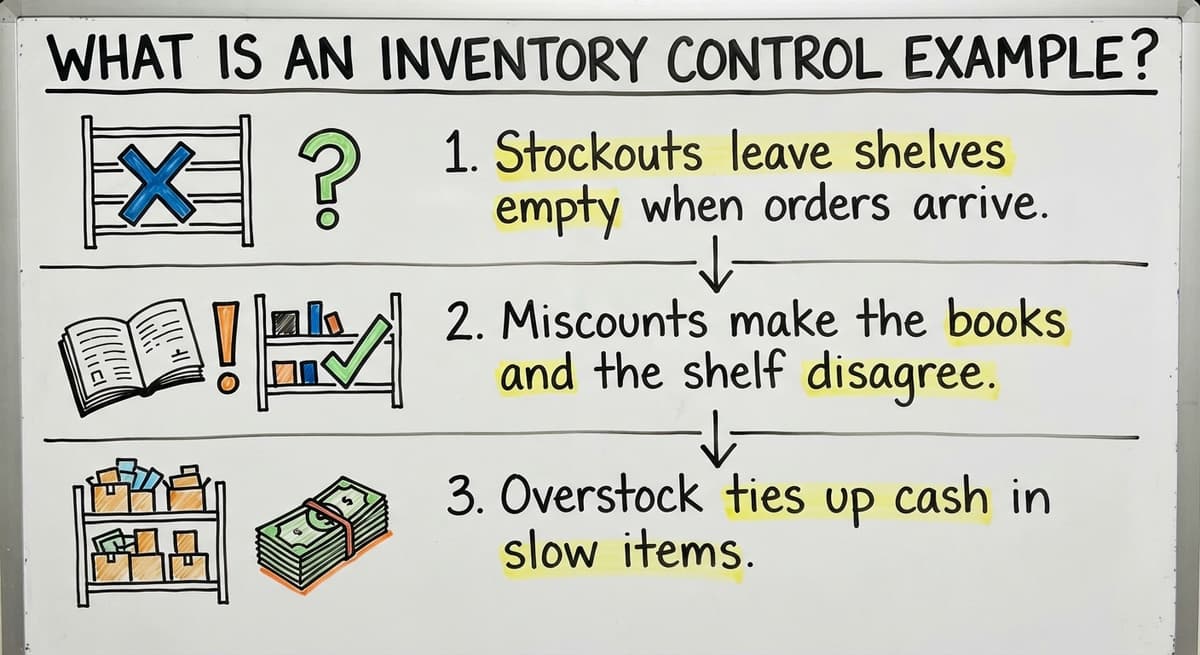
The team runs on accounting software, spreadsheets, printed pick tickets and email. Three problems show up:
- Stockouts leave shelves empty when orders arrive.
- Miscounts make the books and the shelf disagree.
- Overstock ties up cash in slow items.
GS1, the standards body behind barcodes, calls its standards the "global language of business". The company will use that language later to scan items.
Why Do the Counts Disagree Before Inventory Control?
The counts disagree because 3 places hold 3 different numbers. Take one item. The accounting package says 140 units. The spreadsheet says 118. The shelf holds 96.
Customers get short orders. The FTC order rule sets duties on shipping when you said you would.
Staff also hunt for stock. Say 4 people lose 5 hours a week at $20 an hour. That is $20,800 a year (hypothetical).
We build it for your operation, and the first look is free
If you would rather not compare products, describe how your operation already works and we build the system around it.
No build cost. You see it running on your own process first, and the monthly subscription starts only once it is live.
Book a callHow Do You Build the Inventory Control Process?
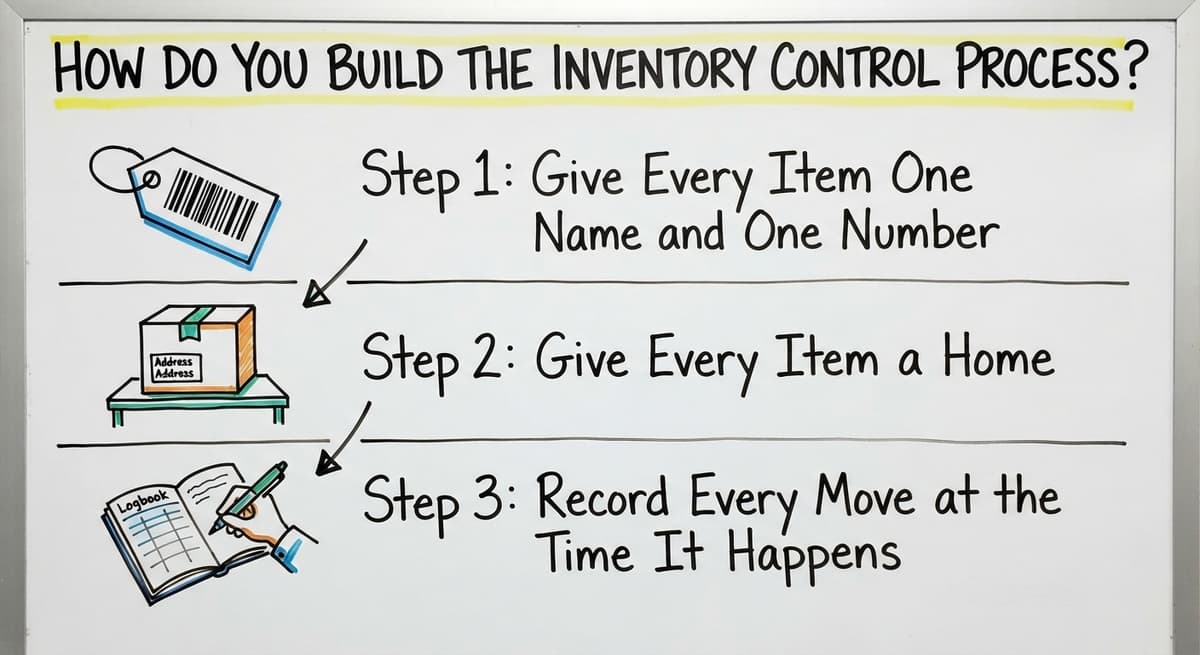
The inventory control process starts with 3 base steps: clean names, fixed homes and live records. Each one removes a cause of bad counts.
Step 1: Give Every Item One Name and One Number
A clean SKU list has one name, one number and one unit of measure per item. The team deletes duplicates and retires old items.
- Messy: "Blk gloves LG box/pr 2"
- Clean: "GLV-114, Nitrile Glove, Black, Large, Box of 100"
One item, one record. That is the rule that makes every later count mean something.
Step 2: Give Every Item a Home
Bin locations are fixed shelf addresses. The company labels each shelf with a code such as A-03-2. That means aisle A, rack 3, shelf level 2.
A fixed home speeds up picking. Pickers walk a set route and stop guessing. New staff find items on day 1.
Labeled shelves also make a miscount easy to spot.
Step 3: Record Every Move at the Time It Happens
The team logs each move at the dock, not at the end of the day. Moves include receiving, putaway, picking, shipping and returns. A scan or a quick entry takes seconds.
A simple movement log looks like this:
- 8:05 AM, GLV-114, received, +40, dock
- 8:30 AM, GLV-114, putaway, 40 to A-03-2
- 10:15 AM, GLV-114, picked, -12, order 5521
- 2:40 PM, GLV-114, returned, +2, order 5388
Live entries keep the shelf and the record in step.
How Do You Set a Reorder Point and Sort by ABC?
A reorder point is the stock level that tells you to buy more. ABC analysis sorts items by sales so you watch the right ones.
Step 4: Set Reorder Points
The formula is daily use times lead time, plus safety stock. Lead time is the days a supplier takes to deliver. Safety stock is a spare cushion for surprises.
Worked numbers for GLV-114:
- Daily use: 12 units
- Lead time: 7 days
- Safety stock: 30 units
- Reorder point: 12 x 7 + 30 = 114 units
When stock drops to 114, the team orders. It reviews fast movers monthly and lets slow items wait.
Step 5: Sort Items With ABC Analysis
ABC analysis puts items in 3 groups by sales. A items drive most sales, so the team counts them most.
In the example, 300 items (20 percent) bring in 80 percent of sales. They are class A. Another 450 items are class B. The last 750 are class C.
Count frequency follows the class:
- A items: every month
- B items: every quarter
- C items: twice a year
The busiest items get the most eyes.
Not sure this is the right shape for your operation
Describe how the work runs today. We map it on a call and show you what it would look like built around that, before you spend anything.
Book a callHow Often Should You Run Cycle Counts?
Run cycle counts every day or week, in small batches. A cycle count is a count of a few items instead of the whole warehouse. In the example, the schedule above is about 29 items a day.

Step 6: Count a Small Set Each Day
The IRS, in Publication 538, says: "To figure taxable income, you must value your inventory at the beginning and end of each tax year." Steady counts make that year-end number easy.
A counter picks the day's items and counts the shelf. The counter compares it to the system number and logs the gap. The warehouse never shuts down.
Step 7: Find Why Counts Do Not Match
A gap has a cause. Fix the cause, not just the number. Four causes show up most:
- A picker grabbed the wrong item.
- A return never reached the log.
- A receiving clerk keyed the wrong quantity.
- Damaged goods left the shelf with no entry.
Every adjustment gets a reason code: WP for wrong pick, RT for return, RC for receiving, DM for damage. After a month, the codes show which fix pays most.

Which Numbers Should You Track?
Track 2 or 3 numbers at first. Five are worth knowing:
- Stock accuracy is the share of counts that match the system.
- Fill rate is the share of order lines shipped complete.
- Stockout count is how many times an item hit zero.
- Days of stock is how long current stock lasts at today's sales pace.
- Turnover is how many times stock sells through in a year.
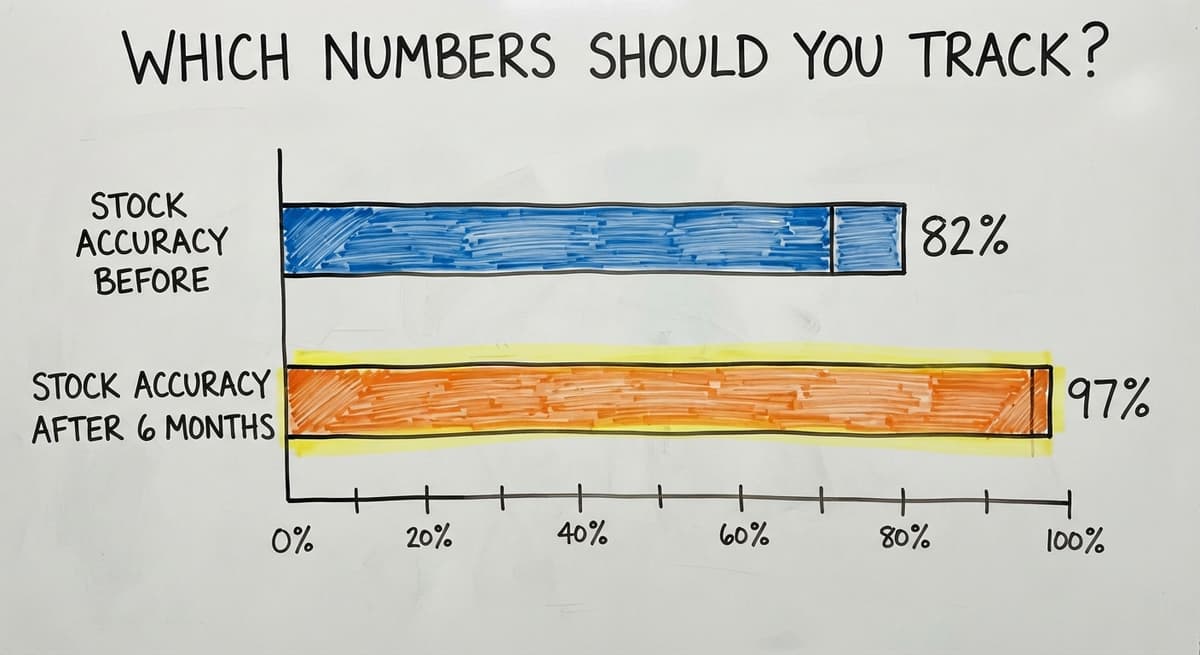
The example starts with accuracy, stockouts and count hours. These figures are hypothetical. Measure your own before and after.
| Measure | Before | After 6 months |
|---|---|---|
| Stock accuracy | 82% | 97% |
| Stockouts a month | 14 | 5 |
| Count hours a month | 40 | 12 |
The table shows what to measure, not what you will get.
Can You Run This With Accounting Software, a Spreadsheet or Custom Software?
Yes. The same 7 steps work with an accounting package, a spreadsheet or custom software. The tool changes. The steps do not.

Where the Accounting Package Fits
Accounting software inventory stays the books. It holds invoices, bills and accounting. A separate working layer tracks stock moves and bin locations.
Three things sync between them:
- Item costs flow to the books.
- Quantities on hand update after each move.
- Buy orders pass back and forth.
The books stay clean. The floor gets live data.
A Spreadsheet Only
The limits show fast. Many editors make many copies. Nothing updates live. Move on when 2 people edit at once or when the file breaks. A spreadsheet is a good start and a poor home for 1,500 SKUs.
Inventory control with a spreadsheet works for very small shops. One person edits one file. Counts stay simple.
Custom Software
The Software Society builds these systems and is local to Columbus, Ohio. The goal is a shared record that fits your floor.
Custom software follows how your team already works. It replaces printed sheets and email and keeps your accounting software. It runs at small scale with no big ERP rollout or data move.
The comparison is easier when one option is built for you
Off-the-shelf means fitting your process to the software. We do it the other way round, and the first look costs nothing.
Book a call
What Mistakes Should You Avoid, and How Do You Copy This?
Four mistakes sink most plans:
- Skipping labels leaves pickers guessing.
- Late entry puts the system a day behind the shelf.
- No named owner means nobody counts.
- Too many reorder rules at once confuse the team.
Buying tools before the process is fixed fails too. NIST offers vendor-neutral guidance on supply chain process.
To copy the example:
- Clean names and numbers.
- Label bin locations.
- Record moves live.
- Set reorder points.
- Sort by ABC.
- Run cycle counts.
- Log reasons for gaps.
Start with your top 50 items. Pilot for one week.

When Should You Ask for Help?
Ask for help when hours vanish into re-keying, stock disputes never end, or spreadsheets break. Those signs mean the manual way has hit its limit.
The Software Society offers a short review of your current workflow. We look at how stock moves today and where it slips. Then you decide the next step.


Frequently asked questions
What is an example of inventory control?
A distributor labels shelves, logs every move as it happens, sets reorder points and counts a few items each day. Stock accuracy rises and stockouts fall.
What are the basic steps of inventory control?
Clean the item list, assign bin locations, record moves live, set reorder points, sort items by ABC, run cycle counts and fix the causes of count gaps.
Can I do inventory control with accounting software and a spreadsheet?
Yes, for a small shop. Accounting software keeps the books and a spreadsheet tracks stock. Move on when several people edit at once or counts keep drifting.
How often should you do cycle counts?
Match the count to the item class. Count A items monthly, B items quarterly and C items twice a year. That is about 29 items a day in the example.
Start with a free first look
A 30 minute call, your operation mapped, and a clear picture of what we would build. No obligation and nothing to install.
Book a callRelated guides
More on the same work.
Guides
- Example of Inventory
- Types of Inventory Control
- Inventory Control Procedure
- Make to Stock Examples
- Types of Stock Control Systems
- Procedure for Stock Control
- Inventory Control Software for Small Business
- Inventory Control with Excel
- Inventory Control for Small Business
- Warehouse Management System Examples
- Examples of Warehouse Management System
- Best Inventory Software
- Classification of Inventory
- Excess Inventory
- Closed for Inventory
- Multi Location Inventory Management Software
- Ms Excel Inventory Template
- Inventory Management for Multiple Locations
- Costing Inventory