

What Are The 7s Rules In A Warehouse?
The 7S rules in a warehouse are Sort, Set in Order, Shine, Standardize, Sustain, Safety, and Spirit. They give every team member a clear system for keeping the workspace clean, organized, and safe, and a floor that runs them well finds items in seconds instead of minutes.
Reviewed August 2026. Each figure comes from the assumptions stated beside it, so you can substitute your own and the arithmetic still holds.
Published 23 August 2026. Reviewed and updated 15 September 2026.
Book a callWhere Do the 7S Rules in a Warehouse Come From?
The original 5S system started in Japanese manufacturing after World War II. A major automaker and other factories used it to cut waste and keep production lines running smoothly. The 5 steps were Sort, Set in Order, Shine, Standardize, and Sustain.
Warehouses added 2 more steps over time. Safety came first, because warehouse floors carry real physical risk. Spirit followed, to address team morale and long-term buy-in.
As OSHA notes, "The warehousing and storage industry includes establishments operating facilities for general merchandise, refrigerated goods, and other products." That broad scope means the rules must work across many types of operations, not just one.
Both 5S and 7S are used in warehouses today. Smaller operations start with 5S and add Safety and Spirit once the basics are stable.
Would you rather have it built around your operation?
The first look is free. If you would rather not compare products, describe how your operation already works and we build the system around it.
No build cost. You see it running on your own process first, and the monthly subscription starts only once it is live.
Book a callWhat Does Each S Stand For?
Here is a quick reference before diving into each step.
| Step | Name | Core idea |
|---|---|---|
| 1 | Sort | Remove what does not belong |
| 2 | Set in Order | Give everything a fixed home |
| 3 | Shine | Clean and inspect regularly |
| 4 | Standardize | Write down the best way to work |
| 5 | Sustain | Build habits so the system holds |
| 6 | Safety | Protect people from harm |
| 7 | Spirit | Build pride and long-term thinking |
Does Your Warehouse Need to Remove Clutter First?
Sort means removing every item that does not belong in the workspace. Walk the floor and pull anything broken, expired, or no longer used. Expired stock, cracked pallets, and obsolete tools all slow people down and hide real inventory.
Many teams use the red-tag method: attach a red tag to any item whose purpose is unclear, then decide within a set window whether to keep, move, or toss it.
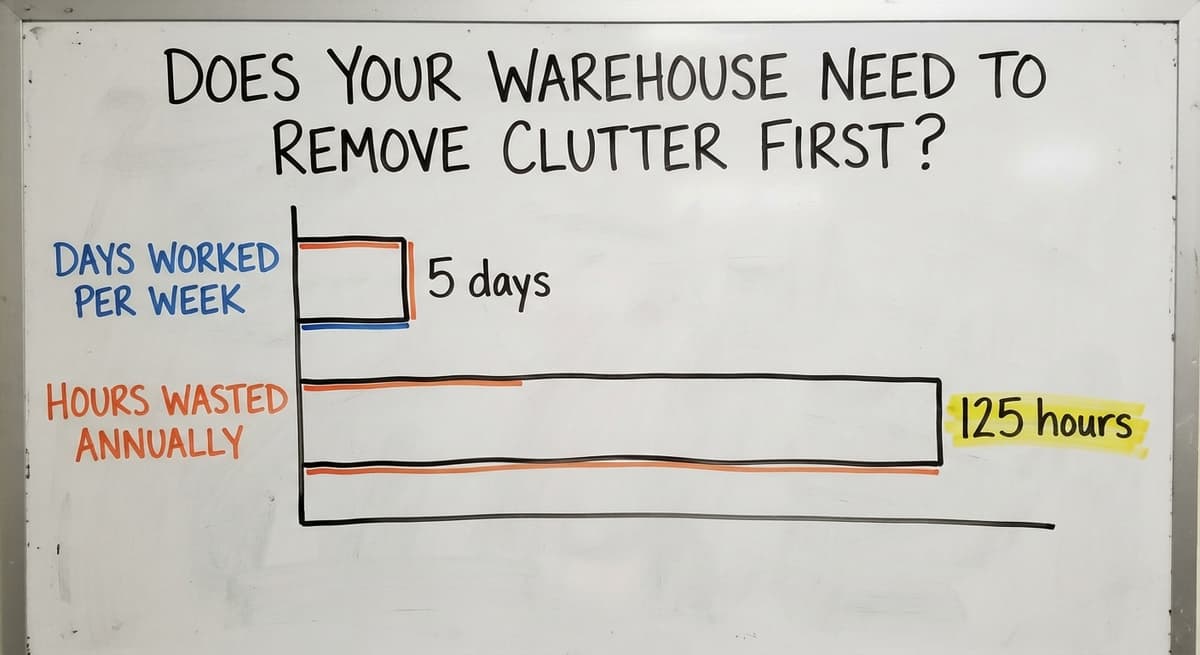
Less clutter means faster picking and fewer errors. A picker who does not have to step around dead stock reaches the right bin faster. That time adds up. 3 pickers losing 10 minutes each per shift, 5 days a week, is 125 hours a year of wasted motion.
Set in Order: Give Everything a Home
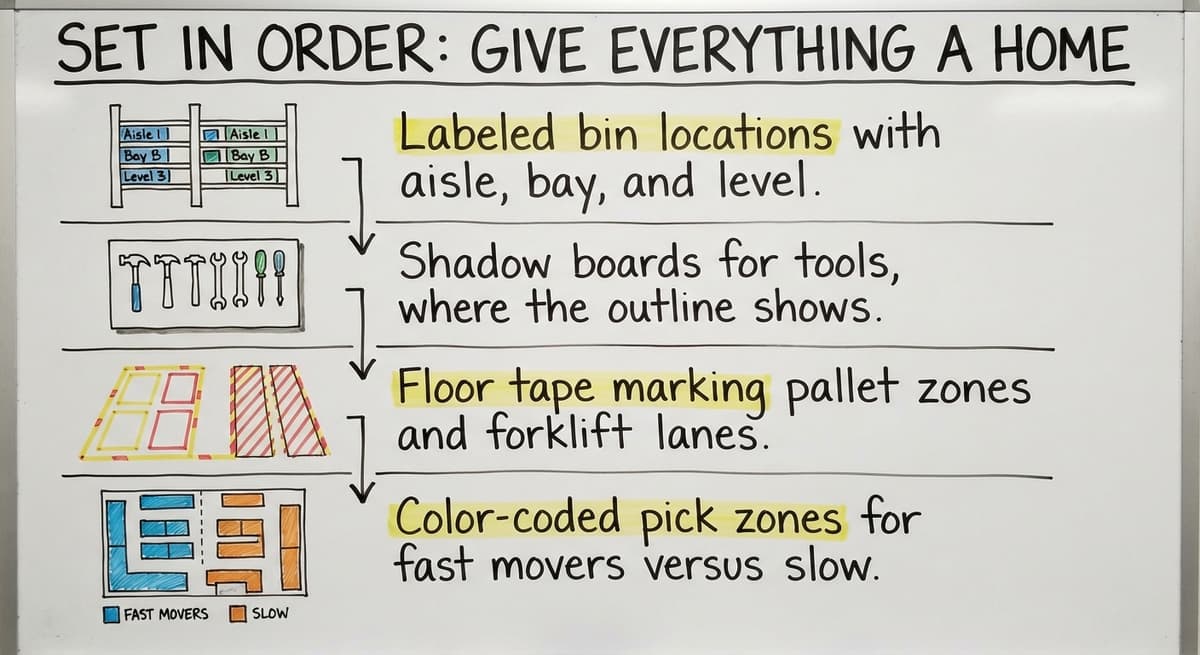
This step means assigning a fixed location to every single item, then marking that location clearly so anyone can find it and return it without asking.
Practical examples in a warehouse:
- Labeled bin locations with aisle, bay, and level codes
- Shadow boards for tools, where the outline shows what is missing
- Floor tape marking pallet zones and forklift lanes
- Color-coded pick zones for fast movers versus slow movers
When locations are fixed, staff do not guess. That directly supports inventory accuracy. It also makes software-driven location tracking work.
A warehouse inventory management software overview will show that most systems rely on fixed location fields. If the physical layout does not match the system, scans and counts will drift.
Is the comparison easier when one option is built for you?
Yes. Off-the-shelf means fitting your process to the software, and custom is the other way round. The first look costs nothing.
Book a call
Shine: Keep the Warehouse Clean
Shine is not just about appearances. Regular cleaning reveals problems that a quick visual check misses: slow leaks under racking, damaged floor markings, missing items, and pest entry points.
Assign cleaning zones to specific team members rather than leaving it to whoever has time. A named owner cleans more consistently than a shared responsibility that everyone assumes someone else is handling.
A clean warehouse is also easier to audit. Clients who visit, insurance inspectors, and OSHA compliance checks all go faster when the floor is clear and labeled. That is a practical reason to treat Shine as a business task, not a chore.

Standardize: Make the Good Habits Routine
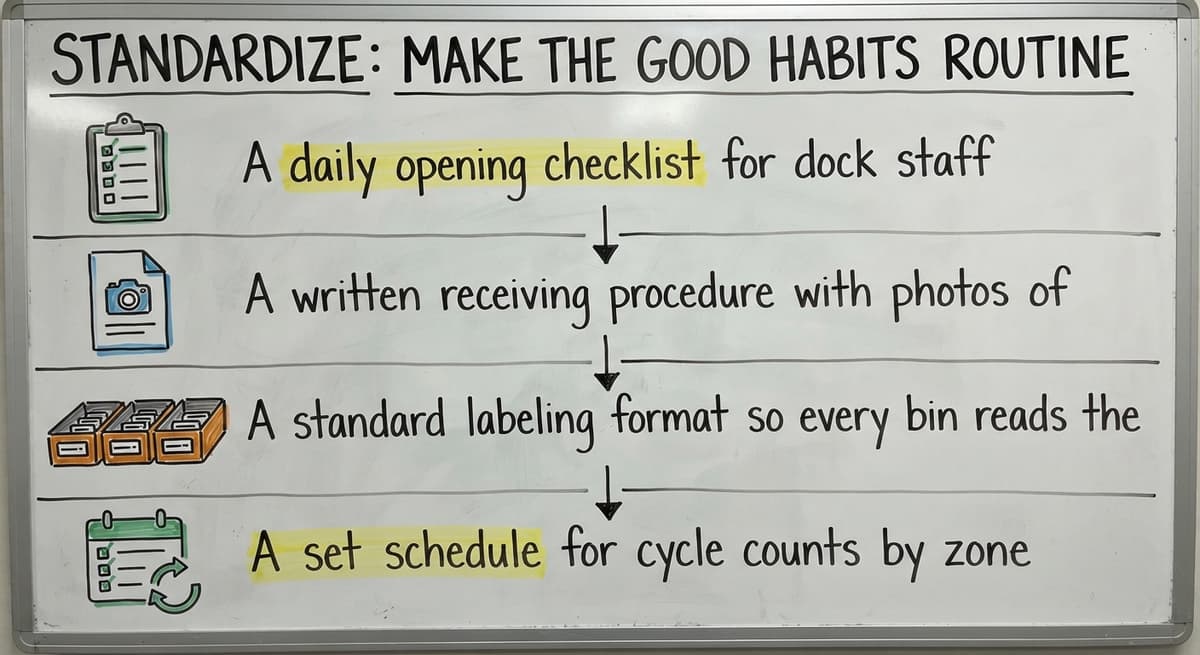
Sorting and cleaning once is easy. Standardize is the step that stops the clutter from coming back. It means writing down the best way to do each task and making that the default for everyone.
Examples that work in a warehouse:
- A daily opening checklist for dock staff
- A written receiving procedure with photos of correct label placement
- A standard labeling format so every bin reads the same way
- A set schedule for cycle counts by zone
New staff get up to speed faster when the standard exists in writing. They do not have to shadow a senior worker for weeks to learn the right way.
Standardized steps are also easier to automate. When a process is written down and consistent, replacing spreadsheets with warehouse management software becomes a real option rather than a distant goal.
This is where many small operations stall. The first 3 steps happen during a push week. Standardize never gets written down. Within a month, the floor looks like it did before.
Sustain: Keep the System Going
Sustain is the hardest step. Building habits that hold requires more than good intentions after a cleanup day.
Practical tools that help:
- Weekly 10-minute walkthroughs with a simple scorecard
- A visible scoreboard showing zone scores by team
- Short daily huddles, 5 minutes at shift start, to flag issues
- Rotating ownership so the same person does not carry it alone
Manual systems struggle here. A paper checklist gets skipped on a busy Friday. A spreadsheet does not send an alert when a zone score drops.
Software dashboards that flag exceptions in real time do the reminding automatically. That is not a small thing. Sustain is where most 7S efforts quietly fail, and it is the exact gap that purpose-built software fills without extra meetings.
Safety: Protect Your People
Safety is the 6th S added to the base 5S framework. It earned its own step because warehouse floors carry real risk: forklifts, heavy racking, loading docks, and fast-moving staff all share the same space.
Warehouse-specific Safety examples:
- Marked forklift lanes separated from foot traffic
- Fire exit paths kept clear at all times
- PPE stored in a fixed, labeled location near the relevant zone
- Spill kits visible and within reach in wet areas
A sorted and organized warehouse is already a safer warehouse. When clutter is gone and locations are fixed, hazards are easier to spot.
OSHA compliance is a practical reason to take this step seriously. Fines for violations are real, and OSHA's warehousing guidance covers the specific hazards inspectors look for.
What does it look like running on your own process?
The first thing you see is it running on your own process, at no build cost. The subscription starts once it is live and doing the job, not before.
Book a call
What Is the Seventh S: Spirit or Sustainability?
The seventh S goes by 2 names depending on the source, and both point to the same idea: long-term thinking beyond the daily task list.
Spirit focuses on people. It means team morale, ownership, and pride in the workspace. When staff feel the system belongs to them, they maintain it. When it feels like a management project, it fades.
Sustainability focuses on the operation and the environment. It means cutting waste, reducing energy use, and building processes that do not burn out people or resources.
Neither version contradicts the other. A team with Spirit tends to run a more sustainable operation. Choose the framing that fits your team's language. The goal is the same: make the system last.
How Do the 7S Rules Work Together?
Each S is a foundation for the one after it. Skipping a step weakens every step that follows.
Sorting without giving everything a home means items come back with no place to return to. Skipping that step before Standardize means labels drift and locations change without notice. Standardize without Sustain means the written rules sit in a binder no one opens.
The 7S system is a cycle, not a one-time project. Warehouses that treat it as an annual cleanup see the same problems return every year. Warehouses that run it as a daily operating rhythm see steady gains in warehouse efficiency and inventory accuracy.
The Warehousing Education and Research Council tracks distribution center performance benchmarks. Operations that score well on accuracy and throughput consistently show strong process discipline, the kind that 7S builds over time.
Applying the 7S Rules When You Use Inventory Software
Software does not replace the 7S rules. It enforces the hardest ones automatically.
Giving each item a fixed home is embedded in fixed location fields. The system will not let a picker put stock in an unlabeled bin.
Standardize lives in required data entry fields and receiving workflows. Staff follow the standard because the screen asks for it, not because a binder says so.
Sustain becomes easier when dashboards flag exceptions in real time. A location with no scan activity for 14 days gets flagged. A zone with a rising error rate shows up in the morning report. The system does the reminding.
Operations running on accounting software plus spreadsheets lose Standardize and Sustain first. There is no system holding the steps in place.
A custom warehouse software for small and mid-size distributors can embed the 7S rules into daily workflow without adding meetings or extra staff. The accounting software integration for warehouse operations keeps financial records in sync while the warehouse system handles location, movement, and accuracy.
If improving picking is the first goal, learning how to improve warehouse picking accuracy shows how location discipline and standardized pick paths cut error rates fast.
Common Mistakes When Starting 7S in a Warehouse
Most 7S efforts fail for the same reasons.
- Treating it as a one-day cleanup. The floor looks great on Friday. By the following Thursday, it does not.
- Skipping Standardize. Without written steps, every person does the task their own way. Improvements fade within weeks.
- Assigning 7S to one person. One person cannot sustain a system across an entire team. Ownership must be shared.
- Not updating labels when layout changes. A label pointing to the wrong bin is worse than no label. Staff learn to ignore the system.
The fix is not more motivation. The fix is a system that holds the standard in place even on a busy day.
Frequently Asked Questions
Is 7S the same as 5S? No. 7S adds Safety and Spirit (or Sustainability) to the original 5 steps. The first 5 steps are identical in both systems.
How long does it take to implement 7S in a warehouse? Sorting and organizing storage locations can happen in days with a focused team. Standardize takes a few weeks to write and test. Sustain takes months of consistent effort before it becomes a real habit.
Do small warehouses need the 7S rules? Yes. Smaller operations feel the benefit faster because every wasted minute shows up directly in throughput. A 5-person team losing 15 minutes each per shift loses more than 300 hours a year.
Can software help with the 7S rules in a warehouse? Yes, especially for Standardize, Sustain, and location accuracy. Software enforces the standard through required fields and flags drift through dashboards, without relying on memory or paper checklists.
Why was Safety added to the base five-step framework? Manufacturing plants added Safety because those first five steps did not explicitly address physical hazards. Warehouses adopted it for the same reason: forklifts, heavy loads, and dock activity create risks that need their own named step.
How do the 7S rules improve inventory accuracy? Fixed locations, the result of giving each item its own spot, mean items are always where the system says they are.
Standardized receiving (Standardize) means stock is logged correctly on arrival. Regular cleaning (Shine) surfaces discrepancies before they compound. Together, the steps cut the gap between what the system shows and what is actually on the shelf.
The IRS requires that businesses "value your inventory at the beginning and end of each tax year." Accurate counts are not optional. A warehouse that runs 7S consistently makes that legal obligation far easier to meet.
The 7S rules give any warehouse a repeatable way to stay organized, safe, and accurate. Start by sorting and giving every item a home.
Write the standards down before the energy fades. Build Sustain into the daily rhythm rather than saving it for a quarterly push.
If your operation is still running on spreadsheets and the same problems keep coming back, the issue is not effort. The issue is the absence of a system that holds the steps in place.
A connected platform built around your real workflow does that work quietly, every day, without adding headcount. If that is the gap you are trying to close, the next step is a conversation about what a purpose-built system would look like for your operation.
Frequently asked questions
Frequently asked questions
Is 7S the same as 5S in a warehouse?
No. The 7S system adds Safety, then Spirit or Sustainability, to the original five steps.
The first five steps, sorting, arranging everything in its place, cleaning, standardizing, and sustaining, are identical in both frameworks. The 2 added steps make 7S a better fit for warehouse and distribution environments.
Why was Safety added to the original 5S warehouse framework?
The initial five-step framework did not name physical hazards as their own priority. Warehouses added Safety as the sixth step because forklift traffic, heavy racking, loading docks, and fast-moving staff create risks that need explicit attention beyond general organization.
How do the 7S rules improve inventory accuracy?
Fixed locations, the result of giving every item its own spot, mean stock is always where the system says it is. Standardized receiving means items are logged correctly on arrival.
Regular Shine checks surface missing or misplaced stock before errors compound. Together, the steps close the gap between system records and physical reality.
Can inventory software support the 7S rules in a warehouse?
Yes. Software enforces fixed placement through location fields and Standardize through required data entry steps. Sustain becomes easier when dashboards flag exceptions automatically. Operations running on spreadsheets lose Standardize and Sustain first because there is no system holding those steps in place.
How long does it take to implement the 7S rules in a warehouse?
Sorting items and finding each one a fixed spot can happen in a few focused days. Writing and testing standards for Standardize takes a few weeks.
Sustain takes months of consistent effort before it becomes a real daily habit rather than a project that fades after the initial push.
Do small warehouses benefit from the 7S rules?
Yes, more than large ones. A small team losing 15 minutes per person per shift loses more than 300 hours a year. Every wasted minute shows up directly in throughput when the team is lean. The 7S rules scale down without losing their value.
What is the seventh S: Spirit or Sustainability?
Different sources use both terms. Spirit refers to team morale and ownership of the workspace. Sustainability refers to reducing waste, energy use, and environmental impact. Both point to the same goal: making the system last beyond the initial implementation effort.
What is the difference between 5S and 7S?
The difference is two added steps. The original 5S method, covering Sort, putting everything in its place, Shine, Standardize, and Sustain, came from Japanese manufacturing to cut waste and streamline production.
Warehouses expanded it into 7S by adding Safety, since warehouse floors carry real physical risk, and Spirit, to build team morale and long-term ownership. Both systems are still used today, with smaller operations starting on 5S before layering in Safety, then Spirit.
What should be included in a warehouse 7S checklist?
A warehouse 7S checklist should cover each step: removing clutter and unused items, assigning fixed labeled locations for tools and stock, scheduled cleaning with named zone owners, written procedures like receiving steps and labeling formats, habit-building tools such as weekly walkthroughs and scorecards, safety measures like marked forklift lanes and visible spill kits, and morale-focused practices that build pride and long-term ownership among the team.
How often should a warehouse conduct a 7S audit?
A warehouse should conduct short, frequent audits rather than one big annual review. Weekly ten-minute walkthroughs with a simple scorecard, paired with brief daily huddles at shift start, keep issues visible before they grow.
Regular checks work better than occasional deep audits because they catch small problems, like a slipping cleaning routine or a drifting label, before the whole system slides back to its pre-cleanup state.
What are examples of warehouse 7S performance indicators?
Examples include zone scores from weekly walkthrough scorecards, tracked and displayed on a visible scoreboard so teams can compare performance over time.
Other indicators are consistency of cleaning by assigned zone owners, accuracy of inventory locations against system records, adherence to written standard procedures, number of safety issues flagged during huddles, and general audit readiness, meaning how quickly a floor could pass an inspection or client visit.
How often should a warehouse 7S audit be performed?
It should be performed frequently and consistently rather than as a rare event.
Short weekly walkthroughs using a simple scorecard, combined with brief daily huddles to flag issues early, keep the system honest between larger reviews. This steady rhythm prevents the common failure pattern where early steps like sorting and cleaning happen once during a push week, then quietly unravel because nobody kept checking.
What is in a free first look?
A 30 minute call, your operation mapped, and a clear picture of what we would build. No obligation and nothing to install.
Book a callRelated guides
The rest of this guide, for the parts of the job this page does not cover.
- What is Picking and Packing in a Warehouse?
- What Does Receiving Mean in a Warehouse?
- What Are the 5 Main Activities in a Warehouse?
- What is the Most Important Part of Warehouse Organization
- What Are the Benefits of Warehouse Management System
- What is the Point of Warehouse Management System
- What Are the Top 5 Warehouse Management Systems?
- What is Asn in Warehouse Management System
- What is a Warehouse Management System
- What is the Best Warehouse Inventory Management System?
- What is a Warehouse Management System Used For
- What is the Difference Between Warehousing and Inventory Management
- What is the Most Popular Warehouse Management System?
- What Are the 7 Types of Warehouses?
- What is Warehousing Operations
- What is the Purpose of a Warehouse Management System
- What is a Warehouse Management System Pdf
- What is Warehouse Operation
- What is B Type of Inventory in Warehouse Management
- What Does Lpn Stand for in Warehousing
- What is a Simple Warehouse Management System?
- What is Warehousing and Inventory Management
- What is a Warehouse Management System Example
- What Warehouse Management System Does Amazon Use