


What Is Asn In Warehouse Management System
ASN stands for Advance Ship Notice. It is a digital document a supplier sends before a shipment leaves their dock. A warehouse management system (WMS) receives that document and uses it to prepare the receiving team before the truck arrives. Small distributors can use ASN processing without a large ERP.
Published 18 August 2026. Reviewed and updated 15 September 2026.
Reviewed and updated 15 September 2026.
Book a callWhat ASN Stands For in a Warehouse Management System?
ASN, short for Advance Ship Notice, is sometimes called an advance shipping notification. The name says what it does: it tells you what is coming before it gets there.
Think of it as a packing list that travels ahead of the freight. The supplier sends it electronically. Your WMS reads it and stores every detail. By the time the truck backs into the dock, your team already knows what is on it.
ASN processing is not a feature reserved for large retailers. Any distributor whose suppliers send shipment data can use it.
Would you rather have it built around your operation?
The first look is free. If you would rather not compare products, describe how your operation already works and we build the system around it.
No build cost. You see it running on your own process first, and the monthly subscription starts only once it is live.
Book a callHow an ASN Works in a Warehouse Management System?
The flow is straightforward. A supplier packs an order and sends an ASN to your WMS before the truck leaves.
Your system matches that ASN to the open purchase order it belongs to. Staff can see the incoming shipment on a screen before the carrier calls.
As OSHA notes, "The warehousing and storage industry includes establishments operating facilities for general merchandise, refrigerated goods, and other products." Moving freight safely means knowing what is coming and where it needs to go. An ASN gives the dock that information in advance.
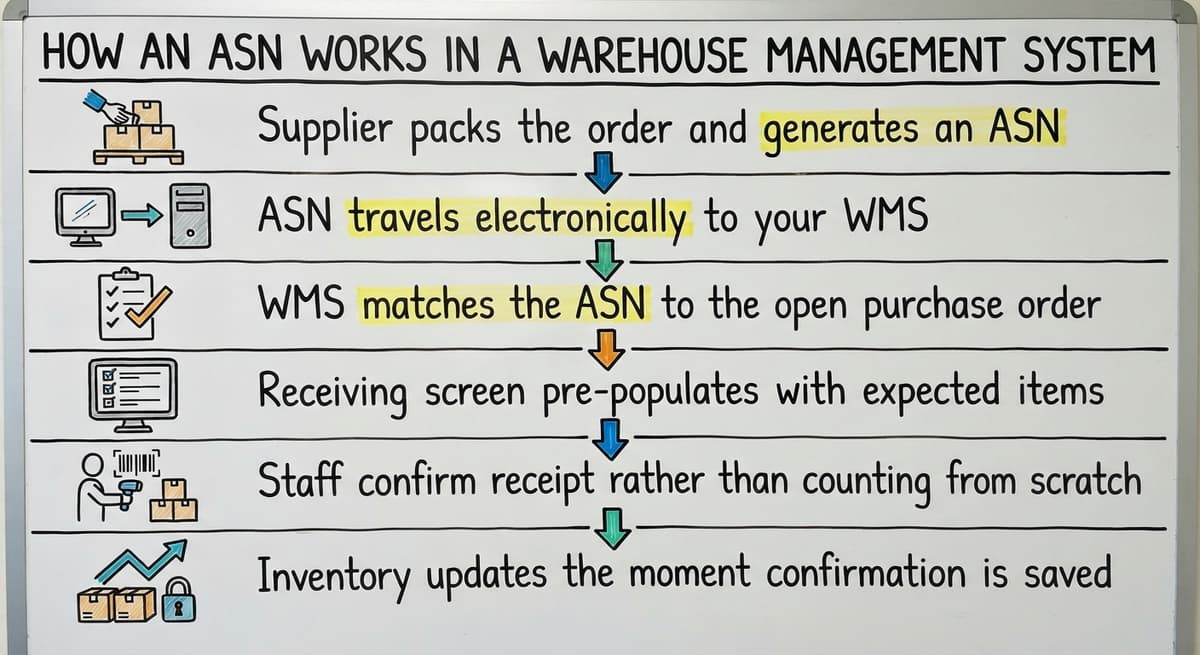
The basic flow looks like this:
- Supplier packs the order and generates an ASN
- ASN travels electronically to your WMS
- WMS matches the ASN to the open purchase order
- Receiving screen pre-populates with expected items and quantities
- Staff confirm receipt rather than counting from scratch
- Inventory updates the moment confirmation is saved
The WMS does the matching work. Staff spend their time confirming, not keying data.
What Information an ASN Contains?
What data is included in an advance ship notice? Every ASN carries the core details a receiving team needs to process a shipment without guesswork.
Common fields include:
- Purchase order number: ties the shipment to the order you placed
- Item numbers and descriptions: confirms what product is inside
- Quantities per item: tells staff how many units to expect
- Carrier and tracking number: lets you trace the freight in transit
- Expected delivery date: allows dock scheduling before the truck arrives
- Lot or serial numbers: required for regulated goods or warranty tracking
GS1, the global standards body for supply chain data, maintains barcode and data standards that make these fields readable across different systems. Their barcode standards explain why a label printed by one supplier scans correctly at a distributor's dock.
Is the comparison easier when one option is built for you?
Yes. Off-the-shelf means fitting your process to the software, and custom is the other way round. The first look costs nothing.
Book a call
Why ASNs Matter for Receiving?
Receiving without an ASN is slow. A team member counts every box, writes down every item number, and keys it all into the system by hand. One misread label creates an inventory error that takes days to find.
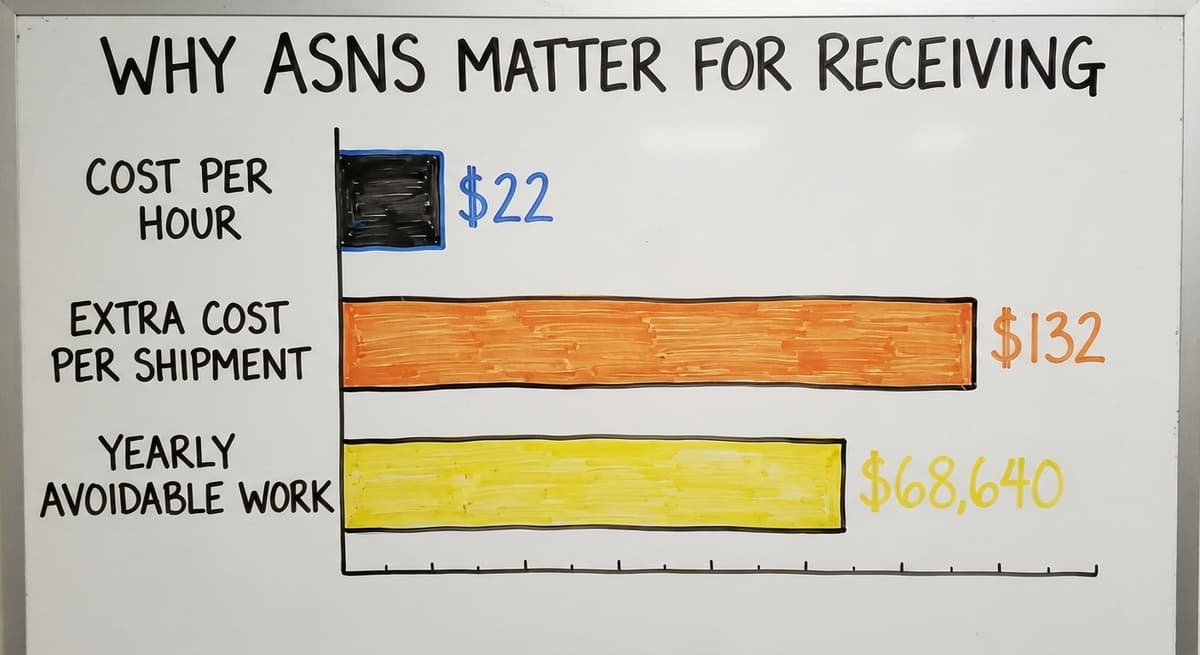
Consider a realistic example. 3 receiving staff spending 2 extra hours each per shipment, at the median material recording clerk wage of around $22 an hour per the US Bureau of Labor Statistics, costs $132 per shipment in labor alone.
Ten shipments a week adds up to $68,640 a year in avoidable work.
An ASN cuts that time because the WMS pre-populates the receiving screen. Staff scan to confirm rather than key to create. Errors drop. Dock scheduling becomes possible because you know arrival times in advance.
For small distributors, the real pain is the mismatch. A truck arrives with 47 units when the purchase order says 50.
Without an ASN, no one knows until the count is done. With an ASN, the WMS flags the gap the moment the shipment is confirmed.
The Warehousing Education and Research Council tracks distribution centre performance benchmarks at werc.org. Receiving accuracy is one of the core measures they recommend tracking. ASN processing directly supports that metric.

ASN vs Purchase Order: What Is the Difference
A purchase order (PO) is what your business sends to a supplier to request goods. An ASN is what the supplier sends back to confirm what is actually shipping.
They match. They do not always match.
| Document | Who sends it | What it confirms |
|---|---|---|
| Purchase order | Buyer (your business) | What you ordered and at what price |
| ASN | Supplier | What is actually being shipped |
A supplier might ship 48 units on a PO for 50 because 2 were damaged before loading.
The WMS compares the ASN to the PO and flags the difference automatically. Your team sees the discrepancy on screen before the receiving count even starts. That is a cleaner process than discovering a shortage three days later during a cycle count.

How Small Distributors Use ASNs Without a Big ERP?
Many small distributors assume ASN processing requires an enterprise system with a six-figure price tag. That assumption is wrong.
A custom warehouse management system for small distributors can handle ASN data at whatever scale fits the operation. The system sits alongside the accounting software rather than replacing it.
Accounting software integration for distributors means purchase orders already in the accounting system feed directly into the WMS. ASN data flows in from suppliers. The two match automatically.
No forced migration. No retraining the whole company on a new platform. The WMS adds ASN handling to what you already run.
The IRS is clear on why inventory accuracy matters beyond operations. IRS Publication 538 states: "To figure taxable income, you must value your inventory at the beginning and end of each tax year." Receiving errors that go uncorrected become valuation errors at year end. ASN processing reduces that risk by catching discrepancies at the dock.
What does it look like running on your own process?
The first thing you see is it running on your own process, at no build cost. The subscription starts once it is live and doing the job, not before.
Book a callCommon Problems ASNs Solve in Day-to-Day Operations
There are 4 situations warehouse managers recognize immediately:
- Surprise deliveries: a truck arrives with no warning and the dock is full. An ASN gives advance notice so you can schedule the door.
- Manual count errors: a receiver misreads a label and 100 units become 10 in the system. Pre-populated screens remove most of that risk.
- Wrong put-away location: without item data in advance, staff guess where product goes. The WMS directs put-away based on ASN data.
- Stock sitting in receiving: items confirmed but not available for orders because the system was not updated. ASN-driven receiving closes that gap the moment confirmation is saved.
Each of these problems has a real cost in labor and customer service. ASN processing removes the guesswork that causes them.

When Your Operation Is Ready for ASN Processing?
ASN support is not only for large companies. A few signs point to readiness:
- Receiving errors show up regularly in inventory counts
- Dock scheduling is reactive rather than planned
- Staff spend significant time keying receipt data by hand
- Suppliers already send shipment data but your system does not read it
That last point matters most. If your suppliers already generate ASN data, the WMS just needs to be configured to receive it. The infrastructure is already there. The gap is on the warehouse side.
Warehouse inventory management software overview covers the broader set of features a WMS can handle. ASN processing is one piece of a larger receiving picture. How to improve warehouse receiving accuracy goes deeper on the steps that reduce errors at the dock.

How Do I Get ASN Support Built Into My Warehouse System?
A custom-built WMS is the fastest route: it can accept ASNs from your specific suppliers from day one. The system matches incoming ASN data to purchase orders already in the accounting software. No enterprise rollout required.
The Software Society builds and supports custom warehouse management systems from Columbus, Ohio. The team configures ASN handling to match your suppliers' data format, connects to your existing accounting software file, and trains your receiving staff on the new flow.
The result is a system shaped around your operation rather than a generic platform you have to adapt to.
If receiving errors are frequent, dock scheduling is chaotic, or inventory counts after receiving are unreliable, ASN processing is a practical next step. Reach out to talk through what your suppliers already send and how quickly a configured system can start reducing the work at your dock.
Frequently asked questions
Frequently asked questions
What is the purpose of ASN?
An ASN, or Advance Ship Notice, tells a warehouse what is coming before the truck arrives. It lets the WMS pre-populate the receiving screen, helps staff schedule dock doors and labor, and flags any difference between what was ordered and what is actually shipping.
What is the difference between ASN and PO?
A purchase order is sent by the buyer to request goods from a supplier. An ASN is sent by the supplier to confirm what is actually being shipped.
A PO says what you want. An ASN says what is on the truck. The two match, but quantities can differ, and a WMS flags those gaps automatically.
When should an ASN be sent?
A supplier should send the ASN as soon as the shipment is packed and handed to the carrier, before the truck leaves their facility.
The earlier the receiving warehouse gets the data, the more time staff have to schedule dock doors, assign labor, and prepare put-away locations.
How do you get your own ASN number?
An ASN number is generated by the supplier's system when they create the shipment record. If you are the buyer, you receive the ASN rather than creating one.
If you are a supplier who needs to send ASNs, your WMS or ERP generates the document and transmits it to the buyer's system, using EDI or a direct API connection.
Can a small distributor use ASN processing without a large ERP?
Yes. A custom warehouse management system can handle ASN data at small scale and sit alongside the accounting software rather than replacing it.
If your suppliers already send ASN data, the WMS just needs to be configured to receive and match it to your existing purchase orders.
How does an ASN speed up the receiving process?
The WMS uses ASN data to pre-populate the receiving screen before the shipment arrives. Staff confirm what they see rather than counting and keying from scratch. That removes most manual data entry, cuts receiving time, and reduces the errors that create inventory discrepancies.
What happens if the ASN does not match the purchase order?
The WMS compares the two automatically and flags any difference. A supplier might ship fewer units than ordered because of damage or stock shortages.
The system shows the gap on the receiving screen so staff can note the discrepancy before the shipment is confirmed, rather than finding it later during a cycle count.
What data fields does an advance ship notice include?
A standard ASN includes the purchase order number, item numbers and descriptions, quantities per item, carrier name and tracking number, expected delivery date, and lot or serial numbers where applicable. These fields give the receiving team everything needed to process the shipment without contacting the supplier for details.
What is the difference between an ASN and a packing slip?
An ASN is a digital document a supplier sends electronically before the shipment leaves, allowing a warehouse system to store the details and prepare staff in advance.
A packing slip is a physical list included inside the shipment itself, only seen once the truck arrives. The ASN essentially acts like a packing list that travels ahead of the freight, giving the receiving team advance visibility rather than information discovered at the dock.
What information should an ASN contain?
An ASN should contain the purchase order number linking the shipment to the original order, item numbers and descriptions confirming the products inside, and quantities per item so staff know how many units to expect. It should also include the carrier and tracking number for tracing freight in transit, an expected delivery date for dock scheduling, and lot or serial numbers when goods are regulated or under warranty tracking.
How does ASN improve warehouse receiving?
ASN improves warehouse receiving by letting the system pre-populate the receiving screen with expected items and quantities before the truck arrives, so staff confirm receipt instead of counting and keying data from scratch. This reduces manual errors, speeds up processing, and allows dock scheduling since arrival times are known in advance.
Discrepancies between what was ordered and what actually shipped are flagged automatically rather than discovered days later.
What is the difference between an ASN and a purchase order?
A purchase order is sent by the buyer to a supplier to request goods, confirming what was ordered and at what price. An ASN is sent by the supplier back to the buyer, confirming what is actually being shipped.
The two match but not always, since suppliers may ship fewer units due to damage or shortages. A warehouse system compares them automatically and flags any differences before receiving begins.
What is in a free first look?
A 30 minute call, your operation mapped, and a clear picture of what we would build. No obligation and nothing to install.
Book a callRelated guides
The rest of this guide, for the parts of the job this page does not cover.
Guides
- Warehouse Inventory Management Systems
- Warehouse Management System Top 10
- Software for Warehouse Management System
- Small Business Warehouse Management System
- Warehouse Management System Types
- Warehouse Inventory Management System
- Warehouse Management System Examples
- Warehouse Management System Implementation
Common questions
- What Are the Benefits of Warehouse Management System
- What is the Point of Warehouse Management System
- What is a Warehouse Management System
- What is a Warehouse Management System Used For
- What is the Purpose of a Warehouse Management System
- What is a Warehouse Management System Pdf
- What is a Warehouse Management System Example
- What Warehouse Management System Does Amazon Use
- What Are the Top 5 Warehouse Management Systems?
- What is the Best Warehouse Inventory Management System?
- What is the Difference Between Warehousing and Inventory Management
- What is the Most Popular Warehouse Management System?
- What is B Type of Inventory in Warehouse Management
- What is a Simple Warehouse Management System?
- What is Warehousing and Inventory Management
- How to Choose a Warehouse Management System