


What Is The Rationale For Inventory Management Quizlet
The rationale for inventory management is to keep enough stock to fill orders without tying up cash in product you do not need yet. Businesses manage inventory to balance 2 competing costs: holding too much and running out. Every principle on an inventory management study guide, from reorder points to safety stock, serves that single goal.
Reviewed and updated: October 2026
Book a callWhy This Question Comes Up in Inventory Management Study
Quizlet decks on inventory management surface the core vocabulary that supply chain courses teach. Students search for plain-language answers to terms like reorder point, safety stock, and economic order quantity. Business owners and operations managers often search this same phrase when they want a quick explanation of the reasoning behind inventory control, not just a definition.
This article covers the textbook rationale first. Then it shows where those principles break down in real wholesale and distribution settings, specifically in businesses running an accounting package alongside spreadsheets. The goal is to connect the study card to the shop floor.
We build it for your operation, and the first look is free
If you would rather not compare products, describe how your operation already works and we build the system around it.
No build cost. You see it running on your own process first, and the monthly subscription starts only once it is live.
Book a callThe Core Rationale: Why Businesses Manage Inventory
Inventory management exists to find the right stock level between two costly extremes. Holding too much stock ties up cash, takes up warehouse space, and risks spoilage or obsolescence. Holding too little leads to stockouts, missed orders, and lost customers.
GS1, the global standards body behind barcode and supply chain systems, notes that accurate spotting and tracking are the foundation of any reliable count, because a system built on GS1 barcode standards "enables businesses to identify, capture and share information about products and assets."
The IRS adds a legal dimension. IRS Publication 538 states directly: "To figure taxable income, you must value your inventory at the beginning and end of each tax year." Managing inventory is not just good practice. It is a legal obligation.
Those 2 pressures, working and legal, are the core rationale for inventory management.
What Concepts Do Inventory Management Quizlet Decks Typically Cover?
Nearly every inventory management study set covers 4 foundational concepts, and knowing all 4 together is what makes the rationale click.
- Demand forecasting means predicting how much product you will need over a set period. A good forecast reduces both overstock and stockouts before they happen.
- Reorder point is the stock level that triggers a new buy order. When on-hand quantity drops to that number, it is time to buy.
- Safety stock is a buffer held to absorb unexpected demand spikes or supplier delays. It is the cushion between your reorder point and zero.
- Lead time is the gap between placing an order and receiving it. Longer lead times mean you need a higher reorder point to avoid running dry.
How the 4 Core Inventory Concepts Connect
These 4 ideas are not separate topics. They connect: your lead time shapes your reorder point, and your demand variability shapes how much safety stock you carry. Understanding the links between them is what the rationale for inventory management is really teaching.
FAQ: What is safety stock and why is it part of inventory rationale?
Safety stock is extra inventory held as a buffer against surprises. A supplier ships late. A customer orders twice the usual amount. Without safety stock, either event causes a stockout. Safety stock is part of the rationale because uncertainty is always present, and the cost of a stockout usually exceeds the cost of carrying a small buffer.

Carrying Costs vs. Ordering Costs
The rationale for inventory management is to minimize the combined total of carrying costs and ordering costs. Each pulls in the opposite direction, which is why finding the right balance needs a formula, not a guess.
Carrying costs include:
- Warehouse space and utilities consumed by stored product
- Insurance on stock held on-site
- Labor to receive, move, and count inventory
- The cost of capital tied up in product sitting on a shelf
Ordering costs include:
- Staff time spent creating and sending buy orders
- Receiving labor when a shipment arrives
- Administrative work to reconcile invoices against deliveries
The comparison is easier when one option is built for you
Off-the-shelf means fitting your process to the software. We do it the other way round, and the first look costs nothing.
Book a callWhat Ordering Costs Actually Add Up To
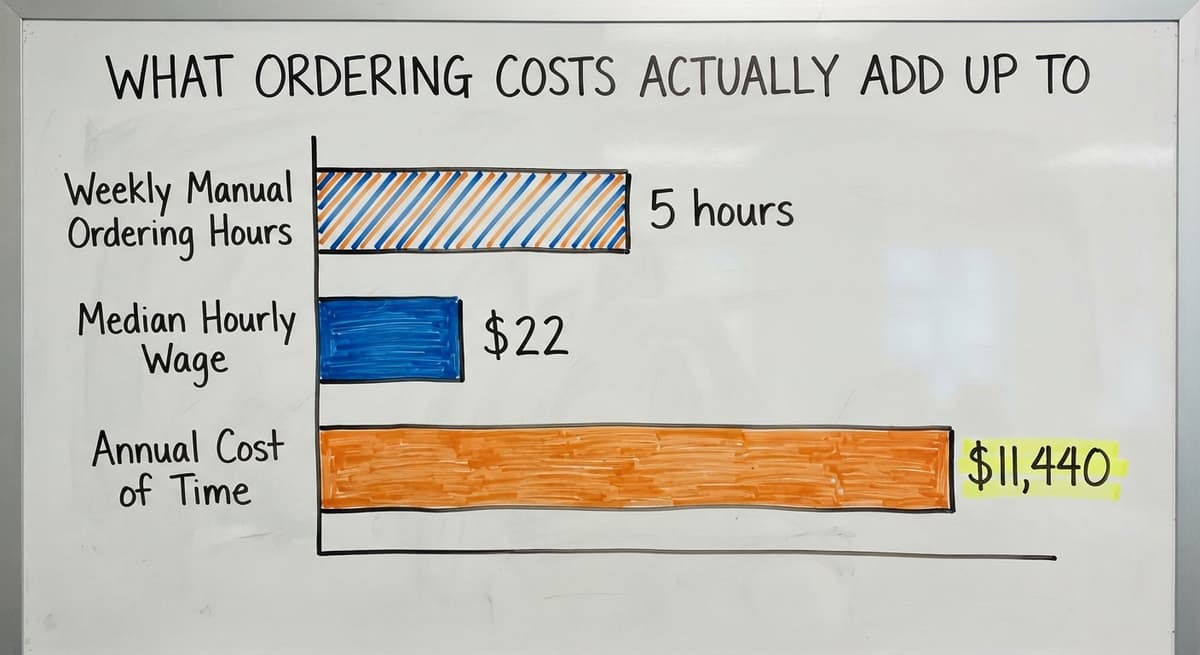
Consider a small distributor with 2 people spending 5 hours a week each on manual ordering tasks. At the current median wage for stock clerks and order fillers of around $22 per hour, per Bureau of Labor Statistics data, that is $11,440 a year in ordering-related labor alone, before a single carrying cost is counted.
Economic Order Quantity (EOQ) is the classic formula that finds the order size where both cost types are lowest together. It does not remove either cost. It finds the point where raising the order size stops saving on ordering costs and starts adding more in carrying costs than it saves.
FAQ: What is the difference between carrying costs and ordering costs?
Carrying costs are what you pay to hold stock: space, insurance, labor, and tied-up cash. Ordering costs are what you pay to replenish stock: staff time, paperwork, and receiving. Inventory management theory says the right order size is the one where the total of both is lowest, which is what the EOQ formula calculates.

Stockouts and Their Real Business Cost
A stockout happens when a customer orders something you do not have on hand. The visible cost is a lost sale. The less obvious cost is a damaged relationship that may take months to repair, if it can be repaired at all.
For wholesale distributors, repeated stockouts push buyers to competing suppliers. A buyer who switches once rarely switches back. The FTC's Mail, Internet, or Telephone Order Merchandise Rule needs sellers to ship when promised or notify the customer and offer a refund. A stockout that goes unmanaged can create a compliance problem on top of a customer service one.
Protecting revenue by keeping the right items available is a core part of the rationale for inventory management. A reorder point set correctly means the stockout never happens, rather than being managed after the fact.
How These Principles Apply to Wholesale and Distribution
Distributors carry hundreds or thousands of SKUs. That scale is where inventory management rationale moves from theory to daily urgency.
Manual tracking in spreadsheets creates specific failure points:
- Reorder points set in a spreadsheet go stale when seasonal demand shifts and no one updates the file
- A single missed reorder on a fast-moving SKU can cost a major account if the customer cannot fill their own orders
- Counting errors compound across locations when staff update separate files rather than a shared system
What Industry Data Says About Distributor Inventory Ratios
The US Census Bureau's Monthly Wholesale Trade data tracks the national inventories-to-sales ratio for wholesale firms. When that ratio rises, distributors are holding more stock relative to what they sell, which is a direct signal that carrying costs are climbing without a matching gain in revenue.

The NIST Manufacturing Extension Partnership offers vendor-neutral guidance on supply chain processes and consistently points to systematic tracking as the foundation of cost control. Knowing the rationale for inventory management is not enough. The principles have to run inside a system that applies them every day, not just when someone remembers to check a spreadsheet.
FAQ: Why do businesses need to manage inventory at all?
Without active inventory management, businesses either overstock and waste cash on carrying costs, or understock and lose sales to stockouts. Neither extreme is sustainable. The IRS also requires that inventory be valued at the start and end of each tax year, so tracking is a legal requirement, not just a business preference.
Where an Accounting Package Falls Short on Inventory Rationale
An accounting package tracks what you bought and sold. It does not tell you when to buy more. That gap is where the rationale for inventory management breaks down in practice for most small distributors.
Specific gaps include:
- No alert when stock hits a reorder point across multiple warehouse locations
- No calculation of safety stock based on lead time variability or demand swings
- No surface for slow-moving SKUs that are quietly consuming carrying costs
See it running on your own process first
No build cost. The subscription starts once it is live and doing the job, not before.
Book a call
Why the Right Tool Matters for Inventory Logic
Many distributors fill those gaps with printed pick sheets, email chains, and memory. That is exactly what inventory management theory says to avoid. Reorder point automating for distributors exists precisely because manual triggers fail under volume.
The accounting package is not broken. It was built for accounting. Asking it to enforce reorder logic across 500 SKUs is asking the wrong tool to do a job it was never designed for. Recognizing that gap is the first step toward applying the rationale in practice, rather than just knowing it.
Turning Inventory Theory Into an Operational System
The rationale covered in inventory management courses points toward one practical outcome: let a system do the work that a human cannot reliably do at scale.
A purpose-built working layer can:
- Flag reorder points automatically when on-hand quantity crosses the threshold
- Calculate safety stock based on actual lead time variability from your own order history
- Surface slow-moving SKUs before carrying costs compound over a full quarter
- Connect to your existing accounting package so financial records stay accurate without double entry

How a Custom Layer Works Alongside Your Accounting Package
Custom warehouse management software built around how a distributor already works applies these principles without forcing a full system migration. The accounting package stays in place for financial reporting. The custom layer handles the inventory logic that the accounting package was never designed to carry.
The result is the theory from the textbook running in the background of daily operations, flagging problems before they become stockouts or write-offs, rather than being consulted after the damage is done.
What Should a Distributor Do First to Move Beyond Theory?
Start by identifying which inventory decisions are still made manually or from memory. That list is your gap map.
Two exercises reveal where the rationale needs to become a real system:
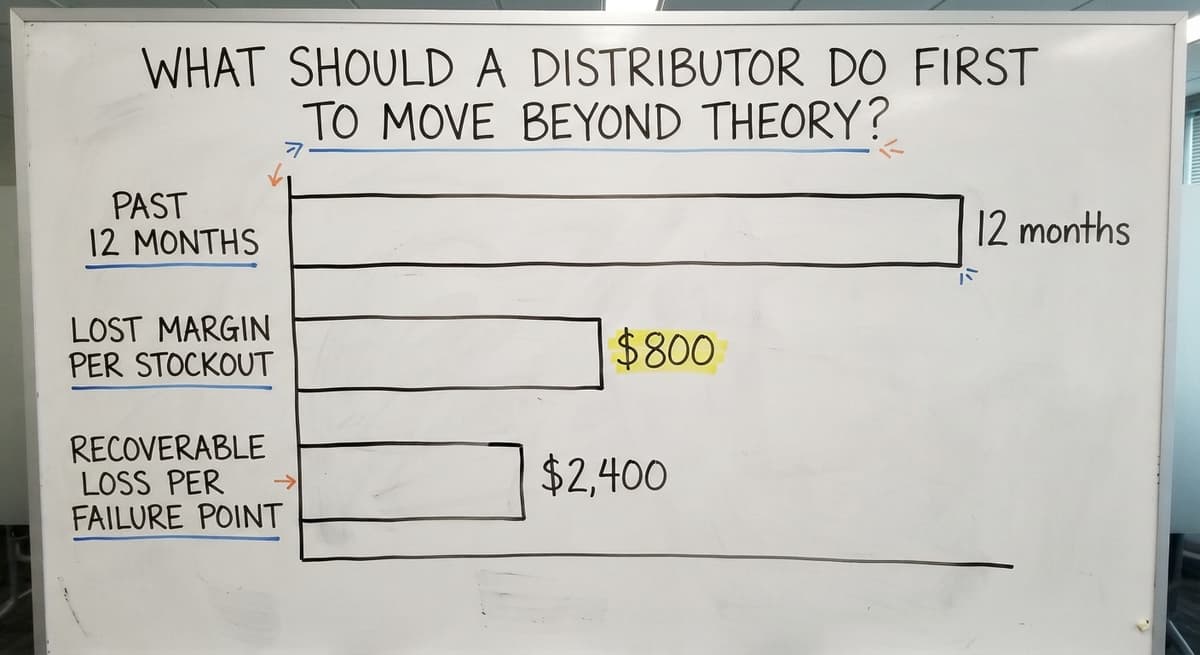
- List every SKU where a stockout or overstock situation cost the business money in the past 12 months. Assign a rough dollar figure to each. Even a conservative estimate, say 3 stockouts at $800 in lost margin each, shows $2,400 in recoverable loss from a single failure point.
- Count how many hours per week staff spend on reorder decisions, buy order creation, and inventory counting. Multiply by their hourly rate. That number is what a system replaces.
How to Start the Conversation With a Software Partner
A local software partner can build inventory management software for wholesale distributors around existing workflows rather than replacing them. The goal is not a new platform for its own sake. The goal is the principles from the study guide running automatically, so your team spends time on customers rather than counting.
If replacing Excel-based inventory tracking is the next step, the right place to start is a conversation about which manual decisions are costing the most, not a demo of features you may never use.
Frequently asked questions
What is safety stock and why is it part of inventory rationale?
Safety stock is extra inventory held as a buffer against surprises. A supplier ships late. A customer orders twice the usual amount. Without safety stock, either event causes a stockout. Safety stock is part of the rationale because uncertainty is always present, and the cost of a stockout usually exceeds the cost of carrying a small buffer.
What is the difference between carrying costs and ordering costs?
Carrying costs are what you pay to hold stock: space, insurance, labor, and tied-up cash. Ordering costs are what you pay to replenish stock: staff time, paperwork, and receiving. Inventory management theory says the right order size is the one where the total of both is lowest, which is what the EOQ formula calculates.
Why do businesses need to manage inventory at all?
Without active inventory management, businesses either overstock and waste cash on carrying costs, or understock and lose sales to stockouts. Neither extreme is sustainable. The IRS also requires that inventory be valued at the start and end of each tax year, so tracking is a legal requirement, not just a business preference.
What is the rationale for inventory management as taught in business courses?
Business courses teach that the rationale for inventory management is to minimize the combined cost of holding stock and running out of it. Carrying too much wastes cash and space. Carrying too little causes stockouts and lost revenue. The goal is the right quantity at the right time, which needs forecasting demand, setting reorder points, holding safety stock, and accounting for lead time.
What is demand forecasting in inventory management?
Demand forecasting means estimating how much of a product you will need over a future period. It uses past sales data, seasonal patterns, and known changes in customer behavior. A good forecast reduces both overstock and stockouts before they occur, rather than reacting after inventory levels are already wrong.
What is economic order quantity and why does it matter?
Economic order quantity (EOQ) is a formula that calculates the order size where carrying costs and ordering costs are lowest together. Ordering too often raises ordering costs. Ordering too much raises carrying costs. EOQ finds the point where both are minimized, which is the core math behind the rationale for inventory management.
How does lead time affect reorder points?
Lead time is the gap between placing an order and receiving it. A longer lead time means you need to reorder earlier, because stock will continue to deplete while you wait. If lead time is unpredictable, safety stock absorbs the variation. Reorder points that ignore lead time cause stockouts even when the math otherwise looks right.
Start with a free first look
A 30 minute call, your operation mapped, and a clear picture of what we would build. No obligation and nothing to install.
Book a callRelated guides
The rest of this guide, for the parts of the job this page does not cover.
- What is the Goal of Inventory Management Quizlet
- What is the Difference Between Aggregate and Item Inventory Management
- What is Abc Classification in Inventory Management
- What is Inventory Management and Its Types
- What is the Main Purpose of Inventory Management
- What is Information Technology Inventory Management
- What is Risk Pooling in Inventory Management
- What is Inventory Management Mary Kay
- What is Stock Taking in Inventory Management
- What is Bin Number in Inventory Management
- What is the Implication of Proper Inventory Management
- What is Inventory Management and Its Importance
- What is the Importance of Eoq in Inventory Management
- What is the Importance of Quality Inventory Management
- What is Inventory Management Explain Techniques of Inventory Management
- What is Mean by Inventory Management
- What is Inventory Management Meaning in Hindi
- What is Inventory Management and Why is It Important
- What is the Purpose of Inventory in Operations Management
- What is Inventory Management Whiteboard Wednesday
- What is Fluctuation Stock in Inventory Management
- What is the Management and Non Managerial Human Resources Inventory
- What is Inventory Listing
- What is Inventory