


What Is Inventory Management Whiteboard Wednesday
Reviewed and updated: October 2026
Inventory Management Whiteboard Wednesday is a short educational format that explains one inventory concept at a time using plain language and simple visuals. Each session runs 5 to 10 minutes. The goal is to help warehouse teams and operations managers understand concepts like reorder points or cycle counts without sitting through a full training course.
Book a callThe Short Answer: What Is Inventory Management Whiteboard Wednesday?
Whiteboard Wednesday is a short-form educational format. It uses plain language and simple visuals to explain one business concept per session. When applied to inventory management, each session walks through one idea, like safety stock or a buy order workflow, step by step. The format is built for operations teams who need to act fast. No jargon. No long courses. Just one clear idea they can use the same day.
We build it for your operation, and the first look is free
If you would rather not compare products, describe how your operation already works and we build the system around it.
No build cost. You see it running on your own process first, and the monthly subscription starts only once it is live.
Book a callWhere the Whiteboard Wednesday Format Comes From
The whiteboard format grew out of the B2B software industry's push to make complex ideas accessible. Vendors and consultants noticed that long manuals and dense records sat unread. Short explainer videos filled that gap.
The style works by stripping a concept down to its core. One episode, one idea, no detours. Wholesale distributors and warehouse managers often find this format when they search for inventory software reviews or look for ways to improve a specific process.
The concepts covered in these sessions often trace back to supply chain standards. GS1, the global standards body behind barcode systems, notes that "barcodes are the backbone of supply chain visibility," and its barcode standards records shows how scan-based counting depends on those standards being applied correctly. That foundation matters when a whiteboard session explains why a cycle count works the way it does.
What Inventory Management Topics Does a Whiteboard Wednesday Session Typically Cover?
Most sessions focus on the pain points that slow warehouse and distribution teams down every week. The topics are chosen because they show up in real operations, not because they sound impressive on a syllabus.
Common session topics include:
- Reorder points: the stock level that triggers a new buy order before you run out
- Safety stock: the buffer quantity you hold to cover demand spikes or late deliveries
- Cycle counts: counting a portion of inventory on a rolling schedule instead of shutting down for a full annual count
- Pick accuracy: measuring how often a picker pulls the right item in the right quantity
- Buy order workflows: the steps from creating a PO to receiving and confirming the goods
- Receiving processes: how incoming stock gets checked, labeled, and entered into your system
Why Each Whiteboard Wednesday Session Stays Narrow
Each session walks through one topic from start to finish. The format respects your time by staying narrow. A session on reorder points does not drift into demand forecasting. That discipline is what makes the format useful for small teams who need a quick answer, not a semester-long course. The whiteboard format also travels well: a manager watches a session, understands the concept, and sends the link to the person on the floor who runs that process. No meeting required. The idea moves from screen to shelf with minimal friction, which is exactly what a lean warehouse team needs.
Why Operations Managers Find This Format Useful
Busy owners and operations managers do not have time for long training courses. A focused 5 to 10 minute explainer on one concept is easier to absorb. It is also easier to share with a team member who handles that specific task.

The whiteboard style works especially well for visual thinkers. Most people who run warehouses and fulfillment centers think in physical terms: pallets, aisles, bins, pick lists. A diagram drawn on a whiteboard matches that mental model better than a spreadsheet or a slide deck full of bullet points.
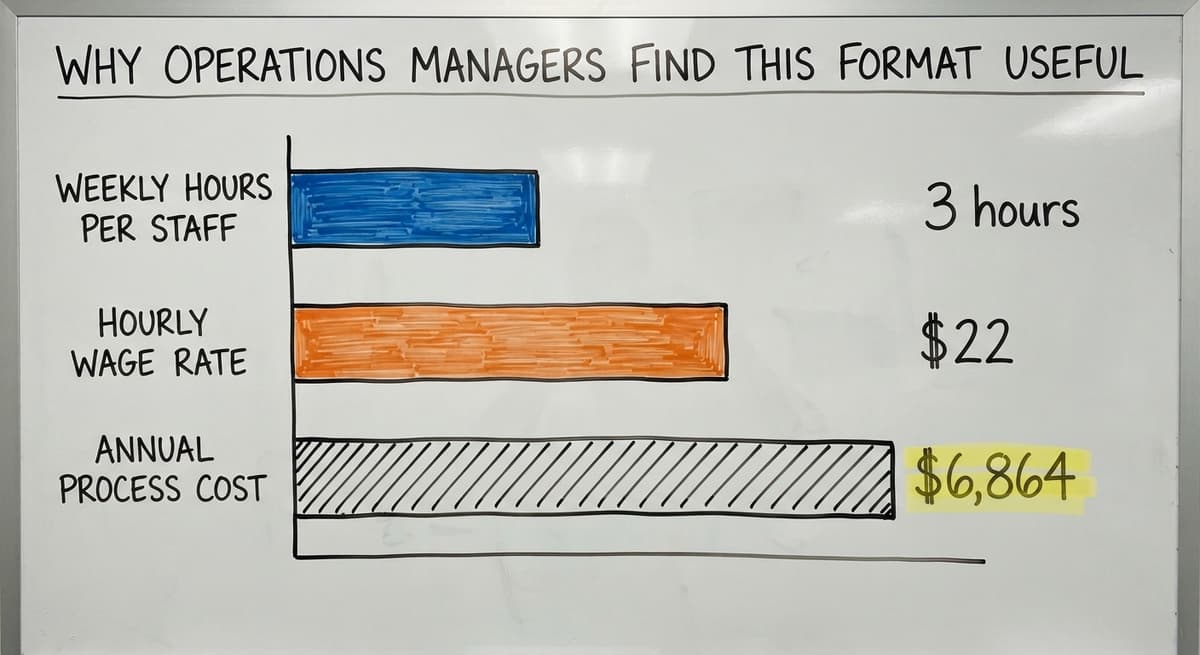
There is also a cost argument. Consider 2 staff members spending 3 hours a week each managing inventory records manually at $22 an hour. That is $6,864 a year spent on a process a short training session might help them do faster and with fewer errors. The format earns its place by reducing that kind of waste.
The Real Reason Teams Share These Sessions
The whiteboard format travels well. A manager watches a session, understands the concept, and sends the link to the person on the floor who runs that process. No meeting required. The idea moves from screen to shelf with minimal friction, which is exactly what a lean warehouse team needs.
The comparison is easier when one option is built for you
Off-the-shelf means fitting your process to the software. We do it the other way round, and the first look costs nothing.
Book a callHow Inventory Management Concepts Connect to Your Daily Operations
Learning a concept like reorder points changes how you read your stock levels. Suddenly the question shifts from "do we have enough?" to "at what number do we act?" That is a different kind of thinking, and it leads to better decisions.
For a wholesale distributor running a small team, these concepts connect directly to daily choices:
- When to place a buy order before a supplier's lead time runs out
- How much overstock to hold without tying up cash in slow-moving product
- What the floor actually has versus what your accounting software shows as on hand

Why Accurate Inventory Counting Is a Legal Requirement
The IRS makes the stakes concrete. IRS Publication 538 states: "To figure taxable income, you must value your inventory at the beginning and end of each tax year." That is not a preference. It is a legal requirement. Understanding how to count and value stock correctly is not just good operations practice. It protects you at tax time. Manual inventory processes create gaps between what you think you have and what is actually there. A whiteboard session on cycle counts helps you see where those gaps form and why.
The Gap Between Learning a Concept and Fixing the Problem
Whiteboard Wednesday content teaches the concept. It does not fix the underlying system. That gap is where most small distributors get stuck.
A manager watches a session on reorder points, understands the math, and then returns to a spreadsheet that has no way to trigger an alert when stock drops below that number. The knowledge exists. The tool does not match it.
Many teams managing inventory in Excel or on printed sheets face this exact problem. They know what good looks like. Their tools cannot deliver it. Identifying that gap is the first real step toward improvement. Ask yourself: where does this process currently live? Is it a spreadsheet, a printed sheet, an email chain, or a field in an accounting package? The answer tells you how far the current system is from what the whiteboard session described.

Why Understanding the Concept Is Necessary but Not Sufficient
Understanding the concept is necessary. It is not enough. The US Census Bureau's Monthly Wholesale Trade data tracks inventory-to-sales ratios across wholesale firms, and that ratio only improves when the counting and ordering systems behind it are reliable, not just understood.
Why Excel Keeps Winning (and Why That Is a Problem)
Spreadsheets feel safe because they are familiar. But a spreadsheet cannot alert you when stock hits a reorder point. It cannot flag a receiving discrepancy in real time. It cannot tell you whether what your accounting software shows matches what is on the shelf. The more your business grows, the wider that gap becomes.
What Good Inventory Management Software Actually Does
Good inventory software automates the decisions and alerts that a whiteboard session explains manually. Instead of checking a spreadsheet each morning to see if stock is low, the system checks for you and sends an alert when a reorder point is hit.
Core functions of solid inventory software include:
- Tracking stock levels in real time across locations or bins
- Triggering reorder alerts automatically when quantity drops below a set threshold
- Logging receipts and adjustments so your on-hand count stays accurate
- Generating pick lists that reduce errors in the fulfillment center
- Syncing with your accounting package so it reflects what is actually in the warehouse
See it running on your own process first
No build cost. The subscription starts once it is live and doing the job, not before.
Book a call
How Inventory Software Fits Into Your Existing Accounting Setup
For businesses already using an accounting platform, the right software works alongside it rather than replacing it. Learning how inventory software works with your accounting package is a practical starting point for any team running both systems today. The goal is to replace the manual parts, not rebuild everything from scratch. The NIST Manufacturing Extension Partnership offers vendor-neutral guidance on supply chain processes and reinforces that the right system fits the operation, not the other way around.
What Should a Small Distributor or Warehouse Look for in Inventory Management Software?
Small distributors should avoid systems built for large enterprises. Those platforms need long rollouts, dedicated IT staff, and months of retraining. They also tend to force you to change how you already work, which creates disruption without guaranteed payoff.
Instead, look for software that fits your current operation and scales with your team. The right questions to ask:
- Does it connect to the accounting package you already use?
- Can it be set up without a six-month rollout project?
- Does it replace only the manual steps that are causing errors, rather than overhauling everything?
- Can a team of 5 to 20 people actually use it without dedicated training staff?
Custom warehouse software for small distributors is built around existing workflows. It keeps your accounting package in place and targets the specific manual processes that are slowing your team down. That is a very different product from an enterprise resource planning system that assumes you have a full IT department.

The Real Cost of Manual Inventory Processes for Small Teams
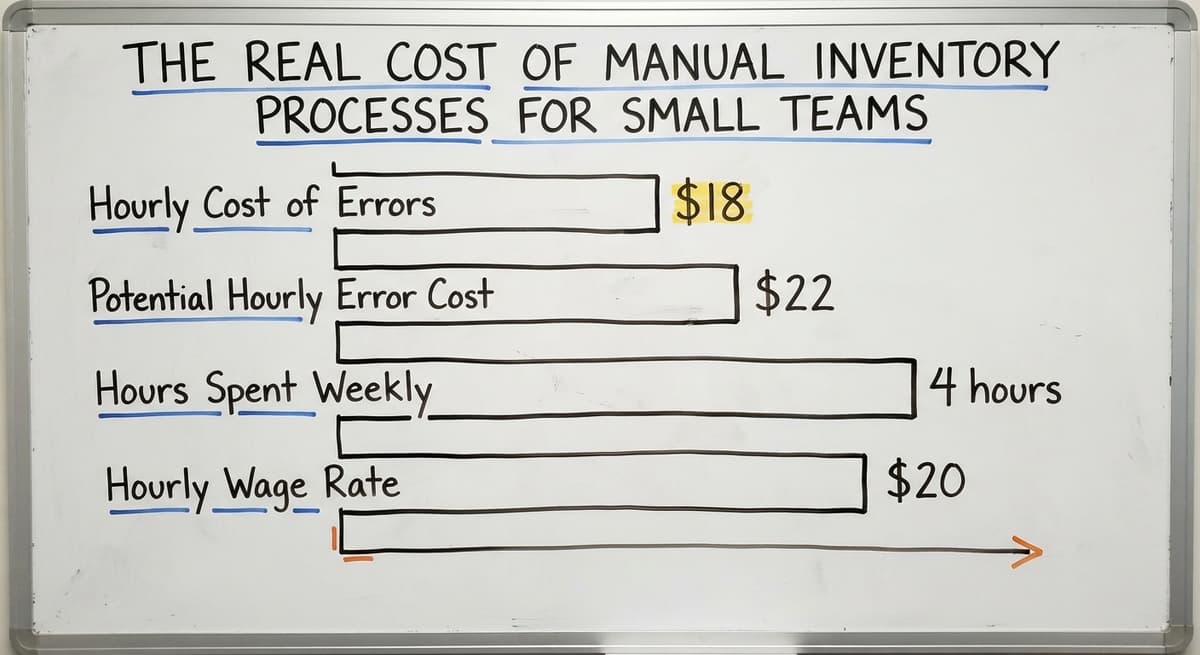
Replacing Excel and spreadsheets in warehouse operations does not mean adopting the most powerful system available. It means adopting the right one for your size and your current way of working. Inventory reorder point automating, for example, can be added to an existing workflow without rebuilding every other process around it. The US Bureau of Labor Statistics tracks wages for stock clerks and order fillers. At roughly $18 to $22 an hour for that role, the cost of manual errors compounds quickly. A team of 3 people each spending 4 hours a week on manual inventory matching at $20 an hour spends $12,480 a year on a process that software can handle in minutes. That arithmetic makes the case for the right tool without needing a vendor's sales pitch.
What Should I Do After Watching an Inventory Management Whiteboard Wednesday Session?
After watching a session, audit the one process the session covered. Do not try to fix everything at once. Pick the concept that felt most familiar because it is causing you the most trouble right now.
Here is a simple way to start:
- Name the process: reorder points, cycle counts, receiving, or whichever topic the session covered.
- Map where that process currently lives: a spreadsheet, a printed sheet, an email thread, or a field in your accounting package.
- Note where the breakdown happens: where does the data go stale, where do errors appear, and where does someone have to manually check something that should be automatic?
- Decide whether your current tools can close that gap or whether a different system is needed.
When to Take the Next Step Beyond the Whiteboard Session
If the gap is real and your current tools cannot close it, a conversation with a custom software partner is the logical next step. The goal is not to buy a platform. The goal is to turn what you learned in a whiteboard session into a working system that runs without constant manual attention. That is what good inventory management looks like in practice, and it starts with knowing exactly where your current process breaks down. What is inventory management software? That question is worth asking directly once you have mapped the gap, because the answer shapes every tool decision that follows.
Frequently asked questions
What are the different types of inventory control systems?
There are 4 main types. Periodic systems count stock at set intervals, like monthly or quarterly. Perpetual systems update stock levels every time a transaction happens. Barcode or scan-based systems automate the perpetual count by scanning items at each step. Custom-built systems combine perpetual tracking with workflows specific to your operation. The right type depends on your order volume, team size, and how much accuracy your business needs day to day.
Is inventory turnover the same as days inventory is outstanding?
No, they measure the same underlying activity from different angles. Inventory turnover tells you how many times you sold through your average stock in a period, usually a year. Days inventory outstanding tells you how many days it takes to sell through that same stock. A turnover of 12 equals roughly 30 days outstanding. Both numbers matter, but days outstanding is often easier to act on because it connects directly to cash tied up in unsold product.
What is merchandise inventory beginning?
Beginning merchandise inventory is the dollar value of stock on hand at the start of an accounting period. It is the ending inventory from the prior period carried forward. The IRS needs businesses to value inventory at the start and end of each tax year to calculate taxable income correctly. For a wholesale distributor, this number anchors your cost of goods sold calculation and affects your reported profit for the year.
Is Square good for inventory management?
There is no single answer that fits every business. A point-of-sale system with built-in inventory tracking works well for retail shops with simple product lines and low order volume. For wholesale distributors or warehouse operations handling buy orders, receiving, and multi-location stock, a dedicated inventory platform or custom-built system is usually a better fit. The deciding factors are order complexity, team size, and whether you need the system to connect to a separate accounting package.
What is the difference between a whiteboard Wednesday session and actual inventory software?
A whiteboard session teaches you what a concept like a reorder point is and how it works. Inventory software executes that concept automatically. The session tells you that stock should trigger a buy order at a certain level. The software watches your stock levels and sends the alert without anyone having to check. One gives you knowledge. The other gives you a system that acts on that knowledge without manual effort.
How does custom inventory software differ from large ERP systems?
Large ERP systems are built for enterprises with dedicated IT staff, long rollout timelines, and the budget to retrain entire teams. Custom inventory software for small distributors is built around the workflows you already use. It targets the specific manual steps causing errors, keeps your existing accounting package in place, and can be up and running without a multi-month project. The difference is fit: one assumes you will change to match the software, the other changes to match you.
Why do warehouse managers use the whiteboard format to learn inventory concepts?
Warehouse managers work in physical environments and tend to think in concrete terms: bins, pallets, pick paths, and stock counts. A diagram drawn step by step on a whiteboard matches that way of thinking better than a dense manual or a slide deck. The format also keeps sessions short, which matters when a manager has 10 minutes between receiving a shipment and running a team meeting. Short, visual, and focused on one idea at a time is the right shape for that audience.
Start with a free first look
A 30 minute call, your operation mapped, and a clear picture of what we would build. No obligation and nothing to install.
Book a callRelated guides
The rest of this guide, for the parts of the job this page does not cover.
- What is the Difference Between Aggregate and Item Inventory Management
- What is Abc Classification in Inventory Management
- What is Inventory Management and Its Types
- What is the Main Purpose of Inventory Management
- What is Information Technology Inventory Management
- What is Risk Pooling in Inventory Management
- What is Inventory Management Mary Kay
- What is Stock Taking in Inventory Management
- What is Bin Number in Inventory Management
- What is the Goal of Inventory Management Quizlet
- What is the Implication of Proper Inventory Management
- What is Inventory Management and Its Importance
- What is the Importance of Eoq in Inventory Management
- What is the Importance of Quality Inventory Management
- What is Inventory Management Explain Techniques of Inventory Management
- What is Mean by Inventory Management
- What is Inventory Management Meaning in Hindi
- What is Inventory Management and Why is It Important
- What is the Rationale for Inventory Management Quizlet
- What is the Purpose of Inventory in Operations Management
- What is Fluctuation Stock in Inventory Management
- What is the Management and Non Managerial Human Resources Inventory
- What is Inventory Listing
- What is Inventory