


What Is Inventory Management Explain Techniques Of Inventory Management
Reviewed and updated: October 2026
Inventory management is the process of ordering, storing, tracking, and controlling stock so your business always has what it needs. It covers raw materials, work-in-progress items, and finished goods. The goal is simple: the right product, in the right quantity, at the right time, without locking up cash in stock you do not need yet.
Book a callWhat Is Inventory Management and Why Does It Matter?
Inventory management means knowing what you have, where it is, and when to order more. It is not a software feature. It is an working discipline that runs through every part of a wholesale or warehouse business. Raw materials come in. Products move through production or picking. Finished goods go out the door. Every step creates a chance for error if no system governs it.
The IRS makes the stakes clear. IRS Publication 538 states: "To figure taxable income, you must value your inventory at the beginning and end of each tax year." That is not optional. Stock control is a legal obligation before it is a business strategy.
Getting this right protects your cash, your customers, and your tax position.
We build it for your operation, and the first look is free
If you would rather not compare products, describe how your operation already works and we build the system around it.
No build cost. You see it running on your own process first, and the monthly subscription starts only once it is live.
Book a call
Why Inventory Management Matters for Distributors and Warehouses
Stockouts cost you sales. Overstock ties up cash and floor space. For wholesale distributors and fulfillment centers, inventory accuracy work out how fast orders ship and whether customers come back.
Many small operations still run on spreadsheets, printed pick lists, and email threads. That works at low volume. At scale, a single data-entry mistake can ripple into wrong shipments, missed deadlines, and lost accounts. The US Federal Trade Commission needs merchants to ship within the time promised or notify the customer. An inaccurate count makes that promise hard to keep.
Proper stock control also supports scan-based receiving and shipping. As GS1 explains, "GS1 barcodes are the most widely used supply chain standards in the world," and they depend on accurate item-level data to function correctly.
Inventory management is the working foundation everything else rests on.
What Are the Main Techniques of Inventory Management?
No single method covers every situation. Most operations use a mix. The techniques below are the ones that appear most often in wholesale distribution and warehouse settings. Each one solves a specific problem. Understanding all of them helps you choose which to apply where.

Should You Use FIFO or LIFO in Your Warehouse?
FIFO (First In, First Out) means the oldest stock ships first. It is the right choice for perishables, dated goods, or anything where age affects quality. Most wholesale distributors default to FIFO because it keeps product fresh and reduces write-offs.
LIFO (Last In, First Out) means the newest stock moves first. It is rare in physical warehouse operations. Some businesses use it for cost-accounting reasons when prices are rising, because it can reduce taxable income. Check with your accountant before adopting LIFO. For most distributors, FIFO is the practical standard.
Technique 2: ABC Analysis
ABC analysis ranks every SKU by value and how fast it sells. A items are high-value or fast-moving. B items are mid-range. C items are low-value or slow-moving.
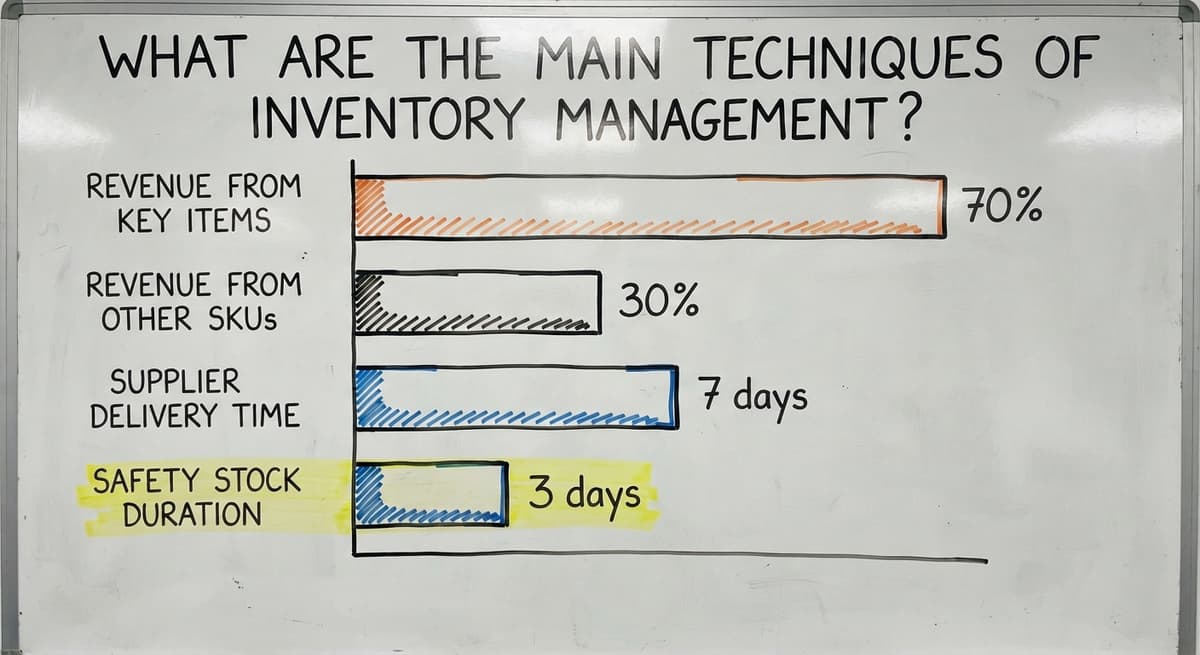
Here is a plain example. A wholesale office-supply distributor carries 2,000 SKUs. Fifty of them, printer cartridges and copy paper, account for 70% of revenue. Those are A items. They need tight reorder control, prime shelf space, and frequent cycle counts. The remaining 1,950 SKUs split the other 30%. Many of those C items can sit on a back shelf and be reordered quarterly.
Without this kind of ranking, most small operations treat every SKU the same. That means spending equal time on a slow-moving specialty item and a fast-moving staple. ABC analysis stops that waste by directing attention where it earns the most return.
Technique 3: Just-in-Time Inventory
Just-in-time inventory (JIT) means ordering stock only when it is needed, not before. The benefit is lower carrying costs. You hold less product, use less space, and tie up less cash.
The trade-off is risk. If a supplier ships late, you run out. JIT works best when lead times are short and reliable, and when demand follows a predictable pattern. A distributor with 3 or 4 trusted suppliers and steady order volume is a good candidate. A business with unpredictable demand or long overseas lead times is not.
Real-time inventory data is required for JIT to function. A manual spreadsheet updated weekly cannot give you the signal accuracy JIT demands.
The comparison is easier when one option is built for you
Off-the-shelf means fitting your process to the software. We do it the other way round, and the first look costs nothing.
Book a callTechnique 4: Reorder Point and Safety Stock
A reorder point is the inventory level that triggers a new buy order. When stock drops to that number, you buy more. Set it too high and you overstock. Set it too low and you run out.
The basic formula: reorder point = (average daily usage x supplier lead time) + safety stock.
Safety stock is a buffer. It covers demand spikes and supplier delays. If you sell 50 units a day and your supplier takes 7 days to deliver, your base reorder point is 350 units. Add 3 days of safety stock (150 units) and your reorder point becomes 500 units.
That math is simple. Getting it right needs clean, consistent data on usage and lead times. Spreadsheets that are updated manually once a week rarely give you numbers accurate enough to trust. According to the US Census Bureau's Monthly Wholesale Trade data, inventories-to-sales ratios shift regularly across wholesale sectors, which means reorder points need periodic review, not a one-time setup.
Technique 5: Cycle Counting
A full annual inventory count shuts operations down. Cycle counting replaces that with a rolling schedule. You count a small portion of your inventory every day or week, rotating through all SKUs over time.
Errors surface quickly. A mismatch between the count and the system record gets caught within days, not at year-end when the damage is done. Disruption stays minimal because the warehouse keeps running.
Cycle counts work best when tied to ABC analysis. Count A items every week. Count B items monthly. Count C items quarterly. That keeps your highest-value stock accurate without overwhelming the team.
Operations that rely on paper or spreadsheet records often skip cycle counts entirely. Reconciling a manual count against a manual record is slow and error-prone. The result is that accuracy drifts all year and only gets fixed during the painful annual shutdown.
Technique 6: Inventory Management Software and Custom Systems
Inventory management software automates the work that manual systems cannot handle at scale. Reorder alerts fire when stock hits the trigger level. Every movement, receiving, picking, shipping, gets logged in real time. Human error drops because fewer steps need manual entry.

Many small distributors and warehouses need a system that works alongside their existing accounting package rather than replacing it. A full enterprise resource planning platform can cost more than the problem it solves and force the team to change every workflow to match the software.
A custom-built system takes the opposite approach. It fits how your operation already works. Your pick process, your receiving flow, your supplier lead times, all of it gets built in rather than worked around. Inventory management software for wholesale distributors built this way tends to get used, because it does not fight the team's habits. Custom working software for warehouses also makes accounting integration for warehouse operations cleaner, since the data model can be designed to match what your accountant actually needs.
The right software supports the techniques you choose. It does not dictate them.
Which Inventory Technique Is Right for Your Operation?
No single technique fits every business. Most operations that run well use a combination. Start with ABC analysis to rank your SKUs. Set reorder points for your top A items first. Add safety stock based on your actual lead times and demand swings. Then build a cycle count schedule around your A and B items.

JIT can come later, once your data is clean enough to trust. Cycle counting keeps that data clean over time. Software or a custom system should sit underneath all of it, handling the tracking and alerts so your team can focus on moving product.
The right system fits your operation. It does not force you to change how you work in order to use it. Order management for fulfillment centers and warehouse workflow automating both become far more effective when the inventory layer underneath them is accurate and current.
If your team is still reconciling stock on spreadsheets, the techniques above will only take you so far. The next step is a system built around the way you actually operate.
Frequently asked questions
What are the four types of inventory management systems?
The 4 common types are periodic systems (you count stock on a fixed schedule), perpetual systems (every transaction updates the count in real time), barcode-based systems (scans drive the perpetual record), and RFID systems (radio tags update stock automatically without a scan). Most small distributors start with a perpetual system tied to barcode scanning. The right choice depends on your order volume, the number of SKUs you carry, and how much manual matching your team can absorb.
What is FIFO, LIFO, and JIT?
FIFO (First In, First Out) ships the oldest stock first. LIFO (Last In, First Out) ships the newest stock first and is used mainly for accounting purposes in rising-cost environments. JIT (Just-in-Time) means ordering only when stock is needed, keeping holding costs low. All 3 are inventory control methods, but they solve different problems. FIFO protects product quality. LIFO affects cost accounting. JIT reduces carrying costs when supplier lead times are reliable.
What software is used for inventory?
There is no single best answer. Options range from spreadsheets (low cost, limited scale) to standalone inventory apps (affordable, general-purpose) to cloud platforms with built-in accounting links (mid-market) to fully custom systems built around a specific operation. What decides the choice is order volume, the number of SKUs, how the operation connects to an accounting package, and whether a generic workflow fits or a custom one is needed.
What are some formulas used in inventory management?
The most common formulas are: reorder point = (average daily usage x lead time) + safety stock; safety stock = (maximum daily usage x maximum lead time) minus (average daily usage x average lead time); inventory turnover = cost of goods sold divided by average inventory value. These formulas are only as good as the data behind them. Clean, consistent usage and lead-time records are required before the math means anything.
How does ABC analysis work in a warehouse setting?
ABC analysis sorts every SKU into 3 groups by revenue contribution or sales velocity. A items (roughly the top 10 to 20% of SKUs) usually drive 70 to 80% of revenue and need the tightest controls. B items are mid-range. C items are slow movers that need less attention. In a warehouse, this shapes where you put stock (A items close to the shipping dock), how often you count it, and how tightly you manage reorder points.
What is safety stock and why does it matter?
Safety stock is extra inventory kept on hand to absorb demand spikes or supplier delays. Without it, any disruption causes a stockout. The right amount depends on how variable your demand is and how reliable your suppliers are. A distributor with steady demand and a dependable supplier needs less safety stock than one with unpredictable orders and long lead times. Setting it correctly needs real usage data, not a guess.
Can a small operation use inventory management techniques without a big ERP system?
Yes. ABC analysis, reorder points, safety stock, and cycle counting are disciplines, not software features. You can apply them with a spreadsheet at low volume. The problem is that manual tracking breaks down as order volume grows. Three staff members spending 6 hours a week each on manual matching at $22 an hour adds up to more than $20,500 a year in labor alone, before counting the errors that slip through. A system built around your operation pays for itself faster than most owners expect.
What is cycle counting and how is it different from a full inventory count?
A full inventory count stops operations while staff count every item in the building. Cycle counting replaces that with a rotating schedule: a small portion of stock gets counted each day or week, so every SKU gets counted several times a year without a shutdown. The advantage is that errors surface within days rather than at year-end. Tied to ABC analysis, cycle counting focuses the most effort on the items that matter most to revenue.
Start with a free first look
A 30 minute call, your operation mapped, and a clear picture of what we would build. No obligation and nothing to install.
Book a callRelated guides
The rest of this guide, for the parts of the job this page does not cover.
- What is the Difference Between Aggregate and Item Inventory Management
- What is Abc Classification in Inventory Management
- What is Inventory Management and Its Types
- What is the Main Purpose of Inventory Management
- What is Information Technology Inventory Management
- What is Risk Pooling in Inventory Management
- What is Inventory Management Mary Kay
- What is Stock Taking in Inventory Management
- What is Bin Number in Inventory Management
- What is the Goal of Inventory Management Quizlet
- What is the Implication of Proper Inventory Management
- What is Inventory Management and Its Importance
- What is the Importance of Eoq in Inventory Management
- What is the Importance of Quality Inventory Management
- What is Mean by Inventory Management
- What is Inventory Management Meaning in Hindi
- What is Inventory Management and Why is It Important
- What is the Rationale for Inventory Management Quizlet
- What is the Purpose of Inventory in Operations Management
- What is Inventory Management Whiteboard Wednesday
- What is Fluctuation Stock in Inventory Management
- What is the Management and Non Managerial Human Resources Inventory
- What is Inventory Listing
- What is Inventory