


What Is The Importance Of Eoq In Inventory Management
EOQ, or Economic Order Quantity, is the ideal number of units to order at one time so your total inventory costs stay as low as possible. It matters in inventory management because it stops you from ordering too much or too little. Both mistakes cost real money. Getting EOQ right cuts carrying costs, reduces ordering costs, and keeps cash moving through your business instead of sitting on shelves.
Reviewed October 2026. Written for owners and operations managers at small and mid-size wholesale distributors and warehouses.
Book a callWhat EOQ Means in Inventory Management
EOQ stands for Economic Order Quantity. It is the exact number of units you should order each time you place a buy order to keep your total costs at their lowest point. The formula balances 2 competing forces: the cost of ordering stock and the cost of holding it. Order too often and your ordering costs climb. Order too little too rarely and your holding costs climb. EOQ finds the number that sits right between those 2 extremes.
We build it for your operation, and the first look is free
If you would rather not compare products, describe how your operation already works and we build the system around it.
No build cost. You see it running on your own process first, and the monthly subscription starts only once it is live.
Book a callThe Two Costs EOQ Tries to Balance
Every inventory decision carries 2 types of cost, and they pull in opposite directions.
Ordering costs include the staff time to create a buy order, supplier processing fees, and inbound shipping charges. Each time your team places an order, those costs hit again.
Holding costs include warehouse space, insurance, spoilage, and the cash tied up in stock sitting on your shelves. GS1, the global body behind supply chain standards, notes that accurate item spotting, enabled by barcode standards, is the foundation of reliable stock control: as GS1 explains at gs1.org/standards/barcodes, "GS1 standards are the most widely used supply chain standards system in the world."
Order more often and ordering costs rise. Order less often and holding costs rise. EOQ finds the point where those 2 costs add up to the least.
Why Does EOQ Matter for Wholesale Distributors and Warehouses?
Why does EOQ matter more for small distributors than for large ones? Because a small or mid-size operation feels every dollar of waste directly. A large enterprise can absorb a bad quarter. Your team cannot.
Overstocking ties up cash your business needs for payroll, new customers, or seasonal surges. Understocking leads to stockouts, missed orders, and customers who call a competitor next time. Neither outcome is acceptable on a lean team.
EOQ gives your operations manager a defensible, repeatable number to work from. Instead of ordering based on a gut feel or last month's habit, your team acts on a figure that reflects your actual demand and your actual costs. That shift alone removes a category of avoidable error from your weekly workflow.
For more on building reliable reorder rules, see how reorder point and safety stock work together in distribution operations.
How EOQ Reduces Carrying Costs
Carrying costs are the expenses that pile up while inventory sits in your warehouse. They include storage space, the labor to count and manage stock, the risk of product obsolescence, and the cost of the capital you spent buying that stock in the first place.
Ordering the right quantity means your average inventory level stays lower. Here is a simple example. If you order 500 units at a time, your average stock on hand is roughly 250 units. If you order 200 units at a time, your average drops to about 100 units. That is 150 fewer units taking up shelf space, drawing insurance, and risking damage or expiry at any given moment.
Ordering at the right quantity keeps your average stock low, and lower average stock means lower carrying costs across every line item.

How Lower Inventory Affects Your Warehouse Footprint and Tax Exposure
Lower average inventory shrinks the warehouse footprint you need. For a distributor paying per square foot, that is a direct line item reduction. The IRS requires that inventory be counted and valued at year-end: as IRS Publication 538 states, "To figure taxable income, you must value your inventory at the beginning and end of each tax year." Carrying less stock makes that valuation simpler and the tax exposure smaller.
The comparison is easier when one option is built for you
Off-the-shelf means fitting your process to the software. We do it the other way round, and the first look costs nothing.
Book a callHow EOQ Reduces Ordering Costs
Every buy order your team places carries a fixed cost. Someone writes the order, a supplier processes it, and a shipment moves. The US Bureau of Labor Statistics reports that stock clerks and order fillers earn a median wage that makes each hour of avoidable admin work a measurable expense.
Ordering in larger, optimized batches means fewer orders placed per year. Fewer orders means less time your team spends writing, approving, and tracking buy orders. On a lean team, those hours are not free. They come at the cost of other work that actually moves the business forward.

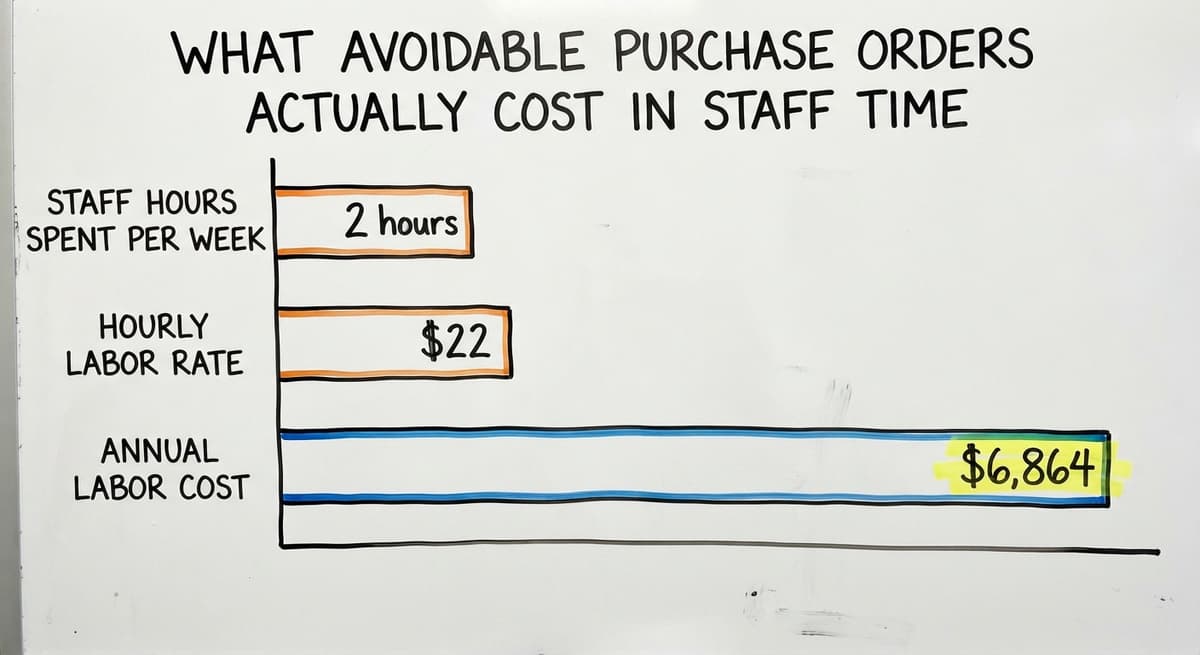
What Avoidable Purchase Orders Actually Cost in Staff Time
Consider 3 staff members each spending 2 hours a week on buy orders that EOQ would consolidate. At $22 an hour, that is $6,864 a year in labor alone, before you count supplier processing fees or inbound freight.
EOQ does not just save money on each order. It saves the staff hours that were going to avoidable orders in the first place.
EOQ and Cash Flow
Inventory is cash in a different form. Every unit on your shelf is a dollar that cannot pay a supplier early, cover a payroll gap, or fund a new product line.
EOQ keeps your average inventory at a level your business can actually afford. When you stop over-ordering, you free up working capital that was sitting idle in your warehouse. That cash can absorb a slow month, take on a large new customer, or handle a seasonal surge without a line of credit.

How the Inventory-to-Sales Ratio Signals Over-Stocking
For operations that track finances in an accounting package, cash visibility is already a priority. EOQ connects that financial discipline to the warehouse floor. The US Census Bureau's Monthly Wholesale Trade data tracks the inventory-to-sales ratio across wholesale firms nationally. When that ratio climbs, it signals that distributors are holding more stock relative to what they sell, exactly the pattern EOQ is designed to prevent.
Where EOQ Breaks Down Without Good Data
EOQ is only as accurate as the numbers you feed into it. The formula needs 3 inputs: annual demand, cost per order, and annual holding cost per unit. If any of those numbers are stale, your EOQ output is wrong.
Businesses running inventory in spreadsheets or printed sheets often discover that their demand figures are months out of date. Supplier lead times change. Prices shift. A seasonal spike can make a static EOQ number dangerously misleading for the next quarter.
A formula built on outdated inputs produces confident-looking answers that are wrong. Keeping EOQ useful means keeping its data current.
See it running on your own process first
No build cost. The subscription starts once it is live and doing the job, not before.
Book a call
Stale EOQ Data and the Fulfillment Failures That Follow
The NIST Manufacturing Extension Partnership provides vendor-neutral guidance on supply chain process, and a consistent theme is that good process depends on current data. A connected inventory system solves this by updating EOQ inputs automatically as sales, receipts, and costs change.
Stale data is not just an inconvenience. The FTC's Mail, Internet, or Telephone Order Rule holds businesses accountable for shipping when they said they would. An EOQ built on bad demand data leads to stockouts, and stockouts lead to the kind of fulfillment failures that carry regulatory and reputational consequences.
Putting EOQ to Work in Your Operation
Start with 3 numbers. You need your annual demand for a given SKU, your cost per buy order, and your annual holding cost per unit. Once you have those, the EOQ formula gives you the order quantity that minimizes total cost.
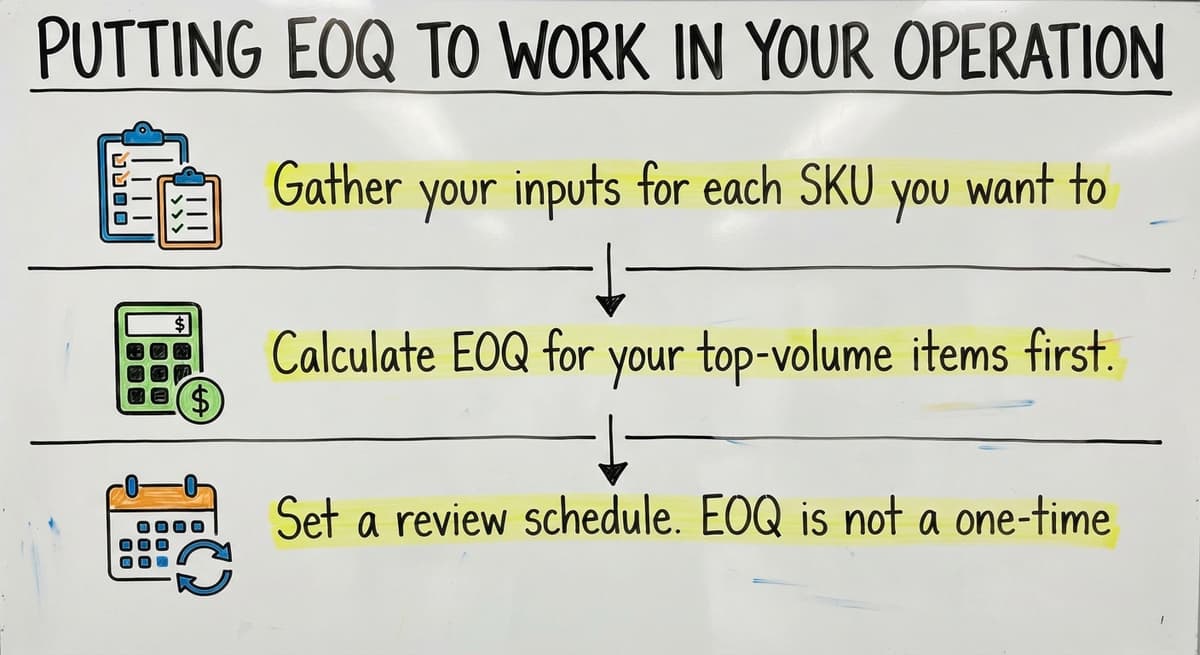
Here is how to move from the formula to a working process:
- Gather your inputs for each SKU you want to tune. Use actual sales history, not a rough estimate.
- Calculate EOQ for your top-volume items first. These carry the most cost risk and the most savings potential.
- Set a review schedule. EOQ is not a one-time calculation. Demand shifts, supplier costs change, and holding costs move with your lease. Review figures at least quarterly.
Building EOQ Into Your Reorder Workflow
- Build EOQ into your reorder workflow so staff act on it automatically. A trigger that fires a buy order when stock hits the reorder point, sized to the EOQ quantity, removes the manual step entirely.
- Keep your accounting package for financials and let a purpose-built system handle the inventory math. Mixing the two jobs in one tool creates the data gaps that make EOQ unreliable.
Inventory management software for wholesale distributors can embed these rules directly into buy order triggers, so the right quantity is suggested every time without a recalculation.
The goal is a system where EOQ logic runs in the background and your team acts on the output, not on a hunch.
When Does It Make Sense to Move Beyond a Spreadsheet for EOQ?
Moving beyond a spreadsheet makes sense the moment your SKU count grows past what one person can reliably track. A spreadsheet works for 20 items. It starts to break at 200, and it fails at 2,000, not because the math is wrong but because the inputs go stale faster than anyone can update them.
A system built around how your operation already works can apply EOQ rules across every SKU without a costly ERP migration. It connects to your existing accounting package, pulls current sales data, and fires buy orders at the right quantity without manual recalculation.
How Custom Operational Software Replaces Spreadsheet Workarounds
The Software Society builds custom working software for distributors and warehouses in exactly this position. The work is local to Columbus, Ohio, and scales to small and mid-size operations, not just enterprise accounts. Your accounting software stays in place for financials. The custom layer replaces only the manual parts: the spreadsheets, the printed pick sheets, the Access databases that one person keeps and no one else fully understands.
If your team is spending hours a week on buy orders that a system could handle in seconds, that is the conversation worth starting. Learn how custom working software replaces Excel and Access workarounds, or reach out to talk through what your operation actually needs.
The right system does not replace your team's judgment. It gives them accurate numbers to act on, every time, without the manual overhead.
Frequently asked questions
What is the EOQ inventory model?
The EOQ inventory model is a formula that calculates the ideal order quantity to minimize total inventory costs. It takes your annual demand, your cost per order, and your annual holding cost per unit, then outputs the order size that keeps the sum of those costs as low as possible. It is a decision rule, not a guarantee: the output is only as good as the inputs.
What is FIFO, LIFO, and JIT?
FIFO (First In, First Out), LIFO (Last In, First Out), and JIT (Just In Time) are inventory management methods, but they answer a different question than EOQ does. FIFO and LIFO describe how you value the cost of goods sold for accounting purposes. JIT is a replenishment strategy that aims to receive stock only when it is needed. EOQ focuses on order quantity; these methods focus on valuation and timing. A business can use EOQ alongside any of them.
How do you improve inventory accuracy?
Inventory accuracy improves when you reduce the gap between what your records say and what is physically on the shelf. The most reliable steps are cycle counting, barcode scanning at receiving and shipping, and removing manual data entry from the receiving process. GS1 barcode standards are the foundation most scan-based systems build on. A connected system that updates records in real time closes the gap faster than any spreadsheet process.
What are the 5 benefits of inventory management?
Strong inventory management delivers 5 clear benefits: lower carrying costs from holding less idle stock, fewer stockouts that lose sales and damage customer relationships, better cash flow from freeing working capital tied up in excess inventory, more accurate financial reporting (the IRS needs year-end inventory valuation), and less staff time spent on avoidable buy orders and manual counts. EOQ is one of the core tools that makes all 5 possible.
How do you calculate EOQ?
EOQ uses 3 inputs: D (annual demand in units), S (cost per order placed), and H (annual holding cost per unit). The formula is the square root of (2 x D x S divided by H). For example, if you sell 1,200 units a year, each order costs $50 to place, and holding one unit for a year costs $4, your EOQ is the square root of 30,000, or about 173 units per order.
Why does EOQ break down when inventory data is inaccurate?
EOQ is a formula, not a judgment call. Feed it wrong demand figures and it returns the wrong order quantity with complete confidence. Stale data is the most common failure point: a demand number from 6 months ago may not reflect a new customer, a lost account, or a seasonal shift. When inputs drift, the EOQ output drifts with them, and the savings the formula promised disappear. Current, connected data is what keeps EOQ reliable over time.
When should a small distributor stop using a spreadsheet for EOQ?
The practical limit for a spreadsheet is roughly the point where one person can no longer keep every input current. Most operations hit it somewhere between 100 and 300 active SKUs. Past that point, demand figures go stale, holding costs go unrevised, and the EOQ numbers the spreadsheet produces are no longer trustworthy. A purpose-built system that pulls live sales and cost data removes that ceiling without requiring a full ERP migration.
What data do you need to calculate EOQ?
You need 3 figures for each SKU: the number of units you sell or use in a year (annual demand), the total cost your business incurs each time it places a buy order (ordering cost), and the cost of holding one unit in stock for a full year (holding cost). Holding cost usually includes storage space, insurance, spoilage risk, and the opportunity cost of the capital tied up in that unit. Accurate inputs produce a useful EOQ. Guessed inputs produce a number that looks precise but is not.
Start with a free first look
A 30 minute call, your operation mapped, and a clear picture of what we would build. No obligation and nothing to install.
Book a callRelated guides
The rest of this guide, for the parts of the job this page does not cover.
- What is Inventory Management and Its Importance
- What is the Importance of Quality Inventory Management
- What is the Difference Between Aggregate and Item Inventory Management
- What is Abc Classification in Inventory Management
- What is Inventory Management and Its Types
- What is the Main Purpose of Inventory Management
- What is Information Technology Inventory Management
- What is Risk Pooling in Inventory Management
- What is Inventory Management Mary Kay
- What is Stock Taking in Inventory Management
- What is Bin Number in Inventory Management
- What is the Goal of Inventory Management Quizlet
- What is the Implication of Proper Inventory Management
- What is Inventory Management Explain Techniques of Inventory Management
- What is Mean by Inventory Management
- What is Inventory Management Meaning in Hindi
- What is Inventory Management and Why is It Important
- What is the Rationale for Inventory Management Quizlet
- What is the Purpose of Inventory in Operations Management
- What is Inventory Management Whiteboard Wednesday
- What is Fluctuation Stock in Inventory Management
- What is the Management and Non Managerial Human Resources Inventory
- What is Inventory Listing
- What is Inventory