


Which Warehouse Management System Would A Jeweler Most Likely Use
A jeweler is most likely to use a jewelry-specific inventory system rather than a standard warehouse management system. Small retail jewelers pair their accounting software with a custom inventory layer built for serial numbers, certificates, and consignment; wholesale jewelry distributors run something closer to a small warehouse. This guide, reviewed in September 2026, covers both.
Published 31 July 2026. Reviewed and updated 15 September 2026.
Book a callWhy Is Jewelry Inventory Different From Standard Warehouse Stock?
Jewelry does not move through a warehouse the way boxes of cereal do. Each piece may be worth hundreds or thousands of dollars. Many items are one of a kind.
A ring is not just a ring. It has a metal type, a karat weight, a stone, a cut, a finish, and a style number.
Standard warehouse software is built for pallets and bulk goods. It counts units. It does not know what those units are made of.
High Value, Small Size, and Unique Attributes
Jewelry items are small enough to lose and valuable enough that losing one matters. A single tray of rings can hold $50,000 worth of stock. A standard WMS tracks location and quantity.
A jewelry operation needs to track the specific piece, not just the count. Serial numbers, stone details, metal grades, and supplier records all need to live in the same system. Without that, a count of "12 rings" tells you almost nothing useful.
Loss Prevention and Audit Trails
In a jewelry setting, knowing who touched a piece and when is not optional.
Theft, misplacement, and consignment disputes all require a clear record. That record is called an audit trail. It logs every move a piece makes from the moment it arrives to the moment it sells or leaves the building.
Standard warehouse software rarely builds this in. Jewelry businesses that skip it find out why it matters only after something goes wrong.
Would you rather have it built around your operation?
The first look is free. If you would rather not compare products, describe how your operation already works and we build the system around it.
No build cost. You see it running on your own process first, and the monthly subscription starts only once it is live.
Book a callWhat Features Does a Jeweler Need in a Warehouse Management System?
Not every feature a large distribution center uses is relevant to a jeweler, and 5 are. But some features matter more in a jewelry setting than in almost any other.
The list below is not about finding the most powerful software. It is about finding the right fit for how a jewelry business actually runs.
Reviewed August 2026. Each figure comes from the assumptions stated beside it, so you can substitute your own and the arithmetic still holds.
Item-Level Tracking and Attribute Management
A jewelry inventory system must track each piece as its own record. That means a unique identifier for every item, not just a SKU shared by 20 similar rings. It also means storing attributes alongside that identifier.
Metal type, karat, stone type, stone weight, style, and finish all need a field. Without attribute tracking, you cannot answer basic questions like "how many 14-karat yellow gold solitaires do we have in stock right now."
GS1, the global standards body for barcodes, explains that a consistent identifier system allows any item to be scanned and recognized across different locations and systems.
You can read more about barcode standards at GS1. For a jeweler, this means barcoding or tagging each piece with a label that connects to its full record in the system.
Consignment, Reorder Alerts, and POS Integration
Many jewelers work with consignment inventory. That means pieces owned by a vendor sit in the jeweler's case until they sell. The jeweler does not own them yet.
The system needs to know the difference between owned stock and consigned stock. Mixing them up creates accounting errors and vendor disputes.
Reorder alerts matter too. A jeweler runs out of clasps, settings, and raw materials just like any other maker.
The system should flag when supplies drop below a set level. It should also connect to the point-of-sale terminal so that a sale on the floor removes the item from inventory in real time.
Safety, Compliance, and Chain of Custody
OSHA notes that "The warehousing and storage industry includes establishments operating facilities for general merchandise, refrigerated goods, and other products," and sets clear expectations for how staff move through those spaces.
Even a small jewelry stockroom is a workplace with safety obligations. Beyond physical safety, chain-of-custody tracking, which logs who handled each piece and when, protects the business during audits and insurance claims.
The IRS is direct on inventory obligations. IRS Publication 538 states: "To figure taxable income, you must value your inventory at the beginning and end of each tax year." That is not a suggestion. It is a legal requirement.
A system that cannot produce an accurate count and valuation at year end creates a tax problem, not just an operations problem.
Is the comparison easier when one option is built for you?
Yes. Off-the-shelf means fitting your process to the software, and custom is the other way round. The first look costs nothing.
Book a callWhich Type of Warehouse Management System Would a Jeweler Most Likely Use?
The answer is a matter of the size of the operation and what it actually does.
A retail jeweler with 2 display cases needs something very different from a wholesale jewelry distributor shipping 500 orders a week. Most jewelers fall somewhere in the middle, and most do not need enterprise-level software.
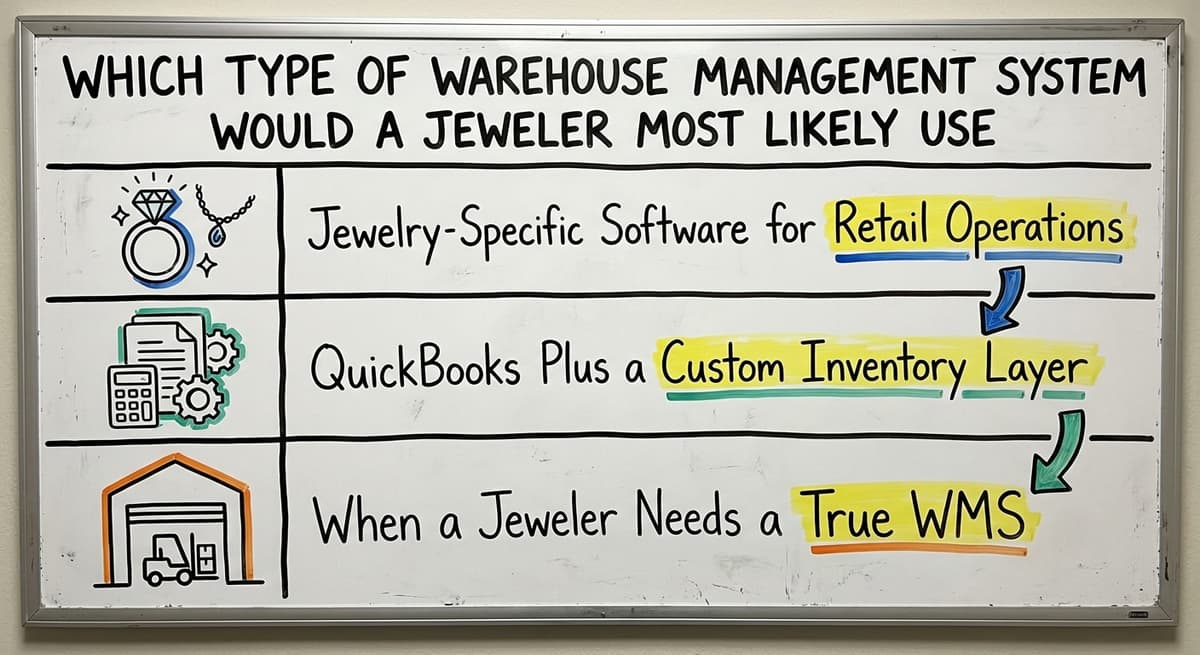
Jewelry-Specific Software for Retail Operations
Retail jewelers are the group most often on software built specifically for their trade. Three names come up regularly in this space.
- Jewelry retail platforms target independent jewelry retailers and handle point-of-sale, inventory, and customer history in one place.
- Jewelry inventory specialists focus on inventory tracking with strong attribute fields for metal and stone details.
- General retail platforms are broader systems with inventory modules that some jewelers customize for their needs.
These tools are not warehouse management systems in the traditional sense. They are inventory and retail management tools shaped around how a jewelry store works. For most retail jewelers, that is exactly what they need.
Your Accounting Software Plus a Custom Inventory Layer
Many small jewelers are already on a standard accounting package for their books. They do not want to replace it. They should not have to.
A practical middle path is to keep the accounting software in place and add a purpose-built inventory layer on top of it.
The inventory tool handles item tracking, attributes, and audit logs. The accounting software handles the books. The 2 systems share data through an integration so nothing has to be entered twice.
This approach avoids a full system migration. It keeps the accounting setup the staff already knows. It adds the inventory control the business actually needs.
For a small team of 5 to 20 people, this is the most realistic path forward. How to integrate inventory tracking with the accounting software is a topic worth exploring before committing to any new platform.
When a Jeweler Needs a True WMS
A wholesale jewelry distributor shipping large volumes of orders is much closer to a traditional warehouse operation. At that scale, the business needs pick-and-pack accuracy, shipping integration, order tracking, and SKU catalog management. A retail-focused jewelry tool will not cover those needs.
A lightweight WMS or a small warehouse management system with jewelry-specific customization becomes the better fit.
The NIST Manufacturing Extension Partnership offers vendor-neutral guidance on supply chain and inventory processes at NIST MEP that can help a business frame what it actually needs before talking to vendors.
Retail Jeweler vs Wholesale Jewelry Distributor: Different System Needs
Retail jewelers and wholesale jewelry distributors have very different operational needs. A boutique with 1 display case and a goldsmith in the back has almost nothing in common with a wholesale jewelry distributor fulfilling orders for 200 retail accounts.
Choosing the wrong type of system for the wrong type of operation is one of the most common and most expensive mistakes in this space.
What a Retail Jeweler Needs
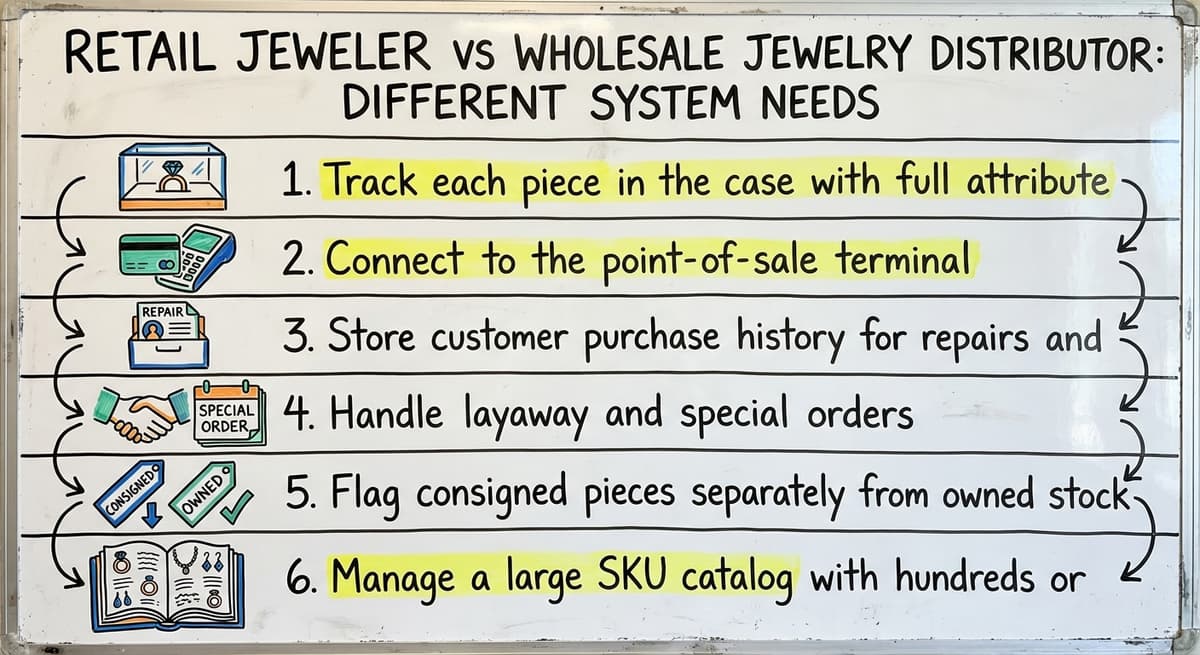
A retail jeweler's priorities are the customer experience and the display case. The system needs to:
- Track each piece in the case with full attribute details
- Connect to the point-of-sale terminal
- Store customer purchase history for repairs and upgrades
- Handle layaway and special orders
- Flag consigned pieces separately from owned stock
Fulfillment speed is not the main concern. Accuracy and presentation are. A retail jeweler needs jewelry inventory software that matches the pace and detail of a high-touch sales environment.
What does it look like running on your own process?
The first thing you see is it running on your own process, at no build cost. The subscription starts once the system is live and doing the job, not before.
Book a callWhat a Wholesale Jewelry Distributor Needs
A wholesale jewelry distributor is closer to a small warehouse. The priorities shift toward speed, volume, and order accuracy. The system needs to:
- Manage a large SKU catalog with hundreds or thousands of active items
- Process and track customer orders from receipt to shipment
- Support pick-and-pack workflows so staff pull the right items
- Connect to shipping carriers for label generation and tracking
- Produce invoices and packing slips automatically
The Warehousing Education and Research Council publishes standard benchmarks for distribution center performance at WERC. A wholesale jewelry operation should measure itself against those benchmarks to understand where its current process falls short.
A retail jewelry tool will not close that gap. Wholesale jewelry inventory management needs a different class of software entirely.
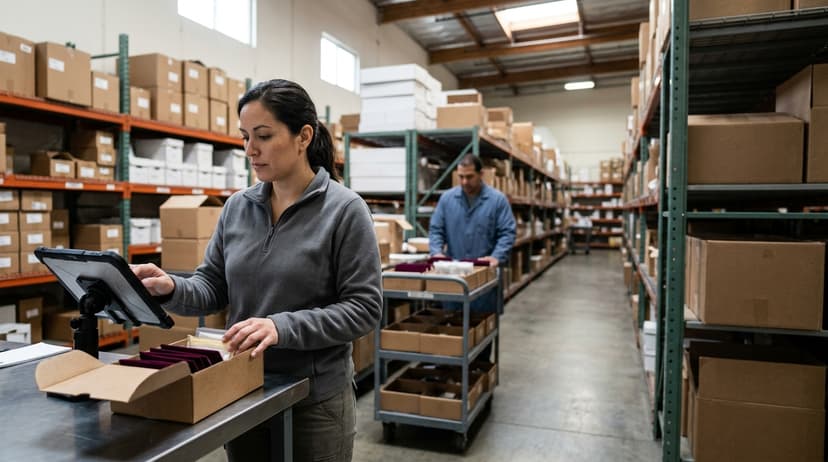
When Does Off-the-Shelf Software Not Fit the Way a Jeweler Works?
Many jewelers are on spreadsheets or paper logs for inventory, because off-the-shelf software does not fit the way a jeweler works. Not because they want to.
Because every system they tried forced them to change how they work to fit the software. That is backwards. The software should fit the business, not the other way around.
The Problem With Generic Systems
Off-the-shelf warehouse software is built for the average operation. It assumes you move boxes. It assumes you have a loading dock. It assumes your items share SKUs with dozens of identical units.
A jewelry business does not work that way. When the software does not match the workflow, staff work around it. They keep a second spreadsheet. They write notes on paper. The system becomes a formality rather than a tool.
Signs your business has outgrown spreadsheet inventory management include missed reorder points, items that show in the system but cannot be found on the floor, and stock counts that never match the books. These are not spreadsheet problems. They are system-fit problems.
A Custom or Semi-Custom Solution Is a Realistic Option
A purpose-built inventory layer does not have to cost what an enterprise ERP costs. A local or boutique software partner can build a tool around the jeweler's existing process.
The accounting software stays in place. The custom layer handles jewelry stock tracking, attribute fields, audit logs, and consignment records. The 2 systems share data through a simple integration.
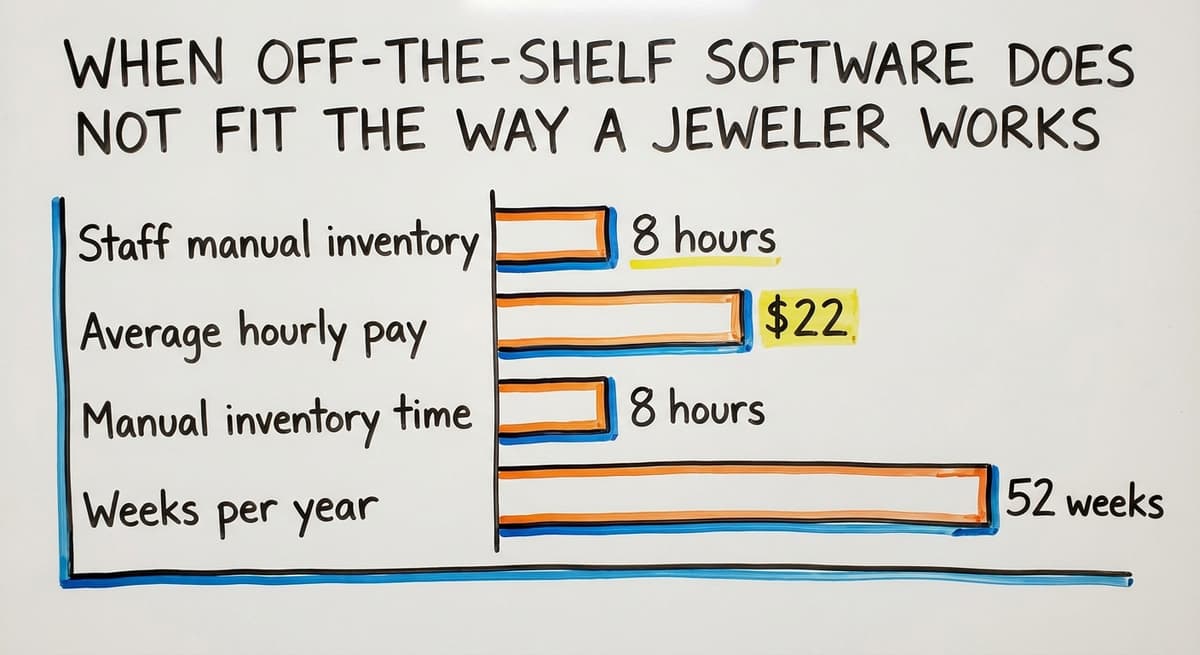
Consider the cost of not solving the problem. If 2 staff members each spend 8 hours a week on manual inventory work, and the average pay for a stock and order clerk is around $22 an hour according to the US Bureau of Labor Statistics, that is 2 people, 8 hours each, 52 weeks a year at $22 per hour. That works out to $18,304 a year in labor spent on a process that a well-built system could handle in a fraction of the time.
Custom inventory software for wholesale distributors and small jewelers is not a luxury. It is the cheaper path when you count what the current process actually costs.
Start with a free first look
A 30 minute call, your operation mapped, and a clear picture of what we would build. No obligation and nothing to install.
Book a callWhat to Expect From a Custom Build
A semi-custom solution built for a small jewelry operation is 5 parts:
- Item-level records with attribute fields for metal, stone, karat, and style
- Barcode or tag printing for each piece
- Audit logs that record every movement
- Consignment tracking separate from owned inventory
- A connection to the accounting software so the books stay current
- Reorder alerts for supplies and raw materials
Implementation for a small team of 5 to 50 staff does not require months of disruption. A focused build with a clear scope can be live in weeks.
Warehouse inventory management software overview resources can help a business owner understand what a reasonable scope looks like before the first conversation with a developer.

Questions to Ask Before Choosing a System as a Jeweler
Before signing a contract or starting a build, a jeweler should be able to answer these questions. If the vendor cannot answer them clearly, that is a signal.
Questions About the System Itself
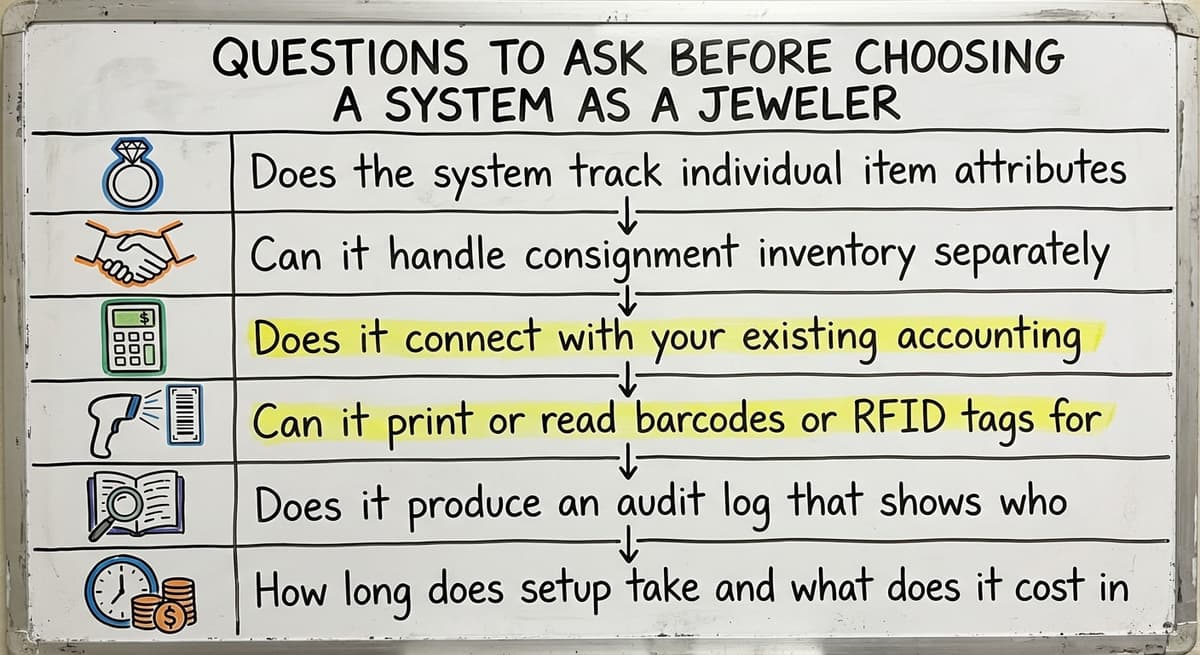
- Does the system track individual item attributes like metal type, stone, and weight?
- Can it handle consignment inventory separately from owned stock?
- Does it connect with your existing accounting software?
- Can it print or read barcodes or RFID tags for each piece?
- Does it produce an audit log that shows who touched each item and when?
The Auburn University RFID Lab has published independent research on RFID use in retail and supply chain settings at Auburn University RFID Lab. For jewelers managing high-value pieces, RFID tagging can reduce count time and improve accuracy compared to manual barcode scanning.
Questions About Fit, Cost, and Support
- There are 6 questions to ask. How long does setup take and what does it cost in total, not just the license fee?
- Is the system built for small operations or does it need a large team to run?
- Will it grow with the business without a full replacement later?
- Is there accessible support when something breaks, not just a ticket queue?
- What happens to your data if you stop using the system?
The US Census Bureau tracks wholesale trade inventories and the ratio of inventories to sales across sectors at US Census Bureau Monthly Wholesale Trade.
For a wholesale jeweler, understanding how inventory levels compare to sales volume is a useful benchmark when deciding how much system complexity is actually warranted. A small operation with a lean catalog does not need the same infrastructure as a national distributor.

What Does the Right System Actually Look Like for Most Jewelers?
The right inventory system for most jewelers is not the biggest or the most feature-rich.
Most jewelers reading this are not running a 50,000-square-foot distribution center. They are running a boutique, a studio, or a small wholesale operation with a team of under 30 people. It is the one that fits the actual workflow without forcing the team to change everything they know.
For a retail jeweler, that likely means a jewelry-specific platform, with some customization for attribute tracking. For a small wholesale operation, it may mean a lightweight WMS with a jewelry-specific layer built on top.
For a business already settled in its accounting software that cannot afford a full migration, it means a purpose-built inventory tool that connects to what is already in place.
The goal is not to have the most advanced system. The goal is to know where every piece is, who has touched it, what it is worth, and when to reorder supplies.
A system that does those 4 things reliably is worth more than a system that does 40 things poorly.

A Practical Path Forward for Small Jewelry Operations
Small jewelry operations have a practical path from spreadsheets to a system that works. Most small jewelers start there. The problem is not the spreadsheet.
The problem is that a spreadsheet cannot send a reorder alert, cannot log who moved a piece, and cannot connect to your point-of-sale system in real time. At some point, the manual process costs more than fixing it.
The practical path forward looks like this:
- Write down exactly how inventory moves through your business today. From arrival to display to sale or return.
- List the 3 biggest pain points. Where does the current process break down?
- Decide whether you need a retail tool, a wholesale tool, or a custom build.
- Ask vendors or developers to show you how their system handles your specific pain points, not a generic demo.
- Check whether the system connects to your accounting software before you commit.
- Ask for a real implementation timeline with a start date and a go-live date.
A system that fits your operation from day one will be used. A system that does not fit gets worked around.
The difference between those 2 outcomes is usually not the software. It is whether the people who built it understood how your business actually runs.
If you are at the point where manual processes are slowing growth and a spreadsheet is no longer enough, a connected system built around your existing workflow is a realistic next step.
Not a six-month ERP project. Not a platform built for a company 10 times your size. A focused, practical tool that solves the specific problems you have right now and grows with the business over time.
Frequently asked questions
Frequently asked questions
What is the most popular warehouse management system?
There is no single most popular system across all industries. Large operations tend to run one of the enterprise suites. Small businesses run lighter cloud systems.
Jewelers most often run a jewelry-specific platform. The right choice depends on the size of the operation, whether it is retail or wholesale, and what it needs to track.
What's the difference between WMS and ERP?
A WMS, or warehouse management system, focuses on tracking inventory movement inside a facility. It handles receiving, storage, picking, and shipping. An ERP, or enterprise resource planning system, covers the whole business including accounting, HR, purchasing, and sales alongside inventory.
A jeweler with a small team does not need a full ERP. A WMS or a specialized inventory tool connected to the accounting software is often enough.
What are some types of warehouse management systems?
Warehouse management systems fall into 3 categories. Standalone WMS tools focus purely on inventory and warehouse operations. ERP-integrated WMS modules sit inside a larger business platform.
Cloud-based WMS tools run in a browser with no local installation required. For jewelers, a fourth option is relevant: jewelry-specific inventory software that handles the attribute tracking and audit trails a general WMS does not include.
What are the three types of inventory management systems?
The 3 main types are periodic, perpetual, and just-in-time. A periodic system counts inventory at set intervals, such as monthly or yearly. A perpetual system updates the count in real time with every sale or receipt.
A just-in-time system orders stock only when it is needed, keeping almost no inventory on hand. Most jewelers benefit most from a perpetual system because high-value, one-of-a-kind pieces need to be tracked continuously, not just at the end of the month.
Do jewelers need a full WMS or just a specialized inventory tool?
Most retail jewelers do not need a full WMS. A jewelry-specific inventory tool or a lightweight system connected to their point-of-sale is usually enough.
Wholesale jewelry distributors who ship large volumes of orders are the exception. They need stronger order management, pick-and-pack support, and shipping integration that a retail inventory tool will not provide.
Can a jeweler keep using their accounting software and still improve inventory tracking?
Yes. A standard accounting package handles accounting well but is not built for detailed jewelry inventory tracking. A purpose-built inventory layer can sit alongside it and connect through an integration.
The inventory tool handles item records, attribute tracking, audit logs, and consignment. The accounting software handles the books. Staff do not have to learn a completely new accounting system, and nothing has to be entered twice.
What should a small jewelry operation avoid when choosing a warehouse system?
Avoid systems built for large distribution centers with complex setup requirements and long implementation timelines. Avoid tools that cannot track individual item attributes like metal type, stone, and karat.
Avoid any system that does not connect to your existing accounting software. And avoid software that forces you to change your entire workflow to match the system rather than the other way around.
Is custom inventory software a realistic option for a small jewelry business?
Yes, for the right business. A small jewelry operation with 5 to 50 staff that has already outgrown spreadsheets but cannot justify a full ERP is a strong candidate for a semi-custom build.
A focused build can add jewelry-specific inventory tracking on top of the accounting software without replacing it. The cost is lower than a full platform migration when you account for training, disruption, and the ongoing labor saved.
Is RFID better than barcodes for tracking jewelry?
For high-value, small items RFID has a real edge: a tray of rings can be counted in seconds without handling each piece, and a tag that leaves the counter without a sale shows up immediately.
Barcodes are cheaper and work fine for receiving and sales. Many jewelers run both: barcodes on tickets for the till, RFID tags on the pieces themselves for daily counts and loss control.
What features should a jewelry warehouse management system include?
Attribute fields for metal, weight, stone type, carat, cut, clarity and certificate numbers; serial tracking for each piece rather than counts by SKU; consignment and memo records; an audit trail of who touched each item and when; fast counting by tray or case; a link to the point of sale and the accounting software; and reports on slow movers, because in jewelry the stock is the cash.
How can jewelers prevent inventory loss and theft?
Count often and make counting cheap: daily tray counts with a scanner or RFID reader, a full count weekly.
Track every piece by serial, record every movement with a user and a time, keep memo and consignment stock separate from owned stock, and reconcile the system against the till and the safe.
Most loss is found late because counts are rare; a system that makes a count take minutes fixes that.
Can a warehouse management system track gemstones and certificates?
A general WMS tracks quantities by SKU and location, which is not enough for gemstones.
A jewelry system, or a custom layer on a general one, tracks each stone as its own record with weight, grade, origin and the grading certificate number, and keeps the certificate document attached to the piece so it travels with it through memo, sale and return. Insist on that before choosing any system.
Not sure this is the right shape for your operation?
The call is free. Describe how the work runs today. We map it on a call and show you what it would look like built around that, before you spend anything.
Book a callRelated guides
The rest of this guide, for the parts of the job this page does not cover.
Guides
- Warehouse Inventory Management Systems
- Warehouse Management System Top 10
- Software for Warehouse Management System
- Small Business Warehouse Management System
- Warehouse Management System Types
- Warehouse Inventory Management System
- Warehouse Management System Examples
- Warehouse Management System Implementation
- Cloud Warehouse Management System
Common questions
- What Warehouse Management System Does Amazon Use
- What is the Most Popular Warehouse Management System?
- Which Software is Best for Warehouse Management?
- What is the Most Important Part of Warehouse Organization
- What Are the Benefits of Warehouse Management System
- What is the Point of Warehouse Management System
- How to Choose a Warehouse Management System
- What is Asn in Warehouse Management System
- How to Create a Warehouse Management System
- What is a Warehouse Management System
- How to Build a Warehouse Management System
- What is a Warehouse Management System Used For
- Warehouse Management System vs Warehouse Control System
- Meaning of Warehouse Management System
- Definition of Warehouse Management System