

Asrs Automated Storage Retrieval System
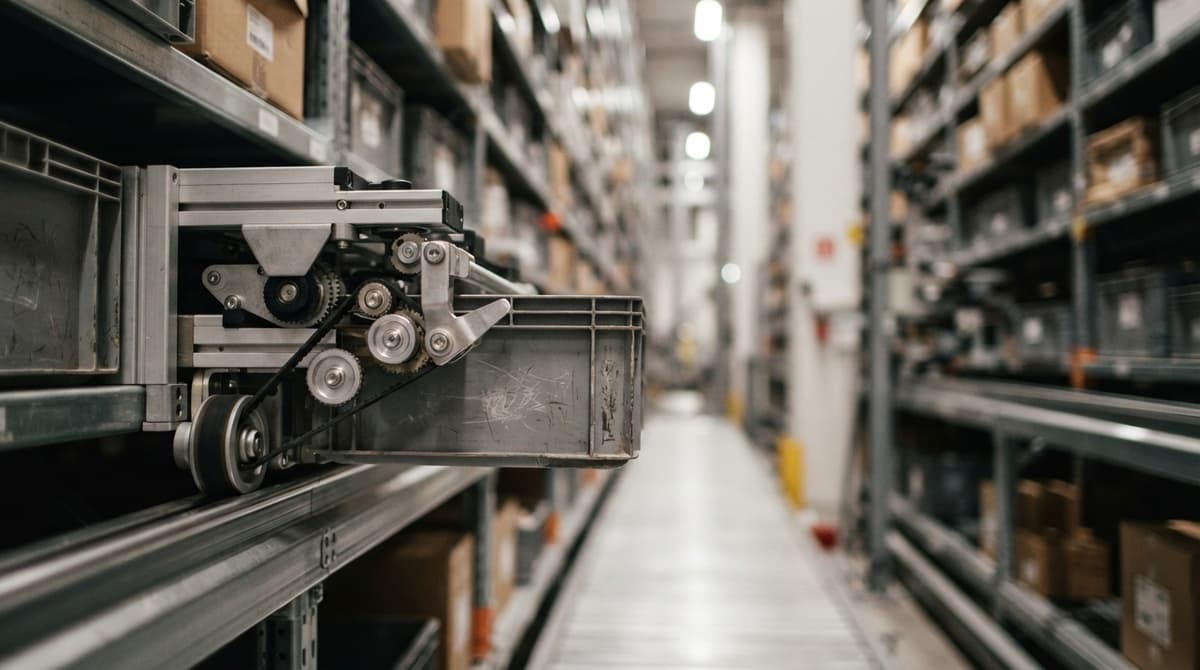
An ASRS automated storage retrieval system is a computer-controlled setup that stores and retrieves inventory without a worker walking the aisle. It combines physical storage, a retrieval machine, and control software. This article explains how it works, what it costs, and whether your operation is actually ready for one.
Published 18 July 2026. Reviewed and updated 15 September 2026.
Book a callWhat Is an ASRS Automated Storage Retrieval System and How Does It Work?
An automated storage and retrieval system has three core parts. First, a storage structure, which holds goods in defined locations.
Second, a retrieval machine, such as a crane, shuttle, or carousel, that moves goods to and from those locations. Third, control software that directs every move.
Reviewed September 2026. Each figure comes from the assumptions stated beside it, so you can substitute your own and the arithmetic still holds.
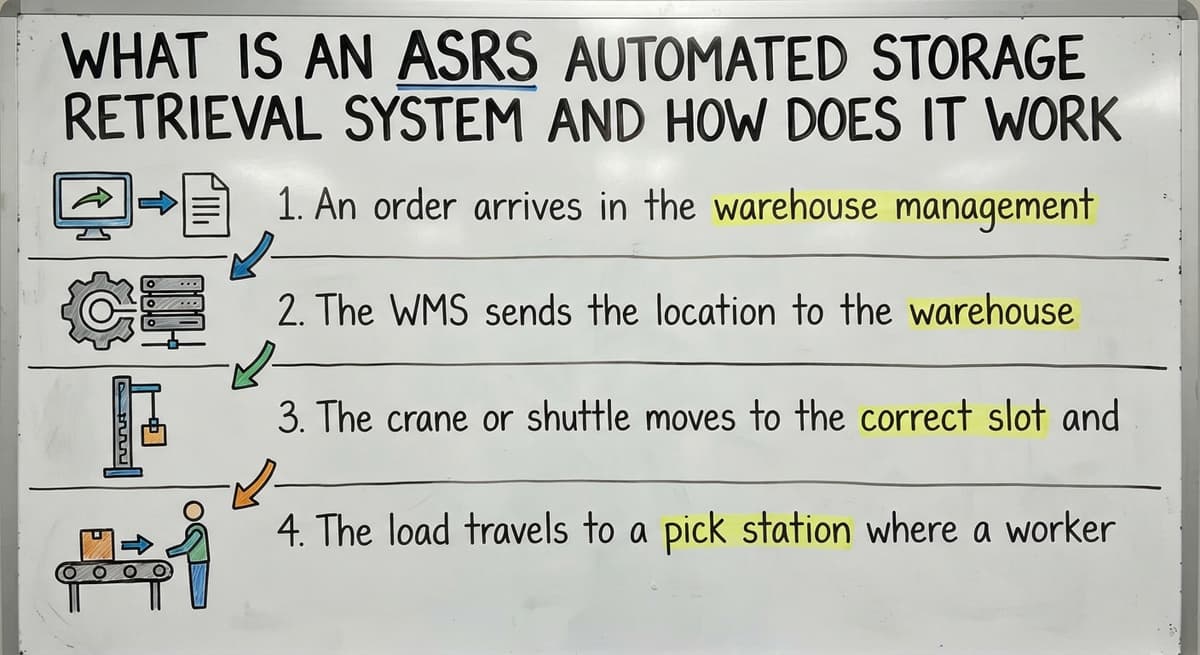
A single pick cycle works like this:
- An order arrives in the warehouse management system (WMS), the software that tracks orders and inventory.
- The WMS sends the location to the warehouse control system (WCS), which directs the physical machine.
- The crane or shuttle moves to the correct slot and pulls the tote or pallet.
- The load travels to a pick station where a worker handles it.
The worker never walks the aisle. The machine does that work. The IRS offers a useful reminder of why accurate inventory matters at every step: as stated in IRS Publication 538, "To figure taxable income, you must value your inventory at the beginning and end of each tax year." A system that tracks every move in real time makes that valuation far easier and more defensible.
ASRS is not just a piece of equipment. It is hardware plus software working together. Remove either layer and the system fails.
Would you rather have it built around your operation?
The first look is free. If you would rather not compare products, describe how your operation already works and we build the system around it.
No build cost. You see it running on your own process first, and the monthly subscription starts only once it is live.
Book a callWhat Are the Different Types of ASRS Systems?
Four main types of ASRS exist, each built for a different load size and throughput need. Choosing the wrong type is one of the most common and costly mistakes buyers make.
Unit-Load and Mini-Load Crane Systems
Unit-load crane systems handle full pallets or heavy loads in tall, narrow aisles. More height means more storage in the same floor footprint. Capital cost is high, so these suit large distribution centers moving consistent, high-volume product.
Mini-load systems work with totes, trays, and cartons rather than full pallets. A wholesale distributor picking mixed-SKU orders is a typical user. Cost is lower than unit-load, but still a real investment, six figures at minimum.
Vertical Lift Modules, Carousels, and Goods-to-Person Shuttle Systems
A vertical lift module (VLM) is a tall enclosed unit that stores trays and delivers them to an ergonomic pick window at waist height.
A horizontal carousel spins bins around a track to bring the right bin to the worker. Both work well in tight spaces and for small-parts operations.
Goods-to-person shuttle systems use robotic shuttles that retrieve totes from a dense storage grid and deliver them to a pick station. These are popular in e-commerce fulfillment centers processing many small orders quickly. They scale well but demand robust warehouse management software to direct shuttle traffic without collisions or delays.
Key Benefits of ASRS for Warehouse Operations
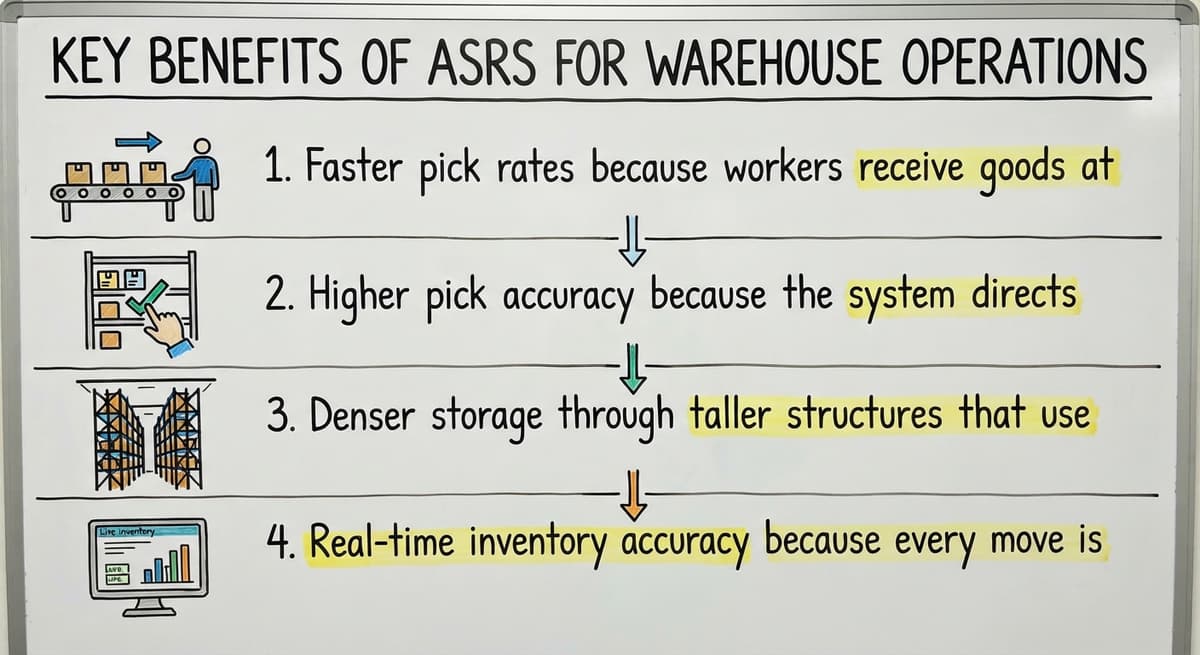
The case for an ASRS automated storage retrieval system rests on four measurable gains.
- Faster pick rates because workers receive goods at a station rather than walking hundreds of feet per pick.
- Higher pick accuracy because the system directs each retrieval to a confirmed location, cutting the chance of a wrong item leaving the building.
- Denser storage through taller structures that use vertical space most manual racking ignores.
- Real-time inventory accuracy because every move is logged, so the count in the system matches the count on the shelf.
The US Census Bureau Monthly Wholesale Trade data shows that wholesale inventories-to-sales ratios shift quickly with demand. Operations that cannot locate stock fast lose sales. ASRS addresses that directly.
Is the comparison easier when one option is built for you?
Yes. Off-the-shelf means fitting your process to the software, and custom is the other way round. The first look costs nothing.
Book a callWhat Are the Disadvantages of ASRS?
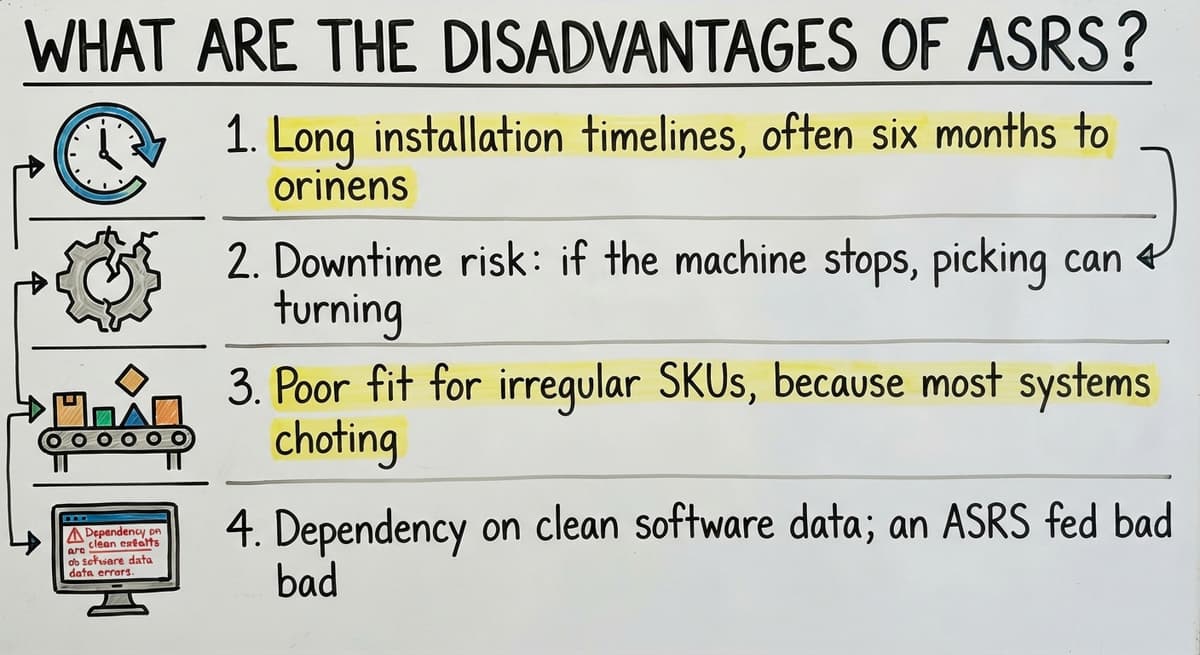
The biggest disadvantage of ASRS is upfront cost, which can disqualify smaller operations before any other factor is considered. Other real limitations include:
- Long installation timelines, six months to over a year for large systems.
- Downtime risk: if the machine stops, picking can stop with it unless a manual backup plan exists.
- Poor fit for irregular SKUs, because most systems are sized for consistent tote or pallet dimensions.
- Dependency on clean software data; an ASRS fed bad inventory records produces bad results faster than a manual process would.
These are not reasons to avoid ASRS entirely. They are reasons to be honest about readiness before signing a contract.
How Much Does an ASRS Cost?
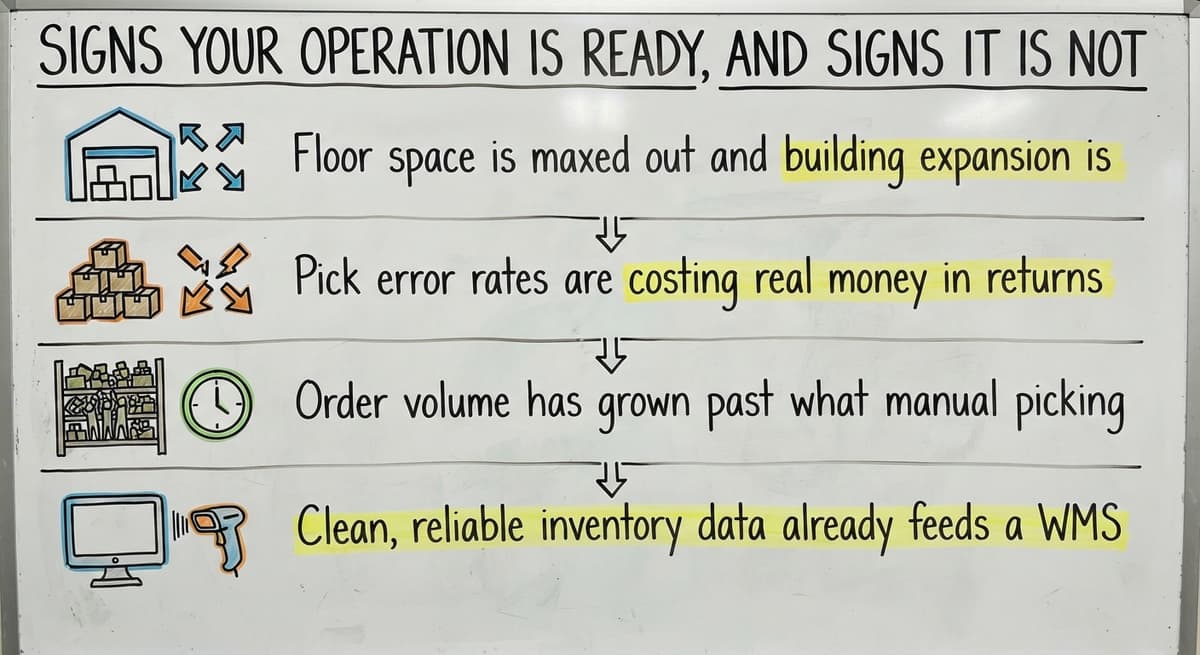
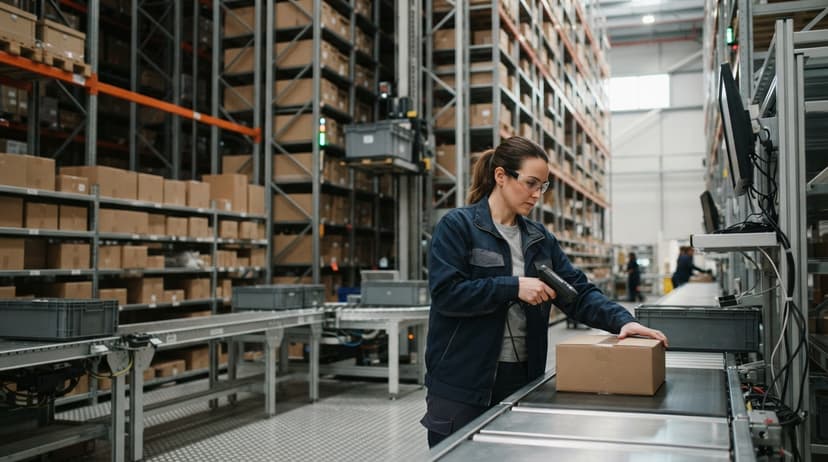
ASRS cost varies widely by type, and no vendor will quote a firm number without knowing your SKU count, throughput, and building dimensions. Honest ballpark ranges look like this:
| System Type | Typical Starting Range |
|---|---|
| VLM or carousel (single unit) | Low six figures |
| Mini-load crane system | Mid to high six figures |
| Unit-load crane system | Seven figures or more |
| Goods-to-person shuttle system | Seven figures or more |
Beyond the buy price, budget for annual maintenance contracts, software license fees, and integration work with your existing systems. The NIST Manufacturing Extension Partnership recommends evaluating total cost of ownership over five years, not just the sticker price, when comparing supply chain automation options.

ASRS vs Manual Racking: Where Each One Wins
Neither approach is right for every operation. The honest comparison comes down to volume, space, and budget.
Manual racking wins on upfront cost and flexibility. You can store an odd-shaped item anywhere. You can reconfigure a rack in a weekend. For operations with low order volume or highly variable SKU sizes, manual racking is the smarter choice.
ASRS wins on throughput, pick accuracy, and space density once volume grows past what manual picking can handle at acceptable labor cost.
The BLS wage data for hand laborers and material movers shows median hourly wages that add up fast across a large picking team. At high volume, the labor math shifts in favor of automation.
The question to ask is not "which is better" but "which fits where my operation sits today and in three years."
What does it look like running on your own process?
The first thing you see is it running on your own process, at no build cost. The subscription starts once it is live and doing the job, not before.
Book a call
Is an ASRS Right for a Small or Mid-Size Warehouse?
Most warehouses with fewer than 20 staff are not ready for a full ASRS, and pushing hardware into an operation that is not ready creates problems rather than solving them.
A VLM or a single carousel can make sense at smaller scale, particularly for a high-velocity subset of SKUs like fast-moving spare parts or controlled items.
The honest answer for most small and mid-size distributors: if your biggest pain is picking errors and you are still tracking inventory on spreadsheets, fix the software layer first.
Automation hardware runs on top of whatever process sits underneath it. A clean process gets faster. A broken process breaks faster.
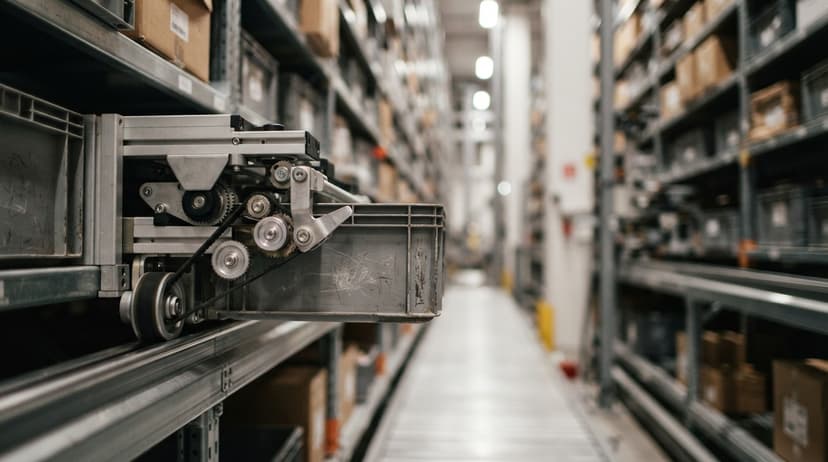
Signs Your Operation Is Ready, and Signs It Is Not
Ready signals point toward a warehouse that has outgrown its current setup:
- Floor space is maxed out and building expansion is not an option.
- Pick error rates are costing real money in returns and rework.
- Order volume has grown past what manual picking can handle at acceptable labor cost.
- Clean, reliable inventory data already feeds a WMS.
Are you not ready for ASRS yet? You are not ready if inventory records live in spreadsheets, SKU counts and order volumes are still manageable by hand, no warehouse management software is in place, or a six- or seven-figure capital project is not in the budget.
Starting with hardware before solving data and software is the most common reason ASRS projects underperform.
What Software Does an ASRS Need to Function?
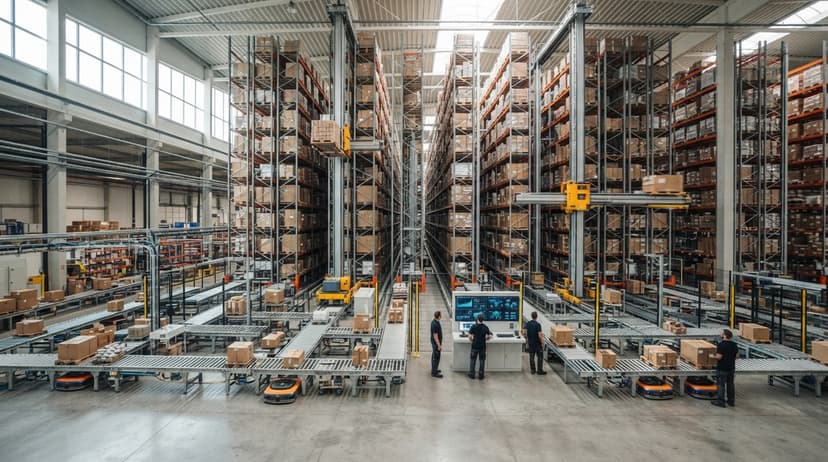
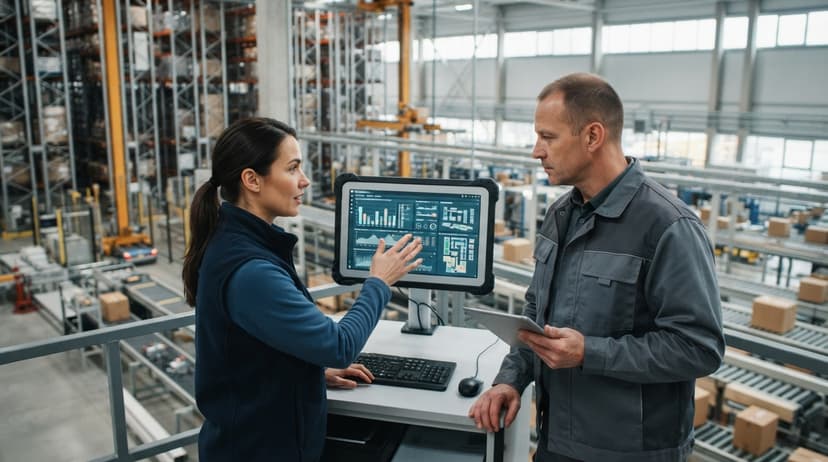
Every ASRS vendor will ask what WMS or ERP you are running before they quote a system. The hardware cannot direct itself. It needs a warehouse control system to send move commands, and that WCS needs clean order and inventory data from a WMS or ERP sitting above it.
Warehouse inventory management software tracks what you have, where it sits, and what has been promised to open orders. The ASRS physically moves goods based on instructions from that software. The two must stay in sync, or inventory counts drift and picks fail.
Accounting software integration for warehouse operations is possible but needs custom work. Most bookkeeping programs were not designed as a WMS.
Connecting one to an ASRS takes a middleware layer that maps order data into commands the WCS can read. This is a real project, not a plug-and-play step.
Custom warehouse software for small distributors can bridge that gap without replacing the accounting tools your team already knows.
Many distributors find that building a proper inventory and order management layer removes the urgent need for ASRS hardware entirely, at least in the near term.
Questions to Ask an ASRS Vendor Before Buying
Before committing to any system, get clear answers to these four questions.
- What WMS or ERP does this system integrate with natively? If your stack is not on the list, ask what custom integration costs and who owns it.
- What happens to operations if the system goes down for a day? A vendor who cannot answer this clearly has not planned for it.
- What is the typical timeline from contract to go-live? Large systems run six months to over a year. Plan your capacity accordingly.
- What are the annual costs beyond the buy price? Maintenance contracts, software licenses, and support fees belong in your five-year model.
Not sure this is the right shape for your operation?
The call is free. Describe how the work runs today. We map it on a call and show you what it would look like built around that, before you spend anything.
Book a call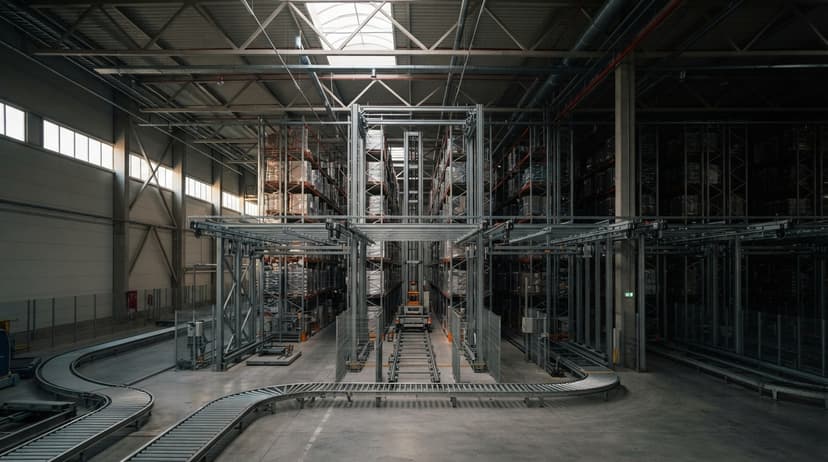
Alternatives to a Full ASRS for Smaller Distributors
A full ASRS automated storage retrieval system is not the only path to better warehouse performance. Smaller operations have real options that cost far less.
- Barcode scanning with a WMS removes the manual entry step that causes most receiving and picking errors, at a fraction of ASRS cost.
- Slotting tuning software places fast-moving SKUs closer to the pack station, cutting walk time without new hardware.
- A single VLM or carousel can automate a high-velocity SKU subset while the rest of the warehouse stays manual.
- Custom warehouse software that replaces spreadsheets delivers most of the accuracy and speed benefit at a much smaller investment than hardware.
Barcode scanning and pick accuracy solutions alone can cut error rates dramatically in operations where the root cause is manual data entry rather than physical throughput limits.
How Columbus-Area and Ohio Distributors Are Approaching Warehouse Automating
How are Ohio distributors actually evaluating warehouse automation right now? Most mid-size operations in the region are starting with software fixes before committing to hardware.
Ohio is a major distribution hub, and many of these businesses are running on basic accounting software plus spreadsheets and feeling the pressure of growing order volume.
The pattern that works: audit the current software stack, build a clean inventory and order management layer, then revisit hardware once the data foundation is solid.
Working with a local partner who understands the operation reduces integration risk and avoids the common mistake of buying a system that does not fit the workflow it is supposed to serve.
A warehouse operations review is a practical first step. It identifies where the real constraint sits, whether that is labor, space, accuracy, or data quality, before any capital commitment is made.
Frequently Asked Questions About ASRS
What does ASRS stand for? ASRS stands for Automated Storage and Retrieval System.
Does ASRS replace warehouse workers? ASRS shifts workers from walking aisles to value-added tasks at pick stations. Headcount impact varies by operation. Most facilities find they need fewer pickers but still need staff for receiving, packing, and exception handling.
How long does ASRS rollout take? VLMs and carousels can be installed in weeks. Full unit-load or shuttle systems run six months to over a year from contract to go-live.
What is ASRS used for? ASRS is used to store and retrieve inventory faster and more correctly than manual picking allows. Common applications include distribution centers, fulfillment centers, parts storage, and cold-storage facilities where labor costs or space constraints make manual picking expensive.
Next Steps If You Are Exploring Warehouse Automating
Start with the data and software layer before committing to hardware. A warehouse inventory management software solution built around your current operation can deliver real gains in accuracy and speed without a seven-figure capital project.
If you are a distributor in Ohio or anywhere else running on spreadsheets and feeling the pressure of growing order volume, a no-pressure operations review is a practical place to start.
We will look at your current pick rates, error rates, and software stack, and tell you honestly where automation would help and where it would not.
Reach out to start that conversation. No hardware sales pitch. Just a clear picture of where your operation stands and what would move the needle most.
Frequently asked questions
What is an automated storage and retrieval system (ASRS)?
An automated storage and retrieval system (ASRS) is a computer-controlled setup that stores and retrieves inventory without a worker walking the aisle. It combines a physical storage structure, a retrieval machine such as a crane or shuttle, and control software that directs every move.
The system delivers goods to a worker at a fixed pick station rather than sending the worker to find the goods.
How much does an ASRS cost?
Cost depends on system type and scale. A single VLM or carousel starts in the low six figures. Mini-load crane systems run mid to high six figures.
Full unit-load crane systems and goods-to-person shuttle systems reach seven figures or more. Annual maintenance contracts, software licenses, and integration work add to the total cost of ownership beyond the buy price.
What are the disadvantages of ASRS?
The main disadvantages are high upfront cost, long installation timelines, and downtime risk. If the machine stops, picking can stop with it. Most systems also work best with consistent SKU sizes, so irregular items are harder to automate.
An ASRS fed bad inventory data will produce bad results faster than a manual process would, making a clean software foundation a hard requirement before installation.
What is ASRS used for?
ASRS is used to store and retrieve inventory faster and more correctly than manual picking allows.
Common applications include wholesale distribution centers, e-commerce fulfillment centers, spare parts storage, pharmaceutical warehouses, and cold-storage facilities where labor cost or floor space constraints make manual picking expensive or impractical.
Can a small warehouse use ASRS?
A full ASRS is rarely practical for warehouses with fewer than 20 staff. However, a single VLM or horizontal carousel can automate a high-velocity SKU subset at smaller scale.
For most small operations, fixing inventory management software first delivers more benefit at a fraction of the cost.
Does ASRS remove warehouse workers?
ASRS does not remove warehouse workers. It shifts them from walking aisles to working at pick stations, packing orders, and handling exceptions.
The actual headcount impact varies by operation, throughput, and how many shifts the system runs. Most facilities see labor hours per order drop rather than total headcount disappear entirely.
How does ASRS connect to your accounting software or existing inventory software?
ASRS hardware needs a warehouse management system or warehouse control system sitting above it to send move commands.
Connecting that layer to accounting software needs custom middleware, because such programs are not designed as a WMS. This is a real integration project, not a plug-and-play step. Custom warehouse software can bridge the two without replacing the accounting tools your team already uses.
What software does an ASRS need to function?
At minimum, an ASRS needs a warehouse control system (WCS) to direct physical moves, and that WCS needs clean order and inventory data from a warehouse management system (WMS) or ERP.
Without a reliable software layer above it, the hardware cannot route picks correctly and inventory counts will drift. Every ASRS vendor will ask what software you are running before quoting a system.
How does ASRS integrate with a WMS?
The warehouse management system tracks orders and inventory, and when an order arrives it sends the required location to the warehouse control system. That control layer then directs the crane, shuttle, or carousel to the correct slot to pull the tote or pallet, which then travels to a pick station for a worker to handle.
The WMS and the physical machine work together as one connected process.
What are the different types of ASRS?
Four main types exist, each suited to a different load size and throughput need. Unit-load crane systems handle full pallets in tall, narrow aisles for large distribution centers.
Mini-load systems move totes, trays, and cartons for mixed-SKU picking. VLMs and horizontal carousels store small parts in tight spaces and bring them to a worker. Goods-to-person shuttle systems use robotic shuttles for fast, high-volume order fulfillment.
What is the difference between ASRS and a traditional warehouse?
The difference comes down to volume, space, and budget. Traditional manual racking wins on upfront cost and flexibility, letting you store odd-shaped items anywhere and reconfigure a rack quickly, which suits low volume or highly variable SKU sizes.
ASRS wins on throughput, pick accuracy, and space density once order volume grows beyond what manual picking can handle at reasonable labor cost, since it uses vertical space and confirmed locations that racking and walking aisles cannot match.
Is ASRS suitable for small warehouses?
Not usually in full form. Most warehouses with fewer than twenty staff are not ready for a complete automated storage retrieval system, since pushing hardware into an operation that lacks clean processes tends to create problems rather than solve them.
However, a single VLM or carousel can make sense at smaller scale, especially for a high-velocity subset of items like fast-moving spare parts, provided the underlying inventory data and process are already solid.
What is in a free first look?
A 30 minute call, your operation mapped, and a clear picture of what we would build. No obligation and nothing to install.
Book a callRelated guides
The rest of this guide, for the parts of the job this page does not cover.
Guides
- Automated Inventory Management System
- Warehouse Inventory Management Systems
- Warehouse Inventory Systems
- Warehouse Management System Top 10
- Software for Warehouse Management System
- Warehouse Tracking System
- Small Business Warehouse Management System
- Warehouse Management System Types
- Warehouse Inventory Management System
- Warehouse Management System Examples
- Warehouse Management System Implementation
- Cloud Warehouse Management System
Common questions
- What Are the Benefits of Warehouse Management System
- What is the Point of Warehouse Management System
- How to Choose a Warehouse Management System
- What is Asn in Warehouse Management System
- How to Create a Warehouse Management System
- What is a Warehouse Management System
- Which Warehouse Management System Would a Jeweler Most Likely Use
- How to Build a Warehouse Management System
- What is a Warehouse Management System Used For
- Warehouse Management System vs Warehouse Control System
- Meaning of Warehouse Management System
- Definition of Warehouse Management System