


Inventory Controller
An inventory controller is the person who keeps a warehouse's numbers honest. When stock levels are wrong, orders get missed, purchasing decisions go sideways, and customers lose confidence. This article is written for the operations manager or business owner who depends on that role and wants to support it with better tools, not for someone writing a resume.
Book a callWhat an Inventory Controller Does and Why the Role Exists
An inventory controller is responsible for tracking what stock comes in, what goes out, and what is on hand at any given moment. The role exists wherever physical goods move: warehouses, wholesale distributors, and fulfillment centers all depend on it. This is not a general warehouse worker who picks and packs, and it is not a purchasing manager who decides what to buy. The inventory controller sits between those two functions, keeping the numbers accurate so both sides can do their jobs without guessing.
We build it for your operation, and the first look is free
If you would rather not compare products, describe how your operation already works and we build the system around it.
Reviewed October 2026. Figures are worked from the assumptions stated beside them, so you can substitute your own and the arithmetic still holds.
The holding cost is the part nobody prices. 500 units sitting for 90 days, at 3 dollars a unit a month, is 4,500 dollars of shelf time on stock that has not sold. Turning that stock 4 times a year instead of 2 halves it.
No build cost. You see it running on your own process first, and the monthly subscription starts only once it is live.
Book a callCore Responsibilities of an Inventory Controller
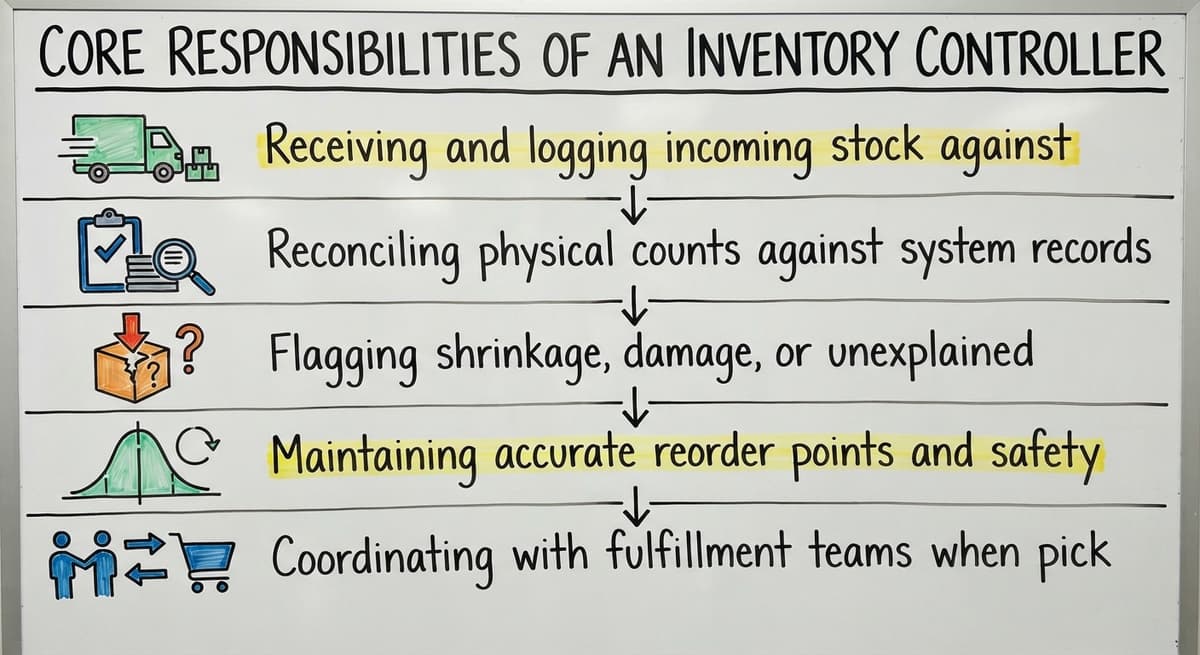
Core responsibilities include:
- Receiving and logging incoming stock against buy orders
- Reconciling physical counts against system records to catch inventory discrepancies
- Flagging shrinkage, damage, or unexplained variance and investigating the cause
- Maintaining accurate reorder points and safety stock levels so the purchasing team acts on real data
- Coordinating with fulfillment teams when pick counts do not match what the system shows
GS1, the global standards body for supply chain spotting, notes that "barcodes are the most widely used automatic spotting technology in the world," and their barcode standards underpin the scanning workflows most inventory controllers rely on daily. Accurate receiving starts at the point of scan, and that accuracy compounds across every downstream process.
Why Does Accurate Inventory Control Matter to a Distribution Business?
Accurate inventory control directly work out whether a distribution business makes or loses money on every order it ships. A stockout costs a sale and can cost a customer relationship. Overstock ties up cash and occupies shelf space that productive SKUs could use. Inaccurate counts push purchasing teams to buy stock that is already on hand, or to skip a reorder on something that is nearly gone.
For a wholesale distributor running on thin margins, those errors are not minor inconveniences. Each one chips away at profitability. Reliable order fulfillment depends entirely on the inventory controller having numbers the rest of the team can trust. When that foundation is solid, purchasing buys smarter, sales quotes with confidence, and fulfillment ships without second-guessing the pick list.
What Does an Inventory Controller Do Every Day?
A typical day starts with incoming shipments. The inventory controller checks what arrived against what was ordered, logs receipts into whatever system the business uses, and flags any short shipments or damaged goods. From there, the day shifts to cycle counting: checking a portion of the warehouse against system records on a rotating schedule so discrepancies surface before they become large problems.
In many small and mid-size operations, much of this work still runs on spreadsheets, printed count sheets, and email threads. A shipment arrives, someone types quantities into a cell, emails the file to a colleague, and the colleague opens a version that may already be out of date. Pick discrepancies from the fulfillment floor come in by text or sticky note. The inventory controller spends a large part of each day not managing stock but correcting data entry errors that the manual inventory process keeps generating.
Common Challenges Inventory Controllers Face
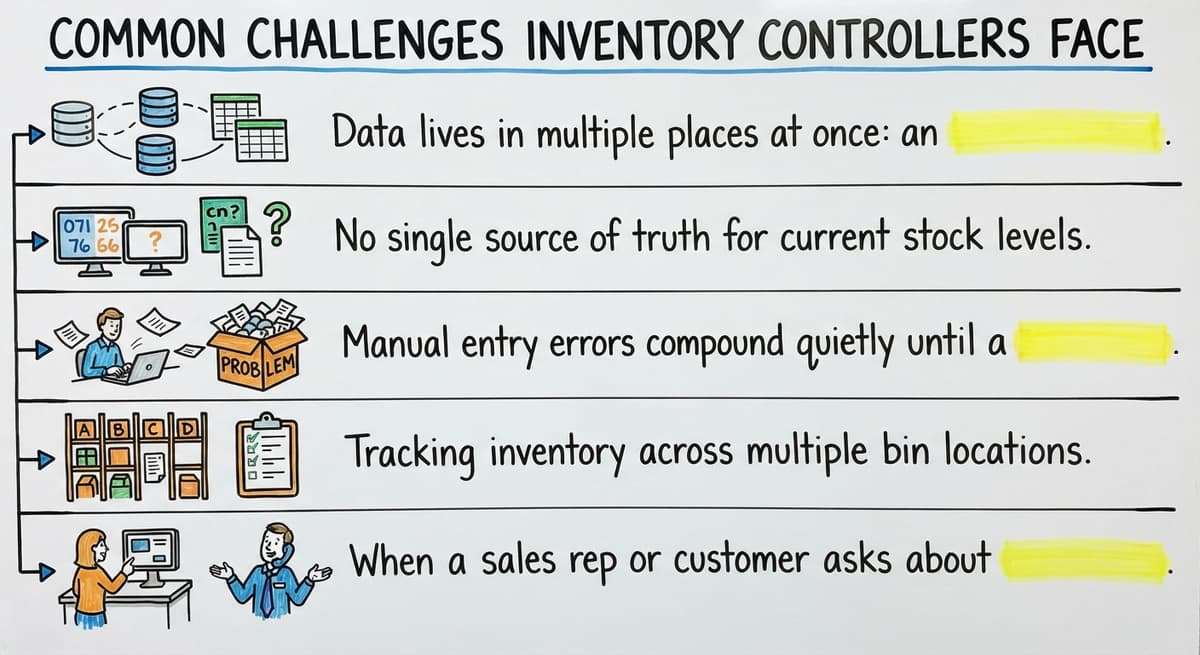
The frustrations that come up most often in this role follow a predictable pattern:
- Data lives in multiple places at once: an accounting package, a spreadsheet, and a clipboard count sheet that nobody has transferred yet
- No single source of truth for current stock levels means every answer to an availability question needs checking two or three places
- Manual entry errors compound quietly until a physical count reveals a gap that took weeks to build
- Tracking inventory across multiple bin locations or warehouse zones is nearly impossible in a flat spreadsheet
- When a sales rep or customer asks about availability, the answer is slow because the data is never quite current
These are not isolated complaints. They are structural problems created by tools that were not built for real-time warehouse inventory tracking.
The comparison is easier when one option is built for you
Off-the-shelf means fitting your process to the software. We do it the other way round, and the first look costs nothing.
Book a callWhy Spreadsheets Fail as Inventory Control Tools at Growing Distributors
Spreadsheets break the moment two people try to edit the same file. Version control is nearly impossible when files travel by email: the inventory controller is working in one copy while a colleague updates another, and neither knows it. Manual counts pull staff off the floor and introduce the kind of human error that a tired person with a clipboard is almost certain to make.
This is a scaling problem, not just a daily inconvenience. A business with five staff can absorb the friction. At twenty or fifty staff, the same manual inventory process becomes a source of fulfillment errors, purchasing mistakes, and staff burnout. The inventory controller ends up spending more time fixing records than managing stock, which is the opposite of what the role is supposed to do.
Inventory Counting Methods and Key Skills Every Inventory Controller Needs
Effective inventory control needs comfort with three counting approaches. Cycle counting divides the warehouse into sections and counts a rotating portion on a regular schedule, so no area goes unchecked for long without requiring a full shutdown. A physical inventory count covers everything at once, usually once a year, and serves as a hard reset on the numbers. ABC analysis ranks counting effort by item value or sales velocity: high-value or fast-moving SKUs get counted more often than slow movers sitting in the back corner.
Soft Skills and Software Fluency an Inventory Controller Must Have
Beyond counting methods, the role demands:
- Attention to detail and genuine comfort with numbers, because small errors in receiving create large problems downstream
- The ability to work across purchasing, sales, and operations without becoming a bottleneck between them
- Comfort with whatever software the business uses, from a basic accounting package to a purpose-built inventory platform
The right software makes all three counting methods easier to schedule, execute, and document without adding administrative overhead.

How Does an Inventory Controller Work Alongside Accounting Software?
Many small and mid-size distributors use dedicated accounting software for invoicing and financials, and the inventory controller's job is to make sure the stock data feeding that system is trustworthy. That accounting platform handles invoicing and financials well. It was not built for real-time warehouse inventory tracking across multiple bin locations, and most inventory controllers know that gap firsthand. The workaround is usually a spreadsheet that bridges what the accounting software shows and what the warehouse floor actually holds.
Why Direct Integration Beats a Spreadsheet Workaround
The better path is a direct integration for distribution operations: software that connects directly to your accounting platform rather than replacing it. The accounting team keeps working in the tool they know. The inventory controller gets a system built for warehouse operations, with receiving logs, cycle count workflows, and stock level alerts that push accurate data into the financial records automatically. No duplicate entry, no version mismatch, no spreadsheet in the middle.
See it running on your own process first
No build cost. The subscription starts once it is live and doing the job, not before.
Book a callReal-Time Inventory Visibility Versus End-of-Day Reports
Knowing stock levels right now is not the same as knowing what they were last night, and that gap decides whether a fulfillment operation runs smoothly or constantly plays catch-up. End-of-day batch updates mean every decision made before the next sync is based on data that may already be wrong. A pick happens at 2 p.m. the system does not reflect it until midnight, and a sales rep quotes availability at 3 p.m. based on a number that no longer exists.
Real-time inventory visibility lets the inventory controller answer availability questions at once, catch a discrepancy the moment a pick does not match the record, and trigger a reorder before a stockout happens rather than after. For a wholesale distributor where order fulfillment speed is a competitive factor, that difference shows up directly in customer satisfaction and repeat business.
Barcode Scanning, Software, and What Good Inventory Management Tools Actually Do
Barcode scanning removes the manual entry step that causes most receiving errors. Instead of reading a SKU off a label and typing it into a cell, the inventory controller scans the item and the system records it. Misreads and transposition errors drop sharply. Even operations with five to fifty staff see measurable accuracy gains from basic scanning workflows, particularly at the point of receipt where errors are cheapest to catch.
How Purpose-Built Inventory Software Changes Daily Operations
Inventory management software for wholesale distributors builds on that foundation by giving the inventory controller one screen showing current stock across all locations. Receipts and shipments log automatically. The system alerts the team when stock drops below reorder points rather than waiting for someone to notice. The time that used to go to manual matching shifts to actual stock management, and the inventory controller can answer an availability question in seconds rather than minutes.

| Manual Process | With Purpose-Built Software |
|---|---|
| Stock levels checked by opening a spreadsheet | Current levels visible on one screen, updated in real time |
| Reorder triggered when someone notices a gap | Automated alert when stock crosses the reorder threshold |
| Receiving logged by typing SKUs by hand | Barcode scan records the receipt instantly |
| Cycle count tracked on a printed sheet | Count results entered in the system during the count |
Inventory Controller Versus Inventory Manager
An inventory controller is a hands-on working role focused on accuracy and daily execution. An inventory manager usually oversees strategy, staffing, and broader supply chain decisions. In smaller operations, one person often fills both functions. Custom warehouse management software that handles routine data tasks lets a single person manage both without the role becoming unsustainable.
Signs Your Operation Has Outgrown Manual Inventory Control
Several signs point to a business that has outgrown its current approach:
- Stock counts are wrong by the time the team acts on them, because the data aged out between the count and the decision
- The inventory controller spends more time correcting records than managing stock
- Fulfillment accuracy is dropping because picks are based on numbers the floor does not match
- New staff cannot be onboarded without sitting next to the one person who holds the process in their head or their personal spreadsheet
When any of those patterns are present, the problem is not the inventory controller. The problem is the manual inventory process they are being asked to run.
Not sure this is the right shape for your operation
Describe how the work runs today. We map it on a call and show you what it would look like built around that, before you spend anything.
Book a callDoes Your Operation Need Custom Inventory Software or an Off-the-Shelf Platform?
Custom inventory software fits the way your operation already works, while off-the-shelf platforms often need the business to reshape its workflows to match the software's assumptions. A distributor with a specific receiving workflow, a non-standard bin structure, or an existing accounting setup that cannot be abandoned does not benefit from a system that forces change as the price of adoption.

Why Enterprise Platforms Are the Wrong Fit for Small Distributors
Custom workflow rollout maps to what the inventory controller already does. The team learns a system built around their actual process, not a generic template designed for a different industry. Existing accounting tools stay in place. The inventory controller is not learning a new job; they are doing the same job with less friction.
Enterprise platforms are built for companies with hundreds of staff and complex multi-entity structures. A distributor with five to one hundred staff needs warehouse operations software for small teams: something that solves the actual bottleneck without a six-month rollout, a large licensing bill, and a feature set the team will never open. A focused tool that does the right things well is more valuable than a platform that does everything expensively.
What to Look for and What to Ask Before Choosing Inventory Control Software
Before evaluating any platform, map out where the current process actually breaks down. Identify the specific points where data goes wrong, where the inventory controller loses time, and where fulfillment accuracy suffers. That map is more useful than any vendor demo.
When evaluating options, rank:
- Integration with existing accounting tools without requiring a full replacement
- Real-time stock visibility across locations and bin positions
- Simple enough for the whole team to use without weeks of classroom training
- A vendor who understands distribution and warehouse operations, not just software development
- Pricing that scales with the actual size of the operation rather than charging for capacity the team will never use
Questions to Ask a Vendor Before Signing
Before signing anything, ask the vendor directly:
- Will this connect to our accounting package without replacing it?
- How long does rollout take for an operation our size?
- Can the system handle our specific workflow, or will we need to change how we work?
- Who supports us after go-live, and what does that support actually look like?
- What does the total cost of ownership look like over the first two years, including setup, training, and ongoing fees?
A vendor who hesitates on any of those questions is telling you something important about what the relationship will look like after you sign.
Next Steps for Improving Inventory Control
The inventory controller role is one of the most important working functions in a distribution business, and it is one of the most frequently under-supported. Manual processes create risk that compounds quietly: wrong counts, stale data, and fulfillment errors that erode customer trust before anyone realizes the source.
Order fulfillment software for fulfillment centers and distributors does not have to mean an expensive enterprise rollout. The right rollout-led partner builds around what already works, connects to the accounting tools already in use, and delivers a system the inventory controller can actually run without a technical team standing behind them.
If the current process is showing any of the warning signs described above, the right starting point is a straightforward conversation about where the friction is and what a practical fix looks like. Reach out to discuss what a purpose-built solution could look like for your operation.
Frequently asked questions
What does the Inventory Controller do?
An inventory controller tracks all stock movement: what comes in, what goes out, and what is currently on hand. Day to day, that means logging receipts, reconciling physical counts against system records, investigating discrepancies, maintaining reorder points, and coordinating with purchasing and fulfillment teams to keep the operation running on accurate data.
Is inventory control a hard job?
It is demanding rather than technically complex. The difficulty comes from the volume of detail, the need to catch small errors before they compound, and the pressure to keep data accurate while coordinating across multiple departments. In operations that still rely on spreadsheets and manual counts, the workload is significantly heavier because the tools create as many problems as they solve.
What is the average salary for an Inventory Controller in the US?
Compensation varies by industry, location, and the size of the operation. Most inventory controller roles in the US fall somewhere between $40,000 and $65,000 annually, with higher pay in larger distribution operations, those requiring specialized software skills, or roles that well combine inventory control and inventory management responsibilities.
What skills are needed to become an Inventory Controller?
The core skills are attention to detail, comfort with numbers, and the ability to work across departments without becoming a bottleneck. Familiarity with counting methods like cycle counting, FIFO, and LIFO is important, as is comfort with whatever software the business uses to track stock. Strong communication matters because the role connects purchasing, fulfillment, and sales on a daily basis.
What inventory counting methods should an inventory controller know?
Cycle counting, physical inventory, and ABC analysis are the three most common. Cycle counting checks a rotating portion of stock on a regular schedule. A full physical count covers everything at once, usually annually. ABC analysis focuses counting effort on the items that matter most by value or sales velocity. Most operations use all three at different times.
What is the difference between real-time inventory visibility and end-of-day batch updates?
Real-time visibility shows current stock levels as transactions happen. End-of-day batch updates reflect where things stood when the last sync ran, which could be hours ago. For a distributor taking orders throughout the day, that lag means availability answers are based on stale data, which leads to overselling, stockouts, and fulfillment errors that could have been avoided.
What should a small distributor look for when evaluating inventory management software?
Rank integration with existing accounting tools, real-time stock visibility, and ease of use for the whole team. Avoid platforms built for enterprise-scale operations with features and pricing that do not match a lean team. Look for a vendor who understands distribution workflows specifically, and confirm what support looks like after rollout, not just during it.
Why do small and mid-size distributors not need an enterprise inventory system?
Enterprise platforms are designed for complex, multi-entity organizations with large IT teams and long rollout timelines. A distributor with five to one hundred staff needs something that fits their actual scale, connects to their existing tools, and can be implemented without months of disruption. Paying for capacity and features the team will never use does not make the operation more efficient.
Start with a free first look
A 30 minute call, your operation mapped, and a clear picture of what we would build. No obligation and nothing to install.
Book a callRelated guides
The rest of this guide, for the parts of the job this page does not cover.
Guides
- Best Inventory Software
- Classification of Inventory
- Excess Inventory
- Closed for Inventory
- Multi Location Inventory Management Software
- Ms Excel Inventory Template
- Inventory Management for Multiple Locations
- Costing Inventory
- Is Inventory a Long-term Asset
- Inventory Management System for Manufacturing
- Inventory Fixed Assets
- Inventory Management Pics
- Inventory Monitoring
- Excel Inventory Template
- Push and Pull Inventory
- Types of Inventory Control
- Consumable Inventory
- B2b Inventory Management
- Jewelry Inventory Management
- Dental Inventory Management
- The Objective of Inventory Management is To