


Is Inventory Assets
Reviewed: June 2025
Reviewed September 2026. Figures are worked from the assumptions stated beside them, so you can substitute your own and the arithmetic still holds.
Yes, inventory is an asset. It is something your business owns that has real dollar value and can be converted to cash when sold. Inventory appears on your balance sheet under current assets, meaning it is expected to turn into cash within 12 months. This article explains what that means in practice, how inventory is valued, and why your tracking system work out whether that asset number is trustworthy.
Book a callIs Inventory an Asset on the Balance Sheet?
Inventory qualifies as an asset because it meets the basic definition: something a business owns that is expected to bring future economic benefit. Assets appear on the left side of a balance sheet, grouped by how quickly they can become cash.
Inventory sits in the current assets section, alongside cash and accounts receivable. The IRS makes the obligation explicit. IRS Publication 538 states: "To figure taxable income, you must value your inventory at the beginning and end of each tax year." That is not optional. It is a legal requirement for any business that carries stock.
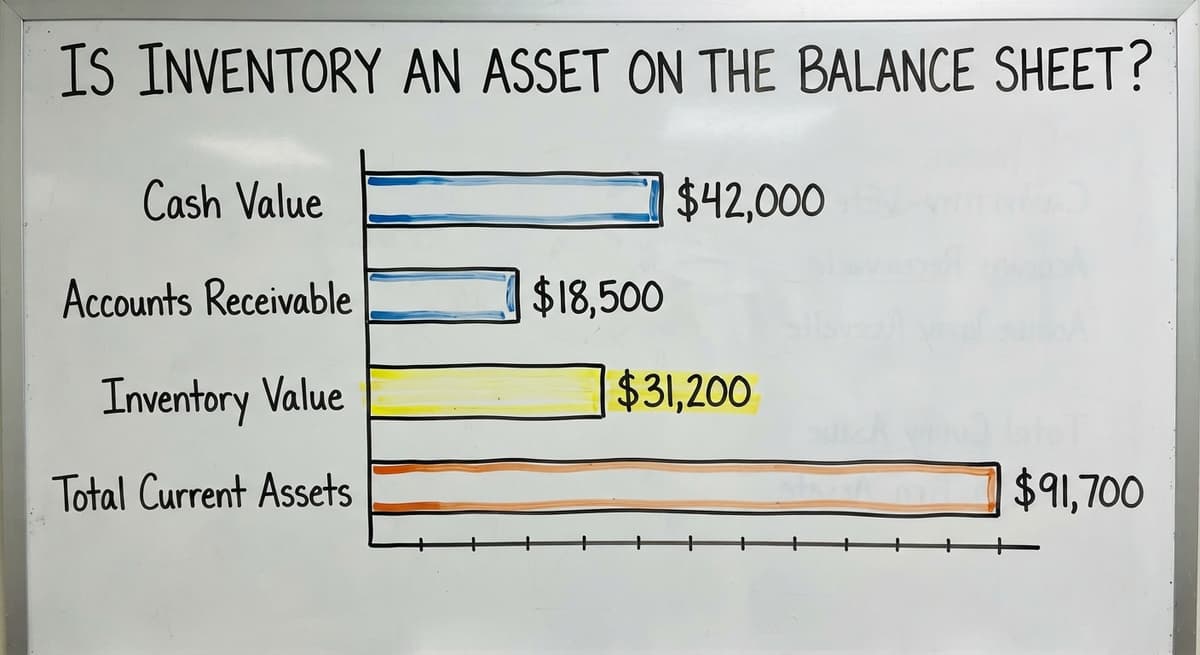
A simple current assets section looks like this:
- Cash: $42,000
- Accounts receivable: $18,500
- Inventory: $31,200
- Total current assets: $91,700
Inventory is third in the list because it takes a little longer to convert to cash than cash itself or an unpaid invoice does.
We build it for your operation, and the first look is free
If you would rather not compare products, describe how your operation already works and we build the system around it.
No build cost. You see it running on your own process first, and the monthly subscription starts only once it is live.
Book a callWhat Type of Asset Is Inventory: Current or Fixed?
Inventory is always a current asset, not a fixed or long-term asset. Current assets turn into cash within 12 months. Fixed assets, like a forklift or a warehouse building, are held for years and depreciate over time.
Inventory is meant to be sold. That intent is what keeps it in the current column. One exception applies: slow-moving or obsolete stock that is unlikely to sell within the year may need to be reclassified or written down. Accountants call this an impaired asset. It still sits on the books, but at a reduced value that reflects what it would actually fetch.
The practical difference matters to lenders. A bank reviewing your financials wants to know how much of your asset base is liquid. Inventory counts. A 10-year-old machine does not carry the same weight.
The 4 Types of Inventory That Count as Assets
Not all inventory looks the same, but all 4 types appear on the balance sheet as assets until the moment they are sold or written off.
- Raw materials are inputs waiting to enter production. Steel coil, lumber, or bulk chemicals all sit here.
- Work-in-progress (WIP) is stock that has been partially assembled or processed but is not yet ready to ship.
- Finished goods are complete products sitting in your warehouse, ready for a customer order.
- Merchandise inventory is stock purchased by wholesalers and distributors for resale without further processing.
Each type carries a cost. That cost is what the balance sheet records, not the price you plan to charge the customer. The US Census Bureau's Monthly Wholesale Trade data tracks national inventory levels across wholesale firms, and the inventories-to-sales ratio it reports reflects exactly these categories in aggregate.
When Does Inventory Stop Being an Asset?
Inventory leaves the asset column the moment a sale is recorded. At that point it becomes cost of goods sold (COGS), which is an expense on the income statement rather than an asset on the balance sheet. The asset shrinks; the revenue line grows.
Three other events also remove inventory from the asset column:
- Write-down: The item still exists but is worth less than its recorded cost. You reduce the asset value to reflect current market value.
- Write-off: The item is gone, damaged beyond use, or expired. It is removed from the balance sheet entirely.
- Theft or loss: Shrinkage that is discovered and confirmed needs the same write-off treatment.
The timing matters for tax purposes. A write-down or write-off reduces your reported asset value and can affect taxable income in the period it is recorded.
How Is Inventory Valued as an Asset?
Inventory must be recorded at cost, not at the price you plan to sell it for. Cost includes the buy price plus freight, duties, and any other charges needed to get the goods to your warehouse. The valuation method you choose affects both your reported profit and your tax bill.
Three methods are accepted under US accounting rules.
FIFO: First In, First Out
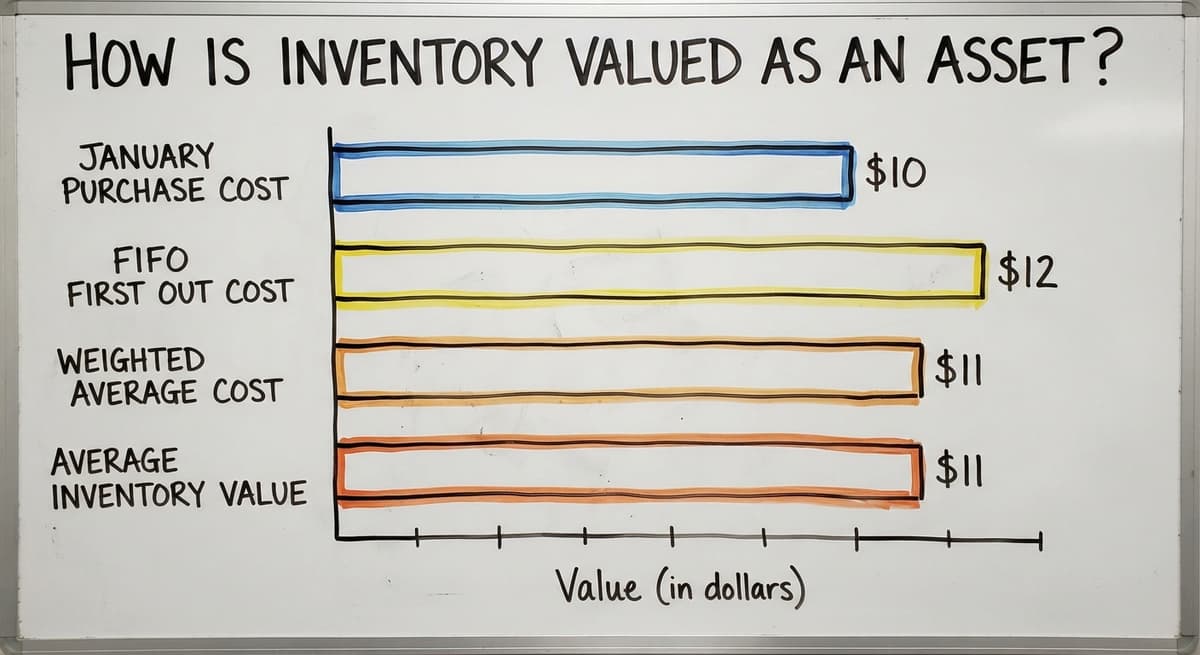
FIFO assumes the oldest stock is sold first. If you bought 100 units at $10 in January and 100 more at $12 in March, FIFO says the January units go out the door first. The remaining inventory on your balance sheet is valued at the newer, higher cost.
FIFO is the standard in food, perishables, and most wholesale distribution. In a rising-cost environment, FIFO produces higher reported profit because the older, cheaper units hit COGS first. QuickBooks supports FIFO inventory costing natively, which makes it a natural fit for distributors already using that platform.
The comparison is easier when one option is built for you
Off-the-shelf means fitting your process to the software. We do it the other way round, and the first look costs nothing.
Book a callIs LIFO Allowed in the United States?
Yes, LIFO is allowed in the US, but it is banned under international accounting standards (IFRS). LIFO assumes the newest inventory is sold first. When costs are rising, that means higher-cost units hit COGS sooner, which reduces taxable income in the short term.
LIFO is less common in wholesale distribution than FIFO, but it is worth understanding if your cost structure is volatile. Switching between methods needs IRS approval, so the choice is not easily reversed. Check IRS Publication 538 for the rules on changing your valuation method.
Weighted Average Cost
Weighted average cost blends all units into a single cost per unit. If you have 200 units that cost an average of $11 each, every sale pulls from that same $11 figure regardless of when the stock arrived.
This method smooths out price swings across buy orders and is simple to apply. It works well for distributors carrying high volumes of similar SKUs where tracking individual lot costs would add complexity without much benefit. The tradeoff is less visibility into cost trends across individual orders.
Why Accurate Inventory Valuation Matters
Overstated inventory inflates your assets and your reported profit at the same time. Understated inventory makes the business look less valuable than it is. Both errors mislead the people who rely on your financials.
Lenders use inventory value when deciding how much credit to extend. Buyers use it when pricing an acquisition. Your own purchasing decisions depend on knowing what stock you actually hold.

What Inaccurate Inventory Counts Cost in Real Dollars
Consider a simple example: 3 warehouse staff each spend 6 hours a week reconciling inventory counts manually. At the median wage for stock clerks reported by the US Bureau of Labor Statistics, that is roughly $20,592 a year in labor, before you count the errors those manual processes introduce. Inaccurate numbers in QuickBooks ripple into every financial report the business produces.
GS1 sets the barcode standards that underpin scan-based inventory counts, and scan-based receiving is the most reliable way to keep cost data accurate at the point of entry.
QuickBooks Inventory Tracking: What It Does and Where It Falls Short
QuickBooks tracks inventory as an asset account automatically when set up correctly. Each buy increases the inventory asset account. Each sale decreases it and records COGS. For a small operation with a single location and a limited SKU count, that works well.
The gaps appear as operations grow. QuickBooks does not handle bin locations, lot numbers, or serial number tracking in a way that scales to a busy warehouse floor. Multi-warehouse operations are difficult to manage inside QuickBooks alone.
Why Workarounds Widen the Gap Between Books and Warehouse
Teams patch the gap with Excel sheets or printed pick lists, and those workarounds create a split between what the software shows and what is physically on the shelf.
The NIST Manufacturing Extension Partnership notes that supply chain accuracy depends on process discipline at every handoff point. QuickBooks captures the accounting entry, but it does not enforce the process discipline on the warehouse floor that keeps that entry accurate.

Why Your QuickBooks Count Does Not Match Your Physical Count
When the physical count differs from QuickBooks, your inventory asset value is wrong. The balance sheet says you own $31,200 in stock. The shelves tell a different story.
Several things cause the gap:
- Receiving errors log the wrong quantity or the wrong SKU at the dock
- Unrecorded returns come back to the warehouse but never get entered in the system
- Shrinkage from theft, damage, or spoilage reduces physical stock without a matching journal entry
- Pick errors ship the wrong item, leaving the wrong count behind in both directions
Staff often discover the gap only at year-end counts. The longer it goes undetected, the more periods of financial reporting carry the wrong asset value. The US Federal Trade Commission also needs businesses to ship orders when promised, and an inaccurate count is the most common reason a seller cannot fulfill that obligation.
See it running on your own process first
No build cost. The subscription starts once it is live and doing the job, not before.
Book a callHow Does Inventory Management Software Keep Asset Records Accurate?
Dedicated inventory management software records every movement: receiving, picking, shipping, and returns. Real-time counts mean the asset value in your books reflects what is physically on hand, not what was on hand last Tuesday before the receiving dock got busy.
A good system does 4 things QuickBooks alone cannot:
- Tracks bin locations so every unit has a known physical address in the warehouse
- Logs lot and serial numbers for traceability and recall management
- Syncs automatically with QuickBooks so the accounting entry happens when the warehouse movement happens
- Flags discrepancies in real time so shrinkage is caught the day it occurs, not at year-end
Why Inventory Software Works Alongside QuickBooks, Not Instead of It
Inventory management software for wholesale distributors does not have to replace QuickBooks. The better approach is to keep QuickBooks for accounting and add a warehouse layer that feeds it accurate data. That is the bridge between a clean balance sheet and an accurate warehouse floor.

Dead Stock, Shrinkage, and Inventory Turnover: 3 Asset Efficiency Signals
Three measures tell you whether your inventory asset is working or sitting idle.
Inventory shrinkage is the loss of stock through theft, damage, or administrative error. Shrinkage reduces your actual asset value below what the books show. Undetected shrinkage overstates profit and misleads every financial decision built on that number. Tracking software that flags discrepancies in real time lets you act before the loss compounds.
Dead stock is inventory that has not moved and is unlikely to sell at full price. It still appears as an asset on paper, but it consumes warehouse space and ties up cash. Accountants need a write-down when stock is impaired. Aging reports in inventory software surface dead stock before it piles up, so you can discount, return, or liquidate before the write-down hits.
How Inventory Turnover Signals Whether Your Asset Is Earning Its Place
Inventory turnover measures how many times you sell through your stock in a given period. High turnover means the asset earns its place. Low turnover means cash is locked in slow-moving goods. Tracking turnover by SKU tells you which items to reorder and which to stop buying. A well-managed inventory asset turns fast and leaves little dead weight.
Custom Software vs. a Big ERP: Which One Is Right for Your Operation?
Enterprise ERP systems are built for large companies and priced to match. A mid-size wholesale distributor often pays for modules, user seats, and rollout services it will never fully use.
Custom working software for distributors takes a different shape. It is built around the way your operation already works. You keep QuickBooks for accounting and replace only the manual tracking parts that are causing errors. There is no forced migration, no months-long rollout, and no ripping out what already works.
Not sure this is the right shape for your operation
Describe how the work runs today. We map it on a call and show you what it would look like built around that, before you spend anything.
Book a call
What a Custom Solution for a Wholesale Distributor Actually Includes
A custom solution for a wholesale distributor usually includes:
- Receiving screens built for your specific product types and supplier workflows
- Pick-and-pack flows that match your warehouse layout
- Real-time inventory counts pushed to QuickBooks automatically through a QuickBooks inventory integration
- Lot and serial number tracking where your products need it
Warehouse management for small and mid-size operations does not need the complexity of a Fortune 500 ERP. It needs the right process discipline at the right points. Custom workflow rollout replaces fragmented manual work with a system aligned to real operations, without the overhead of a platform built for a company ten times your size.
Frequently Asked Questions About Inventory as an Asset
Is inventory a fixed asset or a current asset? Inventory is a current asset. It is expected to convert to cash within 12 months through normal sales activity. Fixed assets, like equipment or buildings, are held for years and depreciated over time.
Does unsold inventory count as an asset? Yes. Inventory counts as an asset from the moment you buy it until the moment it is sold or written off. Sitting on a shelf does not disqualify it.
Can inventory be both an asset and a liability? On the balance sheet, inventory is always an asset. In practice, dead stock behaves like a liability because it consumes space and cash without generating revenue. An accountant would call it an impaired asset and need a write-down.
How Inventory Valuation Affects Your Tax Bill
How does inventory affect my taxes? Higher ending inventory means higher reported assets and higher reported profit, which can increase your tax bill. Lower ending inventory reduces reported profit. The valuation method you use, FIFO, LIFO, or weighted average cost, directly shapes that outcome.

Next Steps for Getting Your Inventory Asset Tracking Under Control
Start with an honest audit. Compare your QuickBooks inventory value to a physical count of what is actually on the shelves. The gap between those 2 numbers tells you how much your asset reporting is off today.
Next, find where manual processes are hiding errors. Spreadsheets, printed pick sheets, and verbal confirmations at the dock are the most common sources of discrepancy. Each one is a place where the books and the warehouse floor can quietly diverge.
How to Choose the Right Software Partner for Your Warehouse Operation
Talk to a software partner who builds around your existing workflow rather than replacing it. The right conversation starts with what is breaking today, not with a demo of every feature a platform offers. Custom working software for distributors is designed for exactly that starting point.
How to reduce inventory shrinkage, close the gap between your books and your warehouse floor, and keep your balance sheet accurate are all solvable problems. They just need the right system behind them.
Frequently asked questions
Is inventory considered an asset on the balance sheet?
Yes. Inventory is a current asset recorded on the left side of the balance sheet. It stays there from the time you buy it until it is sold, written down, or written off. The IRS needs businesses to value inventory at the start and end of every tax year.
What type of asset is inventory: current or fixed?
Inventory is a current asset, not a fixed asset. Current assets are expected to convert to cash within 12 months. Fixed assets like machinery or buildings are held for years and depreciated. Inventory that stops moving and is unlikely to sell within the year may need to be reclassified or written down.
What are FIFO, LIFO, and weighted average cost?
These are 3 accepted methods for valuing inventory. FIFO assumes the oldest stock sells first. LIFO assumes the newest stock sells first and can reduce taxable income when costs rise. Weighted average cost blends all units into a single cost per unit. The method you choose affects both your reported profit and your tax liability.
Why does my QuickBooks inventory not match my physical count?
The most common causes are receiving errors, unrecorded returns, pick mistakes, and shrinkage from theft or damage. Each one changes the physical count without triggering a matching entry in QuickBooks. Dedicated inventory management software records every warehouse movement and syncs it to QuickBooks automatically, which closes the gap.
When does inventory stop being an asset?
Inventory leaves the asset column the moment a sale is recorded. It then becomes cost of goods sold on the income statement. Damaged, expired, or stolen inventory is removed through a write-down, which reduces the recorded value, or a write-off, which removes it entirely.
What is dead stock and how does it affect my balance sheet?
Dead stock is inventory that has not sold and is unlikely to sell at full price. It still appears as an asset on the balance sheet, but accountants need a write-down when the stock is impaired. Until that write-down is recorded, your asset value and reported profit are both overstated.
Do I need a big ERP to keep inventory asset records accurate?
No. Most small and mid-size distributors do not need an enterprise ERP. A better approach is to keep QuickBooks for accounting and add dedicated inventory management software that tracks warehouse movements and syncs them to QuickBooks automatically. That keeps asset records accurate without a costly or disruptive platform change.
How does inventory turnover relate to asset efficiency?
Inventory turnover measures how many times you sell through your stock in a given period. High turnover means the asset is generating revenue consistently. Low turnover means cash is locked in slow-moving goods. Tracking turnover by SKU helps you decide what to reorder and what to stop buying.
Start with a free first look
A 30 minute call, your operation mapped, and a clear picture of what we would build. No obligation and nothing to install.
Book a callRelated guides
The rest of this guide, for the parts of the job this page does not cover.
Guides
- Is Inventory a Long-term Asset
- Inventory Fixed Assets
- Classification of Inventory
- Excess Inventory
- Closed for Inventory
- Multi Location Inventory Management Software
- Inventory Management for Multiple Locations
- Costing Inventory
- Inventory Management System for Manufacturing
- Inventory Management Pics
- Excel Inventory Template
- Push and Pull Inventory
- Consumable Inventory
- B2b Inventory Management
- Jewelry Inventory Management
- Dental Inventory Management
- The Objective of Inventory Management is To
- Qr Code for Inventory Management
- Inventory Metrics
- Inventory Formulas
- Hvac Inventory Management Software