

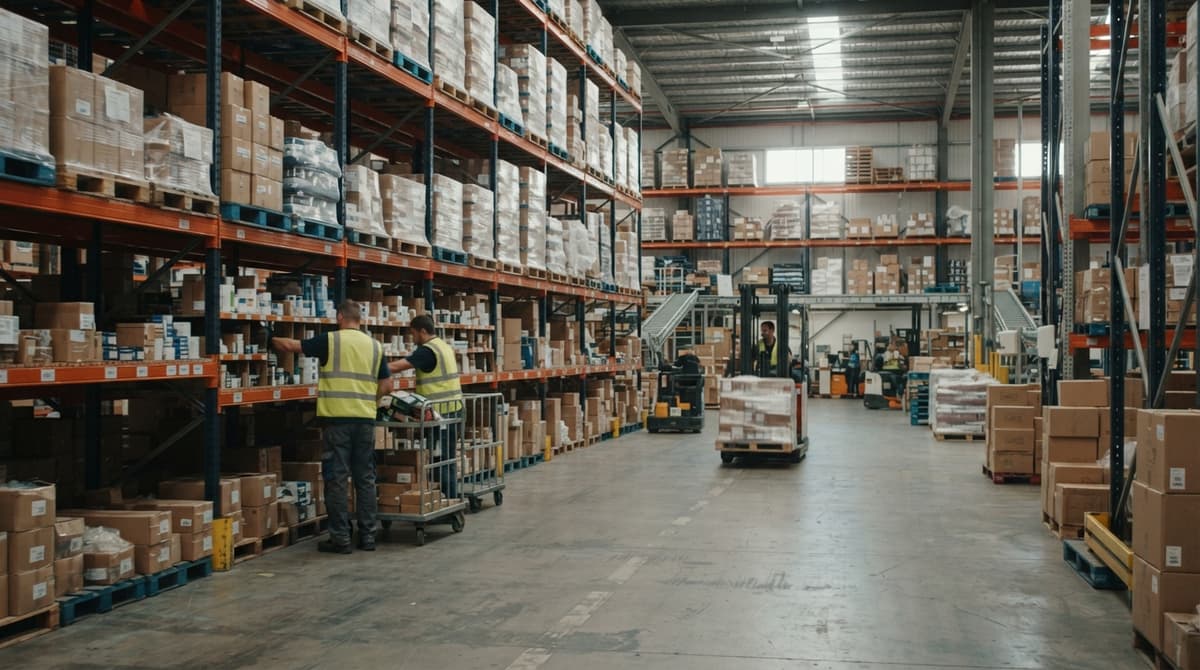
Purpose of Inventory
The purpose of inventory is to let a business fill customer orders without waiting on a supplier. Stock on the shelf turns an order into a same-day shipment.
Book a callWhat Is the Purpose of Inventory?
Inventory is goods held for sale, or for making or moving goods. The purpose of inventory is simple. A buyer calls, and you ship. You do not wait for a truck to arrive first.
Reviewed November 2026.
For a retailer, stock is one part of the business. For a wholesaler or a warehouse, stock is the product. A distributor sells it. A third-party warehouse stores it for others and gets paid for the space and the care.
The US Census Bureau tracks monthly wholesale trade. It reports national inventories, sales, and the ratio between them. That ratio shows how many months of sales sit on wholesale shelves.
We build it for your operation, and the first look is free
If you would rather not compare products, describe how your operation already works and we build the system around it.
No build cost. You see it running on your own process first, and the monthly subscription starts only once it is live.
Book a callWhy Businesses Hold Inventory
The five purposes below explain what that gap costs when it is not covered. Each one also depends on counts that match the shelf. Barcode standards from GS1 are the base for most scan-based counts.
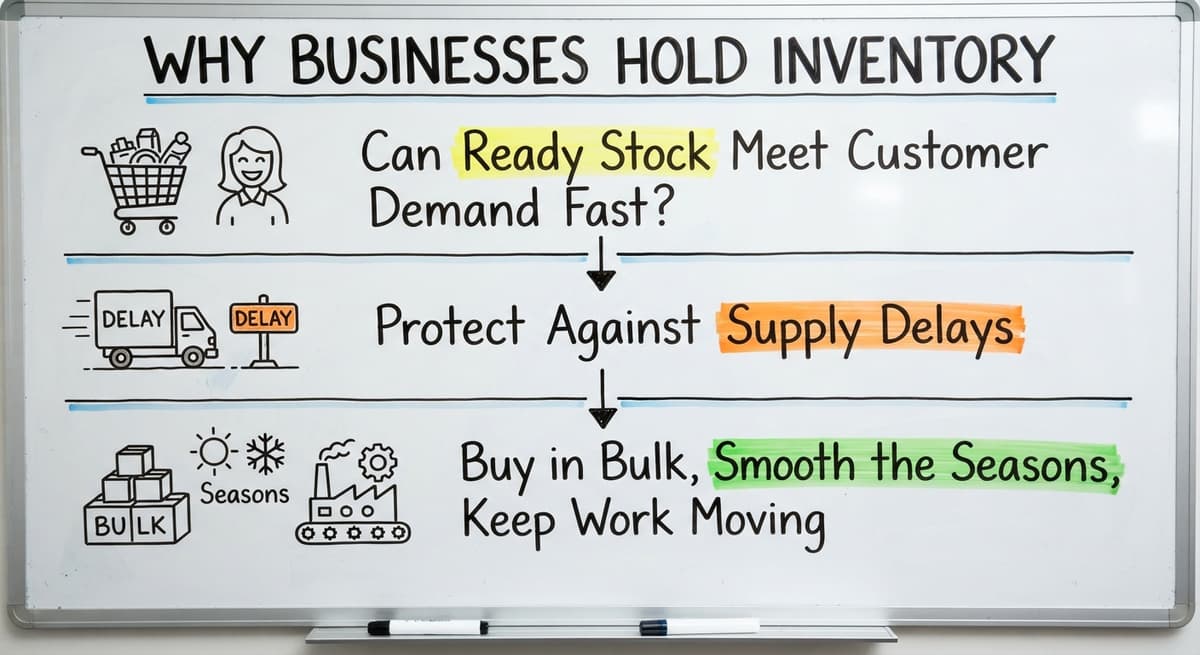
Businesses hold inventory because stock sits between supply and demand. Suppliers ship on their own schedule. Customers want goods now. Inventory fills the gap between the two.
Can Ready Stock Meet Customer Demand Fast?
Picture a restaurant supplier. A kitchen orders 10 cases of cooking oil at 4 p.m. The truck must leave by 6 a.m. If the shelf holds the oil, the driver loads it. If the shelf is empty, the kitchen finds a new supplier. The US Federal Trade Commission also expects sellers to ship when they said they would. An accurate count is how you keep that promise.
Yes. Ready stock lets an order ship the same day it arrives. A buyer who waits a week for your goods will call another distributor.
Protect Against Supply Delays
Safety stock is extra inventory kept to cover late shipments and supplier problems. It is the buffer you hope not to touch.
Suppliers run late. Ports back up. A factory misses a run. Buffer stock keeps your team shipping while the supply chain slips. Say a product sells 20 units a day and the supplier needs 5 days. You need 100 units to last the wait. Add 40 units of safety stock, and a 2-day delay costs you nothing.
When the records are wrong, that buffer is a guess. The team thinks it has 40 spare units. The shelf holds 12.
Buy in Bulk, Smooth the Seasons, Keep Work Moving
Three more purposes share one root. Each one trades a bit of storage for a steadier operation.
- Bulk buying: Larger orders bring lower unit prices and fewer freight charges. Weigh the savings against storage cost. Buy too much and cash gets stuck on the shelf.
- Seasons: A lawn and garden wholesaler builds stock in winter. It sells that stock down by July. Steady buying also keeps warehouse staff busy in slow months instead of swamped in peak ones.
- Daily operations: Parts and supplies keep picking, packing, and shipping moving. One stockout on one item can hold up a whole order. Inventory is the cushion between each step.
Each purpose asks for the same thing: know what you hold, and why you hold it.
The Main Types of Inventory
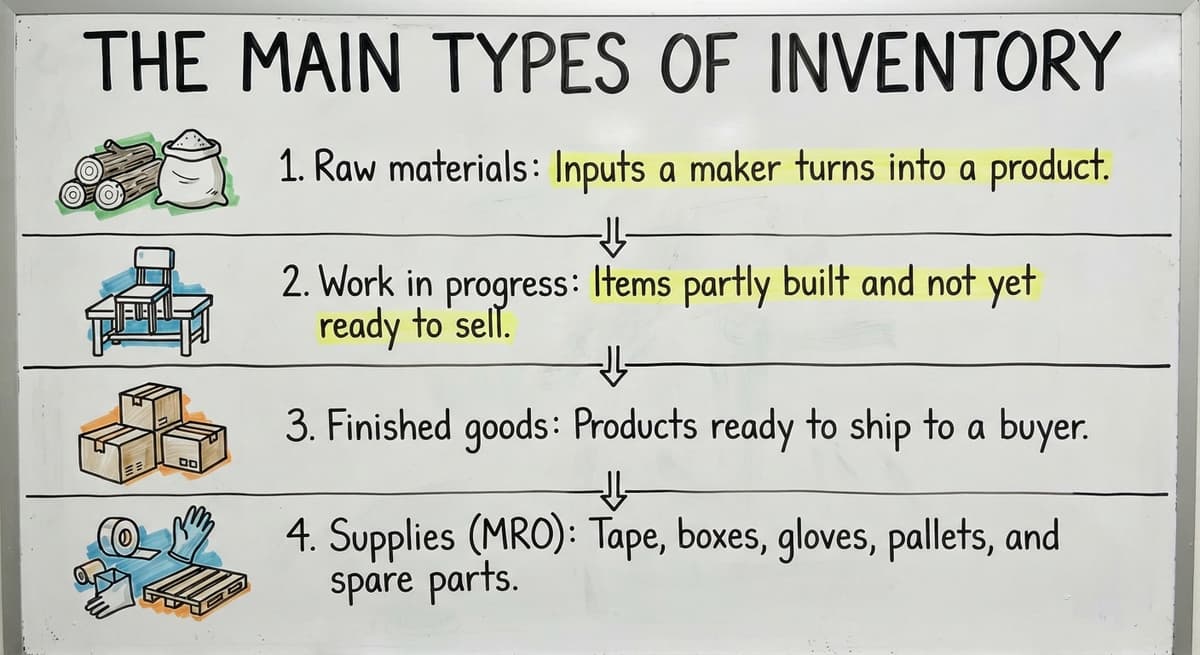
The four types of inventory are raw materials, work in progress, finished goods, and supplies. Supplies are also called MRO: maintenance, repair, and operating items.
- Raw materials: Inputs a maker turns into a product.
- Work in progress: Items partly built and not yet ready to sell.
- Finished goods: Products ready to ship to a buyer.
- Supplies (MRO): Tape, boxes, gloves, pallets, and spare parts.
Distributors and warehouses hold mainly finished goods and supplies. Finished goods earn the revenue. Supplies keep the dock moving. A shortage of either one stops shipments.
Not sure this is the right shape for your operation
Describe how the work runs today. We map it on a call and show you what it would look like built around that, before you spend anything.
Book a callHow Does Inventory Affect Cash Flow?
Inventory ties up cash until the goods sell. Every unit on the shelf is money you cannot spend elsewhere. Buy 500 cases at $24 and you park $12,000 on the floor.
Too little stock loses sales. Too much stock traps cash, and you still pay rent, labor, and insurance on it. Good inventory and cash flow sit in balance.
Inventory also shows on the balance sheet as an asset. That is why an accounting package such as your accounting software tracks it. The IRS makes the count a legal duty. In Publication 538 it says: "To figure taxable income, you must value your inventory at the beginning and end of each tax year." A bad count means a bad tax figure.

What Happens When Inventory Has No Clear Purpose
Inventory with no clear purpose costs money in both directions. Some items pile up. Others run out.
- Overstock and dead stock: Goods nobody buys take space, tie up cash, and get old.
- Stockouts and backorders: A stockout is a sale lost because the item is gone. Backorders leave buyers waiting and unhappy.
- Counts that do not match records: The system says 30. The shelf holds 18. Every promise built on that number is shaky.
Some signs show the problem early:
- Staff walk the floor to check if an item is in stock.
- Spreadsheet counts disagree with the accounting package.
- Customers hear yes, then hear no a day later.
- Reorders come from gut feel or a sticky note.
One of these signs is a nuisance. Two or more mean the stock has lost its job.
How to Keep Inventory Working for You
Every item needs a reason to sit on the shelf. That reason is a customer, a safety buffer, a bulk deal, or a season. If an item has none of these, it is a cost. Three habits keep that reason clear.
Set Reorder Points and Safety Stock
A reorder point is the stock level that triggers a new order. Base it on sales speed and supplier lead time, which is how long the supplier takes to deliver.
Take the math from earlier. At 20 units a day and a 5-day lead time, the point is 100 units plus 40 of safety stock. Order at 140. Demand moves, so review the number every month or two. A reorder point set last year is a guess today. Check your fastest items first.
The comparison is easier when one option is built for you
Off-the-shelf means fitting your process to the software. We do it the other way round, and the first look costs nothing.
Book a callCount and Check Stock on a Schedule
A cycle count checks a few items each week instead of one big count once a year. Your team counts 25 items on Monday, 25 more on Tuesday, and so on. Errors show up in days, not months.
When a count is off, find the cause. Look at receiving, picking, and returns first. Fix the step that broke, not just the number. Update records as goods move, not at the end of the day. NIST offers vendor-neutral guidance on supply chain process for small firms.
Which Items Sell and Which Sit?
Sales data answers this, and ABC grouping makes it easy to read. A items are the few that bring most of your revenue. B items sit in the middle. C items are the many that sell slowly.
Count and reorder A items most often. Check C items less often. Stock more of what sells. Clear what does not with a discount or a bundle. Dead stock is cash you can win back.

Why Spreadsheets and Paper Fall Short
Excel files, Access databases, printed sheets, and email threads give you several versions of the truth. Nobody knows which one is right. An accounting package is good for books. It is often not built for bin locations, lots, or pick paths.
Spreadsheets and paper fail because people type the numbers. Typing causes errors and delays. A pick ticket goes on the floor and the count updates tomorrow, if at all.
Try the cost. Two staff spend 5 hours a week fixing counts at $20 an hour. That is $10,400 a year. The US Bureau of Labor Statistics lists pay for stock clerks and order fillers if you want to use your own local rate.
Tracking Inventory Without a Big ERP
A small distributor can track inventory without a big ERP. An ERP is a large software suite that runs a whole company. Small and mid-size shops do not need a long, costly rollout.
The Software Society is local to Columbus, Ohio, and works at small scale. We build custom software around how your operation already runs. Your team keeps its pick routes and receiving steps. We replace only the manual parts.
Your accounting software stays where it works. We connect to it, so the books stay in one place while the warehouse gets live counts. That is a smaller step than a full system swap.
Ask three things before you start. Which step costs you the most errors? Which count do you trust least? Which report do you wish you had? Start with the first answer. Fix one step, then the next.

Put Your Stock Back to Work
The purpose of inventory is to serve customers, cover delays, save money, and keep work moving. Records that match the shelf make all four possible. If your counts, spreadsheets, and books disagree, talk to The Software Society about a custom fix built around your warehouse.
Frequently asked questions
What is inventory accounting and what is its purpose?
Inventory accounting is how a business values and records the goods it holds. Its purpose is to show true profit and true assets. It also supports tax filing, since the IRS needs you to value stock at the start and end of each tax year.
What are the main types of inventory?
The four types are raw materials, work in progress, finished goods, and supplies. Distributors and warehouses mostly hold finished goods and supplies. Makers hold all four.
Why is too much stock a problem?
Extra stock ties up cash and takes space. It also risks damage and age. You pay storage, insurance, and labor on goods that are not selling.
How often should a warehouse count its stock?
Count fast sellers every week or two with cycle counts. Count slow sellers every few months. Pair that with a full count once a year if tax or audit rules call for one.
Start with a free first look
A 30 minute call, your operation mapped, and a clear picture of what we would build. No obligation and nothing to install.
Book a callRelated guides
More on the same work.
Guides
- Best Inventory Software
- Classification of Inventory
- Excess Inventory
- Closed for Inventory
- Multi Location Inventory Management Software
- Ms Excel Inventory Template
- Inventory Management for Multiple Locations
- Costing Inventory
- Is Inventory a Long-term Asset
- Inventory Management System for Manufacturing
- Inventory Fixed Assets
- Inventory Management Pics
- Inventory Monitoring
- Excel Inventory Template
Common questions
- What is the Main Purpose of Inventory Management
- What is the Purpose of Inventory in Operations Management
- What is the Purpose of a Warehouse Management System
- How to Keep Track of Inventory
- What is the Difference Between Aggregate and Item Inventory Management
- What is Jit Inventory Management
- What is Kanban System of Inventory Management
- What is the Definition of Inventory Management
- Mro Inventory Meaning
- What is an Important Factor in Inventory Management