


Simple Inventory Management
Simple inventory management means knowing what you have, where it is, and when to reorder, in the fewest steps. Start with a clean item list, labeled bins, small daily counts and set reorder points. Fix the manual steps first. Pick a system second.
Book a callWhat Is Simple Inventory Management, and Why Does It Get Messy?
Simple means fewer moving parts, not fewer features that matter. You still track stock, locations and reorders. You just do it in one place, with steps your team can repeat.
Reviewed November 2026.
Messy inventory starts small. A team begins with an accounting package, then adds Excel, Access files, printed sheets and email. Each tool holds a different version of the truth. Growth adds orders, SKUs (stock keeping units, the unique codes for each item) and people faster than habits can keep up. Barcodes help, and the GS1 barcode standards are the shared base for scan-based counts. Habits come before scanners.
We build it for your operation, and the first look is free
If you would rather not compare products, describe how your operation already works and we build the system around it.
No build cost. You see it running on your own process first, and the monthly subscription starts only once it is live.
Book a callIs Your Inventory Process Too Manual?
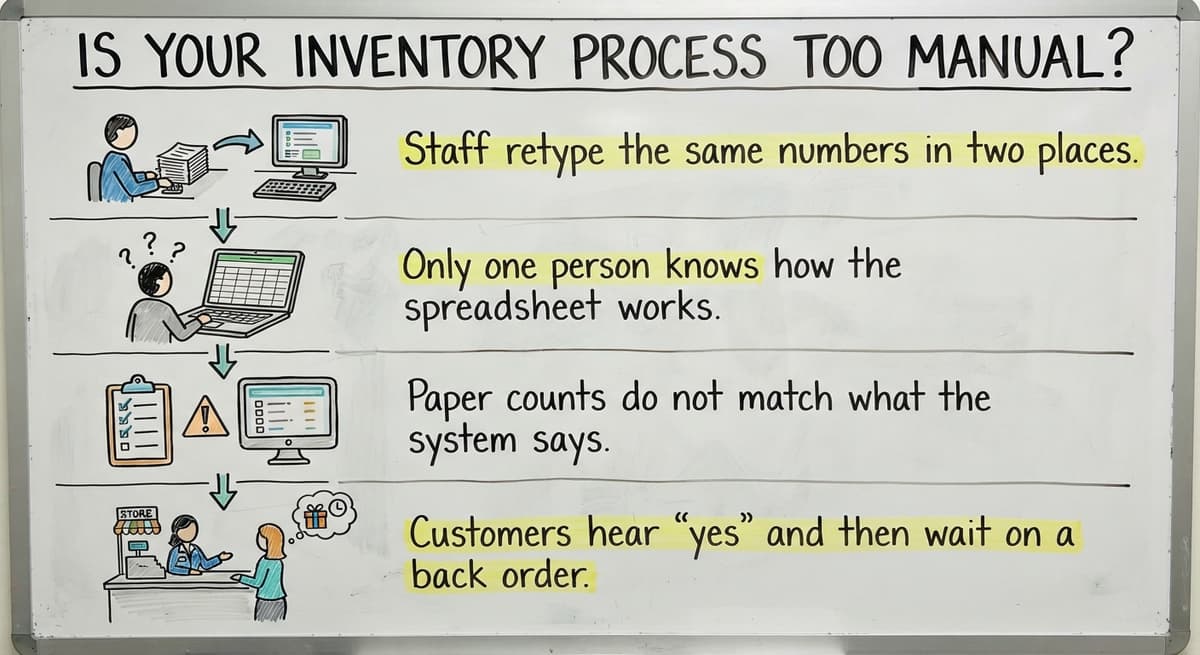
Yes, if you see any of these 4 signs. Each one costs time and trust.
- Staff retype the same numbers in two places.
- Only one person knows how the spreadsheet works.
- Paper counts do not match what the system says.
- Customers hear "yes" and then wait on a back order.
The cost adds up. Say 3 people spend 4 hours a week on re-entry at $22 an hour. That is $13,728 a year. The Bureau of Labor Statistics tracks pay for stock clerks if you want to use your own local rate. Late orders carry a legal side too. The Federal Trade Commission expects you to ship when you said you would. An accurate count protects that promise.

What Should a Small Warehouse Track?
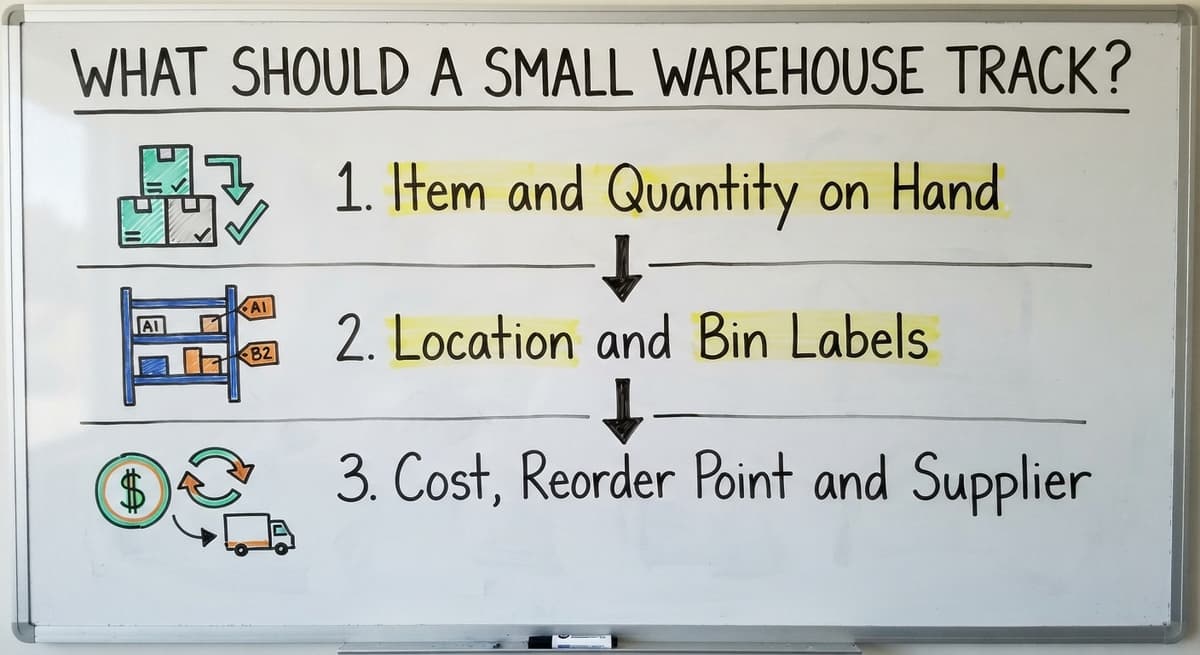
A small warehouse should track 5 things: item, quantity on hand, location, cost and reorder point. Keep the list short so staff use it. Good inventory tracking beats long, ignored forms.
Item and Quantity on Hand
Give each item one name and one SKU. Avoid twins like "Widget 2in" and "widget-2 inch." Duplicates split your count in two. Update the quantity when stock moves, not at the end of the week. A number that is a week old is a guess.
Location and Bin Labels
Use a plain code for zone, shelf and bin, such as A-03-2. Print labels and stick them on the shelf. Clear labels cut pick time and wrong picks. The same scheme works in a small stockroom and a large warehouse. A label turns "somewhere in the back" into an address.
Cost, Reorder Point and Supplier
A reorder point is the stock level that triggers a new order. Use this formula: daily use times lead time, plus a safety cushion. If you sell 20 units a day, the supplier needs 7 days, and you want 40 spare units, the point is 20 x 7 + 40 = 180. Record the usual supplier and unit cost beside it. Reorders then take minutes.
Not sure this is the right shape for your operation
Describe how the work runs today. We map it on a call and show you what it would look like built around that, before you spend anything.
Book a call
How Do You Receive, Pick and Ship Stock the Simple Way?
Use one routine for every delivery and every order. A steady warehouse inventory process stops most errors before they start.
For receiving, follow these steps the same day:
- Check the delivery against the buy order.
- Count the items.
- Label them and shelve them.
- Record them in the system.
- Flag damaged or short items right away, and tell the supplier.
For picking, print pick lists in shelf order so staff walk one path. Add a quick check before packing: right item, right count. Deduct stock at shipment, not at order. Then the numbers stay true. A good routine makes the next count easy.
How Often Should You Count Inventory, and How Do You Set Reorder Points?
Count a few items every day. This is cycle counting, and it replaces the one giant count that shuts you down. Count fast-moving and high-value items more often. A weekly count of your top 20 items beats a yearly count of everything. Still, the tax side is firm. IRS Publication 538 says: "To figure taxable income, you must value your inventory at the beginning and end of each tax year."

When a count is off, find the cause. Was it a late entry, a bad label or a miscount? Fix that, not just the number.
Re-check each reorder point every quarter. Seasonal items need higher levels before the busy months. Use last season's daily use, not this month's. The NIST Manufacturing Extension Partnership offers vendor-neutral guidance on supply chain process.
Pick 3 numbers to watch, such as stock-outs, count accuracy and slow movers. Each number must lead to an action. If it does not, drop it.
When Do You Move Past Spreadsheets, and Do You Need an ERP?
Stop using spreadsheets when errors and re-entry cost more than a fix. A spreadsheet works for a few dozen items and one person. Switch when you have any of these signals:
- You run more than 1 location.
- Several people edit stock at once.
- Errors show up every week.
- Staff lose hours re-entering data.
You can replace Excel inventory spreadsheets without dropping your accounting package. It stays the right home for the books. The manual work around bins, receiving and pick sheets sits outside it. Keep the accounting tool where it helps and replace only the manual parts. A system can sync with your accounting software, so one entry feeds both.
Do you need a big ERP? Most teams of 5 to 100 do not. Big rollouts bring high cost, long timelines and forced process change. A smaller system built around your current work is a real option. Custom inventory management software can match how your team already works. Think of it as a lighter warehouse inventory management system. It fits small scale, and The Software Society builds it with a team in Columbus, Ohio.
A Simple Plan to Start This Month
Four weeks is enough to set the base. Start by listing the manual steps that waste the most time. Then work through this plan:
- Week 1: Clean the item list. One name, one SKU.
- Week 2: Label every location.
- Week 3: Start cycle counts.
- Week 4: Set reorder points for your top items.
Avoid 4 common mistakes. Do not track too much at once. Do not skip staff training. Do not update stock late. Do not buy a system before you map the process. Map the steps first, and the right tool becomes clear. If you want help, talk to The Software Society about a system built around your own workflow.
Frequently asked questions
What is the easiest way to manage inventory?
Keep one clean item list, label every bin, count a few items each day and set a reorder point for each key item. Record every stock move the same day it happens.
How often should I count inventory?
Count a few items every day instead of one big count. Check fast-moving and high-value items each week. Slow movers can wait a month. Investigate every gap and fix its cause.
Can I keep my accounting software and still improve inventory control?
Yes. Keep your accounting software for accounting. Replace only the manual steps around bins, receiving and pick sheets with a system that syncs to it, so one entry feeds both places.
When should I stop using spreadsheets for inventory?
Stop when you add a second location, when several people edit stock at once, when errors show up weekly, or when staff lose hours each week retyping the same numbers.
Start with a free first look
A 30 minute call, your operation mapped, and a clear picture of what we would build. No obligation and nothing to install.
Book a callRelated guides
More on the same work.
Guides
- Simple Inventory Management Software
- Simple Warehouse Management System
- Simple Inventory System for Small Business
- Multi Location Inventory Management Software
- Inventory Management for Multiple Locations
- Inventory Management System for Manufacturing
- Inventory Management Pics
- B2B Inventory Management
- Jewelry Inventory Management
- Dental Inventory Management
- The Objective of Inventory Management is To
- Qr Code for Inventory Management
- HVAC Inventory Management Software
- Inventory Management Software for Schools
Common questions
- What is a Simple Warehouse Management System?
- What is the Difference Between Aggregate and Item Inventory Management
- What is Jit Inventory Management
- What is Kanban System of Inventory Management
- What is the Definition of Inventory Management
- What is an Important Factor in Inventory Management
- What is Abc Classification in Inventory Management
- What is Inventory Management in Working Capital
- What is Poor Inventory Management
- What is Inventory Management and Its Types