


Warehousing Models
Warehousing models are the different ways a business stores, moves, and manages stock: private, public, contract, third-party logistics, bonded, on-demand, and hybrid. Each model is a different split of control, cost, and risk, and each one changes what the software behind it has to do. This guide, reviewed in September 2026, takes the 7 warehousing models one at a time and ends with how to choose.
Published 31 July 2026. Reviewed and updated 15 September 2026.
Book a callWhat Are Warehousing Models?
Naming What You Are Already Doing
A warehousing model is simply the structure your business uses to hold and move goods. You are already running one. Most operators just have not named it.
Naming it matters because it tells you what your costs should look like, what risks you carry, and what kind of software you need to manage it well.
The model you run shapes every daily decision: who receives a shipment, where it gets logged, how a pick list gets made, and how that data reaches your accounting system.
The Models This Guide Covers
The 7 warehousing models this guide covers are:
- Private warehousing
- Public warehousing
- Contract warehousing
- Third-party logistics (3PL)
- Bonded warehousing
- On-demand warehousing
- Hybrid models
Most small and mid-size distributors run one model but manage it with tools built for a different one. That gap is where the manual work piles up.
Would you rather have it built around your operation?
The first look is free. If you would rather not compare products, describe how your operation already works and we build the system around it.
No build cost. You see it running on your own process first, and the monthly subscription starts only once it is live.
Book a callPrivate Warehousing: Full Control, Full Cost
What Does Private Warehousing Mean?
Private warehousing means your business owns or leases its own space and runs all operations in-house. You set the layout. You hire the staff. You choose the systems. No third party is involved in the daily work.
This is the most common model for wholesale distributors and fulfillment operators running 5 to 100 staff. If you have your own building or a long-term lease, this is you.
The Cost Reality
Private warehousing comes with real costs. Fixed costs include rent or mortgage, utilities, equipment, and payroll. Those costs do not drop when volume drops.
The IRS makes the record-keeping obligation clear: as stated in IRS Publication 538, "To figure taxable income, you must value your inventory at the beginning and end of each tax year." That requirement applies no matter what model you run, but it lands hardest on private operators who own the full process.
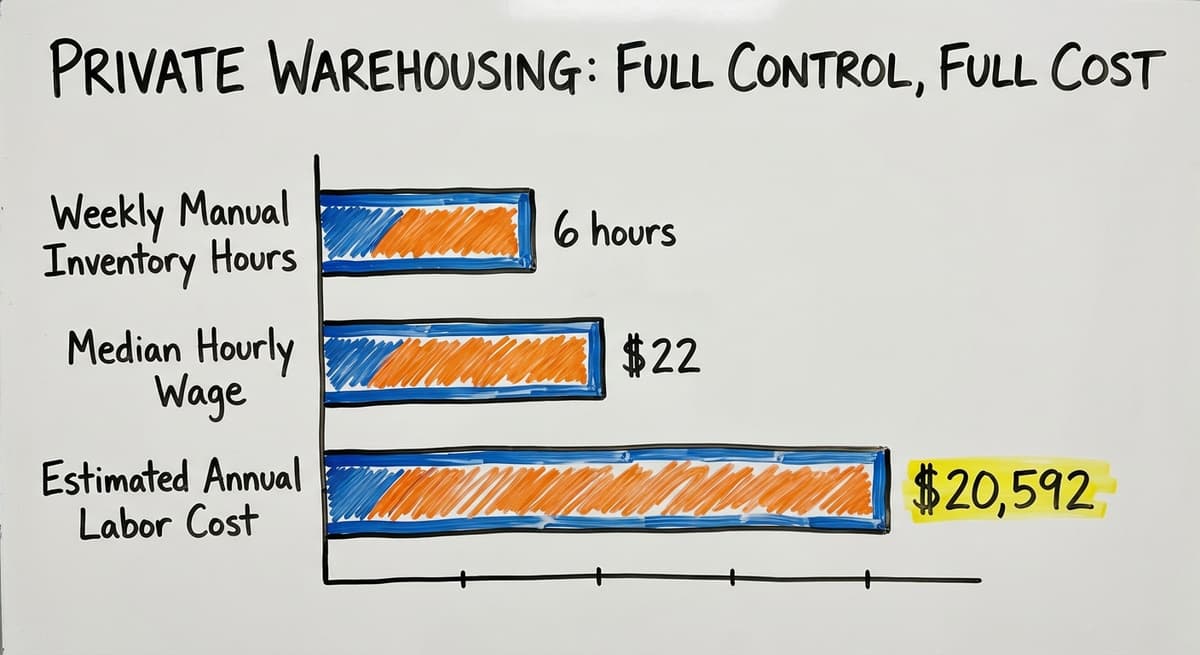
If 3 staff members each spend 6 hours a week on manual inventory counts at $22 an hour (the current median for stock clerks per the Bureau of Labor Statistics), that is $20,592 a year in labor before you count errors and reorders.
Where Do Private Warehouses Break Down?
Private warehouses grow faster than the systems managing them. Volume goes up. SKU counts rise. Staff get added. But the process stays the same: spreadsheets, printed pick lists, and manual tracking.
Reviewed August 2026. Each figure comes from the assumptions stated beside it, so you can substitute your own and the arithmetic still holds.
This is where Warehouse Inventory Management Software earns its cost. The right system matches how your operation already works. It does not ask you to rebuild your process to match the software.
Private warehousing fits businesses with steady, predictable volume and strong process discipline. If your volume swings wildly season to season, the fixed cost structure works against you.
Public Warehousing
What Does Public Warehousing Mean?
Public warehousing means renting shared space from a third-party provider. You pay for the space and services you use. There is no long lease and no building to staff or maintain.
The provider runs the facility on its own systems and processes. You share the building with other businesses.
The Flexibility Benefit
Public warehousing fits businesses with seasonal volume spikes. It also works for businesses testing a new market before committing to a lease. You can scale space up or down without a capital decision.
For a business that needs 3 times the space in Q4 and almost none in Q2, public warehousing can be cheaper than carrying a fixed private lease all year.
The Visibility Challenge
Storing inventory in a public warehouse makes real-time data harder to get. The provider tracks what matters to them. That may not match what you need for order management or accounting.
Inventory Tracking for Small Distributors becomes harder when the data lives in a system you do not control. You need a clear data feed or a manual process to keep your records current. Neither is free.
Contract Warehousing
What Does Contract Warehousing Mean?
Contract warehousing is a longer-term agreement with a third-party provider. The provider dedicates space and staff to your operation. You get more control than public warehousing, but you do not own or lease the building.
Contracts run 1 to 3 years. The provider builds their staffing and layout around your needs.
The Middle-Ground Appeal
Contract warehousing sits between private and public. You get some of the control of a private warehouse without the full capital investment. The provider handles facilities. You focus on your product and your customers.
This model fits businesses that have outgrown public warehousing but are not ready to own or lease their own facility. It is a common step for distributors growing from $5M to $20M in revenue.
The comparison is easier when one option is built for you
Choosing a warehousing model is easier when one option is built around how you already work, and the first look costs nothing.
Book a callThe Integration Challenge
With contract warehousing, your orders, inventory counts, and shipping data still need to connect back to your internal systems. If your provider does not have a clean data export or API, that connection becomes a manual job.
QuickBooks Integration for Warehouses is a real problem here. Many contract warehouse operators find themselves re-entering shipment data into QuickBooks by hand at the end of each week. That is a process gap, not a warehousing model problem. But the model creates the condition.

Third-Party Logistics (3PL)
What Does a 3PL Do?
A third-party logistics provider, called a 3PL, handles warehousing, fulfillment, and often transportation on your behalf. You send them inventory. They receive it, store it, pick orders, pack boxes, and ship to your customers.
You do not manage the warehouse floor. The 3PL does.
The Scalability Benefit
3PLs are built to absorb volume changes. When your orders double in November, the 3PL adds labor without you hiring. When volume drops in January, your costs drop with it.
The cost model is fee-per-transaction or per-unit stored. That makes costs variable rather than fixed. For businesses with uneven demand, this is a real financial advantage.
The Control and Visibility Trade-Off
Working with a 3PL means relying on their systems and processes. Those systems may not match how your business tracks inventory. Discrepancies between the 3PL's counts and your records are common.
Many small distributors use a 3PL for overflow or for a specific product line while keeping core inventory in-house. That hybrid approach adds flexibility but also adds data complexity.
Fulfillment Center Software that connects both sides of that operation is not a luxury. It is a necessity.
Do you need a warehouse management system if you use a 3PL? Yes, in most cases. Your 3PL manages their warehouse. You still need to manage your inventory position, your orders, and your financials.
Bonded Warehousing
What Does Bonded Warehousing Mean?
A bonded warehouse is a government-licensed facility that stores imported goods before customs duties are paid. The goods sit in bond until you release them for sale or distribution. Duties are deferred until release.
This model applies to businesses importing goods from overseas who want to stage inventory before committing to full duty costs.
The Cash Flow Benefit
Deferring duties on a large shipment can free up meaningful working capital. If you import a container of goods and pay duty only as you sell through, your cash position stays stronger.
Bonded warehouses still require the same internal inventory tracking as any other model. The government-licensed status covers the duty deferral. It does not replace your own records.
The US Census Bureau's Monthly Wholesale Trade data shows how much inventory wholesale firms carry nationally. Importers managing large shipments feel that weight directly.
What does it look like running on your own process?
The first thing you see is it running on your own process, at no build cost. The subscription starts once it is live and doing the job, not before.
Book a call
On-Demand Warehousing
What Does On-Demand Warehousing Mean?
On-demand warehousing is a newer model. Businesses access warehouse space and labor through a marketplace or platform, with no long-term commitment. You find available space, book it, and use it.
Think of it like a short-term rental for warehouse capacity. You spin up space quickly without a contract.
The Limitations to Know
On-demand warehousing is growing in adoption. It is most useful for e-commerce businesses and operations with highly variable seasonal demand. It is less useful for distributors who need consistent processes and tight system integration.
Service quality varies by provider. Integration with your existing systems is rarely seamless. The convenience is real. The consistency is not always there.
Regardless of the model you use, the data and process challenge stays the same. Someone has to track what came in, what went out, and what is left. On-demand warehousing does not solve that. It just moves where the space is.
Hybrid Warehousing Models
How Do Hybrid Models Work in Practice?
Most real-world operations do not fit neatly into one model. A business might run a private warehouse for core inventory and rely on a 3PL for overflow. Another might hold one product line in contract space and manage a second line in-house.
This is the operational reality for many wholesale distributors and fulfillment centers running 5 to 100 staff. The NIST Manufacturing Extension Partnership notes that supply chain complexity grows with the number of partners and locations involved. Hybrid models add exactly that kind of complexity.
Where Do the Data Problems Start?
Hybrid warehousing models split your inventory data across multiple locations and systems. Your 3PL has one count. Your private warehouse has another. Your QuickBooks has a third.
This is where spreadsheets, email chains, and manual reconciliation pile up. Someone is copying numbers from one place to another. That person is your most expensive data entry clerk, and they probably have a better job title.
Custom Warehouse Management Systems built for hybrid operations connect those data sources. They give you one view of inventory across all locations without requiring a manual sync every morning.

How Does Your Warehousing Model Shape Your Software Needs?
Different Models, Different Data Flows
Each warehousing model creates different data flows. A private warehouse generates data internally. A 3PL generates data in someone else's system. A hybrid model generates data in both places.
The question is not just which model you run. The question is whether your software matches how that model actually moves data.
Where Does Manual Work Build Up?
Private and hybrid models tend to generate the most manual work. The business owns the process but may not have software that matches it. Orders come in one place. Inventory lives in another. Accounting updates happen at the end of the week, by hand.
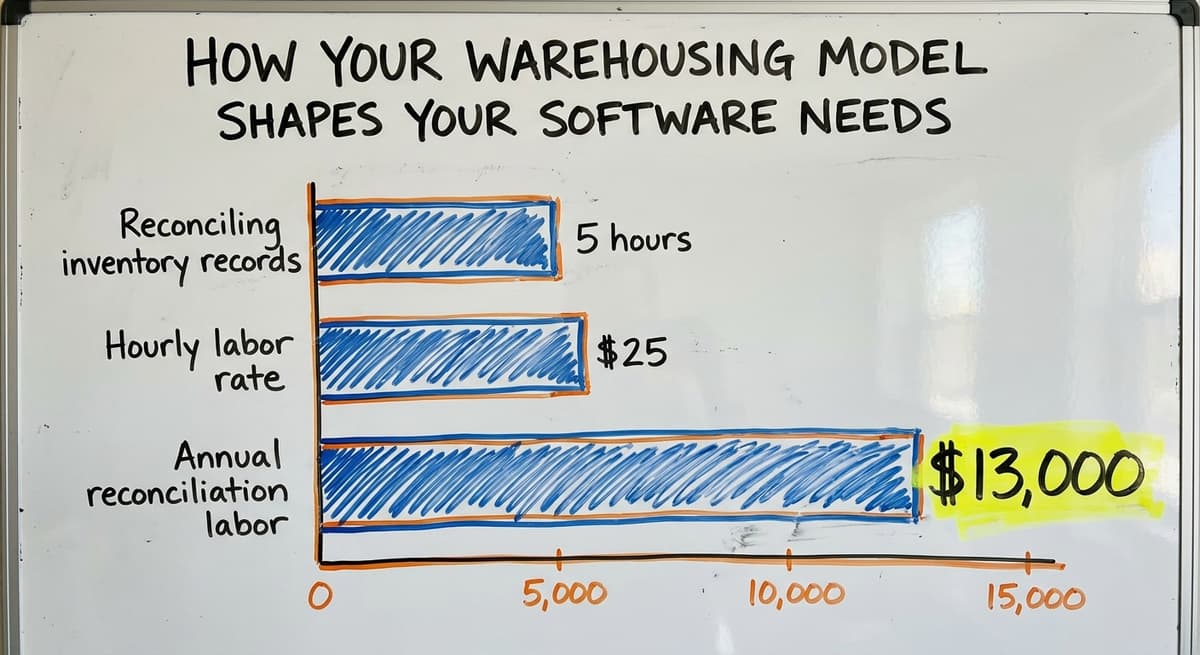
If 2 people spend 5 hours a week reconciling inventory records at $25 an hour, that is $13,000 a year in reconciliation labor alone. That number does not count the cost of errors, late shipments, or oversells.
Matching Software to Your Model
The right inventory management software fits the model you are already running. It does not force you to change your operation to match the software.
For private warehouse operators, that means software that handles receiving, picking, and shipping without requiring a separate QuickBooks entry for each transaction. For hybrid operators, it means a system that pulls data from multiple locations into one view.
If your operation has outgrown spreadsheets and QuickBooks workarounds, the answer is not a bigger spreadsheet. It is a system built around how you actually work.
Choosing the Right Warehousing Model for Your Operation
Five Questions to Ask First
Before you change your model or your software, answer these 5 questions honestly:
- How predictable is your inventory volume month to month?
- Do you need full control over your layout, staff, and processes?
- What is your capital position for fixed versus variable costs?
- Are you managing 1 location or multiple?
- How tightly does your warehouse need to connect to your accounting and order management?
Your answers will point you toward a model. They will also tell you what your software needs to do.
What is in a free first look?
A 30 minute call, your operation mapped, and a clear picture of what we would build. No obligation and nothing to install.
Book a callQuick Model Reference
| Model | Best For | Cost Structure | Control Level |
|---|---|---|---|
| Private | Steady volume, strong process discipline | Fixed | High |
| Public | Seasonal spikes, market testing | Variable | Low |
| Contract | Outgrown public, not ready to own | Semi-fixed | Medium |
| 3PL | Variable demand, outsourced fulfillment | Variable | Low |
| Bonded | Importers deferring duties | Fixed or variable | Medium |
| On-demand | E-commerce, unpredictable demand | Variable | Low |
| Hybrid | Multiple product lines or locations | Mixed | Mixed |
The Model Your Team Can Actually Run
The best warehousing model is the one your team can execute well, supported by systems that match how you work.
Running your own warehouse on spreadsheets is not better than a 3PL with clean data just because you own the building. A 3PL with no integration into your order system is not better than owning your warehouse just because it is flexible.
The model matters. The execution matters more. And the software that connects them is what makes the difference for a 10 to 75 person distribution or fulfillment operation.
Frequently Asked Questions About Warehousing Models
Common Questions: Model Basics
What warehousing model do small distributors use most often? Private warehousing is the top choice for small and mid-size distributors. Most own their space or lease it and run operations in-house. The challenge is that the systems managing that space lag behind the volume.
What is the difference between a 3PL and contract warehousing? Contract warehousing dedicates space and staff to your operation under a longer agreement.
A 3PL serves multiple clients and handles the full fulfillment cycle, including picking, packing, and shipping. A 3PL offers more services. Contract warehousing offers more consistency.
Can a business use more than one warehousing model at the same time? Yes.
Most mid-size distributors run some form of hybrid model: an owned facility for core inventory alongside a 3PL to handle overflow is one of the most common combinations. The trade-off is added data complexity across locations.
Common Questions: Software and Systems
How does my warehousing model affect my inventory management software choice? Your model determines where your inventory data lives and how it moves.
A private warehouse needs software that handles internal receiving, picking, and shipping. A hybrid model needs software that connects data from multiple locations. The model shapes the data flow. The software has to match it.
Do I need dedicated inventory software if I work with a 3PL? Yes, in most cases. Your 3PL manages their warehouse floor.
You still have to track your inventory position, your open orders, and your financials. Without your own system, you are dependent on the 3PL's reports, which may not match your accounting records.
What software do I need for a private or hybrid warehousing model? You need one system that ties receiving, inventory tracking, order management, and accounting together in one place.
For most private warehouse operators, that means moving beyond QuickBooks workarounds to a system built for warehouse operations. A configurable system designed for your specific model will save more time than any off-the-shelf tool that requires you to change how you work.
Frequently asked questions
Frequently asked questions
What is the most common warehousing model for small distributors?
Private warehousing remains the top model for small and mid-size distributors. Most operate from their own building or a long-term lease and run operations in-house.
The challenge is that the systems managing that space lag behind the volume, leading to manual tracking and spreadsheet workarounds.
What is the difference between a 3PL and contract warehousing?
Contract warehousing dedicates space and staff to your operation under a longer-term agreement. A 3PL serves multiple clients and handles the full fulfillment cycle, including picking, packing, and shipping. A 3PL offers more services. Contract warehousing offers more consistency and customization.
Can a business use more than one warehousing model at the same time?
Yes. Most mid-size distributors run some form of hybrid model, such as an in-house facility for core inventory paired with a 3PL handling overflow needs, a frequent pairing. The trade-off is added data complexity, because inventory records are now split across multiple locations and systems.
How does my warehousing model affect my inventory management software choice?
Your model determines where your inventory data lives and how it moves. A private warehouse needs software that handles internal receiving, picking, and shipping.
A hybrid model needs software that connects data from multiple locations. The model shapes the data flow, and the software has to match it.
Do I need a warehouse management system if I use a 3PL?
Yes, in most cases. Your 3PL manages their warehouse floor, but you are still responsible for your inventory position, your open orders, and your financials. Without your own system, you depend on the 3PL's reports, which can differ from your accounting records.
What is bonded warehousing and who needs it?
A bonded warehouse is a government-licensed facility that stores imported goods before customs duties are paid.
Duties are deferred until the goods are released for sale. This model is most useful for businesses importing large shipments from overseas who want to stage inventory and manage cash flow before committing to full duty costs.
What software do I need to manage a private or hybrid warehousing model?
You still need one place where receiving, inventory tracking, order management, and accounting come together. For most private warehouse operators, that means moving beyond QuickBooks workarounds to a system built for warehouse operations.
A custom or configurable platform designed around your specific model will save more time than a generic off-the-shelf tool.
How do I know if my current warehousing model is the right one for my operation?
Ask 5 questions: How predictable is your volume? Do you need full process control? What is your capital position for fixed versus variable costs? Are you managing one location or multiple?
How tightly does your warehouse need to connect to your accounting? Your answers will tell you whether your current model fits or whether a change makes sense.
What is the difference between a warehouse and a distribution center?
A warehouse is primarily a storage facility where goods sit until they are needed, while a distribution center is built around movement, receiving, sorting, and shipping inventory quickly to fulfill orders.
Warehouses focus on holding stock for longer periods, whereas distribution centers emphasize speed and turnover, moving goods through the facility toward customers or retail locations as fast as possible.
Which warehousing model is best for a small business?
There is no single best model since it depends on your volume, capital, and control needs. Public warehousing suits small businesses because it avoids a long lease and lets you rent only the space and services you use.
Contract warehousing can work well once you outgrow public space but are not ready to own a building or sign a lease yourself.
What are the advantages of public versus private warehousing?
Public warehousing offers flexibility. You rent shared space from a provider, avoid a long lease, and can scale space up or down without a capital decision, which suits seasonal volume or testing a new market.
Private warehousing offers full control. You hold your own building through ownership or a long-term lease, set the layout, hire staff, and choose your own systems, though it comes with fixed costs that do not drop when volume drops.
How does automated warehousing work?
Automated warehousing uses technology such as software, scanning systems, and sometimes robotics or conveyors to handle tasks that were once done manually, like tracking inventory counts, generating pick lists, and recording shipments.
Instead of relying on spreadsheets or printed lists, data flows directly between receiving, storage, and order systems, reducing manual entry and keeping inventory records more current and accurate.
Not sure this is the right shape for your operation?
The call is free. Describe how the work runs today. We map it on a call and show you what it would look like built around that, before you spend anything.
Book a callRelated guides
The rest of this guide, for the parts of the job this page does not cover.
Guides
- Warehouse Inventory Management Software
- Warehouse Inventory Tracking Software
- Warehouse Inventory Management Systems
- Pick and Pack in Warehouse
- Warehouse Receiving Software
- Warehouse Inventory Systems
- Warehouse Stock Management Software
- Warehouse Management System Top 10
- Software for Warehouse Management System
- Warehouse Shipment
- Warehouse Tracking System
- Warehousing Operations
- Inventory and Warehouse Management Software
- Small Business Warehouse Management System
- Cloud Based Warehouse Management
- Warehouse Management System Types
- Warehouse Inventory Management System
- List of Warehouse Management Software
- Warehouse Management Costs
- Warehouse Management Cloud
- Warehouse Management System Examples