


What Are the 4 Types of Inventory Management
What are the 4 types of inventory management? Learn perpetual, periodic, ABC analysis and just-in-time, and which fits a small warehouse.
Book a callWhat Are the 4 Types of Inventory Management?
The 4 types of inventory management are perpetual, periodic, ABC analysis and just-in-time (JIT). Perpetual updates counts with every move. Periodic counts stock on a set schedule. ABC analysis ranks items by value. JIT orders stock only when needed. People group these in other ways, but this is the list most wholesalers and warehouses use.
We build it for your operation, and the first look is free
If you would rather not compare products, describe how your operation already works and we build the system around it.
Reviewed November 2026.
No build cost. You see it running on your own process first, and the monthly subscription starts only once it is live.
Book a callWhat Is Inventory Management in Simple Terms?
Inventory management means knowing what you have, where it sits, and when to reorder. Poor control ties up cash in stock, misses orders and builds overstock. Scan-based counts rely on barcode standards. GS1 says its barcodes help "identify products" (GS1 barcode standards). Good counts also help with taxes. IRS Publication 538 says you "must value your inventory at the beginning and end of each tax year."
Which Counting Methods Do Teams Use?
Two of the types of inventory management are counting methods. Perpetual and periodic inventory differ in one way: how fresh the number is.
What Is Perpetual Inventory Management?
Perpetual inventory updates the count each time an item is received, picked or sold. A distributor, for example, sees the count drop when an order ships. The strength is a current number at all times. The weakness is that missed entries pile up as errors. Scanning or steady data entry keeps it honest.
What Is Periodic Inventory Management?
Periodic inventory counts stock at set times, such as weekly, monthly or yearly. Between those counts, the business does not track each sale or delivery as it happens. Teams that keep counts in a spreadsheet, printed sheets or accounting software inventory adjustments often work this way. Setup is easy, because it needs little more than a counting routine and a place to record the results. The numbers go stale between counts, so a shortage or an overstock may go unseen until the next count day. Many small shops start here.
Not sure this is the right shape for your operation
Describe how the work runs today. We map it on a call and show you what it would look like built around that, before you spend anything.
Book a callWhat Are ABC Analysis and Just-in-Time Inventory?
ABC analysis and just-in-time inventory shape how you spend time and money. Neither one replaces a count method.
What Is ABC Analysis in Inventory?
ABC analysis sorts items into A (high value), B (middle) and C (low value) groups. Staff count and watch A items most, since those items carry the most value. B items get a moderate level of attention. C items get less care. ABC analysis is not a count method on its own. It sits on top of perpetual or periodic counts and tells the team how often to check each group. A small team then spends its hours where they matter.
Is Just-in-Time Inventory Right for a Distributor?
Just-in-time inventory means you order stock only when you need it. That keeps holding costs low. It needs reliable suppliers and sound demand data. A delay leaves you short. Distributors must keep stock on hand, so JIT fits only some product lines. For a plain definition, see what is jit inventory management.

How Do the 4 Types Compare?
The four methods are not rivals. Most teams mix them, so the table shows where each one fits.
| Type | Best for | Main benefit | Main risk | Effort |
|---|---|---|---|---|
| Perpetual | Fast-moving stock | Live counts | Missed entries | Medium |
| Periodic | Small, slow shops | Easy start | Stale numbers | Low |
| ABC | Limited staff time | Focus on key items | Wrong grouping | Low |
| JIT | Steady supply lines | Low holding cost | Stockouts | High |
Yes, you can use more than one method at once. Most teams do.
Which Type Is Best for a Small Warehouse?
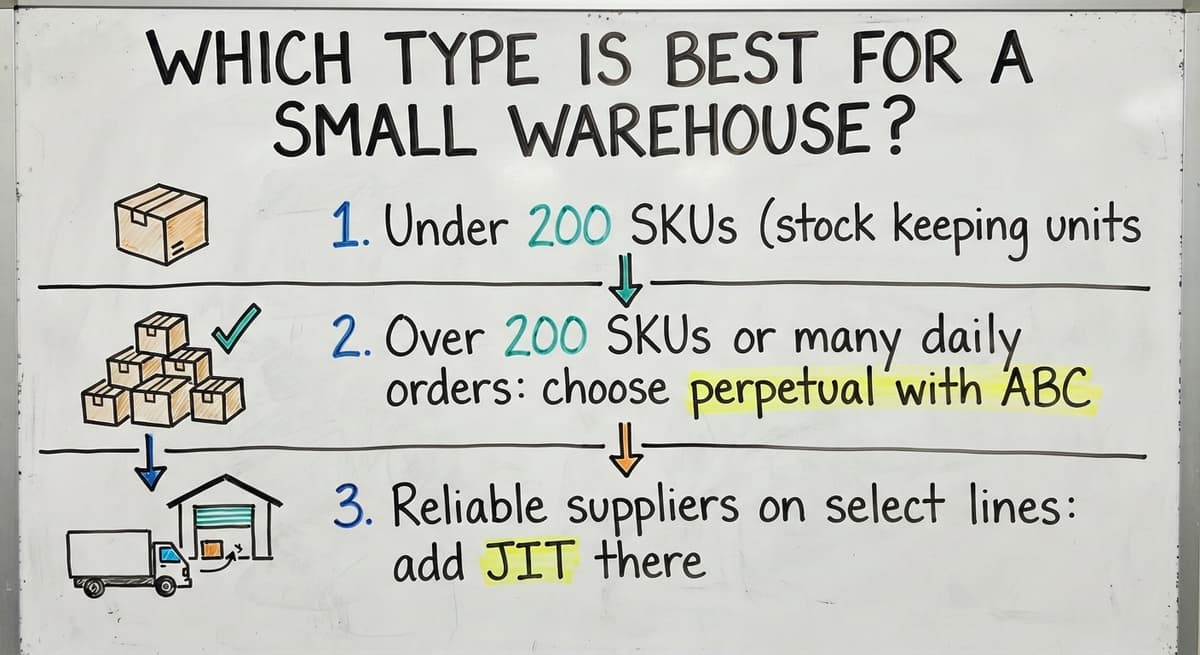
For inventory management for small warehouses, perpetual counting plus ABC analysis works best for most. Add a periodic cycle count to confirm the numbers. Use JIT only where supply is dependable.
- Under 200 SKUs (stock keeping units, or unique items): periodic counts may be enough.
- Over 200 SKUs or many daily orders: choose perpetual with ABC.
- Reliable suppliers on select lines: add JIT there.
The NIST supply chain guidance offers vendor-neutral help.

What Are the Signs Your Current Method Is Not Working?
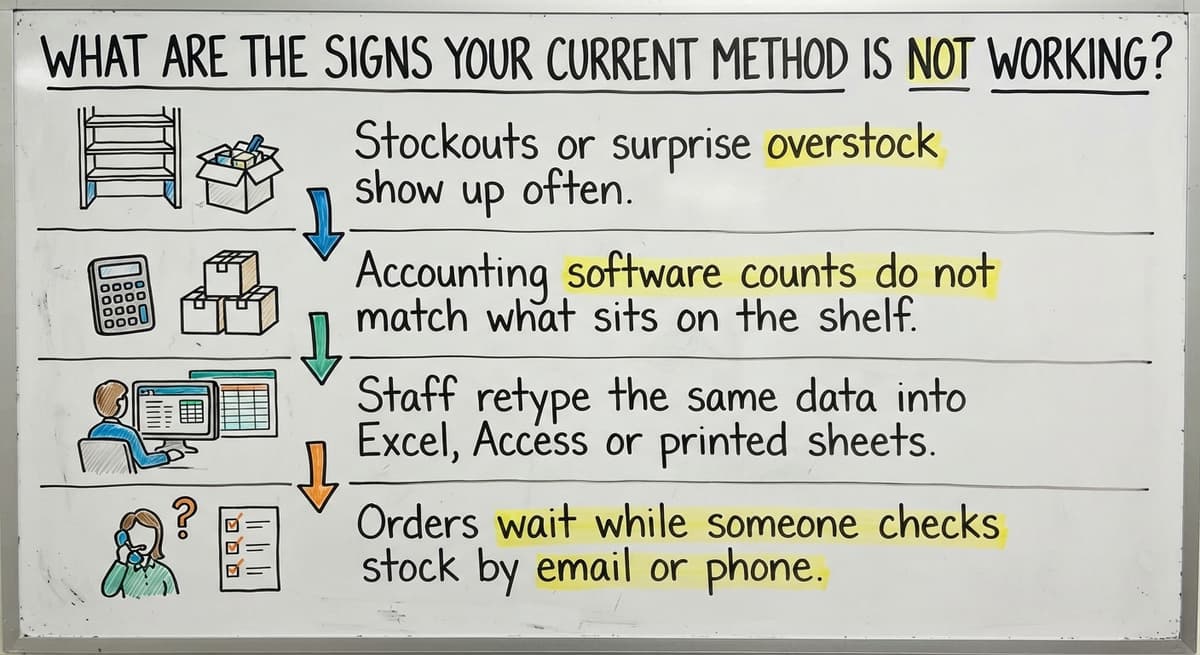
Your method is failing when the shelf and the screen disagree. Watch for these signs:
- Stockouts or surprise overstock show up often.
- Accounting software counts do not match what sits on the shelf.
- Staff retype the same data into Excel, Access or printed sheets.
- Orders wait while someone checks stock by email or phone.
Late orders carry legal weight too. The FTC mail order rule needs you to ship when you said you would. An accurate count protects that promise.
The comparison is easier when one option is built for you
Off-the-shelf means fitting your process to the software. We do it the other way round, and the first look costs nothing.
Book a callDo You Need a Big ERP to Manage Inventory Well?
No. All four methods run on lighter tools. Software can follow how your team already works, with no forced move. Your accounting software can stay where it helps. Software then replaces only the manual steps. Long, costly rollouts worry many owners, and a smaller fix avoids them. Compare options with what is the best warehouse inventory management system?

How Can Software Support Your Method?
Inventory management software handles the dull parts. It updates counts on its own, sends reorder alerts and groups items for ABC. Your team sees one shared view of stock instead of scattered files. We build custom software to match your steps at your scale. The same team also builds your website and search presence.
How Do You Get Started?
Four steps get you moving:
- Write down how stock moves, from receiving to shipping.
- Find where numbers get retyped or go stale.
- Pick one method to tighten first.
- Talk with a local Columbus, Ohio team about fixing only the manual parts.
Start small, fix one gap, and your counts will follow.
Frequently asked questions
What are the 5 stages of the inventory management process?
Sources group them in different ways. A common list is: receive stock, store it, track counts, pick and ship orders, then review and reorder. Each stage feeds the next.
What are the four types of inventory?
This phrase can mean stock types: raw materials, work in progress, finished goods, and supplies. It differs from the 4 methods of inventory management: perpetual, periodic, ABC analysis and just-in-time.
What is the difference between perpetual and periodic inventory?
Perpetual inventory updates counts with every receipt, pick or sale. Periodic inventory counts stock at set times. Perpetual gives live numbers. Periodic takes less setup.
How to manage store inventory?
Count what you have, track every move, and set reorder points. Rank items with ABC analysis. Check the shelf against records on a schedule. A spreadsheet, an off-the-shelf tool or custom software can all do it. Pick by SKU count, order volume and staff time.
Can I use more than one inventory method at the same time?
Yes. Many teams run perpetual counts with ABC analysis, add periodic cycle checks, and use JIT on select lines.
Do I need an ERP to manage inventory well?
No. Lighter tools can run all four methods. Software can replace only the manual parts and keep your accounting software where it works.
How do I know my inventory method is failing?
Look for frequent stockouts, overstock, counts that do not match the shelf, repeated data entry and orders held while staff check stock.
Start with a free first look
A 30 minute call, your operation mapped, and a clear picture of what we would build. No obligation and nothing to install.
Book a callRelated guides
More on the same work.
Guides
Common questions
- What is Inventory Management and Its Types
- How to Manage Inventory Diablo 4
- What Are the Four Types of Wms?
- What is the Difference Between Aggregate and Item Inventory Management
- What is Jit Inventory Management
- What is Kanban System of Inventory Management
- What is the Definition of Inventory Management
- What is an Important Factor in Inventory Management
- What is Abc Classification in Inventory Management
- What is Inventory Management in Working Capital
- What is Poor Inventory Management
- What is the Main Purpose of Inventory Management
- What is Inventory Management in Pharmacy
- What is Effective Inventory Management
- What is Information Technology Inventory Management
- What is Inventory Management in Tally
- What is Risk Pooling in Inventory Management
- What is Inventory Management Mary Kay
- What is Stock Taking in Inventory Management
- What is Hospital Inventory Management
- What is Bin Number in Inventory Management
- What is the Scope of Inventory Management