


What Are The 5 Benefits Of Inventory Management?
Updated October 2026. The 5 benefits of inventory management are: knowing your exact stock at all times, preventing both stockouts and overstocking, speeding up order fulfillment, gaining clear financial visibility, and cutting the manual work that drains your team. Each benefit is a practical outcome, not a software feature, and all 5 are within reach for small and mid-size wholesale distributors right now.
Book a callWhy Inventory Management Matters for Distributors and Warehouses
Most small distributors track stock across spreadsheets, printed pick sheets, and email threads. That setup creates blind spots. You find out something is wrong only after a shipment fails or a customer calls.
Inventory management means having a reliable, real-time picture of what stock you have, where it sits, and what is moving. It is not a software category. It is a discipline that removes guesswork from daily operations.
The 5 benefits below are practical outcomes. Each one describes something your warehouse team will notice in the first few weeks. None of them need a year-long rollout or an enterprise budget.
We build it for your operation, and the first look is free
If you would rather not compare products, describe how your operation already works and we build the system around it.
No build cost. You see it running on your own process first, and the monthly subscription starts only once it is live.
Book a callBenefit 1: You Always Know What Stock You Have
Accurate, real-time stock counts remove the guesswork that comes from reconciling spreadsheets at week's end. Staff know what is on the shelf before a customer order is confirmed, so there are no surprises at pick time.
For warehouse and fulfillment teams running on an accounting package and Excel, discrepancies usually surface only after a shipment fails. That gap between what the spreadsheet says and what the shelf holds is where emergency buys happen. Those unplanned buys cost more per unit and erode margin.
Barcode scanning closes that gap at the source. GS1, the global standards body behind product barcodes, notes that its barcode standards give every item a unique, scannable identity so counts stay accurate without manual re-entry. You can read GS1's barcode standards directly at gs1.org/standards/barcodes. When every receipt and every pick is scanned, the count is current, not a week old.
Accurate Stock Counts Are Also a Legal Requirement
Accurate stock data is also a legal matter. The IRS states plainly in Publication 538: "To figure taxable income, you must value your inventory at the beginning and end of each tax year." A reliable count protects you at audit time, not just at pick time.
Benefit 2: Does Inventory Management Really Prevent Both Stockouts and Overstocking?
Yes, and solving both problems at once is where inventory control pays for itself fastest. Stockouts lose sales and damage customer trust. Overstocking ties up cash and fills shelf space you need for faster-moving SKUs.
Good inventory management sets reorder points, the stock level that triggers a new buy order, based on actual usage patterns rather than gut feel. For wholesale distributors with seasonal or fast-moving SKUs, that balance directly affects cash flow.
The US Census Bureau's Monthly Wholesale Trade data tracks the national inventories-to-sales ratio for wholesale firms. When that ratio climbs, it signals that distributors are holding more stock than demand supports. A tight reorder system keeps your own ratio in check.
How a Custom System Keeps Your Reorder Logic Intact
Custom inventory systems can mirror the reorder logic your business already uses. You do not have to adopt a new process. The system learns your thresholds and flags exceptions so your team acts on data, not instinct.
The result is less cash sitting on shelves and fewer calls from customers who needed something you ran out of.
The comparison is easier when one option is built for you
Off-the-shelf means fitting your process to the software. We do it the other way round, and the first look costs nothing.
Book a callBenefit 3: Order Fulfillment Gets Faster and More Accurate
When inventory data is current and visible, pick-and-pack teams spend less time hunting for items or cross-checking paper lists. That saved time adds up across every order, every shift.
Fewer mis-picks mean fewer returns, fewer customer complaints, and less time correcting mistakes after the fact. A warehouse handling 200 orders a day that cuts its mis-pick rate by even 2% avoids 4 wrong shipments daily. Over a month, that is roughly 80 fewer returns to process.
Replacing printed pick sheets with a live digital workflow removes one of the most common bottlenecks in a growing warehouse. The pick list is always current. Stock that was just received shows up at once. Stock that just shipped is gone from the count before the next picker reaches for it.
Real-Time Inventory Data Keeps You on the Right Side of FTC Shipping Rules
Faster fulfillment cycles also let a warehouse handle more volume without adding headcount. The US Federal Trade Commission's Mail and Telephone Order Rule needs businesses to ship when they say they will. Accurate, real-time inventory data is what makes that promise keepable.
Speed and accuracy in fulfillment are not separate goals. Better stock data delivers both at once.
Benefit 4: You Get Clearer Financial Visibility
Inventory is often the largest asset on a distributor's balance sheet. Knowing its true value matters for daily decisions and for year-end reporting.
Proper inventory tracking feeds accurate cost-of-goods data into your accounting package without manual re-entry. For businesses already using their existing accounting software for warehouse operations, a well-designed inventory layer passes clean data through rather than replacing the tool you already trust.
Owners and operations managers can then see margin by product line, not just total revenue. That view changes which SKUs you promote, which suppliers you negotiate harder with, and which products you quietly phase out.

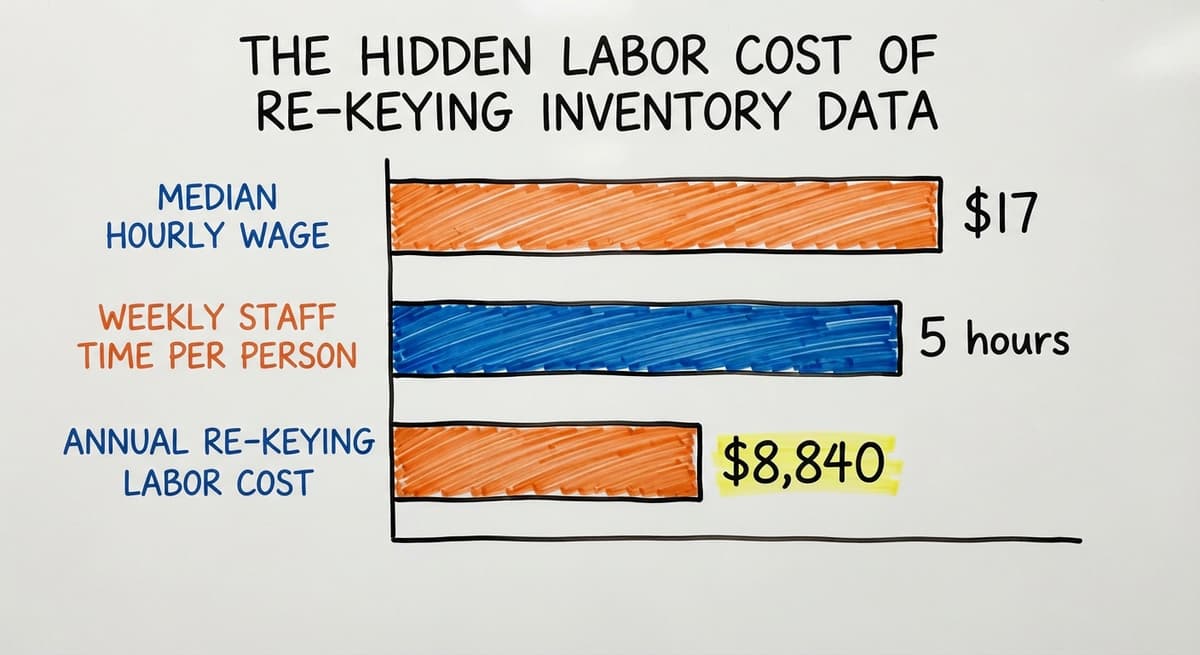
The Hidden Labor Cost of Re-Keying Inventory Data
Consider the labor cost of doing this manually. According to the US Bureau of Labor Statistics, stock clerks and order fillers earn a median wage around $17 per hour. If 2 staff members each spend 5 hours a week re-keying inventory data into your accounting system, that is $8,840 a year in labor before you count errors and corrections.
Clean data flowing automatically into your books turns inventory from a reporting burden into a decision-making tool.
See it running on your own process first
No build cost. The subscription starts once it is live and doing the job, not before.
Book a callBenefit 5: Your Team Spends Less Time on Manual Work
Manual inventory tasks consume hours that could go toward serving customers. Counting, reconciling, and re-keying data between systems are the three biggest offenders in a lean warehouse operation.
Automating routine updates and alerts frees staff to focus on exceptions, not daily data entry. A system that flags when stock drops below a reorder point does not need a person checking a spreadsheet every morning to catch the same thing.
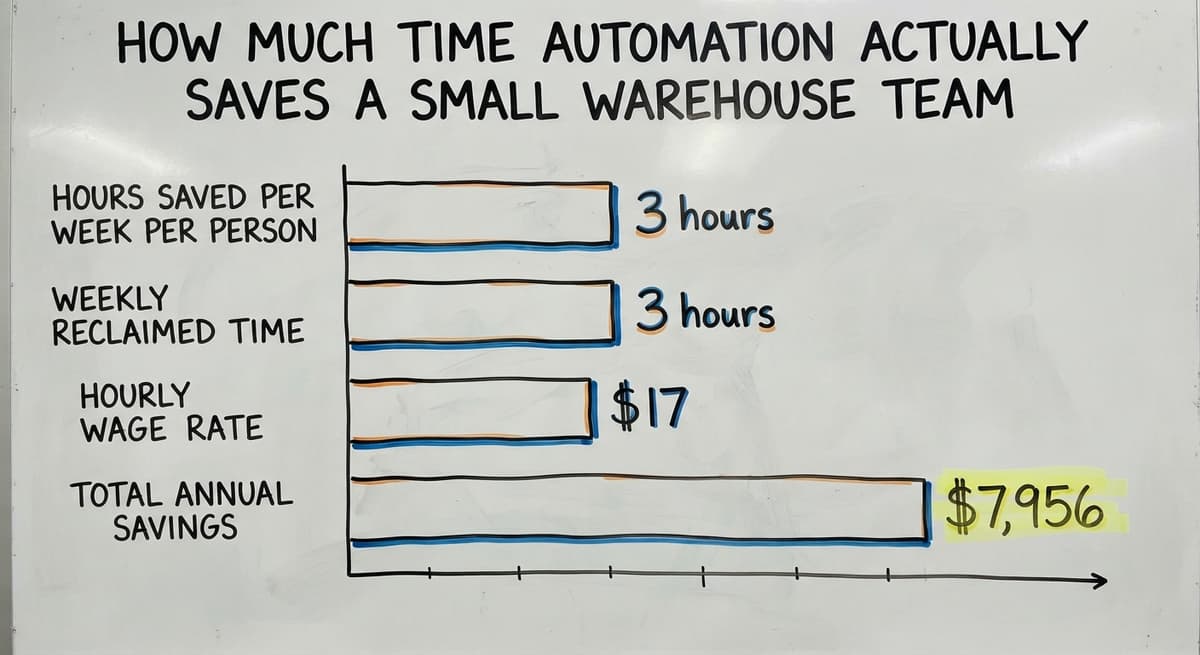
How Much Time Automation Actually Saves a Small Warehouse Team
For teams of 5 to 100 people, reclaiming even 3 hours per week per person adds up fast. Three staff members saving 3 hours each at $17 an hour equals $7,956 a year. That math works even for a single warehouse with a small crew.
The goal is replacing the manual parts, not overhauling the whole operation. Warehouse management software built for small teams slots into your existing workflow rather than demanding you rebuild it from scratch.
Less manual work means fewer errors, lower labor cost, and a team that can grow volume without growing headcount.
How These Benefits Connect to Each Other
The 5 benefits are not separate wins. They form a chain.
Accurate stock data feeds faster fulfillment. Faster fulfillment reduces complaints and returns. Fewer returns mean cleaner financial data. Cleaner data cuts the manual matching work that drains your team. And a team freed from data entry has capacity to grow volume.
The NIST Manufacturing Extension Partnership describes this kind of supply chain improvement as a system change, not a tool swap. Better data leads to better decisions, which leads to less firefighting, which creates room for growth.
Inventory management is a system upgrade. Each benefit reinforces the next.

When Does a Spreadsheet Stop Being Enough for Inventory Tracking?
Spreadsheets and a basic accounting package work fine up to a point. Replacing spreadsheets with a custom operations system becomes urgent when the operation grows past what manual tools can handle reliably.
Watch for these warning signs:
- Inventory counts are wrong more than once a month, even after a recent physical count
- Staff spend several hours each week reconciling data between systems
- Stockouts happen despite the spreadsheet showing stock on hand
- Pick errors are rising as order volume grows
- You cannot answer a margin question by product line without pulling data from multiple places
If 2 or more of those are true today, the spreadsheet is the bottleneck, not the team using it.
What the Right Next Step Actually Looks Like
The right next step is not a big ERP with an 18-month rollout. It is adding a targeted inventory layer that connects to what you already use. Custom inventory software for wholesale distributors is built around your existing process, not a generic one.
The question is not whether to change, but how little you have to change to get accurate data.
Not sure this is the right shape for your operation
Describe how the work runs today. We map it on a call and show you what it would look like built around that, before you spend anything.
Book a callWhat Should a Wholesale Distributor Look for in an Inventory Management Solution?
The right inventory system fits the way your operation already works, rather than forcing a process change on a team that is already busy.
Four things matter most for small and mid-size distributors:
- Accounting software integration for warehouse operations so data flows into your books without manual re-entry or a second accounting tool
- Scales to a team of 5 to 100 without enterprise pricing or a year-long setup
- Reorder logic that mirrors what your buyers already do, rather than a rigid formula
- Built and supported by people who understand wholesale and distribution, not generic software vendors who learned the category last quarter
Custom Scoping Keeps Your Existing Operation Intact
Custom working software for fulfillment centers can be scoped to your specific SKU count, your warehouse layout, and your existing supplier relationships. Accounting software integration for warehouse operations keeps your accounting intact while adding the real-time layer your team needs.
The best solution for your operation is the one your team will actually use, because it works the way they already think.

The Bottom Line on Inventory Management Benefits
The 5 benefits of inventory management are practical and measurable: know your stock correctly, match supply to real demand, fulfill orders faster, see your financials clearly, and free your team from manual work. None of these need a large enterprise budget or a long rollout.
Small and mid-size wholesale distributors can reach all 5 outcomes by adding a targeted inventory layer that builds on what already works. The goal is better data, not a new way of running the business.
Ready to Put These Benefits to Work in Your Operation?
If your team is spending hours each week reconciling data, or if stockouts are happening despite apparent stock on hand, the gap is worth a conversation.
The Software Society is based in Columbus, Ohio and works with distributors and warehouse operations to build inventory systems around the process that already exists. No pre-built product. No pressure to replace what is working.
The starting point is a review of how your current workflow runs and where the data breaks down. That review costs nothing and commits you to nothing. If there is a fit, we build around your operation. Reach out and tell us how your inventory process works today.
Frequently asked questions
What are the four types of inventory management?
The 4 main types are just-in-time (ordering stock only as it is needed), FIFO (first-in, first-out, using oldest stock first), perpetual inventory (tracking stock continuously with every transaction), and periodic inventory (counting stock at set intervals). Most small distributors use a mix of perpetual tracking for daily operations and periodic physical counts to verify accuracy.
What is FIFO in inventory?
FIFO stands for first-in, first-out. It means the oldest stock you received is the first stock you ship or use. For perishable goods or products with expiration dates, FIFO prevents older units from sitting behind newer ones. It also affects how you value inventory for tax purposes, since the cost of the oldest units is what hits your cost of goods sold first.
What is WMS in a warehouse?
WMS stands for warehouse management system. It is software that tracks the movement of stock inside a warehouse, from receiving through put-away, picking, packing, and shipping. A WMS gives staff real-time location data for every SKU so they spend less time searching and more time fulfilling orders. Some WMS tools are large enterprise platforms; others are lightweight systems built for teams of 5 to 50.
What software is best for inventory management?
There is no single best answer. The right choice depends on your team size, SKU count, existing accounting tools, and how your warehouse is laid out. A spreadsheet works for very small operations. An inventory app suits growing teams that need real-time counts without a full WMS. A cloud platform fits mid-size distributors with multiple locations. A custom build makes sense when your process does not fit a generic tool. The deciding factor is whether the system fits your workflow or forces you to change it.
How does inventory management reduce costs for a small distributor?
Cost savings come from 3 areas. First, accurate reorder points cut emergency buys, which usually cost more per unit than planned orders. Second, tighter stock control reduces overstock that ties up cash or gets written off. Third, automating manual count and matching tasks saves staff hours. For a team of 3 people spending 5 hours a week on manual data entry at $17 an hour, that is over $13,000 a year in recoverable labor.
What is the difference between stockouts and overstocking, and how does inventory management prevent both?
A stockout happens when you run out of an item a customer needs, losing the sale and damaging trust. Overstocking means you have bought more than demand supports, tying up cash and shelf space. Inventory management prevents both by setting reorder points tied to actual usage rates. When a SKU drops to its reorder level, the system flags it before you run out. When demand slows, the system shows the surplus before you reorder again.
How much manual work can inventory management remove for a small team?
The manual tasks that consume the most time are physical counts, spreadsheet matching, and re-keying data between systems. A real-time inventory system automates all 3. For a lean team, that can recover 3 to 5 hours per person per week. The work does not disappear entirely, but it shifts from routine data entry to reviewing exceptions, which is a better use of experienced staff.
Start with a free first look
A 30 minute call, your operation mapped, and a clear picture of what we would build. No obligation and nothing to install.
Book a callRelated guides
The rest of this guide, for the parts of the job this page does not cover.
- What is the Main Function of Inventory Management?
- What Are the Benefits of Warehouse Management System
- What Are the Top 5 Warehouse Management Systems?
- What Are the 5 Main Activities in a Warehouse?
- What is the Difference Between Aggregate and Item Inventory Management
- What is an Important Factor in Inventory Management
- What is Abc Classification in Inventory Management
- What is Inventory Management in Working Capital
- What is Inventory Management and Its Types
- What is the Main Purpose of Inventory Management
- What is Information Technology Inventory Management
- What is Risk Pooling in Inventory Management
- What is Inventory Listing
- What is Inventory Management Mary Kay
- What is Stock Taking in Inventory Management
- What is Bin Number in Inventory Management
- What is Inventory
- What is the Goal of Inventory Management Quizlet
- What is the Implication of Proper Inventory Management
- What is Omni-channel Inventory Management
- What is Inventory Management and Its Importance
- What is the Importance of Eoq in Inventory Management
- What is the Importance of Quality Inventory Management
- What is Inventory Management Explain Techniques of Inventory Management